Why an army chief as CDF fits Pakistan's strategic realities

ghazi52

THINK TANK: CONSULTANT
Joined
Mar 21, 2007
Messages
160,759
Reaction score
209,958
Reputation
9,398.6
Country of Origin
Country of Residence

Why an army chief as CDF fits Pakistan's strategic realities​


Pakistan's unique geography and threat environment make appointment a logical choice

Khalid Mehmood
November 09, 2025
pakistan force

Pakistan force


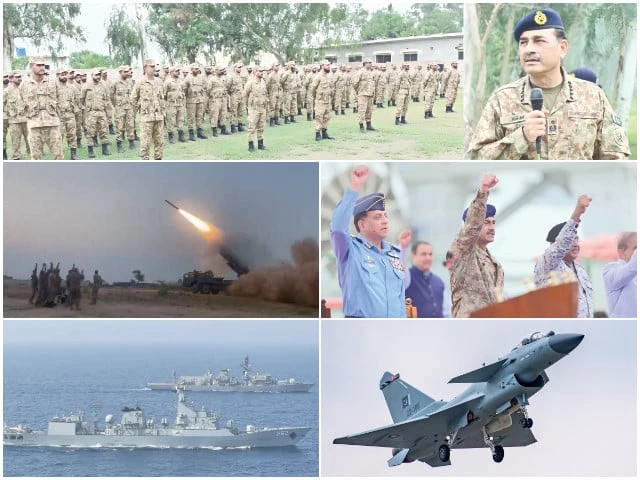
ISLAMABAD: Pakistan's unique geography, threat environment, and military history make the appointment of an army chief as Chief of Defence Forces (CDF) a logical choice, analysts say, provided the arrangement preserves the autonomy and domain expertise of the air force and navy.

Military experts argue that Pakistan's strategic landscape is overwhelmingly continental and population-centric. "The decisive effects that shape policy are produced on land," said one analyst. A senior commander with deep land-warfare experience, empowered to integrate air and naval capabilities, can align ends, ways, and means across the joint force without diluting the roles of other services.

Classical military theory reinforces this approach. Former Russian general and military theorist Carl von Clausewitz stressed that war serves political purposes, and the decisive outcomes — control of territory, people, and government — are secured on land. Unity of command reduces friction, shortens decision cycles, and ensures campaigns are synchronised with policy objectives.

Similarly, a Swiss-French general and military theorist Antoine-Henri Jomini advocated concentration of force on decisive points and interior lines, favouring commanders who understand maneuver over terrain and logistics — core concerns in Pakistan's context.

From a strategic geography perspective, British geographer, academic and politician Halford Mackinder's continental theory highlights that states located along major land corridors must first secure borders, passes, and interior basins before projecting influence outward. Pakistan, positioned at the junction of South, Central, and West Asia, with long land frontiers, fits this continental model.

Modern strategists also note that while air and sea power enable and shape operations, land control remains the ultimate determinant in resolving political contests.

Pakistan's threat environment reinforces this model, according to defence experts. Border management, counterterrorism, urban security in the Indus corridor, gray-zone pressures along the Line of Control, and insurgencies manifest primarily on land. While campaigns are joint in nature — requiring intelligence, precision fires, air mobility, and maritime interdiction — the scheme of maneuver remains land-led.

Ground forces also carry the logistical and mobilisation burden, secure key infrastructure, and provide disaster relief. Defence experts say that a land-experienced CDF can synchronise these civil-military tasks with air force lift and navy sea-lift capabilities. Similarly, integrating ground-based, air-delivered, and emerging sea-based deterrence systems under a single commander ensures cohesive targeting and command-and-control.
 
An army chief as CDF ensures faster decision-making, coherent theater design, and better resource allocation. The likely theaters of operation in Pakistan are defined by land axes, rivers, and passes; theater commands anchored on ground formations but co-led by air and naval deputies allow joint effects while matching geography. A CDF fluent in interagency coordination further strengthens the civil-military interface during crises.

Legal and doctrinal safeguards protect the autonomy of the air force and navy. Service chiefs retain authority over recruitment, training, and service culture, while domain-specific responsibilities — such as integrated air and missile defense for the air force and sea control for the navy — remain under their leadership, with the CDF intervening only for joint priorities.

Defence experts emphasise that a land-focused CDF is a system integrator, not a service monopolist. "Air and sea power are decisive enablers; without them, land campaigns stall.

A land-experienced CDF aligns all three domains to national strategy," said a defense analyst. Success is measured by joint outcomes — border security, safeguarding sea lines of communication, and maintaining air defense coverage — not army-only metrics.

In Pakistan's context, appointing an army chief as CDF aligns with geography, threat perception, and historical campaign experience.

The model works best when accompanied by guarantees that the air force and navy retain operational control over their core missions, budgets, and capabilities. By anchoring joint operations on land while integrating air and maritime power, Pakistan can achieve the decisive political and military outcomes envisioned by classical strategic thought.
 
what are the names of these "analysts" ? What does army chief know about air force or navy to be commanding them ? Isn't a single point of failure being created ?

The Army Chief in Pakistan supercedes the authority of all other Chiefs, including of even the Joint Chief. Nothing changes with this. What I am seeing is this is to prevent the old dramas of the Army Chiefs appointments which have caused a lot of frictions between the PMs and the military brass, including most notably of Nawaz appointing a certain General while kicking out Musharraf.
Also, I believe, a long term goal is being given to General Munir beyond Nov. 2027. The eventual goal is not only removal of the frictions but also to prepare for an inevitable war against India. General Munir has established many contacts over the last 5-6 months and he is given the primacy by several foreign key governments to interact with.
 
Whilst the creation of a CDF role in the Pakistan armed forces is a welcome development, I fear the fact it being a lifetime appointment is a reflection that this is a power move by FM Asim Munir rather than a sincere attempt at thoughtful long term reform the forces genuinely need. If the CDF is also given the power to control the promotion of the senior most officers of each of the services, I feel this will also lead to concerning outcomes.
 
what are the names of these "analysts" ? What does army chief know about air force or navy to be commanding them ? Isn't a single point of failure being created ?

The only thing Muneera needs to do now is claim the title of Fuehrer... the original Fuehrer's saga ended brutally, let's see how this one's saga ends
 
Giving the conventional and nuclear power to one man during war time helps in wartime martial law. It increases our readiness and so deters the war entirely too. Indians will not like this....
 
Giving the conventional and nuclear power to one man
ONE MAN controlling the nuclear assets? No other country has allowed one man to control their nuclear assets for many reasons. Even the most threatened ones.

Army Chief in Pakistan was already controling the defence forces and was more powerful than the other Chiefs. So, contrary to all such claims, this appears to be a political move and not a military one. Unbridled power is the biggest nasha that one can get addicted to and that seems to be the case here.

He is consolidating power to himself. Smartest general to rule Pakistan ever. He will have all the power to himself without staging a coup.
Bravo to Munir. He is indeed turning out to be a 4D chess player after all.
 
ONE MAN controlling the nuclear assets? No other country has allowed one man to control their nuclear assets for many reasons. Even the most threatened ones.
Army Chief in Pakistan was already controling the defence forces and was more powerful than the other Chiefs. So, contrary to all such claims, this appears to be a political move and not a military one. Unbridled power is the biggest nasha that one can get addicted to and that seems to be the case here.
He is consolidating power to himself. Smartest general to rule Pakistan ever. He will have all the power to himself without staging a coup. Bravo to Munir. He is indeed turning out to be a 4D chess player after all.

It is always good to hear from our rivals!
BTW, the nuclear button will still NOT be in one person's hands. It has never been. Even in the most limited group of consultancy, which I believe were when Zia launched the coup against Bhutto or when Musharraf planned the Kargil operation, there were always a few around the Army Chief.
 
Care to elaborate, please?


in a tense and decisive situation, where decisions are to be made in minutes. Delegation of responsibility to assign importance to several tasks to one man, is not risky, it is also not practical..

by my understanding, this should result in more escalation matrices in more domains, leading to effectiveness..


more hands X more minds / time needed to decide = effective matrices
 
ONE MAN controlling the nuclear assets? No other country has allowed one man to control their nuclear assets for many reasons. Even the most threatened ones.

Army Chief in Pakistan was already controling the defence forces and was more powerful than the other Chiefs. So, contrary to all such claims, this appears to be a political move and not a military one. Unbridled power is the biggest nasha that one can get addicted to and that seems to be the case here.

He is consolidating power to himself. Smartest general to rule Pakistan ever. He will have all the power to himself without staging a coup.
Bravo to Munir. He is indeed turning out to be a 4D chess player after all.
It streamlines our wartime decision making hierarchy, where we can seamlessly transition into the nuclear mode if needed. I believe this will regain our nuclear deterrence as the enemy (Indians) cannot rely upon disagreement among the NCA and find a way to wage a politically motivated PR stunt limited conflict like in May. It is in the hands of one man, if he goes crazy then Kaboom. This will also help deploy nukes upfront in an offensive role, for some posturing if needed, and prevent the conflict entirely.
 

Users who are viewing this thread

Pakistan Defence Latest

Back
Top