Pakistan-India Conflict 2025: News Updates and Discussion

1. Indo-Pak War 1971 220 sq.km Chambh Jhaurian corridor , captured by Pakistan, is far more strategic than Siachen ice and rocks, and the ice bound village of Turtuk. The Chambh Jhaurian area is vital because it provides access to the only bridge over the Chenab River at Akhnoor, which serves as the main line of communication and supply route for Indian forces in the western districts of Rajouri and Poonch. The Simla Agreement permanently recognized Pakistan's unchallenged control on the corridor. In a future conflict this corridor will be crucial to Pakistan to deter any incursion by India via Poonch or Rajauri.
2. Though not a Pakistani victory, but in 2020, Pakistan certainly helped its ally China indirectly, in capturing 1100 sq,km of Indian claimed territory in Galwan and Hot Springs area. The pressure of a Pakistani buildup on the LOC front that had been in place since 2019 kept India off balance in a potential 2 front scenario . This enabled Pakistan's ally China to up the ante in Galwan in the border skirmish where 20 Indian troops were killed and 110 captured. against 4 Chinese killed).
The capture of some portion of the glacier in Siachen does nothing to mitigate the challenge the Pakistani-China alliance is posing to India through infrastructure buildup such as , the Karakoram Highway, military airfields both in the Gilgit Baltistan area and the Western Theater command of China, The strategic picture changed after India abolished Article 370 in Kashmir and claimed China controlled Aksai Chin as Indian territory. Kashmir is no longer a "bilateral" India-Pakistan issue. China is now officially a party to the dispute. The LAC, LOC borders are now contested by three parties The Indian borders HAVE changed to India's detriment since 2020; especially since India accepted the 1959 border as claimed by China in that area as part of the 2021 Moscow summit agreement. The borders and territory of Arunachal ( Zhangan) in the North East remain disputed.
1. True.,perhaps the only truly brilliant division sized attack by either of the armies in the subcontinent. Major general januja launched a spectacular attack across well prepared positions of chamb and drove through them never allowing the defenders to regroup, the attack only stalled after he was shotdown in his helicopter by indian tank fire..

In regards to turturk,,Nothing in this mortal struggle is just ice and rocks... indian army didnt launch suicidal frontal assaults on pakistani bunkers in kargil heights though they were just ice and rocks.. neither did pakistan launch multiple brigade sized attacks on siachen posts loosing several colonels and even a brigadier just because its a frozen wasteland... these lands not only are strategic heights giving the defenders unassailable advantage but also a symbol of national elan and pride.

2. Off topic and conjecture,,it holds as much weight of Indians claiming victory because taliban attacked Pakistan posts and captured some soldiers due to keeping pak army busy on western front...doesn't hold much weight.
 
1. True.,perhaps the only truly brilliant division sized attack by either of the armies in the subcontinent. Major general januja launched a spectacular attack across well prepared positions of chamb and drove through them never allowing the defenders to regroup, the attack only stalled after he was shotdown in his helicopter by indian tank fire..

In regards to turturk,,Nothing in this mortal struggle is just ice and rocks... indian army didnt launch suicidal frontal assaults on pakistani bunkers in kargil heights though they were just ice and rocks.. neither did pakistan launch multiple brigade sized attacks on siachen posts loosing several colonels and even a brigadier just because its a frozen wasteland... these lands not only are strategic heights giving the defenders unassailable advantage but also a symbol of national elan and pride.

Could you make a modern day case for the Strategic/Tactical importance of Siachen Sector (including Turktuk) so we can understand what your point exactly is here?

2. Off topic and conjecture,,it holds as much weight of Indians claiming victory because taliban attacked Pakistan posts and captured some soldiers due to keeping pak army busy on western front...doesn't hold much weight.

This is understandable from Indian Political POV.
 
Last edited:
Could you make a modern day case for the Strategic/Tactical importance of Siachen Sector (including Turktuk) so we can understand what your point exactly is here?


This is understandable from Indian Political POV.
As they say, Possession is nine tenths of the law.. either the conflict continues and pakistan will be at a future date forced to assault these elevated and impregnable positions one way or another,,,or there will be a negotiated settlement with preserving the status quo making the actual line of control the international border which would mean india gets to retain these territories.

Then there's also the lore and morale aspects of the battles for capturing these territories. The assault on siachen posts especially the Bana top or Quaid top and turtuk are still remembered in India as glorious victories.
 
As they say, Possession is nine tenths of the law.. either the conflict continues and pakistan will be at a future date forced to assault these elevated and impregnable positions one way or anothe

Hmmm. Not happening. Like @Baibers_1260 already mentioned "keep the ice and rocks for yourself"
Besides, if Pakistan want to assault it can do so with UCAVs, there's no more need for Infantry to scale up the ridges for a ground assault (Modern Method, a couple of strikes can cause Avalanches effectively entrapping the entrenched positions).
Alternatively, if there's a full scale war, with China and Pakistan as two fronts, they can just assault the deeper Laddakh Valley (given it allows for Mechanized/Armoured Movement), encircle and choke the supply lines, practically letting personnel up there to starve and die (Conventional Method).
However, to militarily justify any of the above method, there first has to be a Strategic/Tactical Value of Siachen Sector (since you haven't mention that, despite that being the question, I will not say anything on it yet)

r,,,or there will be a negotiated settlement with preserving the status quo making the actual line of control the international border which would mean india gets to retain these territories.

Yes (if it happens) - again, "keep the ice and rocks"

Then there's also the lore and morale aspects of the battles for capturing these territories. The assault on siachen posts especially the Bana top or Quaid top and turtuk are still remembered in India as glorious victories.

Past glory certainly has the morale boosting value, I'll give you that, but it's a double edged sword. Since 2016 India has been making operational blunders probably because it is still living in the "glory of the past" - But this point of yours is valid for Indian Military.
 
1. True.,perhaps the only truly brilliant division sized attack by either of the armies in the subcontinent. Major general januja launched a spectacular attack across well prepared positions of chamb and drove through them never allowing the defenders to regroup, the attack only stalled after he was shotdown in his helicopter by indian tank fire..
"Possession is nine tenth of the law". Chambh-Jhaurian was captured by Pakistan in the 1965 war, and then returned to India under the Tashkent Agreement. When Chambh-Jhaurian was captured again in 1971 , this time Pakistan refused to return it under the Simla Agreement, and it now remains with Pakistan poised as the proverbial "dagger " to forestall any Indian misadventure in that sector to retake Pakistan Administered Kashmir. Major General Janjua and many others made the ultimate sacrifice retaking that vital "funnel" and history and their nation has etched their names in annals of eternal glory.
In regards to turturk,,Nothing in this mortal struggle is just ice and rocks... indian army didnt launch suicidal frontal assaults on pakistani bunkers in kargil heights though they were just ice and rocks.. neither did pakistan launch multiple brigade sized attacks on siachen posts loosing several colonels and even a brigadier just because its a frozen wasteland...
The Indian Armed forces have done just that ..making suicidal attacks to capture "ice and rock", not just against Pakistan, but against China as well in nearby Ladakh and Leh, also loosing colonels and majors and suffering the humiliating surrender of a brigadier rank officer ( John Dalvi in 1962) .
The term "ice and rock" was first used by the Indian Prime Minister Nehru in the Indian Parliament in August 1959, when it was revealed by the Opposition that China had built a road through "Indian territory " . Nehru didn't want further discussions in Parliament dismissing the territory as "ice and rock" implying it was not worth fighting over. However this parallel is flawed There is no comparison between loosing Aksai Chin which is really strategic allowing China access to Tibet from the Xinjiang region via National Highway 219 and portion of Siachen
The loss of "ice and rock" by Pakistan in Siachen ( which was unoccupied by either adversary until the mid-1980s has done nothing to alter the strategic balance in the region either against Pakistan or China.
The Kargil War was fought and Pakistan did not withdraw from all positions. Point 5353 one of them which is still under Pakistan Control which is on Indian side of LOC. The Indian Army, made several unsuccessful attempts to occupy the post after the Kargil war, has since given up the post as "untenable" given the geography of the region that makes it fairly easy for Pakistani troops to climb

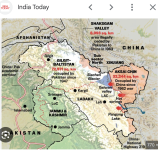
The map below ( from India's premier magazine "India Today " is a stark representation of the ground reality. The Indian hold over Siachen glacier territory is so tenuous given the terrain that no attempt has been made to cut off the Shaksgam Valley which India protests has been "illegally " ceded to China by Pakistan.

1763723025661.png
these lands not only are strategic heights giving the defenders unassailable advantage but also a symbol of national elan and pride.
Rather expensive symbols of "national elan "
India's annual expense for maintaining control of Siachen is estimated to be around ₹3,000 crore (approximately $360 million USD), which breaks down to about ₹5 crore to ₹7 crore per day. Despite the expense in the sum total the Indian Parliamentary resolution of 1991 to recover all of Pakistani Administered Kashmir remains unaddressed. Wonder why the Indian Parliamentary Resolution didn't mention Aksai Chin which is technically "Chinese Administered Kashmir".
2. Off topic and conjecture,,it holds as much weight of Indians claiming victory because taliban attacked Pakistan posts and captured some soldiers due to keeping pak army busy on western front...doesn't hold much weight
1. True.,perhaps the only truly brilliant division sized attack by either of the armies in the subcontinent. Major general januja launched a spectacular attack across well prepared positions of chamb and drove through them never allowing the defenders to regroup, the attack only stalled after he was shotdown in his helicopter by indian tank fire..
"Possession is nine tenth of the law". Chambh-Jhaurian was captured by Pakistan in the 1965 war, and then returned to India under the Tashkent Agreement. When Chambh-Jhaurian was captured again in 1971 , this time Pakistan refused to return it under the Simla Agreement, and it now remains with Pakistan poised as the proverbial "dagger " to forestall any Indian misadventure in that sector to retake Pakistan Administered Kashmir. Major General Janjua and many others made the ultimate sacrifice retaking that vital "funnel" and history and their nation has etched their names in annals of eternal glory.
In regards to turturk,,Nothing in this mortal struggle is just ice and rocks... indian army didnt launch suicidal
The Indian Armed forces have done just that ..making suicidal attacks to capture "ice and rock", not just against Pakistan, but against China as well in nearby Ladakh and Leh, also loosing colonels and majors and suffering the humiliating surrender of a brigadier rank officer ( John Dalvi in 1962) .
The term "ice and rock" was first used by the Indian Prime Minister Nehru in the Indian Parliament in August 1959, when it was revealed by the Opposition that China had built a road through "Indian territory " . Nehru didn't want further discussions in Parliament dismissing the territory as "ice and rock" implying it was not worth fighting over. However this parallel is flawed There is no comparison between loosing Aksai Chin which is really strategic allowing China access to Tibet from the Xinjiang region via National Highway 219 and portion of Siachen
The loss of "ice and rock" by Pakistan in Siachen ( which was unoccupied by either adversary until the mid-1980s) has done nothing to alter the strategic balance in the region either against Pakistan or China.
The Kargil War was fought and Pakistan did not withdraw from all positions. Point 5353 one of them which is still under Pakistan Control which is on Indian side of LOC. The Indian Army, made several unsuccessful attempts to occupy the post after the Kargil war, has since given up the post as "untenable" given the geography of the region that makes it fairly easy for Pakistani troops to climb

The map below ( from India's premier magazine "India Today " is a stark representation of the ground reality. The Indian hold over Siachen glacier territory is so tenuous given the terrain that no attempt has been made to cut off the Shaksgam Valley which India protests has been "illegally " ceded to China by Pakistan.

1763723025661.png
these lands not only are strategic heights giving the defenders unassailable advantage but also a symbol of national elan and pride.
Rather expensive symbols of "national elan "
India's annual expense for maintaining control of Siachen is estimated to be around ₹3,000 crore (approximately $360 million USD), which breaks down to about ₹5 crore to ₹7 crore per day. Despite the expense in the sum total the Indian Parliamentary resolution of 1991 to recover all of Pakistani Administered Kashmir remains unaddressed. Wonder why the Indian Parliamentary Resolution didn't mention Aksai Chin which is technically "Chinese Administered Kashmir".
2. Off topic and conjecture,,it holds as much weight of Indians claiming victory because taliban attacked Pakistan posts and captured some soldiers due to keeping pak army busy on western front...doesn't hold much weight
Doesn't hold much weight? Your Vice Chief of Army Staff Lt.General Rahul Singh would disagree, when he stated that India was facing "two adversaries on a single front " Last we checked the Taliban haven't captured or held any Pakistani territory, nor offered logistical and intelligence support to India. But the wider challenge of a two front war for India is better analyzed in the recent US Congress report on the China Pakistan axis and the "military success" of Pakistan in the May 2025 conflict.Doesn't hold much weight? Your Vice Chief of Army Staff Lt.General Rahul Singh would disagree, when he stated that India was facing "two adversaries on a single front " Last we checked the Taliban haven't captured or held any Pakistani territory, nor offered logistical and intelligence support to India. But the wider challenge of a two front war for India is better analyzed in the recent US Congress report on the China Pakistan axis and the "military success" of Pakistan in
 
Last edited:
DAVIDBENGURION said:
2. Off topic and conjecture,,it holds as much weight of Indians claiming victory because taliban attacked Pakistan posts and captured some soldiers due to keeping pak army busy on western front...doesn't hold much weight
-------------

Doesn't hold much weight? Your Vice Chief of Army Staff Lt.General Rahul Singh would disagree. General Singh stated that India was facing "two adversaries on a single front "
Last we checked the Taliban haven't captured or held any Pakistani territory, nor offered logistical and intelligence support to India. But the wider challenge of a two front war for India is better analyzed in the recent US Congress report on the China Pakistan axis and the "military success" of Pakistan in the May 2025 conflict.
 
Hmmm. Not happening. Like @Baibers_1260 already mentioned "keep the ice and rocks for yourself"
Besides, if Pakistan want to assault it can do so with UCAVs, there's no more need for Infantry to scale up the ridges for a ground assault (Modern Method, a couple of strikes can cause Avalanches effectively entrapping the entrenched positions).
Alternatively, if there's a full scale war, with China and Pakistan as two fronts, they can just assault the deeper Laddakh Valley (given it allows for Mechanized/Armoured Movement), encircle and choke the supply lines, practically letting personnel up there to starve and die (Conventional Method).
However, to militarily justify any of the above method, there first has to be a Strategic/Tactical Value of Siachen Sector (since you haven't mention that, despite that being the question, I will not say anything on it yet)


Yes (if it happens) - again, "keep the ice and rocks"


Past glory certainly has the morale boosting value, I'll give you that, but it's a double edged sword. Since 2016 India has been making operational blunders probably because it is still living in the "glory of the past" - But this point of yours is valid for Indian Military.
Aircraft let alone ucav struggle to act at that altitudes with combat payload. The airdensity at that heights has adverse effects on weapons effectiveness. The iaf has already seen it in 99 when its mirages struggled to deliver their LGBs at that heights. Combined with the fact that the ucavs will be operating in contested airspace, it ain't a feasible option. Further there ain't a single supply roads or lines to siachen which is mainly supplied by airlifts by helis. The strikes to create avalanches is not a credible one as the same would be even more apt for the Indians sitting on heights as seen by the 2012 siachen avalanche which enveloped over 100 Pakistan army soldiers sitting on the lower ridges.

In regards to the Strategic importance of siachen, the Pakistan northern command might enlighten us why it has launched op qaidat in 87, op chumik in 89, the distarous attack on bahadur post in 92 and the intermittent attacks until 99 for this " barren wasteland". May be they know something we are not aware off.

As for the barren ice and rocks, The indian armed forces would rather have these ice and rocks than Pakistan having control over these. Thats for sure.
 
Aircraft let alone ucav struggle to act at that altitudes with combat payload. The airdensity at that heights has adverse effects on weapons effectiveness. The iaf has already seen it in 99 when its mirages struggled to deliver their LGBs at that heights. Combined with the fact that the ucavs will be operating in contested airspace, it ain't a feasible option. Further there ain't a single supply roads or lines to siachen which is mainly supplied by airlifts by helis.
India's annual expense for maintaining control of Siachen is estimated to be around ₹3,000 crore (approximately $360 million USD), which breaks down to about ₹5 crore to ₹7 crore per day. This includes costs for supplies, special equipment, and the logistical support required to sustain troops in one of the world's most challenging environment
If Pakistan can impose such a cost on India the loss of a portion of Siachen is well worth it.

The strikes to create avalanches is not a credible one as the same would be even more apt for the Indians sitting on heights as seen by the 2012 siachen avalanche which enveloped over 100 Pakistan army soldiers sitting on the lower ridges.
If you are giving credit to an avalanche, (a natural phenomenon ) as a military success then I guess the 2004 Tsunami that wiped out an Indian helicopter base in Car Nicobar island killing 116 Indian Air Force personnel AND their families should be a great "military success " and cause of satisfaction as well. 12 Indian Airforce Helicopters with their pilots were lost though ironically the base commander survived.
In regards to the Strategic importance of siachen, the Pakistan northern command might enlighten us why it has launched op qaidat in 87, op chumik in 89, the distarous attack on bahadur post in 92 and the intermittent attacks until 99 for this " barren wasteland". May be they know something we are not aware off.
Likewise, The Indiian Northern Command also should enlighten why they launched "Operation Snow Leopard" trying to capture the heights of ice and rock around Pangong Lake from which they ultimately withdrew under the "disengagement plan" with the PLA.
As for the barren ice and rocks, The indian armed forces would rather have these ice and rocks than Pakistan having control over these. Thats for sure.
90% of the "ice and rock" lost by India is to China ( 38,000 sq.km) not Pakistan. The lush valleys of Kumrat, Naran, Kaghan, Leepa, and Neelam with their ski slopes, apricot and pomegranate groves remain with Pakistan and will remain for the foreseeable future. The Karakoram Highway linking Kashgar to Hasan Abdal is bustling with traffic as is China's National Highway 219 linking Urumuqi to Lhasa. All through "Indian " territory. Pakistan would much rather delegate the fight over "ice and rock" to China and may the soul of Colonel B. Santosh Babu clubbed to death in Galwan in June 2020 in a "no firearms " fight rest in peace, Across the "havoc of war " ( Churchill on Rommel) even Pakistan salutes his courage.
 
Aircraft let alone ucav struggle to act at that altitudes with combat payload. The airdensity at that heights has adverse effects on weapons effectiveness. The iaf has already seen it in 99 when its mirages struggled to deliver their LGBs at that heights. Combined with the fact that the ucavs will be operating in contested airspace, it ain't a feasible option.

I hope you are not using ChatGPT for these responses because it seems like it given the basics you're getting wrong. Anyhow, the high average of peaks in Siachen sector is ~ 20,000 ft - both MALE and HALE UCAVs operate above this height 🥲

Contested Airspace? UCAVs don't even have to get near LOC. The Eastern and slight North Eastern vector to strike Siachen comfortably sits inside Pakistan.

Why mention 99 and Mirage? I hope you realize how old both of those are?

Further there ain't a single supply roads or lines to siachen which is mainly supplied by airlifts by helis.

Do you understand how supply lines work? Especially under the situation I described earlier - if China and Pakistan move deeper into the Ladakh valley. If that happens do you think air supplies will be flying freely as in peacetime?

The strikes to create avalanches is not a credible one as the same would be even more apt for the Indians sitting on heights as seen by the 2012 siachen avalanche which enveloped over 100 Pakistan army soldiers sitting on the lower ridges.

Do you know how far Gayari Sector is from the Siachen Glacier or even Saltoro Ridge? Also, are you assuming that mountain ridges only slope down in one direction and that there is no downward slope on Indian side from where they access Siachen Sector? I hope you understand that UCAV strikes are "Precision Strikes".

In regards to the Strategic importance of siachen, the Pakistan northern command might enlighten us why it has launched op qaidat in 87, op chumik in 89, the distarous attack on bahadur post in 92 and the intermittent attacks until 99 for this " barren wasteland". May be they know something we are not aware off.

No they don't have to enlighten us because I'm not asking you about the historical Strategic/Tactical importance of Siachen when it couldn't be engaged aerially and provided an Infantry incursion vector into Pakistani held areas. I'm asking you about modern day Strategic/Tactical value. So please you enlighten us since you think Pakistan may in future "want" to assault the area as in the past. You are providing evidence for my earlier statement here about "India living in the past glory and committing blunders in modern warfare"

As for the barren ice and rocks, The indian armed forces would rather have these ice and rocks than Pakistan having control over these. Thats for sure.

Yes, India can keep it. Isn't that what was the very first message by @Baibers_1260
 
India's annual expense for maintaining control of Siachen is estimated to be around ₹3,000 crore (approximately $360 million USD), which breaks down to about ₹5 crore to ₹7 crore per day. This includes costs for supplies, special equipment, and the logistical support required to sustain troops in one of the world's most challenging environment
If Pakistan can impose such a cost on India the loss of a portion of Siachen is well worth it.


If you are giving credit to an avalanche, (a natural phenomenon ) as a military success then I guess the 2004 Tsunami that wiped out an Indian helicopter base in Car Nicobar island killing 116 Indian Air Force personnel AND their families should be a great "military success " and cause of satisfaction as well. 12 Indian Airforce Helicopters with their pilots were lost though ironically the base commander survived.

Likewise, The Indiian Northern Command also should enlighten why they launched "Operation Snow Leopard" trying to capture the heights of ice and rock around Pangong Lake from which they ultimately withdrew under the "disengagement plan" with the PLA.

90% of the "ice and rock" lost by India is to China ( 38,000 sq.km) not Pakistan. The lush valleys of Kumrat, Naran, Kaghan, Leepa, and Neelam with their ski slopes, apricot and pomegranate groves remain with Pakistan and will remain for the foreseeable future. The Karakoram Highway linking Kashgar to Hasan Abdal is bustling with traffic as is China's National Highway 219 linking Urumuqi to Lhasa. All through "Indian " territory. Pakistan would much rather delegate the fight over "ice and rock" to China and may the soul of Colonel B. Santosh Babu clubbed to death in Galwan in June 2020 in a "no firearms " fight rest in peace, Across the "havoc of war " ( Churchill on Rommel) even Pakistan salutes his courage.
1. Again, no one denies the capture of chamb was a spectacular success thanks to general Januja which Pakistan retains to this day. I can't speak for the Indian military machine why they chose to forego chamb, but my guess would be that seeing in both 65 and 71 war they have lost chamb whose plain fields facilitate armoured thrusts, they must have decided to pull back across more defensible lines to protect akhnoor and in return they get to keep the 800 sq km of turtuk of baltistan whose heights offer defenders advantage. They simple decided best to keep 800 sq km than ask for 250 sq km.

2. In regards to avalanche, you must have mistaken my point, it being the dependence of offensive strategies on avalanches is rather a Hail Mary option, as the chance of cutting off supply routes relying on avalanches is very small, seeing in that Pakistani positions at the lower ridge are more prone to avalanches due to the hotter temperatures as seen in the 2012 disaster. The 2012 Siachen disaster had nothing to do with the Indian army and more to do with Pakistani positions on the lower ridges.

3. In regards to the cost of maintaining India's commanding positions on Siachen heights or turtuk, one must keep in view that Pakistan is facing an adversary 12 times its size in economy. The Indian armed forces can sustain these elevated positions and in its attempt to match these formations, the Pakistani armed forces have essentially tanked their economy for the past 70 years. The comparison of GDP per capita between the two nations in the last 20 years reflect that.

4. The loss of aksai chin and the 62 conflict was a disaster and was the impetus for Indian army being reorganised and re armed. Trying to one up china would only result in us tanking our economy like Pakistan did. The best for now would be to contain them and deal with Pakistan while trying to bring up the economy to a parity with china. But that's completely different topic and I can't see how that comes into play when discussing about the territorial looses due to the military engagements between India and Pakistan... unless of course if one wants to pump up Pakistani military achievements on the back of the exploits of PLA.
 
I hope you are not using ChatGPT for these responses because it seems like it given the basics you're getting wrong. Anyhow, the high average of peaks in Siachen sector is ~ 20,000 ft - both MALE and HALE UCAVs operate above this height 🥲

Contested Airspace? UCAVs don't even have to get near LOC. The Eastern and slight North Eastern vector to strike Siachen comfortably sits inside Pakistan.

Why mention 99 and Mirage? I hope you realize how old both of those are?


Do you understand how supply lines work? Especially under the situation I described earlier - if China and Pakistan move deeper into the Ladakh valley. If that happens do you think air supplies will be flying freely as in peacetime?


Do you know how far Gayari Sector is from the Siachen Glacier or even Saltoro Ridge? Also, are you assuming that mountain ridges only slope down in one direction and that there is no downward slope on Indian side from where they access Siachen Sector? I hope you understand that UCAV strikes are "Precision Strikes".


No they don't have to enlighten us because I'm not asking you about the historical Strategic/Tactical importance of Siachen when it couldn't be engaged aerially and provided an Infantry incursion vector into Pakistani held areas. I'm asking you about modern day Strategic/Tactical value. So please you enlighten us since you think Pakistan may in future "want" to assault the area as in the past. You are providing evidence for my earlier statement here about "India living in the past glory and committing blunders in modern warfare"


Yes, India can keep it. Isn't that what was the very first message by @Baibers_1260
I don't see how one can fail to differentiate chat gpt from a user. Please don't see wikipedia data about the altitude of male drones being 9000m and assume they would be able to operate at heights of 6000m at Siachen with full payload and efficiency. Vastly more powerful jets of the IAF have struggled at lower altitudes of Kargil , let alone siachen. The male drones or ucavs operating at that heights would be operating at the limit of their endurance and payload capacity and would be easy prey for portable stingers. Real world unfortunately dosent work like that.

The scenario of Pakistan and china teaming up to clobber India is such a far fetched one that you may as well land on Jupiter before that. The most probable scenario would be that china sits by the side and supply Pakistan with arms rather than take on India directly and risk taking a atomic weapon for its troubles.

My reason in mentioning the gayari avalanche was to point out that Pakistan would be more vulnerable to these so called precision strikes to cause avalanches (if ever they are feasible), in view of them sitting on lower ridges and the warmer temperature there which makes the ice susceptible to melting and break easily.

As for the value of Siachen, "it is nothing but it is also everything". Either Pakistan army accepts a peace settlement which would result in India getting the whole glacier or it launches strikes across these positions, which we all know the results of. Indians would rather be up on those ridges looking down on Pakistanis rather than being on the lower slopes looking up like in Kargil.
 
3. In regards to the cost of maintaining India's commanding positions on Siachen heights or turtuk, one must keep in view that Pakistan is facing an adversary 12 times its size in economy. The Indian armed forces can sustain these elevated positions and in its attempt to match these formations, the Pakistani armed forces have essentially tanked their economy for the past 70 years. The comparison of GDP per capita between the two nations in the last 20 years reflect that.
Banya talk ( Sigh) : In regards to maintaining control over "ice and rock" let me remind you that with a per capita GDP of one quarter of Mexico, India is facing an adversary China whose 2024 GDP at approximately $18.74 trillion is 4.76 times larger compared to India's $3.91 trillion. Consequently, China's GDP per capita is also much higher, at about $13,303.1 in 2024 versus India's $2,696.7. The costs of maintaining control of the heights around Pangong Lake began to pinch which is why India chose to accept the 1959 LAC proposed by China at the 2021 Moscow summit which raises a moot point why the 1962 conflict in that area ( Arunachal Zhangan is a different issue) was fought in the first place. Maybe Indian EAM "Laser Eyes" Jai Shankar can explain. Maybe the money could be better spent to address the malnourished 800 million population subsisting on $3.24 per day.

With a "100:1" advantage over Pakistan India can continue to maintain its troops on "ice and rocks" , even as the lines of communication between China and Pakistan ACROSS bits of " Indian ice and rock" are solidified and strengthened and remain secure. Any attempt by India to disrupt that "ice and rock" road will result in a much severer punishment than being dinked on the head with barbed wire laced clubs,

Hate to get ecclesiastical but one piece of sacred "ice and rock " an "abode" known as Mount Kailash has never been attempted to be recovered despite being defiled by the PLA installations of radar and Surface to Air missile defense assets, along with crew quarters fully equipped with heated toilets. This against the sentiments of 1.4 billion Indian citizens.
 
As for the value of Siachen, "it is nothing but it is also everything". Either Pakistan army accepts a peace settlement which would result in India getting the whole glacier or it launches strikes across these positions, which we all know the results of. Indians would rather be up on those ridges looking down on Pakistanis rather than being on the lower slopes looking up like in Kargil
Why would there be a "peace settlement " when the enmity between India and Pakistan is no longer territorial, but a generational religious conflict based on a fascist mindset of India's desire for revenge for perceived grievances over 800 years of medieval history.
Other than India & Pakistan ( and soon India & Bangladesh ) today there are no religious wars being fought between nations ( note the term "nations") . The wars are for territories ( Israel Palestine), resources, or perceived security threats (Ukraine Russia). The Crusades were the last wars fought over religion.
Siachen and "Ice and Rock" will matter very little in the larger scheme of things in the full blown nuclear conflict to come and nor will India's $5 trillion economy and the honor of hosting the World's Largest Slum matter. If India feels comforted with fighting and "winning " the Siachen conflict even as its adversary quietly developed nuclear weapons and nuclear tipped missiles it is certainly a welcome distraction so far as Pakistan is concerned. Other nations such as Israel are more focused on controlling a long term existential threat rather than electronic media narratives.over local skirmishes.
 
Last edited:

Users who are viewing this thread

Country Watch Latest

Latest Posts

Back
Top