𝐈𝐧𝐝𝐢𝐚’𝐬 𝐀𝐞𝐫𝐨𝐬𝐩𝐚𝐜𝐞 𝐏𝐨𝐰𝐞𝐫: 𝐌𝐨𝐫𝐞 𝐆-𝐅𝐨𝐫𝐜𝐞, 𝐋𝐞𝐬𝐬 𝐁𝐫𝐚𝐢𝐧𝐟𝐨𝐫𝐜𝐞
It’s time India should stop pretending that India is an aerospace powerhouse just because LCA Tejas can pull 8G turns at airshows. For 40 years, the Tejas programme has dragged on; rebranded, relaunched, repainted but never truly reborn. Four decades for a single-engine light fighter? That’s not a development cycle. That’s a generational crisis. What India celebrates in the Tejas narrative is always the same: kinetics, thrust-to-weight ratio, angle-of-attack, G-maneuvers, the same old “look, we can turn tightly” chest-thumping.
But here’s the truth the cheerleaders refuse to acknowledge: modern air combat isn’t about how tight you can turn, it’s about how far ahead you can think. India is still stuck in a 1980s Top Gun VHS tape.
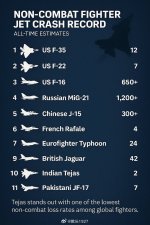
View attachment 161275
Today’s decisive combat edge lies in:
- Sensor fusion
- Real-time data-links and network-centric warfare
- Integrated electronic warfare suites
- Seamless BVR dominance
- Secure, jam-resistant communications
- Multi-domain interoperability
These are the technologies that win air superiority, not acrobatics, not paint jobs, not political speeches. India’s aerospace ecosystem still struggles with basic integration maturity:
- Indigenous AESA radars delayed and underperforming
- BVR missiles integrated years late and software not compatible
- No robust secure datalink ecosystem like Link-16 or MADL
- EW capabilities that lag a generation
- A supply chain that depends heavily on foreign vendors, while claiming “atmanirbharta”
- And let’s not forget the jet engine dependency that remains India’s biggest strategic vulnerability. After 40 years, India still can’t build a reliable indigenous fighter engine. No sensor suite, no weapon integration, no network capability can compensate for this core weakness.The heart of fighter aviation is the engine and India still doesn’t have one. A country that aspires to 5th-gen combat capability still cannot build:
- a reliable indigenous turbofan,
- a high-thrust core,
- an afterburner section that doesn’t eat itself,
- or even a sustained high-T/W ratio engine that meets modern combat loads.
The Kaveri engine remains a national case study in how not to run R&D, thousands of crores, decades of delays, and still not a single operational fighter variant. As a result, India remains dependent on foreign engines for every “indigenous” fighter platform, including Tejas.
What does this dependency mean? That India still cannot dictate:
- thrust class evolution
- thermal management
- fuel efficiency curves
- hot-section materials
- or afterburner signature modulation
All of which are essential for:
- supercruise,
- stealth shaping,
- BVR-first engagement tactics,
- high-altitude combat, and
- sustained multi-sortie wartime operations.
India loves to announce aerospace breakthroughs. But announcements don’t shoot down enemy aircraft. India doesn’t need more flypasts. India needs competence.
1. Competence in systems engineering.
2. Competence in weapons integration.
3. Competence in EW, AI-enabled decision loops, and autonomous teaming.
4. Competence that takes decades of consistent, disciplined investment in R&D, not ceremony.
As long as India glorifies airshow theatrics over true combat capability, India will remain a spectator in the modern fighter era, not a leader.
It’s time to stop bragging!


 If you look inside the cockpit it seems like he was raising left arm.


