

desperate times call for desperate measures?J-35A will likely come as the F-16A/Bs likely won't serve past 2040 from what I can assess. The PAF doesn't have any real options that can slot into the offensive spear-tip role.
Follow along with the video below to see how to install our site as a web app on your home screen.
Note: This feature may not be available in some browsers.
desperate times call for desperate measures?J-35A will likely come as the F-16A/Bs likely won't serve past 2040 from what I can assess. The PAF doesn't have any real options that can slot into the offensive spear-tip role.

Blk 30 and below? Absolutely. Turkiye essentially did that itself.suppose we have money for it , can we do it without us approval

I guess the money might be a issue for adding 1 or 2 sq of J-10's, and more JF-17's. Pakistan economy is struggling and with it the defense budget. But even if the numbers of old fighters are smaller than reported, we still have many Mirages and F7PG's to replace, from the old forum times, there were discussions that JF-17s will become the backbone, meaning replacing the F7s' and large number of Mirages but we are only at what? roughly 150+ JF-17's? The number should be around 200-250, but again it might be the finance that tie Air forces hands.hes talking shite.
Most of PAF's mirages now are EoL, they selected the few remaining airframes to form 50TA Sqn
Cobras transitioned to J-10s
Haiders, Block 3's
I think the mirages were consolidated to Rafiqui, they're becoming far too difficult to keep running now. Theres no F-7P's as far as i know, with some F-7PG's remaining.
Its definitely not 250+ older planes.
But yea, they're going to need to do something about the dwindling sqn strengths as aircraft become unserviceable. Only real option is pick up some more JF-17s, but i think block 3 is an interim, hence the hesitance, its clear the PAF is waiting for something otherwise the JF-17 or J10 option has always been there... I wonder whether the PAF would trade some mirage squadrons for example for Kizilelma, would be interesting.
I think jf 17 number are unknown and there many people in this forum were surprised when they saw 24 series of JF 17 B3 was traveling to Azharbhijan.hes talking shite.
Most of PAF's mirages now are EoL, they selected the few remaining airframes to form 50TA Sqn
Cobras transitioned to J-10s
Haiders, Block 3's
I think the mirages were consolidated to Rafiqui, they're becoming far too difficult to keep running now. Theres no F-7P's as far as i know, with some F-7PG's remaining.
Its definitely not 250+ older planes.
But yea, they're going to need to do something about the dwindling sqn strengths as aircraft become unserviceable. Only real option is pick up some more JF-17s, but i think block 3 is an interim, hence the hesitance, its clear the PAF is waiting for something otherwise the JF-17 or J10 option has always been there... I wonder whether the PAF would trade some mirage squadrons for example for Kizilelma, would be interesting.

They are already being rationed AFAIK.J-35A will likely come as the F-16A/Bs likely won't serve past 2040 from what I can assess. The PAF doesn't have any real options that can slot into the offensive spear-tip role.
Desperate measures need to be scalable not just from an airframe perspective but also from infra to operate them which goes well beyond just the serviced jet.

I feel those programs have separate ideas.@Oscar @Ak01 gustaakhi muaaf but i think Turkiye’s biggest challenge with the KAAN is engine.
What if Turkiye and Pakistan reached an agreement where a downgraded/de-rated (means scaled small) variant of the KAAN is produced in Pakistan as the PFX (obviously with full Turkish assistance), and Pakistan supplies Chinese engines for it?
That way, if the original KAAN engine program faces delays or sanctions, both the PAF and the TuAF would have a viable backup fighter (the PFX) ready to go.
Does that make sense as a Plan B for both countries?


Given the close relationship between Pakistan and Turkey, I don't want to comment on Türkiye or the KAAN project (as this would draw a lot of criticism from Pakistanis). But I can say with certainty that your idea is impossible to realize. There is absolutely no possibility that China would provide engines for the project you described.What if Turkiye and Pakistan reached an agreement where a downgraded/de-rated (means scaled small) variant of the KAAN is produced in Pakistan as the PFX (obviously with full Turkish assistance), and Pakistan supplies Chinese engines for it?

Astaghfirullah, tawba tawba.when are you going to renounce islam and let everyone know you worship the chinese instead?

I'm still waiting for your dua. Will you make dua that PML, PPP, and all corrupt bureaucrats, officers, and politicians in Pakistan are erased? I'm just trying to make sure we don't have any cult-members here -- just Neutrals. Are we all Neutrals here, my guys?Ameen. There you go. Now next time my humble suggestion is to start focusing on the right things.
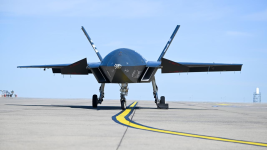
The most optimal path available to Pakistan's SOE base is a loyal wingman UCAV.Desperate measures need to be scalable not just from an airframe perspective but also from infra to operate them which goes well beyond just the serviced jet.
To me half the challenge with CCAs or Unmanned systems is having the net and resources to operate them effectively as part of overall ecosystem.
I literally said Amen to what you said. And ill say it again. Erase all the corrupt from PMLN, PTI, PPP and any other political party. Dont be thick headed.I'm still waiting for your dua. Will you make dua that PML, PPP, and all corrupt bureaucrats, officers, and politicians in Pakistan are erased? I'm just trying to make sure we don't have any cult-members here -- just Neutrals. Are we all Neutrals here, my guys?
The most optimal path available to Pakistan's SOE base is a loyal wingman UCAV.
The technology guts for it all are there in AWC. In fact, the South Africans explicitly called out ALCM tech as the starting point for a small recoverable UCAV with x2-4 AAM or SDB carriage capability.
So, Pakistan can get from A to B here, though the runway may be pretty long due to the technical work we need to master as part of the process.
That said, however, a partnership between Baykar Group and AWC would be perfect and allow this to happen. First, Baykar doesn't offer a UCAV of this particular class (though it's likely required by the TuAF), so there's no overlap or competing product segment. Second, it much simpler to build and even indigenize for Pakistan compared to the Kizilelma.
Now, I also have a more controversial view, but if the PAF wants a new lightweight fighter to call its own and actually integrate its industry into, then it should sign onto the TAI Hurjet and work with TAI to develop that into the dream 4,5+ or 5-minus jet the PFX is being made out to be.
It'd mean taking a couple of steps back from where the JF-17 is, but it can be a great leap forward if we build an actual industry around it. We will NOT get this from the Chinese as their incentives structure is clearly to manufacture everything and export it -- they're not a friendly trade partner (testified by the whole world except for the Chinese).
But the players to make the alternative happen are all there: TAI's core platform in Hurjet and their good expertise in flight controls, etc; the Ukrainians with their AI-9XXX turbofan proposal (which, at one point, was shown to the PAF); NASTP with their radar, avionics, EW/ECM design work; and NESCOM with an industrial base of sorts (that needs some reforming, but it's a starting point).
We can do it, and I would rather this route, but it takes the mentality of our nuclear program (i.e., where we built the nuclear fuel cycle ourselves) rather than the, "We'll buy it from China" view.
On Baykar's side, it'd be a way for them to get a partner who'd share the R&D funding for said CCA drone and guarantee an upfront large-scale order. In most cases, partnerships like this are often built on these two foundations: (1) share funding and (2) initial order set. It's easier to do this with someone else than to do it alone. For ex., yes, Baykar could do it alone regardless, but it's always good to take the less costly path (sharing with a partner) as it would free up your funding and resources for other areas.I literally said Amen to what you said. And ill say it again. Erase all the corrupt from PMLN, PTI, PPP and any other political party. Dont be thick headed.
With regards to your point on loyal wingman, good point but why do we need to partner with Baykar? Wouldnt Baykar prefer doing it by themselves? We already have a good foundation in Shahpar, we can defo take it from there.
Hurjet defo can be explored but only makes sense if we are going for TFX as well. If our foundation is going to stay at chinese fighter jets then making our trainer in combination with China makes more sense.
if i could turn back time, i would abort whoever decided on the JF-17 project instead of developing a mirage 3 based fighter in house wholly.What we paid for with the JF-17 is to become less dependent on the West (which is good) to become more dependent on China (which is not good).


