US Economy - News, Updates and Discussion

Between 2013 and 2025, the birth rate of newborns in the United States will average about 1.26 percent, and the natural death rate of the population will be about 0.83 percent. The net population growth rate should be 0.43%.

12 years, immigrants entering the U.S. legally have averaged about 1.2 million per year. Illegal immigrants will only increase.

2013 US population 316 million, even without counting illegal immigrants by 2025 there should theoretically be 348 million people, but the US actually only has 338 million people.

May I ask where the other 10 million people have gone? Note that this is still without counting illegal immigrants.

Your initial numbers are wrong

Birthrate average over 2013–2025: ~1.15%, not 1.26%
Deathrate average over 2013–2025: ~0.91%, not 0.83%

growth rate: 0.24% not 0.43%
 
To view this content we will need your consent to set third party cookies.
For more detailed information, see our cookies page.
 
US moves to seize $12 billion in bitcoin tied to Cambodia scam kingpin Chen Zhi

The U.S. Department of the Treasury has launched one of its largest-ever financial crime crackdowns, moving to seize 127,271 bitcoin valued at about US$12 billion from Chinese national Chen Zhi and his Cambodia-based Prince Group, which Washington has designated as a transnational criminal organization.

The Treasury’s Office of Foreign Assets Control (OFAC) and Financial Crimes Enforcement Network (FinCEN), working with the U.K.’s Foreign, Commonwealth and Development Office, said the Prince Group orchestrated industrial-scale “pig-butchering” scams—long-term relationship frauds that trick victims into bogus investments before disappearing with their funds. The network is also accused of human trafficking, forced labour, and sexual exploitation within “scam compounds” in Cambodia.

U.S. authorities say Chen’s organization laundered illicit proceeds through real-estate, banking, and bitcoin-mining ventures, including a Laos-based operation called Warp Data Technology Lao Sole Co., allegedly used to funnel digital assets into wallets controlled by Chen.

---

Bitcoin was designed to be censorship-resistant — a digital asset beyond government control because ownership is recorded on a decentralized blockchain and secured by private keys only the holder can access. In theory, this makes it immune to seizure. Yet in practice, authorities can still confiscate coins when they gain control of wallets, custodial accounts, or private keys through investigations, arrests, or cooperation with exchanges. The U.S. Treasury’s move to seize 127,000 BTC highlights that while the network itself can’t be shut down, human custody and off-chain weaknesses remain the system’s most vulnerable points.

---

The unprecedented seizure of over US$12 billion in bitcoin underscores intensifying U.S. scrutiny of crypto flows linked to online fraud and human trafficking. The action may heighten compliance pressure on exchanges and financial institutions across Asia handling high-risk crypto transactions.

Its also helpful for funding Trump's BTC reserve!


To view this content we will need your consent to set third party cookies.
For more detailed information, see our cookies page.
 

New report shows LOW Inflation...no tariff impact​


To view this content we will need your consent to set third party cookies.
For more detailed information, see our cookies page.
 

US Economy & Bitcoin to BOOM after rumors of more rate cuts & QE​


To view this content we will need your consent to set third party cookies.
For more detailed information, see our cookies page.
 

We’re Number Two! How Trump ceded the future to China​

PAUL KRUGMAN

NOV 03, 2025

https%3A%2F%2Fsubstack-post-media.s3.amazonaws.com%2Fpublic%2Fimages%2F79965d52-f168-4d96-9ffd-d6b7521a4225_1432x780.png

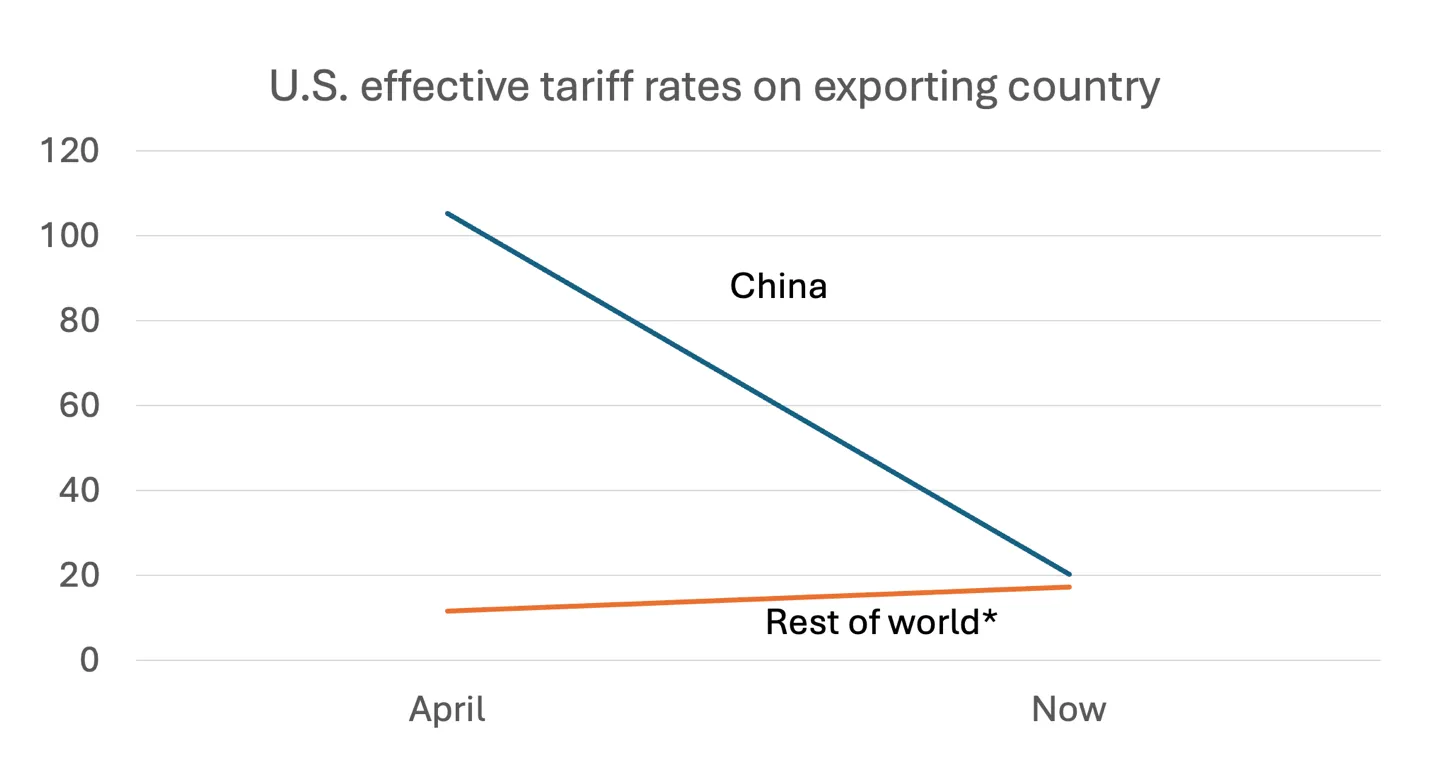
*Excluding Canada and Mexico

Source: Yale Budget Lab

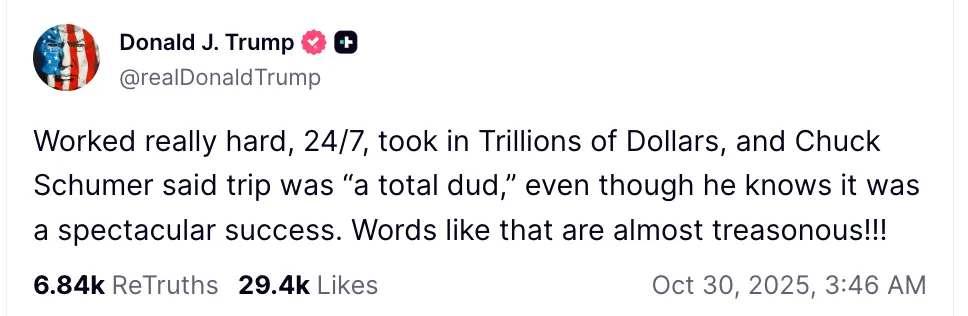
Does Donald Trump realize that he has ceded world leadership to China? Probably not: During his recent Asian trip, foreign leaders flattered him and showered him with personal gifts, so he came home with his ego even more inflated than usual. Nobody close to him would dare tell him that if you look at the substance of what he agreed to, it amounted to an ignominious retreat. When Chuck Schumer pointed out the reality of what Trump didn’t accomplish, his reaction was hysterical:

https%3A%2F%2Fsubstack-post-media.s3.amazonaws.com%2Fpublic%2Fimages%2F3bbda324-0303-4e10-9197-272a240b1977_968x316.png


Well, if this be treason, make the most of it. The whole world knows what Trump’s sycophants won’t tell him: His confrontation with China has ended up demonstrating Chinese strength and American weakness.

Now, I am not a mercantilist. Trump may imagine that the world economy is a zero-sum game, where one nation’s gain is another nation’s loss. But it isn’t. China’s astonishing rise since the economic reforms of Deng Xiaoping hasn’t made America poorer. If anything, the rapid ascent of a nation of 1.4 billion people from desperate poverty to middle-income status (per capita, China still lags America and Europe) has made us richer, expanding world markets and providing us with manufactured goods that would be far more expensive to produce at home.

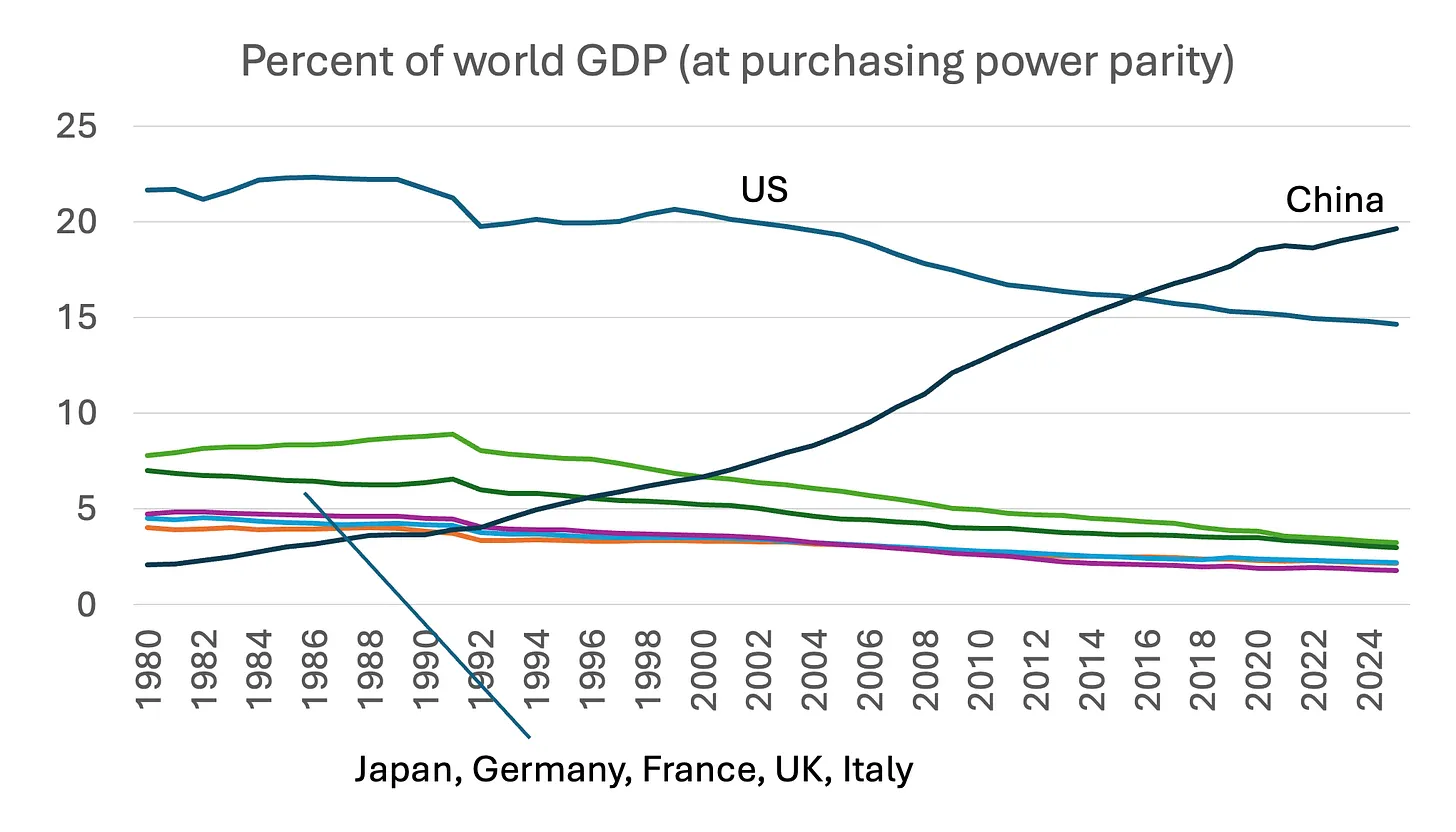
But China’s rise has created geopolitical problems. As recently as the 1980s all of the world’s largest economies were democracies, allied to the United States both by formal treaties and by shared political values. Democracies as a group still dominated the world economy in the early years of the 21st century. But now China’s economy, measured by the real quantity of goods and services it produces, is bigger than America’s and much bigger than any other nation’s:

https%3A%2F%2Fsubstack-post-media.s3.amazonaws.com%2Fpublic%2Fimages%2F93bbad6c-e4ce-4491-a31b-e0e452b86a23_2040x1166.png


Source: International Monetary Fund

In addition to being huge, China’s economy is in some ways more advanced than you might expect given that it is still only a middle-income nation. As I explained yesterday, China dominates renewable energy, one of the most important technologies of the 21st century, and it is giving America serious competition in information technology too.

Why is any of this a problem? China isn’t evil, and while I love my country I don’t believe that America and its allies have any inherent right to rule the world. But by historical standards America was a relatively benign hegemon, largely because we were more than a nation: we were an idea. And the Pax Americana, for all its many failures and sometimes grievous sins, was on balance a force for freedom. Calling us the leader of the free world was more than political boilerplate: It described something real, despite the many blots on our record.

China, by contrast, is not a democracy: It’s an autocratic regime, and those who expected the growth of the Chinese middle class to lead inexorably to political liberalization have been proved decisively wrong. Nor does China seem to stand for anything beyond China.

So China’s rise threatens the liberal, generally pro-freedom world order America helped build. What should we do about it?

The Biden administration took the potential threat from China’s rise much more seriously than most people realize, and tried to implement quite strong policies to contain that threat. In particular, it acted on three fronts:

1. Support for renewable energy: The Inflation Reduction Act provided subsidies for green energy — both for its use, e.g. purchase of electric vehicles, and for domestic manufacturing of key equipment like batteries. These subsidies were intended to serve multiple purposes, including promoting renewables and helping depressed regions, but one goal was to dent China’s dominance of important technologies.

2. Support for advanced technology: The CHIPS Act provided subsidies for advanced technology, especially semiconductor manufacture, with the goal of keeping the U.S. at the cutting edge and reducing our dependence on foreign suppliers.

3. Export controls: The Biden administration imposed controls on exports of both semiconductors and semiconductor manufacturing equipment to China, with the goal of choking off Chinese access to the future of AI and high performance computing.

Would these policies have been effective at constraining China, helping the U.S. maintain a technological edge? We’ll never know, because the Trump administration has abandoned all of them.

America is no longer contesting dominance of renewable energy, because Trump and company hate wind and solar power. They aren’t just canceling the subsidies, they’re trying to kill renewable energy in general.

Trump has harshly criticized the CHIPS Act and the whole idea of using subsidies to promote domestic manufacturing. He prefers tariffs. And as the chart at the top of this post shows, he initially imposed very high tariffs on China. (The tariff rate shown was for April 15 — not the initial “Liberation Day” tariff, but the revised tariff imposed a week later, after Scott Bessent, the Treasury secretary, and Howard Lutnick, the Commerce secretary, convinced Trump to completely revise his plans while Peter Navarro, the trade czar, was in another meeting.)

But now Trump has slashed tariffs on China. According to the Budget Lab’s estimate, tariffs on China are now similar to tariffs on other countries excluding Canada and Mexico. For example, China now faces tariffs not significantly higher than those imposed on our erstwhile allies in the European Union.

And Trump has suggested that Nvidia, which produces the most advanced AI chips, may be allowed to sell to China after all.

So basically Trump has backed down in his confrontation with China. If this was a trade war, China won. Why?

A large part of the answer is that the Chinese had more leverage over us than we did over them. We are or were an important export market for China, but China has a near-monopoly on rare earths, which are crucial for much advanced technology. And China’s limits on rare-earth exports to the United States were a much bigger problem for us than Trump’s tariffs were for them.

Trump didn’t cause this imbalance, which successive U.S. administrations have failed to address. But he was clearly oblivious, imposing punitive tariffs without any apparent awareness that China could strike back.

Trump has also proved willing to be moved by Chinese promises to resume purchases of U.S. soybeans. You might say that he ceded the future to China in return for a hill of beans. This is especially amazing when you bear in mind that China made similar promises to buy U.S. goods during the first Trump administration and never came close to delivering on those promises.

More generally, despite tough talk about China, Trump’s tariff spree hasn’t focused clearly on the key geopolitical issue of rising Chinese power. Instead, he’s been busy imposing tariffs on Brazil because he doesn’t like its domestic politics — they dared to try and convict a former president who attempted a coup — and on Canada, because the province of Ontario aired a TV ad that upset him. Trumpian tariff policy has been less America First than Ego First.

All in all, this whole confrontation has been a demonstration of Chinese strength and American weakness. Add in the way that Trump has alienated our allies, and it seems fair to say that America is no longer the world’s leading power. Unless a future president can engineer a miraculous recovery in our global stature, the future now belongs to China.
 
Disagree with the author. The Biden and Trump admins have been equally bad and hostile to China, but in different ways, Trump gov doesn't cede to China, no.
 
here we go...

Tricolor: The messy collapse of a subprime auto lender

Subprime lender PrimaLend Capital Partners files for bankruptcy protection​


  • Tricolor Holdings: This Dallas-based subprime auto lender and used car retailer (operating as Tricolor Auto, Ganas Auto, etc.) filed for Chapter 7 liquidation in September 2025. The collapse came amid allegations of significant fraud, including the potential double-pledging of collateral, which is currently under investigation by the U.S. Department of Justice. Major banks like JPMorgan Chase and Fifth Third Bank are facing hundreds of millions of dollars in combined losses related to the company's failure.
  • PrimaLend Automotive Receivables Trust: A key automobile lender, PrimaLend, filed for Chapter 11 bankruptcy in October 2025 after months of missed interest payments, signaling broader strains in the subprime auto market.
 
The US is witnessing a 'semiconductor boom' as we speak, with chip giants like TSMC and Samsung pouring huge foreign investments into the region.

The U.S. Is Shifting Its Stance From 'Passive' to Being An Aggressive Manufacturer of Key Technologies​

With the Trump administration taking over the office, we have seen an 'unprecedented' level of chip demand coming in from US customers, which is why companies like TSMC have pledged to invest 'hundreds of billions' into America to ensure that the nation has a resilient chip supply chain. Projects like TSMC Arizona indicate that the US is emerging as a world semiconductor hub, alongside Taiwan, which is why, according to an estimate by McKinsey, the development of the chip industry in the US is significantly higher than in any other region.

According to the report, nearly 90% of the total FDI in the chip industry was directed towards the US in 2025 alone, with a majority of partnerships formed between entities from Taiwan and South Korea. Of course, out of all the names shifting manufacturing to the US, there's no doubt that TSMC is the largest, not just in terms of the magnitude of its investments, but also in the importance of the company's pursuit to establish a chip supply chain in the US. TSMC's Arizona fab is currently mass-producing the 4nm technology, and even has plans to scale up to A16(1.6nm), showcasing the firm's commitment towards producing chips in then US.

Apart from Taiwan, South Korea has heavily invested in the US semiconductor sector, driven by companies such as Samsung and Micron. Samsung's Taylor facility has been a victim of delays ever since it received CHIPS Act grants under the Biden adminstration, but based on recent reports, the fab is back on track, and is showing promising development towards producing the SF2 (2nm) process in the US. The company has also received pivotal orders for Tesla's custom AI chips; hence, it would not be wrong to say that Samsung also plays an integral role in the US chip supply chain.

Well, one of the significant reasons why manufacturing activity in the US has 'boosted' in recent times is due to the policy of the Trump administration to take this matter as 'national security', which is why President Trump has threatened companies like TSMC with massive tariffs up to 100% if they are unable to mass-produce chips in the nation. Since a large portion of the Taiwan chip giant's customers are indeed from the US, the firm needs to have resilient production lines in place.

The chip supply chain shift isn't just exclusive to the US, since the report also dives into how Europe has switched its stance into actively protecting its "technological base", following aggressive export controls, and even seizing control of entities like Nexperia. TSMC is also known to be investing in the EU, particularly in Germany, which ultimately indicates the broader intent to move manufacturing from the East to the West. While the efforts certainly don't guarantee that the West will have an independent supply chain, they surely do enhance the region's stance towards becoming a key manufacturer of technologies on home grounds.
 

US moves to deepen minerals supply chain in AI race with China​

Bloomberg News | December 1, 2025 | 4:24 pm Critical Minerals Regulatory Issues Asia Australia Europe USA Rare Earth
AdobeStock_81752591-1024x683.jpeg

The White House. Stock image.
The US will seek agreements with eight allied nations as part of a fresh effort to strengthen supply chains for the computer chips and critical minerals needed for AI technology, according to the top State Department official for economic affairs.

blank.gif

The initiative, which builds on efforts dating back to the first Trump administration, unfolds as the US looks to cut dependence on China. It will begin with a meeting at the White House on Dec. 12 between the US and counterparts from Japan, South Korea, Singapore, the Netherlands, the UK, Israel, the United Arab Emirates and Australia, Jacob Helberg, the undersecretary of state for economic affairs, said in an interview.


Helberg, a former adviser at Palantir Technologies Inc., said the summit will focus on reaching agreements across the areas of energy, critical minerals, advanced manufacturing semiconductors, AI infrastructure, and transportation logistics.


Helberg said the countries were chosen for reasons that range from being home to some of the most important semiconductor companies to their critical minerals resources.

“It’s clear that right now in AI, it’s a two-horse race — it’s the US and China,” Helberg said. “We want to have a positive, stable relationship with China, but we’re also ready to compete, and we want to make sure that our companies can continue building transformative technologies without being subject to coercive dependencies.”

Helberg’s initiative builds upon years of efforts on critical minerals supply chains by prior administrations largely aimed at helping reduce western dependence on China. The State Department in the first Trump administration launched the US Energy Resource Governance Initiative with the aim of securing supply chains for critical minerals like lithium and cobalt. The Biden administration launched a Minerals Security Partnership that aimed to funnel foreign investment and western expertise to the mining sectors of developing nations.

Even so, the US and other countries have been unable to break China’s stranglehold over rare earths supplies. China is home to more than 90% of global rare earths and permanent magnets refining capacity, compared with just 4% for second-place Malaysia, according to the International Energy Agency, a Paris-based intergovernmental organization.

China announced tighter rare earths export controls in early October, only to agree to a one-year suspension after a meeting between Trump and President Xi Jinping.


Helberg said that unlike the Biden-era initiative, which had more than a dozen core countries, his focus is on producer countries. While the first Trump administration initiative focused on critical minerals, it came before the public release of AI platforms like ChatGPT, and the new plan focuses across all layers of the technology involved in AI, not just one, Helberg said.

Helberg, 36, was previously senior adviser to Palantir chief executive officer Alex Karp and also co-founded the Hill and Valley Forum, a gathering of tech leaders and US lawmakers focused on national security challenges, especially those related to competition with China and the advancement of AI and other technologies.


He framed the work with trusted allies for his AI initiative as an “America centric” strategy, rather than one that’s reactive to China.

“Countries who are participating understand the transformative impact of AI, both for the size of a country’s economy, as well as the strengths of a country’s military,” he said. “They want to be a part of the AI boom.”
 
Real gross domestic product (GDP)increased at an annual rate of 4.3 percent in the third quarter of 2025 (July, August, and September), according to the initial estimate released by the U.S. Bureau of Economic Analysis. In the second quarter, real GDP increased 3.8 percent.
 
Looks like the reenactment of the Monroe Doctrine is bearing fruits. Yes, the USA needs to go back to the very mission, vision, and motivation behind her birth at the first place.....
 

Users who are viewing this thread

Pakistan Defence Latest

Latest Posts

Back
Top