Goenitz
Elite Member
the Twitter account, pilot or the tech guy?Hehe that's me lol
Follow along with the video below to see how to install our site as a web app on your home screen.
Note: This feature may not be available in some browsers.
the Twitter account, pilot or the tech guy?Hehe that's me lol
the twitter account , check it out makes good illustrationthe Twitter account, pilot or the tech guy?
I knew that Bilal was different. Actually, I mistook Arsalan for another Bilal (you).Bro I am not that Bilal. His handle here is Quwa.
Yes, it will have around 15 seconds time to identify the target already in front of it.4 km is more than enough range for this seeker. It only needs to track the target in the endgame
how complicated would it be to add flares to it like kh01 ?Ok so I will separate my thoughts in separate posts for clarity.
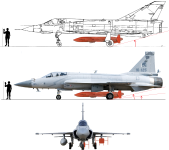
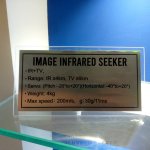
Taimoor is clearly a development of the Ra'ad 2. However, we should not think this is a simple progression. Ra'ad 2 is a nuclear delivery system so it a) has no need to be pinpoint accurate, and b) needs as much space as possible for its payload. This tells us that Taimoor very likely has a smaller space for its warhead. The weight of the seeker isn't huge (4 kg from above specs) but the space that the seeker takes up is significant. Regardless, for the kinds of mission Taimoor is meant for, this loss in boom matters naught.
Regarding what it takes to "add a seeker":
Ra'ad 2 has a guidance system based on INS (maybe TERCOM/DSMAC etc) and the entire flight software is designed for it. Now you add a seeker. You need to add some software and memory to be able to recognize targets. You need a system to feed it target picture before it is launched. Secondly, you need to add an end-game guidance based on the seeker inputs. This is an entirely new phase of flight, and what lets it hit targets so accurately. You need lots of simulation and testing to get this right. 4 km is more than enough range for this seeker. It only needs to track the target in the endgame. It is essentially a Ra'ad2 the rest of the way. The legacy guidance and navigation gets you in the vicinity of the target, and the new seeker+end-game guidance gets you to the target.
Founder of the Mughals aka the house of Taimoor. Masters of South Asia and Afghandus before British came. You will see afghandus trying to descreate his name in this thread.What does the name mean ( for those of us who are less cultured ! ).
Wait so no GPS guidance?Ok so I will separate my thoughts in separate posts for clarity.
Taimoor is clearly a development of the Ra'ad 2. However, we should not think this is a simple progression. Ra'ad 2 is a nuclear delivery system so it a) has no need to be pinpoint accurate, and b) needs as much space as possible for its payload. This tells us that Taimoor very likely has a smaller space for its warhead. The weight of the seeker isn't huge (4 kg from above specs) but the space that the seeker takes up is significant. Regardless, for the kinds of mission Taimoor is meant for, this loss in boom matters naught.
Regarding what it takes to "add a seeker":
Ra'ad 2 has a guidance system based on INS (maybe TERCOM/DSMAC etc) and the entire flight software is designed for it. Now you add a seeker. You need to add some software and memory to be able to recognize targets. You need a system to feed it target picture before it is launched. Secondly, you need to add an end-game guidance based on the seeker inputs. This is an entirely new phase of flight, and what lets it hit targets so accurately. You need lots of simulation and testing to get this right. 4 km is more than enough range for this seeker. It only needs to track the target in the endgame. It is essentially a Ra'ad2 the rest of the way. The legacy guidance and navigation gets you in the vicinity of the target, and the new seeker+end-game guidance gets you to the target.
It might be augmented.Wait so no GPS guidance?


We use essential cookies to make this site work, and optional cookies to enhance your experience.