Navigation
Install the app
How to install the app on iOS
Follow along with the video below to see how to install our site as a web app on your home screen.
Note: This feature may not be available in some browsers.
More options
Style variation
You are using an out of date browser. It may not display this or other websites correctly.
You should upgrade or use an alternative browser.
You should upgrade or use an alternative browser.
US - Pakistan relationship
- Thread starter ghazi52
- Start date
More options
Who Replied?




ghazi52
THINK TANK: CONSULTANT
- Thread starter
- #34
2025 marks decisive reset in Pakistan-US ties: Washington Times
Paper says Trump drops “India First,” elevates Pakistan after May conflict reshapes Washington’s South Asia strategy
Web Desk
December 22, 2025
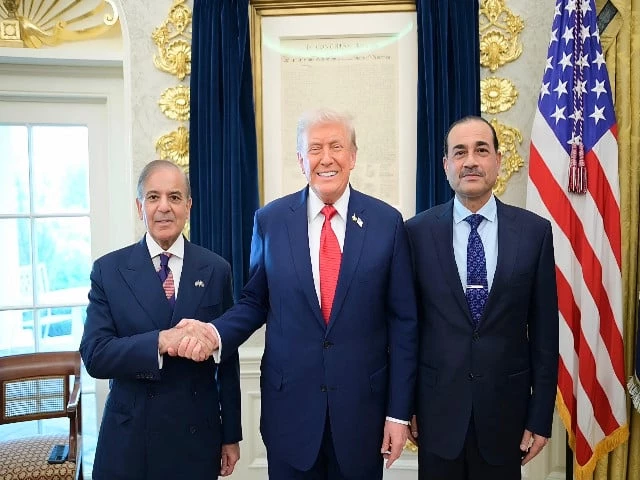
Prime Minister Shehbaz Sharif and Field Marshal Asim Munir meet US President Donald Trump at the White House in Washington DC on September 25, 2025. Photo: Handout
The Washington Times has described 2025 as a turning point in Pakistan–US relations, citing what it called a dramatic shift in Washington’s approach.
The newspaper said President Donald Trump abandoned the long-standing “India First” policy and elevated Pakistan’s strategic importance, a change it linked largely to the May conflict between Pakistan and India.
In May 2025, following India’s unprovoked attacks, Pakistan launched a calibrated military response, Operation Bunyanum Marsoos, targeting Indian troop concentrations, air assets, and key command infrastructure. Retaliatory strikes neutralized over 26 high-value installations across five Indian states, including missile silos, air defence systems, logistics hubs, and communications networks.
Pakistani drones and cyber operations further disrupted India’s energy grids, rail networks, and surveillance systems, while multiple Rafale jets were reportedly shot down. The operation demonstrated Pakistan’s military discipline, precision, and strategic reach, sending a clear message that its airspace and national sovereignty would not be violated.
ghazi52
THINK TANK: CONSULTANT
- Thread starter
- #35
The article provides a special analysis of the growing rapport between Chief of Defence Forces, Field Marshal Syed Asim Munir and President Trump, describing Pakistan’s transformation from an “undesired state” to a key partner. Its rapid image-building and opinion shift in Washington are described as rare and unique, positioning Pakistan as a central pillar of Trump’s South Asia policy.
Earlier, during his official visit to the United States, Field Marshal Munir praised President Trump for helping prevent “many wars,” including brokering the May Pakistan-India ceasefire.
Addressing the Pakistani diaspora, he highlighted Pakistan’s diplomatic successes, warned against any future Indian aggression, and reaffirmed that Indian Illegally Occupied Jammu and Kashmir remains an internationally recognized dispute.
The military chief also held high-level engagements with US military and political leadership, emphasizing strengthened bilateral cooperation, regional security, and counterterrorism collaboration.
Earlier, during his official visit to the United States, Field Marshal Munir praised President Trump for helping prevent “many wars,” including brokering the May Pakistan-India ceasefire.
Addressing the Pakistani diaspora, he highlighted Pakistan’s diplomatic successes, warned against any future Indian aggression, and reaffirmed that Indian Illegally Occupied Jammu and Kashmir remains an internationally recognized dispute.
The military chief also held high-level engagements with US military and political leadership, emphasizing strengthened bilateral cooperation, regional security, and counterterrorism collaboration.
ghazi52
THINK TANK: CONSULTANT
- Thread starter
- #36
Initially, Washington had sought to strengthen India through platforms like the Quad, sidelining Islamabad. However, India’s political climate, restrictions on personal freedoms, uneven military performance, and diplomatic rigidity cast doubt on its role as a regional stabilizer.
The first thaw in Pakistan-US relations came via secret counterterrorism exchanges, signaling substantive cooperation. In March, Trump unexpectedly praised Pakistan’s counterterrorism efforts during a national address, prompting a policy shift.
Islamabad seized the opportunity, turning limited cooperation into strategic gains. Engagement increased, and the bilateral relationship evolved from transactional to strategic. T
he short but intense May skirmish with India became a decisive turning point, showcasing Pakistan’s military discipline, strategic focus, and asymmetric capabilities - qualities that reportedly surprised Trump.
The article also highlights historic engagement between Trump and Field Marshal Munir, including their first-ever luncheon meeting for a Pakistani military chief and Munir’s red carpet visit to US Central Command Headquarters for high-level talks.
Advisers described their relationship as a “budding bromance,” with Munir emerging as a disciplined, strategic, and carefully image-managed figure in Washington. Pakistan also leveraged this attention with light diplomatic gestures and public relations moves, further boosting its standing.
The first thaw in Pakistan-US relations came via secret counterterrorism exchanges, signaling substantive cooperation. In March, Trump unexpectedly praised Pakistan’s counterterrorism efforts during a national address, prompting a policy shift.
Islamabad seized the opportunity, turning limited cooperation into strategic gains. Engagement increased, and the bilateral relationship evolved from transactional to strategic. T
he short but intense May skirmish with India became a decisive turning point, showcasing Pakistan’s military discipline, strategic focus, and asymmetric capabilities - qualities that reportedly surprised Trump.
The article also highlights historic engagement between Trump and Field Marshal Munir, including their first-ever luncheon meeting for a Pakistani military chief and Munir’s red carpet visit to US Central Command Headquarters for high-level talks.
Advisers described their relationship as a “budding bromance,” with Munir emerging as a disciplined, strategic, and carefully image-managed figure in Washington. Pakistan also leveraged this attention with light diplomatic gestures and public relations moves, further boosting its standing.
ghazi52
THINK TANK: CONSULTANT
- Thread starter
- #37
US President Donald Trump called the visit an “honour,” praising Munir for helping avert further escalation between Pakistan and India. The meeting discussed the recent Middle East conflict, Pakistan’s understanding of Iran, and regional security issues.
Trump credited Munir’s leadership in securing the May ceasefire, calling it a major contribution to preventing war between the nuclear-armed neighbours, and noted that the luncheon marked the first time a US president hosted a Pakistani army chief unaccompanied by civilian officials.
By early 2026, The Washington Times notes, Pakistan sits at the center of Trump’s emerging grand strategy for South Asia and the Far East.
It offers Washington discreet channels to Iran, a potential role in Gaza, and a subtle counterweight to China’s regional influence. Islamabad has re-established itself as a serious regional actor, reshaping US policy and rewriting the balance of power in South Asia.
Trump credited Munir’s leadership in securing the May ceasefire, calling it a major contribution to preventing war between the nuclear-armed neighbours, and noted that the luncheon marked the first time a US president hosted a Pakistani army chief unaccompanied by civilian officials.
By early 2026, The Washington Times notes, Pakistan sits at the center of Trump’s emerging grand strategy for South Asia and the Far East.
It offers Washington discreet channels to Iran, a potential role in Gaza, and a subtle counterweight to China’s regional influence. Islamabad has re-established itself as a serious regional actor, reshaping US policy and rewriting the balance of power in South Asia.


hasssanali8998
Elite Member
the mineral deal right .1.2 billion dollars investment in Baluchistan

Goenitz
Elite Member
He said too many things. I think it is some US companies working independently/in tandem with the Saudi companies.the mineral deal right .

Watandar
SpeedLimited
Asad Ali Toor discussed this mineral issue on his podcast. His discussions with senior politicians and govt officials revealed Pakistan doesn't actually know where the minerals are in Baluchistan or KPK and needs very expensive geological surveys done to determine the presence, location and quantity of mineral deposits.He said too many things. I think it is some US companies working independently/in tandem with the Saudi companies.
He said the US doesn't trust Pakistani govt and is insisting on an agreement before doing any expensive geological survey, where IF the US finds something then only American companies would be allowed to mine the deposits and there would be no room for Pakistan to bring in Chinese or someone else.
ghazi52
THINK TANK: CONSULTANT
- Thread starter
- #42
High-level Senate delegation to visit US from Jan 20
News DeskJanuary 6, 2026
https://whatsapp.com/channel/0029VaMc238IiRov8okfYy3n
A high-level Senate delegation, led by Deputy Chairman Senator Syedaal Khan, will undertake an official visit to the United States from January 20 to 25, 2026, the Senate Secretariat said on Tuesday.
The development comes after Pakistan-US relations saw a notable thaw in 2025, a year marked by high-level engagement, strategic recalibrations, and complex regional developments.
The Secretariat termed the visit a “historic milestone” in Pak–US parliamentary relations, signifying the “beginning of a new institutional chapter in bilateral engagement”.
According to the statement, the visit was organised under the auspices of the Pakistan Policy Institute USA. It will also include the United States–Pakistan Inter-Parliamentary Group for the first time.
“This development represents a major achievement of strategic and non-traditional parliamentary diplomacy,” the statement said, adding that the visit “reflects a shared commitment to strengthening democratic institutions through direct engagement between elected legislatures”.
The Secretariat added that the initiative came at a “critical juncture” of global and regional transformation, particularly in South Asia and the Middle East.
It further said that the visit would be undertaken with clearly defined strategic objectives, including the “establishment of a permanent institutional mechanism” for sustained inter-parliamentary dialogue between the US Congress and the Senate of Pakistan.
“The delegation aims to promote democratic values, exchange best legislative practices, enhance parliamentary oversight, and strengthen institutional cooperation beyond traditional executive-level diplomacy,” it said.
The Secretariat said that the visit would also focus on engaging with the Pakistani-American community to present the country’s parliamentary perspective on regional and global issues, while advancing scientific, cultural, and policy-oriented cooperation.
No Pakistani parliamentary delegation has held formal engagements at the Rayburn House Office Building under the auspices of the US Congress in the 77-year history of Pakistan–US relations.
The Secretariat said that the program would also include a press conference and media engagements at the National Press Club, Washington, D.C., as well as community and policy receptions in New Jersey.
It further said the visit would lay the foundation for regular parliamentary exchanges, enhanced legislative cooperation, and a sustainable institutional partnership between Pakistan and the United States—anchored in mutual respect, democratic principles, and long-term strategic engagement.
In April last year, a US Congressional delegation visited Pakistan, describing their visit as “highly successful and productive”.
The delegation, comprising Congressmen Jack Bergman, Tom Suozzi and Jonathan Jackson, held meetings with senior Pakistani officials, including Field Marshal Asim Munir.
ghazi52
THINK TANK: CONSULTANT
- Thread starter
- #43
Pakistan seeks economic dialogue with US, flags regional security concerns
Anwar Iqbal
January 9, 2026
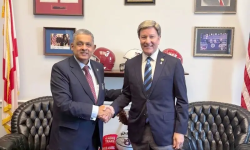
Pakistan’s Ambassador to the US Rizwan Saeed Sheikh meets US House Armed Services Committee Chairman Mike Rogers. — Photo courtesy @AmbRizSaeed/X
WASHINGTON: Pakistan has called for the launch of a high-level economic dialogue with the United States at the earliest and urged a shift in bilateral engagement from geopolitics to geoeconomics during a series of meetings between the country’s envoy Rizwan Saeed Sheikh and senior members of Congress.
Meeting House Foreign Affairs Committee Chairman Brian Mast and House Armed Services Committee Chairman Mike Rogers, Pakistan’s Ambassador to the US said 2026 should be treated as a “year of action” to translate shared intentions into concrete economic cooperation.
“Our focus is shifting from geopolitics to geoeconomics,” he said, according to one of two handouts issued after the meeting, and stressed the need for institutionalised engagement in sectors such as energy, defence, minerals, information technology and artificial intelligence.
Ambassador Sheikh said Pakistan’s low-cost, high-quality manufacturing base positioned it well to meet growing US market needs, highlighting surgical instruments, textiles and sports goods as areas with strong export potential.
He said that “2026 should be the year of action for a long-term, sustainable partnership based on economic cooperation”, noting that footballs manufactured in Sialkot had been used in five consecutive Fifa World Cups.
US State Secretary Marco Rubio has recently spoken positively about expanding ties with Pakistan, describing the relationship as one with significant untapped potential.
“We see an opportunity to expand our strategic relationship with Pakistan,” Rubio said in October 2025, adding that Washington valued Islamabad’s long history of cooperation, particularly in counter-terrorism.
ghazi52
THINK TANK: CONSULTANT
- Thread starter
- #44
Rubio sought to reassure regional partners, saying that closer engagement with Pakistan does not come at the expense of US ties with India.
“I don’t think anything we’re doing with Pakistan comes at the expense of our relationship or friendship with India, which is deep, historic, and important,” he had said, describing US policy as pragmatic and interest-based.
US President Donald Trump, however, has also highlighted strains in Washington’s dealings with New Delhi.
Speaking at a political gathering this week, Trump said: “I have a very good relationship with Prime Minister Modi … he’s not that happy with me because they’re paying a lot of tariffs now,” referring to trade and energy-related differences between the two countries.
Meanwhile, in his meeting with US lawmakers, Ambassador Sheikh also praised the US president’s political judgment and personal engagement in helping de-escalate tensions following the military escalation between Islamabad and New Delhi in May 2025.
According to the handouts, the discussions in Washington also focused on regional security challenges, with the Pakistani ambassador warning that terrorism originating from Afghanistan continued to pose serious threats to Pakistan’s security as well as to regional and international peace.
He told congressional leaders that terrorist incidents in Pakistan increased by 40 per cent in 2024 and by a further 25pc in 2025, attributing the rise to militant groups operating from Afghan soil.
He expressed concern over the continued misuse of advanced weapons left behind during the US withdrawal from Afghanistan.
Addressing South Asian tensions, Ambassador Sheikh referred to the events of May 2025 and said India’s “irresponsible and aggressive behaviour” had lowered the threshold of escalation in the region.
He warned that confrontation between two nuclear-armed neighbours had moved beyond conventional conflict to include advanced technologies, describing the use of dual-capable weapons in a region of 1.7 billion people as deeply alarming.
Ambassador Sheikh cautioned that decisions based on misperceptions or miscalculations could undermine regional peace and reiterated that the unresolved issue of Kashmir and the right of self-determination of its people remained central to lasting stability in South Asia.
Both sides agreed on the need to institutionalise structured and regular dialogue on issues of mutual interest, including economic cooperation and security.
Ambassador Sheikh also extended invitations to congressional leaders to visit Pakistan to strengthen parliamentary and people-to-people ties.
About his meeting with Rogers, the envoy said on X that the two discussed the “ascendantly evolving Pak-US partnership”.
“Focused on regional security challenges, the escalating and sponsored terrorism from Afghanistan, and the subsequently urgent need to address the leftover military equipment. Emphasised that a stable, standalone Pak-US relationship remained vital to regional as well as global peace, security and stability,” he said.
“I don’t think anything we’re doing with Pakistan comes at the expense of our relationship or friendship with India, which is deep, historic, and important,” he had said, describing US policy as pragmatic and interest-based.
US President Donald Trump, however, has also highlighted strains in Washington’s dealings with New Delhi.
Speaking at a political gathering this week, Trump said: “I have a very good relationship with Prime Minister Modi … he’s not that happy with me because they’re paying a lot of tariffs now,” referring to trade and energy-related differences between the two countries.
Meanwhile, in his meeting with US lawmakers, Ambassador Sheikh also praised the US president’s political judgment and personal engagement in helping de-escalate tensions following the military escalation between Islamabad and New Delhi in May 2025.
According to the handouts, the discussions in Washington also focused on regional security challenges, with the Pakistani ambassador warning that terrorism originating from Afghanistan continued to pose serious threats to Pakistan’s security as well as to regional and international peace.
He told congressional leaders that terrorist incidents in Pakistan increased by 40 per cent in 2024 and by a further 25pc in 2025, attributing the rise to militant groups operating from Afghan soil.
He expressed concern over the continued misuse of advanced weapons left behind during the US withdrawal from Afghanistan.
Addressing South Asian tensions, Ambassador Sheikh referred to the events of May 2025 and said India’s “irresponsible and aggressive behaviour” had lowered the threshold of escalation in the region.
He warned that confrontation between two nuclear-armed neighbours had moved beyond conventional conflict to include advanced technologies, describing the use of dual-capable weapons in a region of 1.7 billion people as deeply alarming.
Ambassador Sheikh cautioned that decisions based on misperceptions or miscalculations could undermine regional peace and reiterated that the unresolved issue of Kashmir and the right of self-determination of its people remained central to lasting stability in South Asia.
Both sides agreed on the need to institutionalise structured and regular dialogue on issues of mutual interest, including economic cooperation and security.
Ambassador Sheikh also extended invitations to congressional leaders to visit Pakistan to strengthen parliamentary and people-to-people ties.
About his meeting with Rogers, the envoy said on X that the two discussed the “ascendantly evolving Pak-US partnership”.
“Focused on regional security challenges, the escalating and sponsored terrorism from Afghanistan, and the subsequently urgent need to address the leftover military equipment. Emphasised that a stable, standalone Pak-US relationship remained vital to regional as well as global peace, security and stability,” he said.

Fatman17
THINK TANK: CONSULTANT
Pakistan has called for the launch of a high-level economic dialogue with the United States at the earliest and urged a shift in bilateral engagement from geopolitics to geoeconomics during a series of meetings between the country’s envoy Rizwan Saeed Sheikh and senior members of Congress.
Meeting House Foreign Affairs Committee Chairman Brian Mast and House Armed Services Committee Chairman Mike Rogers, Pakistan’s Ambassador to the US said 2026 should be treated as a “year of action” to translate shared intentions into concrete economic cooperation.
Read more: https://www.dawn.com/news/1965985/
Meeting House Foreign Affairs Committee Chairman Brian Mast and House Armed Services Committee Chairman Mike Rogers, Pakistan’s Ambassador to the US said 2026 should be treated as a “year of action” to translate shared intentions into concrete economic cooperation.
Read more: https://www.dawn.com/news/1965985/
Users who are viewing this thread
Total: 2 (members: 0, guests: 2)
Pakistan Defence Latest
-
 Somalia Reportedly Agrees to Acquire Pakistan’s JF-17 Fighter Jets (11 Viewers)
- Latest: Hamartia Antidote
-
-
KP govt backs out of counterterrorism commitments during talks: Naqvi (4 Viewers)
- Latest: SteppeWolff
-

-
Country Watch Latest
-
 Iran - Israel/US War: Israel-US declare war on Iran, Iran responds (93 Viewers)
- Latest: Persian Gulf
-

-

-

Latest Posts
-
-
Somalia Reportedly Agrees to Acquire Pakistan’s JF-17 Fighter Jets (11 Viewers)
- Latest: Hamartia Antidote
-

-
Iran - Israel/US War: Israel-US declare war on Iran, Iran responds (93 Viewers)
- Latest: Persian Gulf
-