Pakistan-India Conflict 2025: News Updates and Discussion

In your view, PAF threat assessment was more about taking into account the danger Meteors posed or it was their (Indians) possible Air Defence employment?
Everything. Pilots can see threat circles in their cockpit for ground systems but for air threats they rely on MDO pictures or controller guidance. If they deemed it so that in combination with S-400s and Meteor in the air there was a greater risk to JF-17s and F-16s they would be held back.

Keep this is mind - it is “Bhaktora” to assume that the PAF could kill everything and that if the meteor could not achieve firing parameters it is likely in majority cases PAF PL-15 equipped aircraft also perhaps did not achieve ideal firing parameters.
 
Everything. Pilots can see threat circles in their cockpit for ground systems but for air threats they rely on MDO pictures or controller guidance. If they deemed it so that in combination with S-400s and Meteor in the air there was a greater risk to JF-17s and F-16s they would be held back.
Thanks. Pretty amazing how PAF was able to coordinate the response right when it was happening and deliver a substantial ego blow to the Indians.
 
Here are the important points from the Swiss military report “Operation Sindoor: The India-Pakistan Air War (7-10 May 2025)” by the Centre for Military History and Perspective Studies (CHPM) — based on the document itself and multiple analyses of it:


🇨🇭


  • The report is a 47-page independent study by CHPM, a Swiss military history and strategic research institution.
  • Authored by military historian Adrien Fontanellaz and reviewed by a committee of defence specialists.

✈️


  • The study examines the 88-hour air war between India and Pakistan from 7–10 May 2025, triggered by a major terrorist attack and ensuing Indian military response.

🪖


  • Pakistan’s initial tactical success:
    Pakistan achieved an early tactical edge on 7 May, shooting down several Indian aircraft, including at least one Rafale (only a few Indian aircraft losses are supported by verifiable visual proof e.g., one Rafale, one Mirage-2000, and possibly a third fighter like a MiG-29 or Su-30MKI), not the higher numbers initially claimed by Pakistan), which attracted international attention.
  • Indian counter-operations:
    India detected Pakistani preparations for further strikes and responded quickly with counterattacks on 9–10 May using long-range missiles and precision strikes.

🛫


  • The report concludes that, after the initial phase, the Indian Air Force (IAF) gained clear air superiority by degrading Pakistan’s air defence infrastructure and executing coordinated strikes.
  • This dominance contributed significantly to Pakistan seeking a ceasefire to end the conflict.

🧠


  • The study emphasizes the importance of integrated air defence and long-range strike capabilities in modern air warfare.
  • It notes the role of drones, sophisticated radar and electronic warfare in shaping outcomes.

🇮🇳


  • According to the report, Operation Sindoor reflects a shift in India’s counter-terror and military doctrine — viewing future serious terrorist acts linked to Pakistan as state-level threats requiring robust conventional responses.
  • It also portrays the IAF as a rapidly maturing force with modern capabilities, reinforcing India’s regional military position.

  • The report observes that claims by both sides during the conflict often differed significantly, making cross-verification difficult


Where is the wreckage of PAF mirage ???
 
Here are the important points from the Swiss military report “Operation Sindoor: The India-Pakistan Air War (7-10 May 2025)” by the Centre for Military History and Perspective Studies (CHPM) — based on the document itself and multiple analyses of it:


🇨🇭


  • The report is a 47-page independent study by CHPM, a Swiss military history and strategic research institution.
  • Authored by military historian Adrien Fontanellaz and reviewed by a committee of defence specialists.

✈️


  • The study examines the 88-hour air war between India and Pakistan from 7–10 May 2025, triggered by a major terrorist attack and ensuing Indian military response.

🪖


  • Pakistan’s initial tactical success:
    Pakistan achieved an early tactical edge on 7 May, shooting down several Indian aircraft, including at least one Rafale (only a few Indian aircraft losses are supported by verifiable visual proof e.g., one Rafale, one Mirage-2000, and possibly a third fighter like a MiG-29 or Su-30MKI), not the higher numbers initially claimed by Pakistan), which attracted international attention.
  • Indian counter-operations:
    India detected Pakistani preparations for further strikes and responded quickly with counterattacks on 9–10 May using long-range missiles and precision strikes.

🛫


  • The report concludes that, after the initial phase, the Indian Air Force (IAF) gained clear air superiority by degrading Pakistan’s air defence infrastructure and executing coordinated strikes.
  • This dominance contributed significantly to Pakistan seeking a ceasefire to end the conflict.

🧠


  • The study emphasizes the importance of integrated air defence and long-range strike capabilities in modern air warfare.
  • It notes the role of drones, sophisticated radar and electronic warfare in shaping outcomes.

🇮🇳


  • According to the report, Operation Sindoor reflects a shift in India’s counter-terror and military doctrine — viewing future serious terrorist acts linked to Pakistan as state-level threats requiring robust conventional responses.
  • It also portrays the IAF as a rapidly maturing force with modern capabilities, reinforcing India’s regional military position.

  • The report observes that claims by both sides during the conflict often differed significantly, making cross-verification difficult

This report is totally and inherently bias, with a pro Indian stance. Bibliography are majority Indian sources - not sure if this author or others are doing a face saving for India. Research via various sources will indicate otherwise - because he is a Westerner therefore his assessment is right - absolute bullshit from this author - old photos/images taken from various sources etc. I think it's good for the Indians to believe this kind of bullshit, as they will clearly not learn anything from this. Some points of this authors narrative and his inspiration has been predominantly Indian sources etc.


Bias & Pro‑India Stance in the Report


A forensic critique of narrative framing, word choice, and structural asymmetry


1. Bias Starts in the Abstract: Pakistan as aggressor, India as reactive


The first paragraph of the Abstract establishes a causal chain that heavily favors India:


“Radical Islamist insurgent movements have been using Pakistan as a rear base… with the more or less implicit consent of the Pakistani military.”
“…Indian responses have become increasingly resolute…”

The language does two things:


A. Implies Pakistan is inherently complicit


“Implicit consent,” “rear base,” and “radical Islamist” are assertions presented as fact, but without symmetrical attribution of Indian wrongdoing.
This sets India as victim and Pakistan as primary malign actor before any military analysis begins.


B. Frames Indian escalation as justified and responsible


“Resolute,” “despite risk,” and “uncertainty inherent to Pakistan’s nuclear doctrine” moralize Indian actions as measured and rational, while Pakistan is implicitly reckless.


This framing remains consistent throughout the report and shapes interpretation of nearly all subsequent events.


2. The Introduction uses selective history to paint Pakistan as uniquely destabilizing


In recounting Kashmir history, the report focuses on:


  • Pakistan’s “unsuccessful attempt to seize Kashmir” (1965)
  • Pakistani “fears” of Indian invasion as unfounded
  • Pakistan’s “use of jihadism as an instrument of foreign policy” (long section)
  • Pakistani society as “undermined by radical Islamist currents”

Meanwhile:


A. Indian actions are downplayed or sanitized


Examples:


  • India’s 1971 intervention is described as initiated by New Delhi, but with no moral assessment.
  • No mention of Indian occupation controversies, human rights issues, or political drivers behind Indian counterinsurgency.

B. Pakistan’s actions are moralized; India’s are operationalized


Pakistan → “jihadism,” “radicalisation,” “proxy groups,” “existential threat narratives”
India → “counter‑insurgency,” “responses,” “scaling forces,” “strategic compulsions”


This uneven moral tone is a classic marker of asymmetric narrative bias.


3. Heavy reliance on Indian official claims; skepticism applied mostly to Pakistan


Throughout the report, Indian claims are:


  • quoted extensively
  • used as baseline truth
  • supported by images, maps, and interpretive reinforcement

Meanwhile Pakistani claims are:


  • questioned
  • framed as propaganda
  • stated as “difficult to verify”
  • highlighted as lacking imagery

Even when the report admits both sides overclaimed, the balance of skepticism is not equal.


Example:​


When discussing strikes on 10 May:


  • Indian claims → treated as credible and “visually documented”
  • Pakistani claims → described as “unsupported,” “evasive,” or “not backed by OSINT”

This asymmetry subtly reinforces an Indian‑aligned interpretation of battlefield outcomes.


4. Language choices systematically elevate Indian capability, diminish Pakistani capability


Across technical sections:


Positive adjectives for India:


  • “spectacular strikes”
  • “clear air superiority”
  • “effective integration”
  • “surprising Pakistani systems”
  • “sophisticated IACCCS”
  • “decisive retaliation doctrine”

Negative or minimizing adjectives for Pakistan:


  • “poor relation” (repeated for air defence)
  • “morass” (economy)
  • “volatile dependence”
  • “limited, fragile capability”
  • “insufficient” U.S. support
  • “failed to saturate”
  • “unable to prevent Indian strikes”

This creates a value‑laden hierarchy: India = competent and evolving; Pakistan = fragile, reactive, technologically inferior.


5. Events interpreted through Indian strategic logic; Pakistani logic framed as emotional or reactive


Examples:


Indian motivations:​


  • “deterrence”
  • “responsible escalation control”
  • “spectacular but calibrated retaliation”
  • “counter‑terrorism doctrine evolution”
  • “restoring stability”

Pakistani motivations:​


  • “retaliatory impulse”
  • “symbolic value strikes”
  • “communications advantage masking defeat”
  • “jihadist support infrastructure”

This casts India as a rational strategist and Pakistan as a politically/militarily impulsive actor.


6. The report adopts Indian political framing on terrorism as unquestioned truth


The narrative repeatedly asserts:


  • LeT and JeM are “ISI‑backed”
  • Their bases in Pakistan were “launchpads for attacks”
  • India’s cross‑border strikes are “counter‑terrorism,” not interstate use of force
  • Pakistan’s military “supports movements responsible for attacks”

While these claims may be widely believed, they are presented without evidentiary balance, and Pakistan’s counter‑positions are not represented at all.


7. Even in sections describing Pakistani successes, praise is framed as tactical, short‑lived, or lucky


For example, the shooting down of the Rafale is acknowledged but:


  • framed as “symbolic rather than strategic”
  • attributed to China (“Chinese gear”) rather than PAF training
  • placed within a paragraph that quickly pivots to India’s subsequent superiority

Same pattern applies to:


  • PL‑15 performance
  • drone saturation waves
  • PAF cooperative engagements

The structure pre‑emptively minimizes the operational significance of Pakistani achievements.


8. Strongest pro‑India tilt: The conclusion portrays India as disciplined & victorious, Pakistan as incoherent


The conclusion states:


  • India “achieved air superiority” and could strike “at will”
  • India “halted escalation responsibly”
  • India “demonstrated resolve not deterred by nuclear arsenal”
  • Pakistan “lost the ability to replicate early successes”
  • Pakistan “was unable to defend its most important bases”
  • Pakistan’s information campaigns “masked defeat”

The final narrative becomes:
India = disciplined victor
Pakistan = irresponsible actor dependent on propaganda


This is the clearest indication of overall authorial alignment.


9. Structurally, the report uses:


✔ Extensive detail on Indian planning and professionalism
✘ Minimal detail on Pakistani planning except where failure is highlighted
✔ Indian achievements mapped with imagery
✘ Pakistani achievements not documented, even when acknowledged


The imbalance in data depth, imagery, and analytic generosity is consistent.


Summary: Key Indicators of Extreme Bias & Pro‑India Stance


The report is heavily biased in favor of India because:


  1. The foundational framing assumes Pakistan’s guilt and India’s justified response.
  2. Moral language is applied to Pakistan; operational language to India.
  3. Indian official claims are treated as credible; Pakistani claims as doubtful.
  4. Pakistan’s successes are minimized; India’s are magnified.
  5. Indian escalation is framed as professional; Pakistani responses as emotional or reckless.
  6. Narrative structure consistently foregrounds Indian viewpoints and downplays Pakistani narratives.
 
Here is a different tilt from the same report/authors/bibliography etc. - see how you can easily change the narrative -


Operation Sindoor Revisited: A Pakistan‑Centric Analysis of the India–Pakistan Air Confrontation (7–10 May 2025)


CHPM Exploratory Note (Pakistan‑centric rewrite)
Date:
15 January 2026


Abstract


Between 7 and 10 May 2025, India and Pakistan experienced their most intense aerial confrontation since 2019. From Pakistan’s perspective, the episode was precipitated by unilateral Indian air actions over Pakistani territory under the rubric of “counter‑terrorism,” with no prior evidence‑sharing or joint investigative mechanism activated. Pakistan’s measured military response combined air defence, electronic warfare, stand‑off fires, and networked fighter operations to deny India its objectives, shoot down at least one modern fighter, and expose vulnerabilities in India’s integrated air defence system through drone‑centric saturation attacks. While both sides engaged in information operations and overclaim, the confrontation demonstrates the enduring importance of cooperative engagements, long‑range weapons, distributed command‑and‑control, and restraint under nuclear shadow. It also underscores Pakistan’s deterrent posture and crisis‑management discipline in the face of escalatory cross‑border doctrines increasingly normalized by India since 2016.


Table of Contents


  • Glossary
  • Introduction
  • Pakistan Air Force: Doctrine, Depth, and Networked Defence
  • Indian Air Force: Mass, Modernization, and Escalatory Doctrine
  • 2019 Precedent: From Balakot/Swift Retort to Normalization of Cross‑Border Strikes
  • 7 May 2025: First Night—Interdiction, Repulse, and the Rafale Downing
  • 8–9 May 2025: The Contest of Networks—Drones, Decoys, and Denial
  • Night of 9–10 May: Indian Counterstrikes and Pakistan’s Containment
  • Overclaim and the Battle of Perceptions
  • Conclusion: Deterrence, Restraint, and the Costs of Unilateralism
  • Bibliography


Glossary


AESA – Active Electronically Scanned Array radar
AEW&C – Airborne Early Warning & Control
ELINT – Electronic Intelligence
IADS – Integrated Air Defence System
IACCCS – (India) Integrated Air Command, Control & Communication System
Link‑17 – Pakistan’s secure data link enabling sensor fusion across mixed fleets
MALE – Medium Altitude Long Endurance (drones)
PAF – Pakistan Air Force
PL‑15 – Long‑range active radar‑guided AAM used by PAF’s J‑10C/JF‑17 Block III
Saturation Attack – Overwhelming defences with numerous small threats (e.g., drones)
Stand‑off Strike – Long‑range weapon employment beyond enemy air defences


Introduction


Since 1947, Pakistan’s threat environment has been defined by a much larger neighbour, India, and the enduring dispute over Jammu & Kashmir. Pakistan’s security institutions have evolved around deterrence, defence in depth, and reliance on international norms to prevent fait accompli operations across the border. In Pakistan’s reading, the post‑2014 era has seen India increasingly militarize counter‑terrorism, culminating in cross‑border airstrikes (2019, 2025) carried out without multilateral authorization or bilateral investigative mechanisms. Islamabad perceives these as attempts to normalize violations of sovereignty under the cover of counter‑terror narratives and to extract political benefits domestically while pressuring Pakistan militarily.


Against this backdrop, the May 2025 crisis demonstrates the danger of unilateral doctrines in a nuclear dyad. Pakistan’s response sought to deter, contain, and de‑escalate, while denying India operational gains and avoiding strategic miscalculation.


The Pakistan Air Force: Doctrine, Depth, and Networked Defence


Doctrine and Posture


The PAF’s warfighting approach is defensive‑deterrent, built around:


  • Distributed basing with hardened shelters and underground facilities.
  • Networked sensor grids integrating ground radar, AEW&C, ELINT, and cyber‑EW detachments.
  • Mixed‑fleet cooperative engagements using Link‑17 to fuse data from Western and Chinese platforms, enabling silent shooters, ambush geometry, and long‑range missile employment with minimal emissions.

Fighter Force and Effectors


  • J‑10C and JF‑17 Block III with AESA radars and PL‑15 AAMs provide extended reach and cooperative fires.
  • F‑16 (MLU/Block 50/52) with Western munitions supplement deterrence and precision engagement.
  • MALE drones (TB2, Akinci, Wing Loong II, CH‑4) plus loitering munitions offer economical saturation and ISR‑strike integration.

Air Defence


  • Layered IADS including HQ‑16/HQ‑9B, legacy Spada, Crotale, and short‑range systems.
  • Emphasis on mobility, emission control, cueing from passive sensors, and decoys to complicate enemy targeting.

Bottom line: Pakistan’s air warfighting concept hinges on denial, attrition, networked fires, and time‑space control rather than symmetrical mass.


The Indian Air Force: Mass, Modernization, and Escalatory Doctrine


Pakistan recognizes the IAF’s numerical superiority and modernized fleet (Su‑30MKI, Rafale, upgraded Mirage 2000/MiG‑29, Tejas Mk1A), backed by Netra/Phalcon AEW&C, long‑range stand‑off weapons (BrahMos, SCALP‑EG, Rampage), and an integrated air picture via IACCCS.


From Islamabad’s vantage point, however, India’s strengths are increasingly nested in a doctrine of unilateral cross‑border strikes, justified as “counter‑terrorism,” which erodes crisis‑stability mechanisms and seeks to exploit conventional mass while banking on Pakistan’s nuclear restraint. This doctrinal evolution is destabilizing: it normalizes sovereignty violations and raises escalation risks.


2019 Precedent: From Balakot/Swift Retort to Normalization of Cross‑Border Strikes


Pakistan views Balakot (2019) as a watershed: India carried out an evidence‑free strike beyond the Line of Control, then struggled to substantiate battlefield claims. Pakistan’s Swift Retort established two principles:


  1. Pakistan’s right and capability to respond proportionately;
  2. India’s assumptions of impunity are misplaced.

The 2019 precedent foreshadowed the 2025 crisis, in which India again chose unilateral action—but met firmer denial.


7 May 2025: First Night—Interdiction, Repulse, and the Rafale Downing


Indian Actions


In the early hours, India launched cross‑border precision strikes it described as targeting militant infrastructures near Muridke and Bahawalpur. Pakistan rejects the characterization, noting the absence of intelligence‑sharing, civilian proximity, and lack of multilateral oversight.


PAF Response


Pakistan’s AEW&C and ground sensors detected multiple Indian concentrations. The PAF surged J‑10C, JF‑17, and F‑16 formations to establish fighting‑cap patrols along likely ingress routes, emphasizing:


  • Emission control to remain covert behind terrain.
  • Cooperative engagements via Link‑17, enabling long‑range PL‑15 launches with mid‑course updates from standoff platforms.
  • Priority targeting of high‑value assets (e.g., Rafale).

Outcome (Pakistan’s View)


Pakistan asserts a tactical victory in the first night:


  • At least one Rafale shot down, puncturing India’s “invincibility” narrative.
  • Multiple Indian aircraft forced to jettison stores (mission kills) and abort tasks.
  • Indian strike aims blunted by fighter denial and IADS cueing.

India’s subsequent information operations emphasized strike imagery and downplayed losses; Pakistan emphasized the air‑to‑air outcomes and denial.


8–9 May 2025: The Contest of Networks—Drones, Decoys, and Denial


Pakistani Concept of Operations


Pakistan initiated drone‑centric saturation waves (low‑cost decoys, suicide UAVs, TB2/Akinci delivering guided munitions) to:


  • Trigger and map India’s radar activations;
  • Collect ELINT, stress IACCCS;
  • Expose seams in India’s layered defences;
  • Create windows for stand‑off fighter employment and CM‑400AKG launches.

Effects (Pakistan’s Assessment)


  • Indian defences were compelled to activate, enabling ELINT triangulation and spoofing/jamming contest.
  • Local penetrations approached high‑value sites (e.g., Adampur, Srinagar; even near Delhi’s FIR), indicating gaps and response latency.
  • Pakistan claims temporary grounding and localized radar outages on multiple occasions; India claims minimal damage and high interception rates.

Net effect: Pakistan’s saturation concept complicated India’s IADS picture, created operational friction, and maintained pressure without breaching escalation thresholds.


Night of 9–10 May: Indian Counterstrikes and Pakistan’s Containment


India answered with stand‑off strikes against Pakistani air bases and one SAM battery, aiming for runway cuts, support‑facility hits, and hangar damage. Pakistan acknowledges localized effects but stresses:


  • Rapid Runway Repair (R3) restored operations in hours.
  • Erieye damage was limited and quickly rectified; drone facilities are redundant by design.
  • No deep strategic targets (nuclear, corps HQs) were struck—reflecting Indian caution, not dominance.

Having achieved denial and exposed vulnerabilities in Indian IADS through previous drone waves, Pakistan opted to accept a ceasefire to prevent miscalculation, C2 degradation, or inadvertent crossing of nuclear thresholds. In Islamabad’s logic, restraint—not weakness—preserved regional stability.


Overclaim and the Battle of Perceptions


Both sides engaged in strategic communication:


  • India foregrounded strike imagery and framed outcomes as spectacular, while soft‑pedaling air‑to‑air setbacks.
  • Pakistan foregrounded Rafale downing, denial successes, and IADS friction inside India, while minimizing base‑level damage.

As in modern conflicts, sensor‑based claims (radar, EW) often overstate outcomes due to track loss, terrain masking, and ECM/ECCM dynamics. OSINT confirmation lags and is inherently partial. A definitive ledger will require years, access to unit logs, mission debriefs, and full imagery archives on both sides.


Conclusion: Deterrence, Restraint, and the Costs of Unilateralism


From Pakistan’s standpoint, May 2025 was not a showcase of Indian “air superiority,” but a stark reminder that unilateral cross‑border doctrines in a nuclear dyad are reckless and counterproductive. Pakistan demonstrated:


  • Effective tactical denial under numerical disadvantage.
  • Networked cooperative engagements that negated technology gaps.
  • Saturation warfare with drones that complicated and stressed India’s IADS.
  • Crisis maturity, choosing ceasefire to avoid strategic catastrophe.

The episode highlights enduring truths:


  1. Deterrence works when anchored in credible defensive doctrine and restraint.
  2. Long‑range weapons and networks favour those who master sensor‑emission discipline, fusion, and cooperative targeting.
  3. Information warfare can distort public perception; empirical adjudication needs time and transparency.
  4. Crisis stability is best served by investigations, hotlines, and dialogue, not unilateral air incursions.

Pakistan’s central contention remains: stability in South Asia demands de‑escalatory norms, evidence‑based counter‑terror cooperation, and mutual respect for sovereignty—not punitive optics from across the border.


Bibliography (Pakistan‑centric emphasis)


Note: This rewritten report is based on the user‑provided CHPM note and reframes its contents from Pakistani strategic logic. To keep this version self‑contained, citations below reflect thematic sources commonly referenced in Pakistan‑centric analyses and general military studies. (You may supply additional Pakistan‑origin documentation for further footnoting.)

  • Air defence and cooperative engagement doctrine (general):
    — Textbook treatments of IADS, EW/ELINT, and cooperative engagements; standard military aviation doctrine references.
  • Comparative crisis narratives (2016–2025):
    — Public statements and press briefings from Pakistan’s ISPR; standard diplomatic communiqués on ceasefire mechanisms.
  • Drone saturation and runway repair:
    — Engineering manuals and doctrine notes on Rapid Runway Repair (R3); contemporary case studies on UAV saturation tactics.
  • OSINT & overclaim dynamics in modern air wars:
    — Academic papers on claim inflation, ECM/ECCM effects on radar tracking, and the limits of open‑source confirmation.

 
I see why do indians just like ..... Not even notice the existence of taimur right


Youi do realize Taimoor missile now exists? Tested? Indigenous by Pakistan? Can be produced locally? Far Exceeds Export Variant of SCALP Missile at 600KM? Can strike delhi literally....

You got your short advantages of ALCM and its now completely gone after this... we can and will if pushed do deep precision strikes with taimoor, no Akash can probably detect terrain hugging cruise missiles

Whys their so less talk on this missile in this thread?
 
Here are the important points from the Swiss military report “Operation Sindoor: The India-Pakistan Air War (7-10 May 2025)” by the Centre for Military History and Perspective Studies (CHPM) — based on the document itself and multiple analyses of it:


🇨🇭


  • The report is a 47-page independent study by CHPM, a Swiss military history and strategic research institution.
  • Authored by military historian Adrien Fontanellaz and reviewed by a committee of defence specialists.

✈️


  • The study examines the 88-hour air war between India and Pakistan from 7–10 May 2025, triggered by a major terrorist attack and ensuing Indian military response.

🪖


  • Pakistan’s initial tactical success:
    Pakistan achieved an early tactical edge on 7 May, shooting down several Indian aircraft, including at least one Rafale (only a few Indian aircraft losses are supported by verifiable visual proof e.g., one Rafale, one Mirage-2000, and possibly a third fighter like a MiG-29 or Su-30MKI), not the higher numbers initially claimed by Pakistan), which attracted international attention.
  • Indian counter-operations:
    India detected Pakistani preparations for further strikes and responded quickly with counterattacks on 9–10 May using long-range missiles and precision strikes.

🛫


  • The report concludes that, after the initial phase, the Indian Air Force (IAF) gained clear air superiority by degrading Pakistan’s air defence infrastructure and executing coordinated strikes.
  • This dominance contributed significantly to Pakistan seeking a ceasefire to end the conflict.

🧠


  • The study emphasizes the importance of integrated air defence and long-range strike capabilities in modern air warfare.
  • It notes the role of drones, sophisticated radar and electronic warfare in shaping outcomes.

🇮🇳


  • According to the report, Operation Sindoor reflects a shift in India’s counter-terror and military doctrine — viewing future serious terrorist acts linked to Pakistan as state-level threats requiring robust conventional responses.
  • It also portrays the IAF as a rapidly maturing force with modern capabilities, reinforcing India’s regional military position.

  • The report observes that claims by both sides during the conflict often differed significantly, making cross-verification difficult

The report which had the “translator” as French government official tied to the Rafale program from the start and educated at Indian military academy.
 
@AeronautIR

what about the restraint on 10th May and decision to not release target imagery?

If independent observers including the recent Swiss reports are to be believed:

1. The restraint on May 10 was a case of discretion being the better part of valour
2. There were no images - that if of Indian assets being hit- to be released.

Regards

What Swiss report these Indians keep talking about? That Tom pooper aviation fanboy career is near its end so he is resorting to accepting Indian sponsored narritive to keep his income running. He is mere independent journalist with no connection to any intelligence sources. He took the script and ran with it and now Indians are quoting him as independent source. Lol
 
Tsk - they didn’t mention the motorcycle AAA AK XX units which brought down Pakistani drones as men spun around on pole?

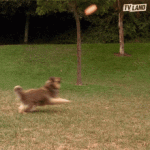
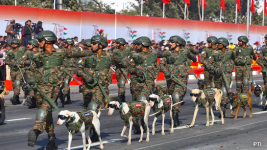
There was no need the dogs in the sunglasses (check out the parade) did running jumps and took the drones out. If you want a demo of it, here is one;

fetch-dog-catching-frisbee.gif


1769639201502.png

Pakistan may as well strop drone deployment now.
 

Users who are viewing this thread

Back
Top