If Australia switched to EVs, we’d be more reliant on China’s car factories – but wean ourselves off foreign oil

Beijingwalker

VIP Member
Joined
Nov 4, 2011
Messages
92,423
Reaction score
113,148
Reputation
2,099.7
Country of Origin
Country of Residence

If Australia switched to EVs, we’d be more reliant on China’s car factories – but wean ourselves off foreign oil

Published: April 8, 2025 5.17am BST

Australia has huge reserves of coal and gas – but very little oil. Before the 20th century, this didn’t matter – trains ran on local coal. But as cars and trucks have come to dominate, Australia has become more and more reliant on imported oil.

Imports now account for around 80% of total refined fuel consumption, the highest level on record.

If the flow of oil stopped due to war or economic instability, Australia would have about 54 days worth in storage before we ran out. That would be a huge problem.

But as more drivers switch from petrol and diesel to electric cars, this equation will change. We can already see this in China, where a rapid uptake of electric vehicles has seen oil demand begin to fall.

On one level, ending Australia’s dependence on foreign oil makes sense at a time of great geopolitical uncertainty. But on the other, going electric would lead to more reliance on China, now the world’s largest manufacturer of EVs.

Reducing reliance on oil makes clear sense for climate and national security reasons. But going electric has to be done carefully, to ensure Australia isn’t reliant on just one country.

oil tanker sydney harbour.

If the oil tankers stopped, Australia would have just one month of fuel. Ryan Fletcher/Shutterstock

Importing oil makes us vulnerable​

In recent years, almost all of Australia’s refineries have closed. The government spent billions keeping the Geelong and Brisbane refineries open, as well as other fuel security measures, such as boosting domestic fuel reserves and building more storage.

The last two refineries rely on imported crude oil, as Australian oil from the North-West Shelf largely isn’t suitable for local refining.

As a result, Australia is more reliant than ever on importing fuels from large refineries in Asia such as South Korea, Singapore and Malaysia. In 2023, around 45,000 megalitres of fuel were imported from these nations.

Almost three-quarters (74%) of these liquid fuels are used in transport, across road, rail, shipping and air transport. But road transport is the big one – our cars, trucks and other road vehicles use more than half (54%) of all liquid fuels.

This reliance presents clear energy security risks. If war, geopolitical tension, economic turmoil or price volatility slows or stops the flow of oil, Australia’s cities and towns would grind to a halt.

In January, Australia had 30 days worth of petrol. Our stores of all types of oil are a bit higher, at 54 days worth. But that’s still well short of the 90 days the International Energy Agency (IEA) requires of member nations.

Electricity made locally​

Shifting to electric vehicles promises cleaner air and far lower ongoing costs for drivers, as electricity is much cheaper than petrol or diesel and maintenance is far less.

But there’s another factor – the energy source. Australia’s electricity is all produced and consumed inside its borders, using local resources (sun, wind, water, coal and gas).

In this respect, electric vehicles offer much greater energy security. A war in the Middle East or a trade war over tariffs would not bring Australia to a halt. This is one reason why China has so aggressively gone electric – to end its soaring dependence on foreign oil.

Mainstreaming EVs in Australia will mean accelerating production of renewable electricity further so we can power not just homes and industry but charge cars, trucks and buses, too.

Doing this would boost our energy security, break our dependency on imported oil and drive down emissions.

EV manufacturing is expanding rapidly with more models, lower purchase prices, improved battery charging times and increasing consumer adoption.

Globally, over 17 million EVs (battery and plug-in hybrids) were sold in 2024, including 91,000 battery and 23,000 plug-in hybrids in Australia.

IEA data shows electric vehicles are already reducing oil demand globally, as are electric bikes and mopeds.

Ending our dependence on oil will be slow. Australia Institute research estimates 8% of imported fuels could be replaced by local electricity once EVs make up 25% of the passenger car fleet. At 100% EVs, we would reduce oil demand by 33%.

The other two-thirds of demand is largely from trucks, planes and ships. Electric trucks are coming, but the sector isn’t as mature as electric cars. It’s a similar story for planes and cargo ships.

woman hand charging electric car.

All electricity in Australia is produced locally. For transport, that’s a boon to energy security. Marian Weyo

Energy security and EVs​

Australia doesn’t manufacture EVs at scale. As a result, we import EVs from the top manufacturing nations. China is far and away the leader, building 80% of Australia’s new EVs.

Australia is a major producer of critical minerals essential to the manufacture of EVs, as well as other green technologies such as lithium, cobalt and nickel. But China dominates much of the global supply chain for refining these minerals and manufacturing batteries.

There’s a risk in relying largely on one country for EVs, especially given the present geopolitical instability.

cars and a car transporter ship.

Australia’s EVs are imported from the top EV nation China and other suppliers. Rangsarit Chaiyakun/Shutterstock

Balancing security and sustainability​

EVs unquestionably offer large benefits for Australia’s energy security by steadily reducing our reliance on imports from volatile global oil markets.

But this has to be balanced with other security concerns, such as a heightened reliance on China, as well as the privacy and security risks linked to data collection from digitally connected EVs.

A balanced approach would see authorities emphasise energy independence through renewables and strong support for vehicle electrification through legislative and regulatory frameworks.

Under this approach, policymakers would work to diversify supply chains, strengthen cybersecurity and encourage local manufacturing of EV components.

This approach would reduce new security risks while unlocking the environmental and economic benefits of widespread EV adoption.
 
Australia is a sparsely populated continent sized country

85% of its population lives just in 6 cities
Ie Sydney, Melbourne, Adelaide, Perth, Brisbane, Canberra.

EVs while good for Daily commute , are not suitable for intercity travel.

Mainly due to lack of Charging Infrastructure on Highways , Even the time taken to charge these vehicles could exceed 1 hr with fast charging, compared to Gasoline, which could provide a 500km range from 2 minutes of Refueling
 

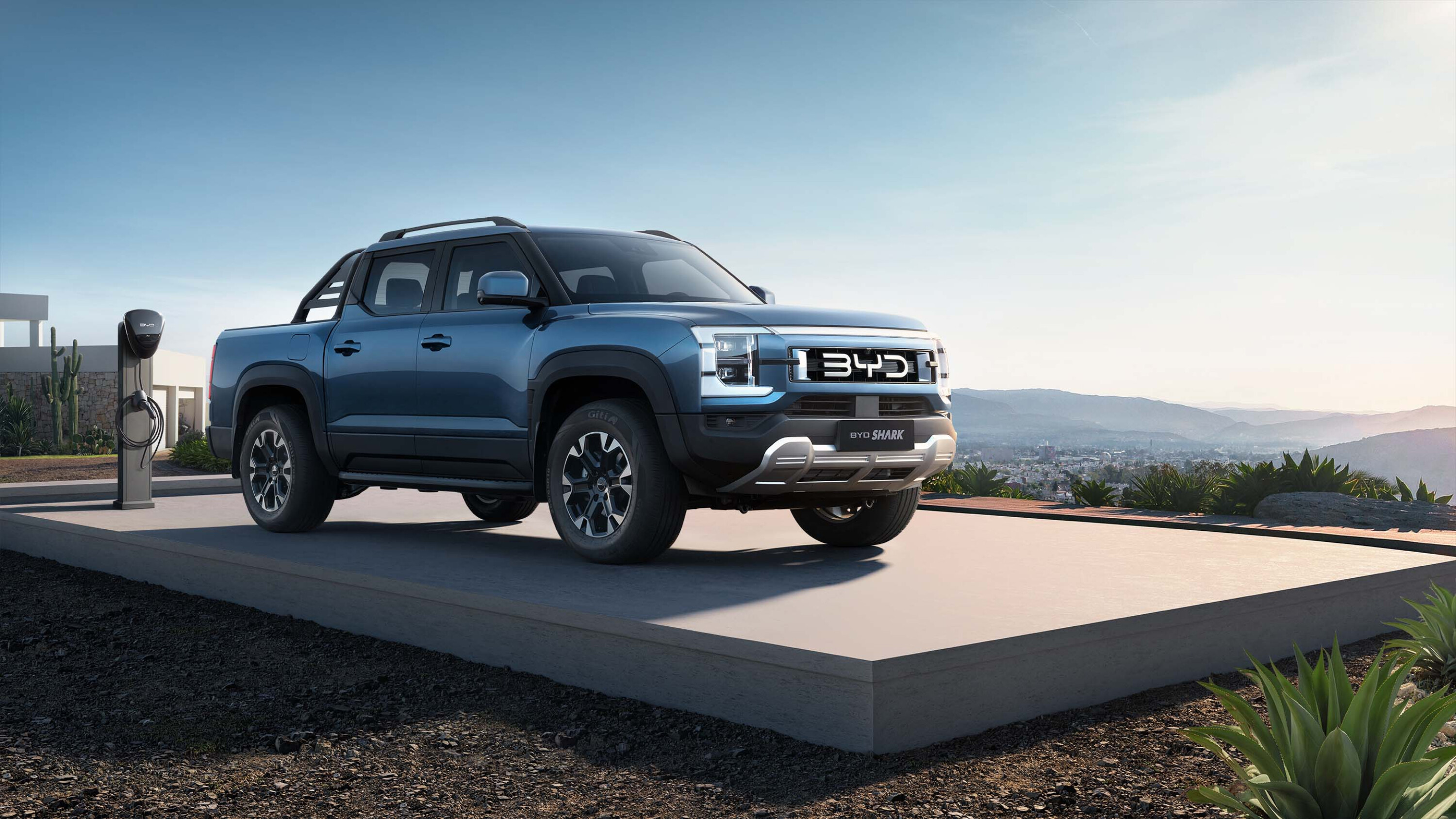
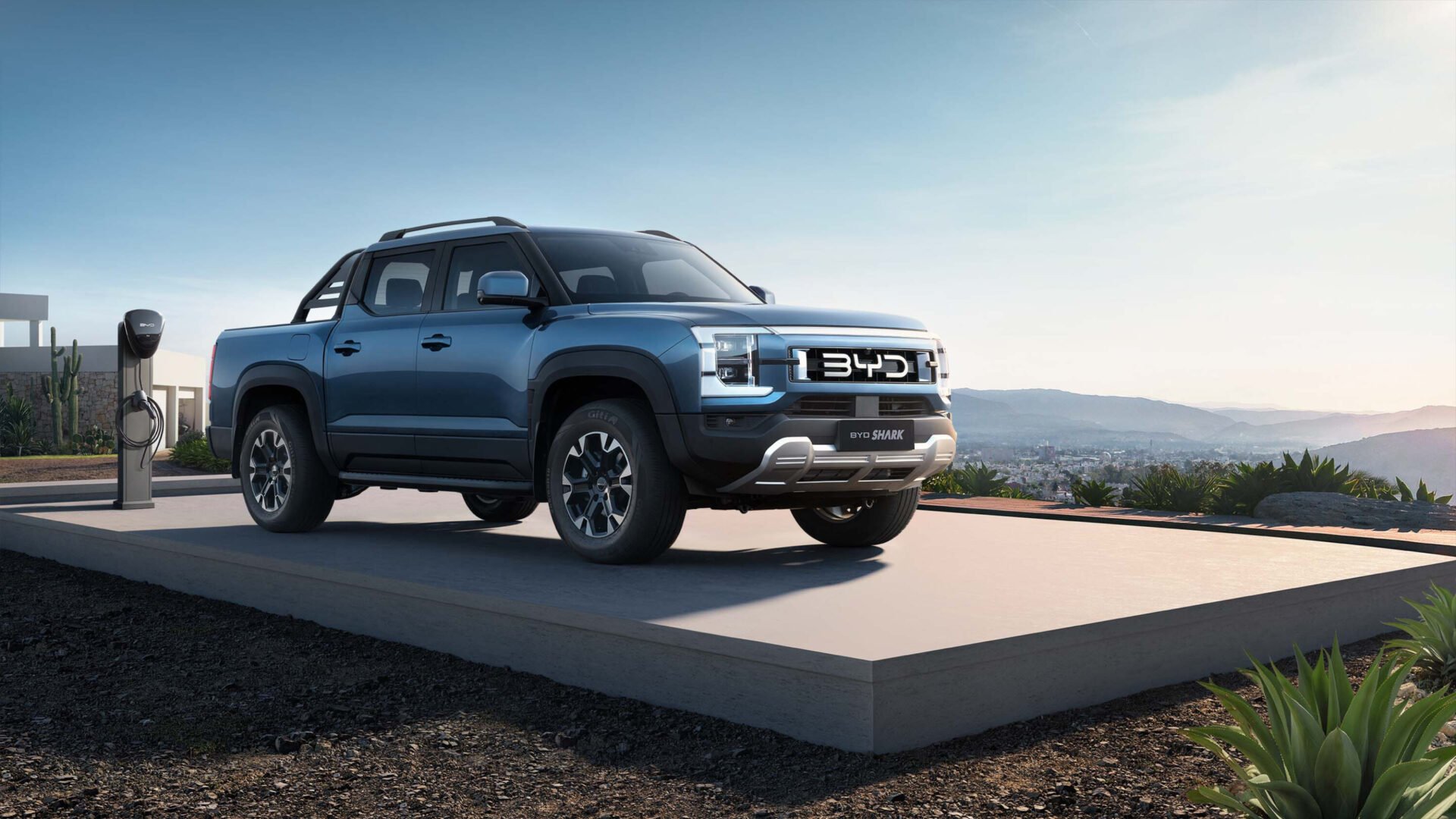
BYD is celebrating back-to-back record sales months in Australia with 4,811 vehicles sold in March thanks to new product like the Sealion 7 electric SUV and Shark 6 PHEV ute.

According to VFACTS, Australia’s national vehicle sales report, the brand’s 4,811 sales result marks a 100 per cent increase in year-on-year figures and a big increase on the 3,281 sales of the month before it.

In particular, the new Shark 6 plug-in hybrid ute sold strongly with 2,810 registrations or 58 per cent of the company’s March sales with buyers taking delivery before the FBT exemption on plug-in hybrids ended on April 1.

4886733b-2025-byd-shark-plug-in-hybrid-ute-04-1920x1080.jpg
 
There is no urgent need for EV as there is enough oil to last 10,000 years
Simply planting more trees , will fix any climate issues

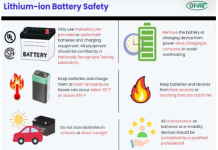
Driving cars with "Acid filled" batteries are quite a danger for vehicle drivers, imagine all that acid getting into rivers and sea , if EV becomes mass scale
 
Acid filled batteries , and driving do not mix
Human flesh , if the acid hits the skin

a) Fires
b) Chemical injuries
c) Batteries can cause fires in extreme weather environments

Car accidents are quite common on roads

To view this content we will need your consent to set third party cookies.
For more detailed information, see our cookies page.


Where do the dead batteries end up ? Rivers or Sea in countries where laws are lean on monitoring waste products, impact PH level of river and seas , or eco systems where sea plants grow
 
Last edited:
There is no urgent need for EV as there is enough oil to last 10,000 years
Simply planting more trees , will fix any climate issues

Driving cars with "Acid filled" batteries are quite a danger for vehicle drivers, imagine all that acid getting into rivers and sea , if EV becomes mass scale

Climate change is a liberal hoax born out of mental psychosis.
 
Just fad don't get your bum burned by EV battery

Forget about the ads where people dressed in angelic white robe driving EV, Claiming solving climate issues with dangerous batteries

1744114260017.png


How common are road accident ?
  • Very common
 
Last edited:

Australia's EV Sales 2025: Complete Year in Review

2025 marked a turning point for electric vehicles in Australia. EVs surpassed 13% of total car sales for the first time, signalling a continued shift in buyer preferences towards electric options.

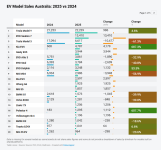
Australia sold 156,857 electrified vehicles in 2025, combining 103,355 battery electric vehicles (BEVs) and 53,502 plug-in hybrid electric vehicles (PHEVs). This represents a 38.7% increase from 2024's total of 113,419 electrified vehicles.

BEVs grew 14.1% year-over-year, while PHEVs exploded with 134.5% growth. Together, electrified vehicles captured 13.1% of the total market, up from 9.5% in 2024.

The broader market grew just 0.9% to 1,195,999 total vehicles. Traditional fuel types showed clear decline. Petrol sales dropped 10.2% to 475,434 units. Diesel fell 1.1% to 364,555 units. Only hybrids and electrified vehicles posted gains, with conventional hybrids up 14.2% to 199,153 units.

Top-Selling EVs of 2025​


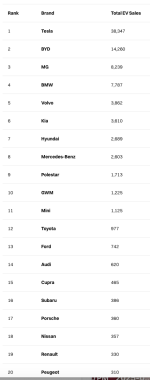
1770700601076.png1770700565265.png


BYD’s Australian surge continues​

Feb 9 2026 - 6:21 am PT

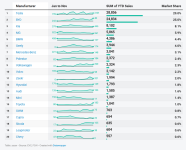
According to data from the Federal Chamber of Automotive Industries, BYD sold 5,001 vehicles in Australia in January, a staggering 641% increase year-over-year, outselling Tesla by a factor of 10. Tesla, meanwhile, dropped to 24th place with just 501 sales, down 32% from January 2025.

The numbers reflect a dramatic shift in Australia’s EV landscape. Just last year, we reported how BYD was closing in on Tesla’s lead in Australia, with the gap narrowing through 2025. By May, BYD had taken control of the Australian EV market with the Sealion 7 becoming the country’s best-selling EV.

Now the dominance is clear. BYD’s January haul was led by the Sealion 7 (1,171 sales) and Atto 2 (562 sales), neither of which existed in the Australian market a year ago. The company’s aggressive pricing strategy, including launching the first sub-$30,000 EV in Australia with the Dolphin, is paying dividends.

Tesla’s weak January is partly explained by stock constraints following a solid December, similar to patterns we’ve seen in other markets. But even accounting for monthly fluctuations, it is still down more than 30% over the same period last year. The trend is unmistakable.

Four Chinese brands now sit in Australia’s top 10: BYD (6th), GWM (7th), Chery (9th), and MG (10th). Together, Chinese-made vehicles added 8,014 sales compared to January 2025, more than offsetting declines from established brands like Toyota.

Overall, EVs hit 7,409 sales in January, up 93.3% year-over-year, now accounting for 8.4% of Australia’s new car market. And that growth is coming almost entirely from brands that aren’t Tesla.

This follows BYD’s global victory over Tesla in 2025, when the Chinese automaker outsold Tesla in pure battery-electric vehicles for the first time on an annual basis.
 
Last edited:
avatr12 is coming this year to australia. its definitely in my top 3 cars to buy. All australians forsee Chinese EV completely taking over in the next 5-10 yrs.

Remember as BYD etc use its Thailand ports to export right hand drive vehicles to Australia. Much of Australia cars are imported from Thailand however all of those cars are Chinese brand cars.
 
avatr12 is coming this year to australia. its definitely in my top 3 cars to buy. All australians forsee Chinese EV completely taking over in the next 5-10 yrs.

Remember as BYD etc use its Thailand ports to export right hand drive vehicles to Australia. Much of Australia cars are imported from Thailand however all of those cars are Chinese brand cars.
Watch out the Aussies might follow American footsteps to ban Chinese EVs in the coming years as they are most loyal bunch to American agendas on China. That's a possibility despite its cousin Canada is taking a different route than US to import some Chinese EVs. Aussies usually listen to American whims and desperately want to be in US led white club. The latest anti-China move by Aussies is they want to take back Darwin port that is on a lease of 99 years to China because of American wish. So you can see what they likely to do to Chinese EVs if pressured by US.
 
Watch out the Aussies might follow American footsteps to ban Chinese EVs in the coming years as they are most loyal bunch to American agendas on China. That's a possibility despite its cousin Canada is taking a different route than US to import some Chinese EVs. Aussies usually listen to American whims and desperately want to be in US led white club. The latest anti-China move by Aussies is they want to take back Darwin port that is on a lease of 99 years to China because of American wish. So you can see what they likely to do to Chinese EVs if pressured by US.
Australia has changed in the sense that it has gone the European route and traditional parties (left vs right) who dealt with china before are being replaced by far left and far right parties (thanks to mass indian migration).

Good news is the far left party and the current party which is still left wing is more favourable to China and seems to remain in power with alliance with far left party. This means that Chinese cars should remain and increase for the forseeable future.

Australia always had large Chinese community (traditionally largest non white community) and most Australians don't actually care at all about China. They did a vote on the street and most Aussies wouldn't think twice about buying chinese car
 
  • Like
Reactions: ety
There is no way Australia will become EV dominant, that's regardless of where they came from. There are just too vast and too long to travel, unless you had 1000km range EV, that's not going to happen.

Most Australians are still buying petrol cars, almost 5 to 1 to EV, even when we are supposed to be phasing out ICE engines in 2030, which is 4 years away. You are talking about at least post -2050 to be EV dominant, and a lot of that would not be Chinese EV
 

Users who are viewing this thread

Country Watch Latest

Back
Top