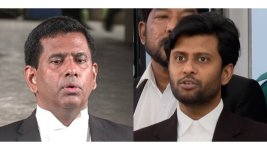
ICT prosecutor raises corruption allegations against Tajul, Tamim

MNZGamerX

Registered Member
Joined
Dec 12, 2023
Messages
1,751
Reaction score
1,908
Reputation
936.0
Country of Origin
Country of Residence
compilation II (57).jpg

Star Online Report

A prosecutor of the International Crimes Tribunal has raised serious allegations of corruption and irregularities against Tajul Islam, the immediate past chief prosecutor of the court, and fellow prosecutor Gazi Monawar Hossain Tamim.

In a Facebook post yesterday, Prosecutor BM Sultan Mahmud alleged a series of irregularities, including money exchanges and questionable handling of high-profile cases.

According to the post, in late November last year, the wife of Abzal, an accused in the case over the killing and burning of six bodies in Ashulia, entered Tamim’s room in the evening carrying a heavy bag.

“After noticing the matter, we immediately went to Tajul Islam’s room and informed him. No action was taken; instead, we were scolded,” Sultan alleged.

He further claimed that Tamim later admitted in front of others that Abzal’s wife had visited his office. “The chief prosecutor only asked why the accused’s wife had gone to his room. The matter ended there,” he said.

Sultan alleged that Abzal was later made a state witness and eventually acquitted in the final verdict.

He also raised concerns over the Chankharpul case, in which law enforcers opened fire on protesters, killing at least six people. Sultan claimed that despite a video clip showing Sub-Inspector Ashraful instructing others to open fire, he was made a witness instead of an accused. “I have that video. Anyone can see it if needed,” he said.

He further questioned why Assistant Police Commissioner Al Imran Hossain was reportedly relieved from the Abu Sayed killing case in Rangpur, alleging that several witnesses had mentioned Imran’s name before the court.

Sultan also alleged that former IGP Chowdhury Abdullah Al-Mamun was made a state witness without justification. “Under his direct instructions, his force emptied the laps of hundreds of mothers,” he said.

“Not only IGP Mamun, but in the Ashulia case, Abzal was also made a state witness in exchange for money. A syndicate of three or four people has been involved in this cycle from the beginning,” he alleged.

He further claimed that “Tajul and Shishir Monir’s syndicate” allowed notorious police officers, including the IGP, to evade trial and turned the chief prosecutor’s office into a money-making tool.

“Are these not acts of corruption? Is this not a betrayal of the blood of the martyrs?” he asked.

When asked about the allegations at a press conference yesterday, Tajul Islam said, “These are personal allegations, of which I have no knowledge. We have investigated such claims, and they are completely false. It is unfortunate if anyone spreads such stories out of personal malice.”

“The tribunal’s proceedings have been fully transparent and proven in court. Anyone making false accusations with dishonest intent should remember that the entire nation, along with the media, has witnessed how transparently the trials have been conducted,” he added.

Prosecutor Gazi Monawar Hossain Tamim told The Daily Star, “These allegations have been made against me out of personal malice. I serve as a prosecutor administrator, and many people visit my office every day. I firmly state that no one can prove any accusation against me.”

Supreme Court lawyer Mohammad Shishir Manir expressed surprise at the allegations, calling them “incredible and whimsical, based on surmise and conjecture”.

“If my learned friend has any credible information, he can disclose it to the public. I am always ready to face any credible allegation,” he said.

Asked whether he would investigate the corruption allegations, newly appointed Chief Prosecutor Aminul Islam said he would act if he received a formal complaint.

“Today is not the day for such queries,” he said.
 
What we are seeing now in Bangladesh under the BNP government is a dismantling of the Jamaati power structures created under the Interim Government, so the removal of senior army officers including head of DGFI, resignation of university deans and the replacement of the ICT Chief Prosecutor indicates that a crack down has begun.

The problem is that TR appears to be guided by RAW, army top brass and a faction of the Choton gang ... What the 2024 uprising was meant to abolish or hinder has now made a comeback and the so-called revolution is now dead. This is entirely the fault of the Jamaat and NCP. They just didn't listen.
 
Last edited:
Well what you can misinformation and conspiracy theories turned out to be true. It is you who remain blinkered as you still have wet dreams of the Jamaat coming to power. I have been far more accurate about what is happening in Bangladesh then the bloody Jamaatis on this forum who just can't get off their high horse and admit that they are complete morons and have no intellectual depth or intelligence and that it is really better that they keep their mouths shut.

On a serious note!

What I hope will happen is that we end up with two non-dynastic parties: one secular nationalist like the Young Turks. And the other like the current Indonesian ruling party.

That would cater for the vast majority of the population.

Bangladeshis do not want Islamist (using the state and/or its agents to enforce religion) parties.

Jamat cobbled together an unholy alliance to crawl to a 1/3 of the votes. In the absence of BAL - they took advantage of dynastic rivalries - to gain votes.

If BAL and BNP were head to head - Jamat wouldn’t even get 10%. That’s why they are desperate to keep BAL out.
 
What I hope will happen is that we end up with two non-dynastic parties: one secular nationalist like the Young Turks. And the other like the current Indonesian ruling party.

It is certainly a possibility and the AL may be on the way to that as even if the AL were to make a comeback it cannot be with members of the Sheikh family who are all implicated in the last regime. The same could happen in the BNP but there would need to be something similar to happen as in 2024. For a while that might leave the door open for the Jamaatis but more likely the military will need to take over in a transitionary period till things settle down. If there were two non-dynastic parties that would probably be good for the country.

Bangladeshis do not want Islamist (using the state and/or its agents to enforce religion) parties.

Yes the Jamaat's main failure was it could not become broad based enough like the AKP and could not appeal to the majority so relied on anti-Indian and anti-AL sentiment but that could only get it so far.

Jamat cobbled together an unholy alliance to crawl to a 1/3 of the votes. In the absence of BAL - they took advantage of dynastic rivalries - to gain votes.

If BAL and BNP were head to head - Jamat wouldn’t even get 10%. That’s why they are desperate to keep BAL out.

I was always opposed to the Jamaat joining hands with the secretive and notorious Choton gang to gain power and it was the betrayal of a faction therein that led to the crashing defeat. The JI also relied too much on American and Pakistani support thinking that was enough to get it a majority. It's campaign for the whole 18 months was wholly negative, manipulative, abusive, deceitful and duplicitous. Without the AL not being on the scene the Jamaat got a bump but that will dissipate over time even if the AL is not there. If the AL were to make a return as a non-dynastic party then it would be all over for the JI unless they can fundamentally change their tactics, methods and perspectives.
 
India is still very much behind the AL but will likely not tolerate a Hasina return or members of her family. If she is being slow poisoned then that is part of the plan but the outlook still doesn't look good for the Jamaatis.

AL without Hasina or Sheikh family is just a headless chicken. Being behind AL and not tolerating Hasina or her family is contradictory.
 
AL without Hasina or Sheikh family is just a headless chicken. Being behind AL and not tolerating Hasina or her family is contradictory.

That may be so but stranger things have happened. In any case, as I mentioned earlier the AL is making a comeback -

Flags up, doors locked: Is the Awami League quietly re-emerging in the new political space?

The interim Yunus government barred all Awami League activities pending trials for crimes against humanity; yet after the election, activists began reopening party offices across the country
awami-league-office-bb-avenue-050824-19-1724009988.jpg

Kazi Mobarok Hossain
bdnews24.com
Published : 25 Feb 2026

Even at its quietest, the Awami League has never been absent from Bangladesh’s political consciousness.

Resented by some, missed by others, but never entirely erased from public life.

During the election, the party’s operations were frozen under interim measures; yet, the day after the polls, offices reopened across the country, sparking widespread debate.

The question lingers: are these moves directed by party leadership, or are activists spontaneously asserting themselves in a reshaped political landscape?

Nearly 18 months after the party was ousted and the Yunus interim government took power, Awami League activists are re-emerging -- quietly and purposefully.

From Prohibition to Reactivation

On May 10 last year, following a wave of protests, the interim government issued a formal ban on all activities of the Awami League and its allied organisations.

Party registration was suspended, effectively blocking participation in elections.

• The student wing, Bangladesh Chhatra League, had been previously banned as a “terrorist organisation”.

• Subsequent attempts by leaders and activists to stage protests were sporadic and limited.

• Reopening offices or hoisting the national flag remained unseen until now.

The Yunus government formally stepped down after holding a parliamentary election and a public vote on Feb 12. Reports suggested that the Bangladesh Nationalist Party (BNP) and the Jamaat-led Islamic alliance sought to attract Awami League voters.

With a clear majority, the BNP formed the government, while Jamaat assumed opposition seats, achieving the largest non-BNP parliamentary presence in history with 68 seats.
dhanmondi-32-050824-1-1722858211.jpg

Local Activism: Offices Reopen

Panchagarh: The morning after the BNP victory, on Feb 13, a sealed Awami League office in Sadar Upazila was reopened.

A 1-minute-35-second video circulating on Facebook shows the union office lock being removed in the presence of local BNP leader Abu Daud Pradhan.

The union Awami League’s Joint Secretary Kamruzzaman addressed party activists, saying: “At this first moment, Abu Daud Pradhan has freed our Chaklaha Union Awami League, the organisation close to our grassroots, allowing us to act once more.”

Thakurgaon: On Feb 15, Pirgonj Upazila Awami League office was reopened, flags hoisted, national anthem sung, and slogans raised by party workers.

This area falls under Thakurgaon-3, where BNP’s Md Zahidur Rahman defeated Jamaat’s candidate.

Barguna: On Feb 16, Betagi Upazila’s office saw Chhatra League and Jubo League activists cleaning the premises, offering prayers for Bangabandhu Sheikh Mujibur Rahman and Sheikh Hasina.

Chhatra League Secretary Sifat Sikdar said, “A democratically elected government is in place. Our party was not allowed to contest, but we hope political space under this government will be better than under an unelected regime. That is why we reopened our office.”

Similar reopenings occurred nationwide almost daily, though some offices faced immediate attempts at seizure or arson.

madaripur-al-office-220226-01-1771772857.jpg

Spontaneity over Instruction

The Yunus government had barred all activities of the Awami League and its affiliates under allegations of “extrajudicial killings, abduction, inhumane torture, arson, terrorism, and crimes against humanity”.

• The prohibition came into effect May 10, formally gazetted May 12.

• Many offices were attacked, looted, or abandoned.

• Following the BNP victory, grassroots activists report that reopening was initiated independently, without direct orders from party leadership.

On Friday, Pabna district leaders of the Awami League gathered abruptly, entered the party office, and raised slogans.

Asked whether the move had instructions from higher command, Pabna district Chhatra League former publicity secretary Towsikur Rahman said: “We collectively discussed and agreed to reopen the office. It was a spontaneous initiative involving the Awami League, Chhatra League, and Jubo League members.

“We entered, hoisted the national flag, and paid tribute to Sheikh Mujibur Rahman and the martyrs of the Liberation War.”

Some offices immediately faced arson attempts, but rapid mobilisation of activists and protests on main streets prevented further escalation.

“Those who set fires were unknown individuals aiming to create panic. BNP and Jamaat leadership had no involvement,” Towsikur said.

Pabna-5, recently won by the BNP’s Shamsur Rahman Shimul Biswas, saw police visit the homes of Chhatra League and Jubo League leaders multiple times, with arrests already made, though activists say they remain resolute.

• Madaripur: On Feb 17, Kalkini Upazila office reopened with cake-cutting and slogans led by student leaders.

• Gopalganj: In Kashiani, activists hoisted the national flag; videos circulated widely online.

bulldozer-dhanmondi-32-060225-102-1738803709.jpg

Dhaka and Central Offices

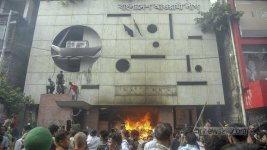
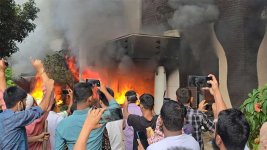
Following the mass uprising, central Awami League offices across Gulistan and Dhanmondi, along with the Muktijuddho-era Sheikh Mujib residence-turned-museum, suffered arson and vandalism.

The Tejgaon office endured a similar fate.

• On Feb 14, a small group restored flags and paid homage outside the central office.

• On Feb 16, Jubo Mohila League activists placed flags and portraits at Dhanmondi 32, the former home of Sheikh Mujib, saying the political climate now allowed such activity.

Awami League Joint General Secretary AFM Bahauddin Nasim said, “After the interim government’s exit, activists feel a sense of relief. They believe a peaceful environment will return.

“They are visiting their offices, paying respects at historic party sites, and placing flowers and flags -- all spontaneously.”

Perspectives on Legality and Political Rights

Local BNP leaders have largely refrained from commenting, though they confirmed that some party activists had been arrested during searches.

A BNP student leader, speaking anonymously, said: “There was no party directive to open offices. Activists acted openly once the BNP formed the government.”

He said the party had no organisational directive opposing it.

BNP leaders say the issue will be addressed through legal channels.

Secretary General Mirza Fakhrul Islam Alamgir said, “The party was not in favour, but any action will be considered according to the law.”

Permanent Committee member Abdul Moyeen Khan added, “We believe in multi-party democracy and parliamentary democracy. The BNP is a liberal party; we do politics inclusively and reject revenge politics.”

Immediate-past inspector general of police Baharul Alam instructed police to prevent prohibited parties from acting unlawfully, saying: “Any attempts to create disorder must be legally addressed.”

After months of prohibition, attacks, and political upheaval, the reopening of offices suggests that Awami League activists are testing the limits of political space under the new government.

Grassroots leaders describe the reopening of offices as both a practical step and a symbolic return to political activity, paying tribute to historical figures and party heritage.

The cautious yet determined activism signals that, while the era of “mob” violence may be over, the political life of Bangladesh remains charged, resilient, and deeply connected to its historical roots.

Whether this marks the beginning of a broader political reactivation remains an open question in Bangladesh’s shifting political landscape.

 
That may be so but stranger things have happened. In any case, as I mentioned earlier the AL is making a comeback -

So basically, the evidence behind your claim is "stranger things have happened". Sounds convincing!
 
View attachment 180639

Star Online Report

A prosecutor of the International Crimes Tribunal has raised serious allegations of corruption and irregularities against Tajul Islam, the immediate past chief prosecutor of the court, and fellow prosecutor Gazi Monawar Hossain Tamim.

In a Facebook post yesterday, Prosecutor BM Sultan Mahmud alleged a series of irregularities, including money exchanges and questionable handling of high-profile cases.

According to the post, in late November last year, the wife of Abzal, an accused in the case over the killing and burning of six bodies in Ashulia, entered Tamim’s room in the evening carrying a heavy bag.

“After noticing the matter, we immediately went to Tajul Islam’s room and informed him. No action was taken; instead, we were scolded,” Sultan alleged.

He further claimed that Tamim later admitted in front of others that Abzal’s wife had visited his office. “The chief prosecutor only asked why the accused’s wife had gone to his room. The matter ended there,” he said.

Sultan alleged that Abzal was later made a state witness and eventually acquitted in the final verdict.

He also raised concerns over the Chankharpul case, in which law enforcers opened fire on protesters, killing at least six people. Sultan claimed that despite a video clip showing Sub-Inspector Ashraful instructing others to open fire, he was made a witness instead of an accused. “I have that video. Anyone can see it if needed,” he said.

He further questioned why Assistant Police Commissioner Al Imran Hossain was reportedly relieved from the Abu Sayed killing case in Rangpur, alleging that several witnesses had mentioned Imran’s name before the court.

Sultan also alleged that former IGP Chowdhury Abdullah Al-Mamun was made a state witness without justification. “Under his direct instructions, his force emptied the laps of hundreds of mothers,” he said.

“Not only IGP Mamun, but in the Ashulia case, Abzal was also made a state witness in exchange for money. A syndicate of three or four people has been involved in this cycle from the beginning,” he alleged.

He further claimed that “Tajul and Shishir Monir’s syndicate” allowed notorious police officers, including the IGP, to evade trial and turned the chief prosecutor’s office into a money-making tool.

“Are these not acts of corruption? Is this not a betrayal of the blood of the martyrs?” he asked.

When asked about the allegations at a press conference yesterday, Tajul Islam said, “These are personal allegations, of which I have no knowledge. We have investigated such claims, and they are completely false. It is unfortunate if anyone spreads such stories out of personal malice.”

“The tribunal’s proceedings have been fully transparent and proven in court. Anyone making false accusations with dishonest intent should remember that the entire nation, along with the media, has witnessed how transparently the trials have been conducted,” he added.

Prosecutor Gazi Monawar Hossain Tamim told The Daily Star, “These allegations have been made against me out of personal malice. I serve as a prosecutor administrator, and many people visit my office every day. I firmly state that no one can prove any accusation against me.”

Supreme Court lawyer Mohammad Shishir Manir expressed surprise at the allegations, calling them “incredible and whimsical, based on surmise and conjecture”.

“If my learned friend has any credible information, he can disclose it to the public. I am always ready to face any credible allegation,” he said.

Asked whether he would investigate the corruption allegations, newly appointed Chief Prosecutor Aminul Islam said he would act if he received a formal complaint.

“Today is not the day for such queries,” he said.

TR is rewarding his party loyalists. I see nothing wrong with it.
Jamat would have done the same if they came into power.
 
TR is rewarding his party loyalists. I see nothing wrong with it.
Jamat would have done the same if they came into power.

Party loyalists like him who were not victims under the AL regime. No as many have already explained the changes in the army, DGFI, universities and courts indicates a weeding out of Jamaati inclined people and that a faction of the Choton gang have prominence in this administration indicates an Indian RAW, army and Deep State influence.
 

Users who are viewing this thread

Pakistan Defence Latest

Latest Posts

Back
Top