Operation Ghazab Lil Haq (Pakistan - Afghanistan War)

CDF Munir says all necessary measures to be taken for neutralising threat from Afghan border​

Says peace with Kabul contingent on Afghan Taliban forsaking terrorist support


Chief of Defence Forces (CDF) and Chief of the Army Staff Field Marshal Syed Asim Munir on Wednesday termed the use of Afghan soil by the Fitna al Khawarij and Fitna al Hindustan for terrorism against Pakistan “unacceptable”, warning that all necessary measures would be taken to neutralise the threat emanating from across the border.

A press release from the Inter Services Public Relations (ISPR) said that the field marshal visited Wana in South Waziristan to review the prevailing security situation and operational preparedness along the Western border.

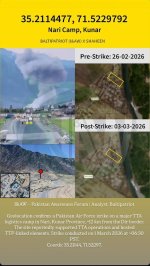
Pakistan is currently waging 'Operation Ghazab Lil Haq' that was launched late on Thursday after renewed clashes along the Pakistan-Afghanistan border, when Afghan Taliban forces fired on multiple locations, prompting swift military retaliation. The neighbours have clashed along the frontier since last week, when Afghanistan launched a border offensive in response to Pakistani air strikes.

The ISPR said the field marshal was given a comprehensive briefing on the security environment, ongoing intelligence-based operations and measures in place for border management. He was also briefed in detail on the ongoing operation and recent developments along the Pakistan-Afghanistan border.

"The field marshal emphasised that use of Afghan soil by Fitna al Khawarij and Fitna al Hindustan for acts of terrorism against Pakistan was unacceptable and all necessary measures would be taken to neutralise the threat emanating from across the border. The field marshal reiterated that peace could only prevail between both sides if the Afghan Taliban renounced their support for terrorism and terrorist organisations," the ISPR said.


Fitna al Khawarij is a term the state uses for terrorists belonging to the banned Tehreek-e-Taliban Pakistan (TTP) while Fitna al Hindustan is a term designated by the state for terrorist organisations in Balochistan.

Interacting with officers and troops deployed in forward areas, CDF Munir commended their "professionalism, operational vigilance and high morale" during the ongoing skirmishes. He also lauded their steadfast commitment to safeguarding the country's sovereignty and ensuring peace and stability in the region.


Appreciating the Pakistan Army’s operational preparedness, the field marshal expressed full confidence in the combat readiness, synergy and resilience of formations deployed along the Pakistan-Afghanistan border.

Read: 481 Afghan Taliban killed, 226 checkposts destroyed as Operation Ghazab Lil Haq enters seventh day

CDF Munir was received upon arrival by the Peshawar Corps commander. He also laid a floral wreath at the Martyrs Monument to pay homage to those who had sacrificed themselves for the country. He offered prayers and reaffirmed that the sacrifices of martyrs remained the cornerstone of Pakistan’s security and resilience.

On Monday, a senior Pakistani security official said that “Operation Ghazab Lil-Haq” would continue until the Afghan Taliban government provided a guarantee that it would stop facilitating terrorist groups targeting Pakistan.

The official said the Afghan Taliban “will have to decide whether they stand with Pakistan or with the terrorist groups operating from their soil”.

So far, Pakistani security forces have killed 481 Afghan Taliban combatants and destroyed 226 checkposts during the operation. More than 696 Afghan operatives were injured, 198 tanks and armoured vehicles were destroyed, 35 Afghan posts were captured, and 56 locations across Afghanistan were successfully targeted in air strikes.

Islamabad said its February air strikes that sparked the escalation were targeting terrorists. Islamabad accuses Afghanistan of failing to act against terrorist groups that carry out attacks in Pakistan, a claim the Taliban government rejects. The border fighting has affected multiple Afghan provinces.

Also Read: PM briefs parliamentary leaders on regional tensions, Pakistan’s foreign policy stance

The violence of recent days is the worst since the October fighting that killed more than 70 people on both sides, with land borders between the neighbours largely closed since.

Tensions also surged after a series of explosions in Kabul on October 9 last year. Taliban forces subsequently targeted areas along Pakistan’s border, prompting Islamabad to respond with cross-border shelling. The exchanges caused casualties and infrastructure damage on both sides and led to the suspension of trade after border crossings were closed on October 12, 2025.
 
That are they post setup, in such a way that if one os overriun, the others will be able to cover ingress routes into Pakistan;
I don’t know if there is formal coverage or more of a tribal knowledge type scenario.
 
I think if foreign nations are trying to force an end to the war — not sure how true the claims are — then every useful military structure or one that contributes should be struck in Afghanistan before a ceasefire. Let them walk around in the desert with sandals at least.

But there will not be any diplomatic solution ever, these animals would rather die than have peace with Pakistan and if you are smart it's easier to acknowledge that and give it to them
 
I think if foreign nations are trying to force an end to the war — not sure how true the claims are — then every useful military structure or one that contributes should be struck in Afghanistan before a ceasefire. Let them walk around in the desert with sandals at least.

But there will not be any diplomatic solution ever, these animals would rather die than have peace with Pakistan and if you are smart it's easier to acknowledge that and give it to them
China and Turkey have offered to mediate. Pakistan shouldn't stop until our objectives are competed.
 
This is what our enemies are doing to us — just replace "Kurds" with Afghans and their local puppets (TTP/BLA) — just with the added historical genocidal hatred of Afghans.

They should not be shown any ounce of mercy when it comes to securiry, not on religious or humanitarian grounds. Animals who would harm you any chance they get dont deserve idealistic mercy.

To view this content we will need your consent to set third party cookies.
For more detailed information, see our cookies page.
 

Kabul’s choice


March 4, 2026

EDITORIAL: By now Kabul should understand that Pakistan’s threshold has shifted. The argument is no longer about past strikes or competing casualty claims; it is about what will and will not be tolerated going forward.

Islamabad’s position has been repeated often enough to qualify as doctrine: Afghan territory cannot be allowed to function as a sanctuary for groups that attack Pakistan. If that condition is not met, responses will follow.

The mistake in much of the current commentary is its backward gaze. It recounts October clashes, weekend exchanges, mediation attempts and retaliatory operations. Those episodes matter only to the extent that they reveal a pattern. The pattern is simple.

Dialogue without verifiable enforcement has failed. Assurances without dismantlement have failed. Temporary ceasefires without structural correction have failed.

Looking ahead, the calculus becomes clearer. Pakistan has signalled that cross-border militancy will carry direct costs. This reflects a recalibrated security doctrine in which deterrence is reasserted through visible action.

Islamabad has concluded, finally, that absorbing repeated attacks while awaiting goodwill from Kabul is strategically unsustainable. The domestic cost of inaction now exceeds the diplomatic cost of response.

The Afghan leadership faces an uncomfortable reality. Sovereignty entails responsibility. When armed groups operate from one’s territory against a neighbour that neighbour will eventually act.

Kabul may dispute the scale, timing or necessity of Pakistan’s strikes. What it cannot plausibly deny is that militant networks hostile to Pakistan have continued to function from Afghan soil since the Taliban’s return to power in 2021. That continuity erodes any claim that the matter is exaggerated or episodic.
 
What changes now is the margin for ambiguity. Pakistan is unlikely to accept another cycle in which attacks are followed by talks, talks by fresh attacks and renewed appeals for restraint.

The demand for written undertakings and verifiable action was not procedural pedantry; it was an attempt to anchor accountability. Without monitoring mechanisms and demonstrable dismantling of camps, engagement could become theatre.

There are strategic consequences for Kabul if this impasse persists. Border closures disrupt trade and strain already fragile Afghan economic conditions. Sustained confrontation hardens regional alignments.

International actors urging restraint will eventually expect concrete measures from both sides, and the burden of proof regarding sanctuaries will increasingly fall on the host state. Continued denial without demonstrable counterterrorism action narrows diplomatic space.

For Pakistan, the forward posture must combine firmness with discipline. Military responses can degrade networks and restore deterrence. They cannot substitute for a durable framework. Islamabad’s long-term interest lies in a stable western frontier, not a perpetual theatre of limited escalation. That stability requires clarity from Kabul: either act decisively against groups targeting Pakistan or accept that cross-border responses will remain part of the equation.

The region has entered a phase where patience is measured differently. Escalation is undesirable. Yet passivity in the face of sustained violence is equally untenable.

Pakistan has indicated that it will defend its territorial integrity and citizens without hesitation. The seriousness of that commitment should no longer be in doubt.

The choice before Kabul is therefore strategic rather than rhetorical. It can convert dialogue into enforceable cooperation, backed by verifiable dismantling of hostile networks. Or it can continue a posture that invites calibrated but persistent retaliation. The first path restores predictability. The second prolongs volatility.

Something like the recent cycle cannot be normalised. Not for Pakistan, and not for regional stability. The next phase will be defined less by what has already happened and more by whether Afghanistan moves from assurances to action.

Copyright Business Recorder, 2026
 

Users who are viewing this thread

Pakistan Defence Latest

Back
Top