Iran killed any delusions of US military domination over China

Beijingwalker

VIP Member
Joined
Nov 4, 2011
Messages
91,968
Reaction score
112,942
Reputation
2,153.6
Country of Origin
Country of Residence
Iran killed any delusions of US military domination over China

Not only did today's conflict exacerbate shortages, it also exposed how unprepared we are for a true Great Power war

JENNIFER KAVANAGH
APR 29, 2026

These days, everyone in Washington is talking about U.S. missile stockpiles. The previously niche topic has been thrust onto the front page of major newspapers and is discussed daily on television and radio programming.

And for good reason. After the war in Iran severely depleted U.S. missile reserves, including its most sophisticated air defense and offensive weapons, there are growing questions about the ability of the U.S. military to do what is required to defend U.S. interests, especially in the near-term.

The news gets much worse, however. Not only did the first 40 days of conflict with Iran exacerbate shortages of expensive and exquisite U.S. munitions; they have also shown that the United States is not ready for a major power war.

Though the U.S. military was able to achieve individual tactical successes in Iran, the conflict and its outcome have sharply undercut key principles of U.S. military strategy and raised doubts about the viability of U.S. contingency plans, in particular for a future war in Asia. Moving forward, the United States will need to recalibrate its commitments to better match the realities of modern warfare and the growing limits on U.S. military power.

A war against Iran and one in Asia (over Taiwan for instance) would look different in many ways, especially given that the former is offensive and the latter would most likely be defensive. But there are several notable similarities. First, as in the Middle East, in Asia, the United States would rely heavily on forward bases across the region to launch aircraft and house logistics and combat support capabilities. It would depend on ground-based air defense and a network of radars and sensors to protect those bases and to inform U.S. missile targeting.

Second, in Asia as in Iran, the U.S. military would exploit fighter jets, bombers, and warships using stand-off weapons alongside ground-based missiles to fire at adversary air defenses, radars, and missile launchers. It would also target hostile aircraft and naval vessels including those supporting an amphibious invasion or those setting up a blockade.

Third, in the case of a war over Taiwan, the United States plans to use drones to create a “hellscape” for Chinese forces, preventing their ability to advance through the sea, air, or on the ground. Drones also featured heavily in Iran, with the U.S. military debuting new systems.

The Iran war, fought with a weaker adversary, challenges each of these foundational pillars of the U.S. military strategy for future major power wars, whether against China or otherwise.

Perhaps most importantly, the Iran war casts serious doubt on the utility and viability of U.S. forward bases in a major conflict. After the United States attacked Iran on February 28, U.S. bases across the region were not sources of strength but massive liabilities and easy targets. From the war’s first days, U.S. bases suffered heavy drone and missile attacks and were even reportedly bombed by Iranian fighter jets.

The damage suffered by U.S. bases across the Middle East was staggering. Infrastructure, air defense systems, and ground-based sensors and radars were destroyed. Pricey U.S. aircraft, including refuelers and AWACS early warning jets, were damaged. In fact, bases across the Middle East were so susceptible to adversary attack that U.S. military personnel could no longer operate out of them and were instead forced to work from nearby locations and hotels.

If bases in the Middle East are not defensible, the Pentagon cannot assume that those spread across the Pacific will be either. In fact, many or most may be largely un-usable, especially in the crucial early days of any war.

Another key result in the Middle East that should set off alarm bells across the Pentagon’s senior leadership is Iran’s ability to damage and degrade the sensors and radars that support the U.S. regional air defense network, a military success for Iran that left U.S. bases exposed.

The United States has long relied on ground-based air defense systems to protect U.S. personnel, infrastructure, and assets from adversary missiles. But Iran was able to effectively disable these systems, suggesting that this approach to force protection is entirely insufficient in a world of “precise mass” where even weak adversaries have advanced targeting capabilities. If the U.S. ground-based air defense network could not survive against Iran, it is most certainly inadequate for a war with China.

The U.S. experience against Iran also raises questions about U.S. plans to rely primarily on stand-off weapons to strike Chinese ships and military targets in an Indo-Pacific contingency. Although this strategy evolved as a response to China’s anti-access/air denial capabilities, which will make operating close to the mainland coast impossible, the war in Iran suggests that the stand-off approach may be limited in what it can accomplish.

Although the U.S. military was effective in destroying much of Iran’s air defenses, reports suggest that it was only able to eliminate perhaps 50 percent of the country’s missiles and missile launchers and an even smaller portion of its drone production. Indeed, although Iran’s rate of fire collapsed significantly after the first few days of the war, the United States was never able to fully suppress Iran’s missile fire or stop it from launching drones at U.S. and Gulf state targets. U.S. forces are likely to fare much worse in a campaign to disable China’s missile and drone capabilities, given China’s more advanced air defense and deeper missile arsenal.

Moreover, in this type of contested environment, goals like air superiority and sea control are largely out of reach even for the United States. Although the U.S. military did eventually achieve a degree of air dominance over Iran, this did not eliminate risk to U.S. aircraft. The constraints on U.S. naval power were even more extensive. Not only were U.S. warships forced to operate at a distance from Iranian coasts because of missile and drone threats, but the ability of the U.S. Navy to control the waters off Iran’s coast was limited. The U.S. blockade let through at least as many Iranian ships as it diverted.

In a war in Asia, U.S. warships would face even greater challenges. In a worst case scenario, aircraft carriers and destroyers could be forced to operate beyond the second island chain, reducing their value in a defense of Taiwan or an effort to blockade Chinese ports.

Finally, there is the issue of drones. Iran had the clear advantage here, both in the air and undersea. The United States is far from being competitive in the drone space, let alone ready to create a hellscape for China, one of the industry’s leaders.

The bottom line is that the Iran war has cast a spotlight on the flaws and weaknesses in U.S. military strategy, both in general and specifically as it pertains to contingencies in Asia. The United States has for decades assumed that its forward bases will be defensible and that power projection assets such as bombers, aircraft carriers, and fighter jets will allow the United States to prevail in military contests even far from home.

It has assumed that it can dominate the air and the seas and protect assets on the ground, even close to adversary terrain.

If these things were ever true, they are not anymore. Money and time can fix munitions shortages in the medium term, but they cannot solve these more serious and, in many ways, intractable strategic shortcomings. In an increasingly multipolar world where access to military power has been democratized and the United States has a smaller advantage than in the past, what the United States can achieve with military force will be more limited. U.S. strategic aims and ambitions will need to adjust accordingly.
 

China is America’s Military Equal Now And In Any Future Fight, Marine General Warns


Faced with the rapidly growing China threat, the U.S. has to start hardening its bases now, said Marine Lt. Gen. Stephen Sklenka.

HOWARD ALTMAN
PUBLISHED APR 29, 2026 3:50 PM ED

he general in charge of keeping the United States Marine Corps sustained in a fight dismisses the notion that China poses a near-peer threat to the U.S. It’s far more serious and will make the currently paused conflict with Iran pale by comparison should the two superpowers come to blows, said Lt. Gen. Stephen Sklenka, the USMC Deputy Commandant for Installations and Logistics.

“There is no threat that looms larger than the People’s Republic of China,” Sklenka said during the 2026 Modern Day Marine Expo in Washington, D.C. “Don’t listen to this garbage about them being a near peer. They’re a peer because they rival us in nearly every single measure of national influence.”

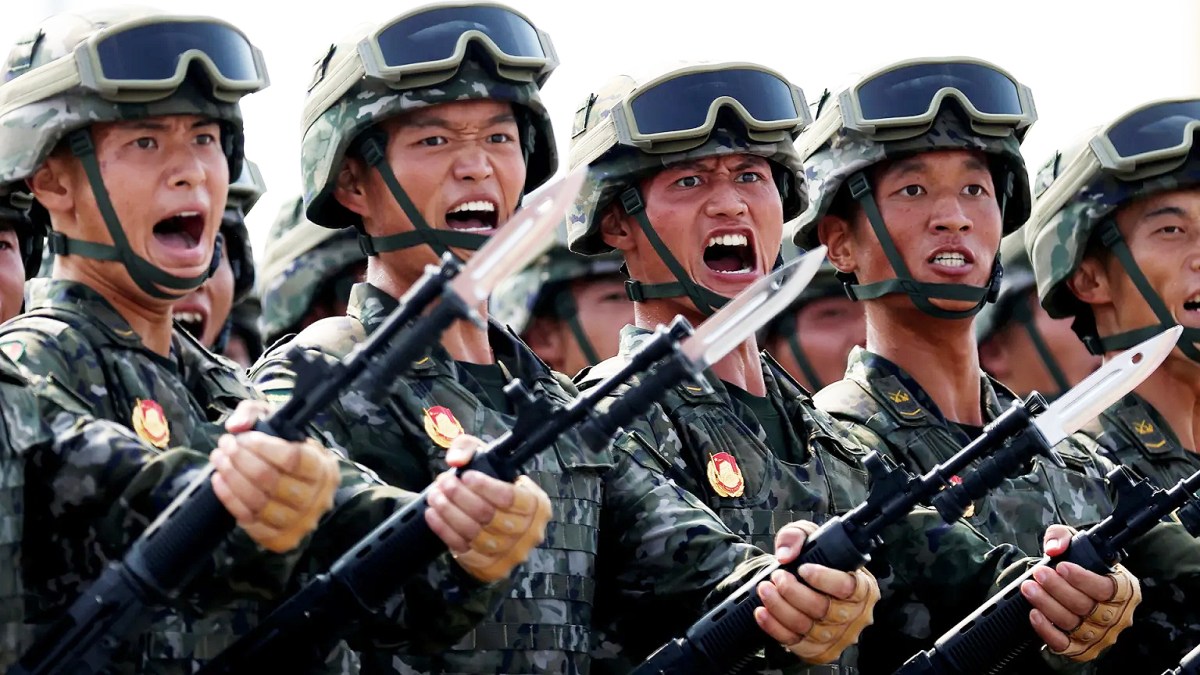
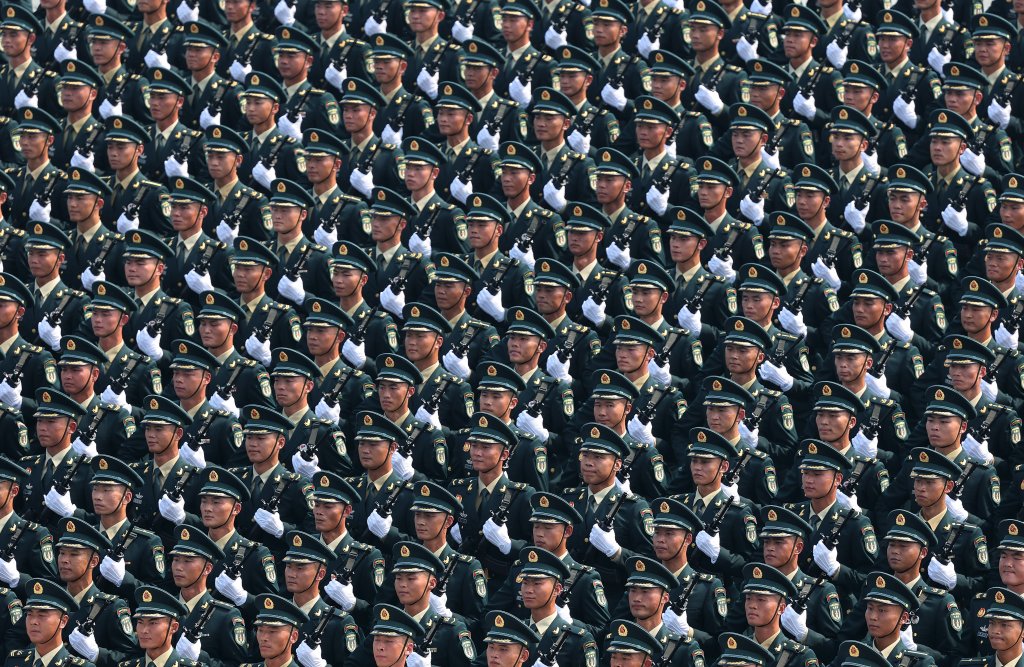
The People's Liberation Army PLA Rocket Force formation attends a military parade in Beijing, capital of China, Sept. 3, 2025. China on Wednesday held a grand gathering to commemorate the 80th anniversary of the victory in the Chinese People's War of Resistance against Japanese Aggression and the World Anti-Fascist War. (Photo by Guo Yu/Xinhua via Getty Images)
The People’s Liberation Army PLA Rocket Force formation attends a military parade in Beijing, capital of China, Sept. 3, 2025. (Photo by Guo Yu/Xinhua via Getty Images) Xinhua News Agency

As the “lead strategist” and former Deputy Commander of U.S. INDOPACOM, Sklenka said he “got to be pretty familiar with how General Secretary Xi was thinking and what his intentions are.”

The Chinese leader’s “vision is to upend the international structure [and] supplant us as the global leaders. And in many ways, it’s been Xi’s thinking, his vision, that has helped my own thinking about the demands of modern warfare, particularly when waged in the Pacific and particularly waged against a peer adversary, something that’s new to all of us.”

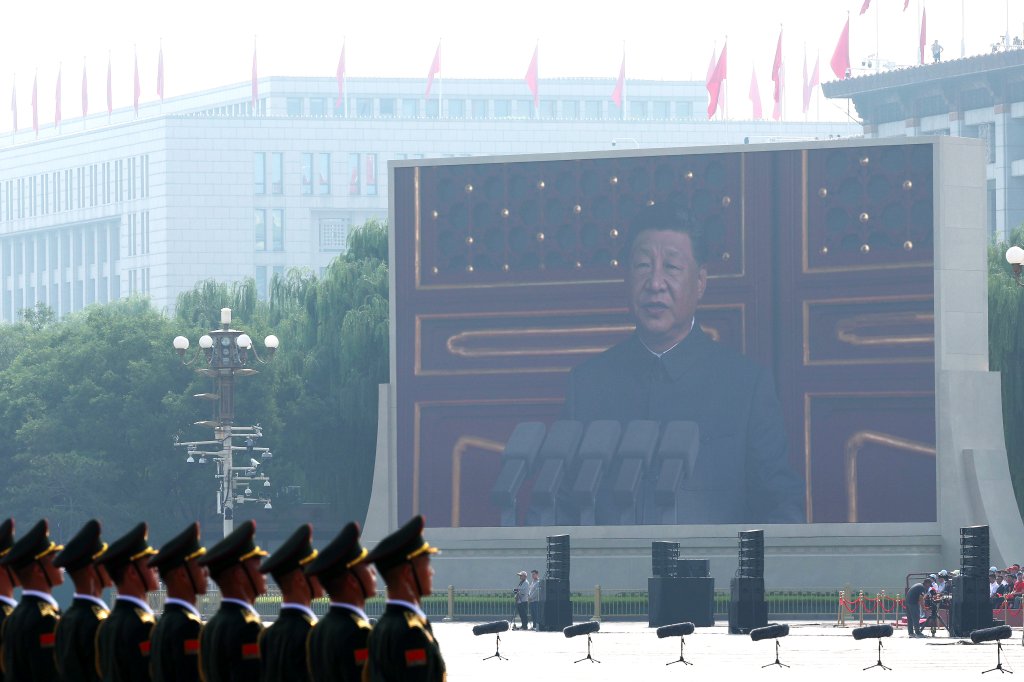
BEIJING, CHINA - SEPTEMBER 03: A display shows China’s President Xi Jinping delivering a speech during a military parade marking the 80th anniversary of victory over Japan and the end of World War II, in Tiananmen Square on September 03, 2025, in Beijing, China. China's Victory Day military parade serves as a powerful display of national pride and military power. This year's parade carries heightened geopolitical weight with the attendance of leaders like Vladimir Putin, Kim Jong Un and Masoud Pezeshkian, underlining China's diplomatic alliances as it presents itself as an alternative global leader. (Photo by Lintao Zhang/Getty Images)
China’s President Xi Jinping wants to supplant the U.S. as a global leader, a U.S. Marine Corps general warns. (Photo by Lintao Zhang/Getty Images) Lintao Zhang

Epic Fury offers some sobering lessons, Sklenka noted. While the U.S. is able to pour forces into theater via uncontested skies and largely uncontested seas, Iran was still able to inflict a great deal of pain on America and its allies during the fighting. And, it still is, economically through an ongoing closure of the Strait of Hormuz. A fight with China would be far worse, Sklenka cautioned.

“We’re about two months into combat operations with Epic Fury. We’ve got service members who have tragically been wounded and killed by Iran. They’ve launched hundreds of drones and ballistic missiles at our bases and our allies throughout the region – Israel, Saudi Arabia, Qatar, Kuwait, Jordan – reinforcing the point that the bases that we have, they’re no longer administrative garrison sanctuaries. We really need to start looking at our bases as warfighting formations, just as critical of a warfighting formation as our divisions, wings and [Marine Expeditionary Units] MEUs.”

We’ll talk more about that later in this story.

You can see damage to U.S. bases in the Middle East in the following satellite images.
To view this content we will need your consent to set third party cookies.
For more detailed information, see our cookies page.


Iran has “illustrated how a mid-tier power can hold a significantly superior force at risk,” Sklenka suggested. “As a learning organization, we ask ourselves, ‘how do we carry every lesson from this fight forward, and how do we ensure that we’re equally prepared to dominate the conflict with China?’”

“Think about the complexities and complications that we’re [facing] with Iran, and then ask yourself, ‘how are we going to respond and act when we’re going up against a nation that’s number two in national GDP?’” he added. “The fact is that Iran doesn’t have anywhere near China’s economic might. They don’t have their industrial base. They certainly don’t have their military modernization trajectory.”

“Over the last 10 to 15 years, the Chinese manufacturing base has been out-producing us,” Sklenka posited. “Xi is on a wartime footing. There’s no doubt about that. It’s underpinned by an industrial base that’s out producing the world in ships and steel, precious minerals and satellites, munitions.”

China’s “shipbuilding capacity is reported to be 230 times the capacity that the United States has,” the general continued. “They more than doubled their nuclear powered submarine construction, their arsenal of ballistic and cruise missiles is undergoing a rapid expansion.”

“Their nuclear stockpile is the fastest growing in the world. They’re pursuing innovative, intelligentized warfare tactics,” Sklenka pointed out. “They’re using artificial intelligence, drone swarms, exploring the cognitive and innovative domains to achieve their dominance. They’re building a military design to dominate the Pacific, and I believe ultimately beyond the Pacific.”

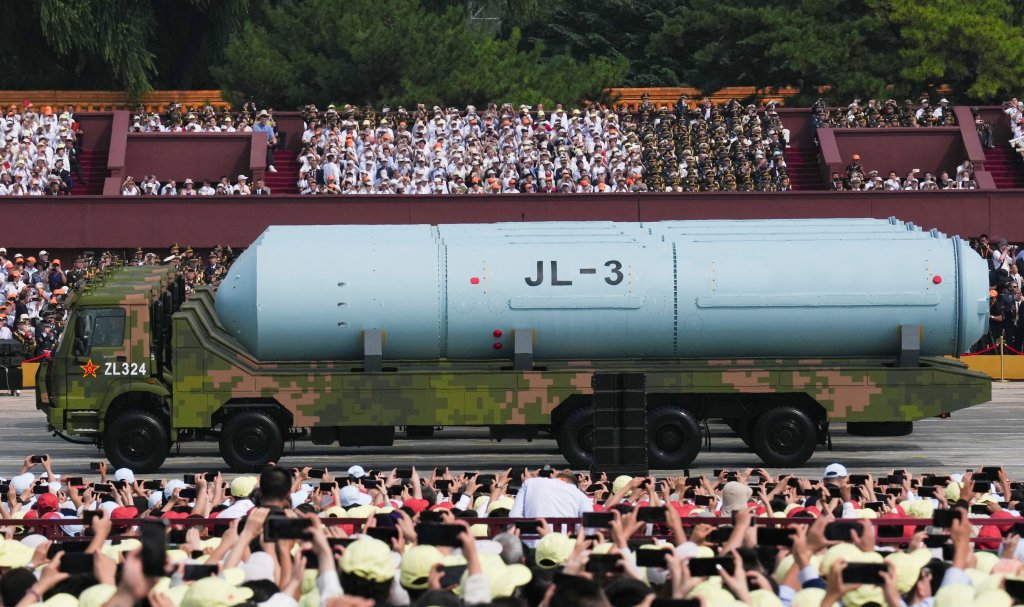
The nuclear missile formation passes through Tian'anmen Square during a military parade in Beijing, capital of China, Sept. 3, 2025. China on Wednesday held a grand gathering to commemorate the 80th anniversary of the victory in the Chinese People's War of Resistance against Japanese Aggression and the World Anti-Fascist War. (Photo by Yan Linyun/Xinhua via Getty Images)
The nuclear missile formation passes through Tian’anmen Square during a military parade in Beijing, capital of China, Sept. 3, 2025. (Photo by Yan Linyun/Xinhua via Getty Images) Xinhua News Agency

China’s intent, Sklenka added, “is clear. They want to regain that self-identified moniker of the Middle Kingdom, and they want to resume what they believe is their rightful place in the world. They’re not interested in sharing that position with us or with anybody else. General Secretary Xi’s view is that it’s their time, and this is the context. I bring that all up for our transformation.”

“None of us in uniform today have ever had to operate in a world where a legitimate peer simultaneously contests us in every single domain,” said Sklenka. “We are talking terrestrially and non-terrestrially, kinetically and non-kinetically. We’re going to have to fight to get to that fight, and we’re going to have to embrace these challenges and not operate under the auspices of how we did in the 80s and 90s. History is proven, and our current operations are confirmed, that the society that can project and sustain power and sustain their forces most effectively, ultimately, they prevail.”

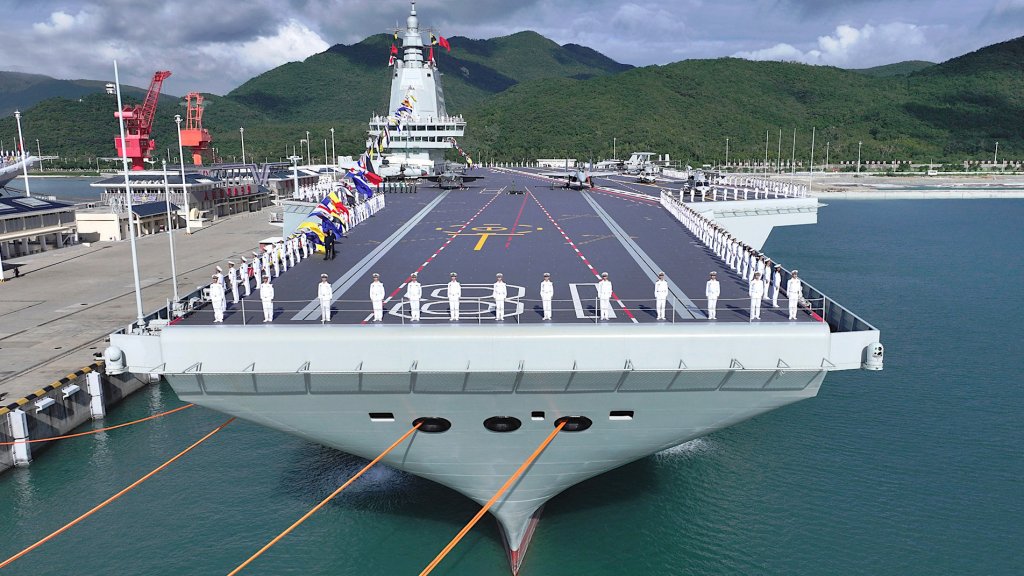
China has now formally commissioned its first catapult-equipped aircraft carrier, the Fujian, into service.
China has now formally commissioned its first catapult-equipped aircraft carrier, the Fujian, into service. (Chinese Ministry of National Defense)

Looking to the future, Sklenka echoed warnings that TWZ has made for years about the vulnerability of U.S. military installations, both at home and abroad. No increases in magazine depth, additional weapons systems or advancements with AI and other new technologies will ultimately matter “if you can’t get off the installation in the first place,” he stated. “The ability to mobilize and deploy is underpinned by the readiness of our installations. It’s a concept that we’re just now really starting to wrestle with.”

“Our bases, posts and stations…are the front lines of decisive terrain. And I’m not just talking about those in the first island chain. This isn’t just [Marine Corps Installations Pacific] MCIPAC. Our CONUS installations are subject to non-kinetic attacks. Non kinetic-attacks, they’re going to be just as debilitating and just as strategically consequential as any kinetic attack that’s going to be out there. And they’re going to carry an air of non-attrition that’s designed to both confuse decision makers and sow chaos during the most critical phases of the fight, the beginning, the first shots of that next war.”

That first salvo, Sklenka said, is most likely not going to be delivered by a missile or bomber.

“They’re likely not going to be fired in the South China Sea or in the Taiwan Strait,” he explained. “They’re going to be a cyber attack against a power grid on our base, a disinformation campaign targeting military families or a drone swarm coming off one of our installations.”

The localized drone attack concern is exactly what TWZ has long predicted and became a reality last year in Russia and Iran. Last June, Ukraine launched Operation Spider Web, an audacious near-field attack on Russian air bases, destroying a large number of strategic bombers with remotely operated drones set up in trucks placed near those installations.

Spider Web was followed about two weeks later by an operation Israel carried out, using drones pre-positioned inside Iran to attack the Islamic Republic’s air defenses.

“I think our installations have to start being treated as warfighting platforms,” Sklenka proclaimed. “We need the best solutions for counter UAS. We got to quit talking about it, start delivering that. We need resilient power. You have to be able to absorb when our communications are cut and continue those communications actions. We need hardened infrastructure and a hard network.”

His plea for hardening infrastructure runs counter to thinking by some U.S. military leaders, particularly in the Pacific, who have downplayed the need to do more to physically harden existing bases. You can read more about that in our story here.

Sklenka had other suggestions for protecting installations.

“We need integrated base defense, and we need industry’s help to do all this,” he urged. “We’re not going to be just fighting from our bases. In many cases, we’re going to be fighting for those bases. That’s a concept that’s new to us. We got to start embracing that.”

 
Iran killed any delusions of US military domination over China

Not only did today's conflict exacerbate shortages, it also exposed how unprepared we are for a true Great Power war

JENNIFER KAVANAGH
APR 29, 2026

These days, everyone in Washington is talking about U.S. missile stockpiles. The previously niche topic has been thrust onto the front page of major newspapers and is discussed daily on television and radio programming.

And for good reason. After the war in Iran severely depleted U.S. missile reserves, including its most sophisticated air defense and offensive weapons, there are growing questions about the ability of the U.S. military to do what is required to defend U.S. interests, especially in the near-term.

The news gets much worse, however. Not only did the first 40 days of conflict with Iran exacerbate shortages of expensive and exquisite U.S. munitions; they have also shown that the United States is not ready for a major power war.

Though the U.S. military was able to achieve individual tactical successes in Iran, the conflict and its outcome have sharply undercut key principles of U.S. military strategy and raised doubts about the viability of U.S. contingency plans, in particular for a future war in Asia. Moving forward, the United States will need to recalibrate its commitments to better match the realities of modern warfare and the growing limits on U.S. military power.

A war against Iran and one in Asia (over Taiwan for instance) would look different in many ways, especially given that the former is offensive and the latter would most likely be defensive. But there are several notable similarities. First, as in the Middle East, in Asia, the United States would rely heavily on forward bases across the region to launch aircraft and house logistics and combat support capabilities. It would depend on ground-based air defense and a network of radars and sensors to protect those bases and to inform U.S. missile targeting.

Second, in Asia as in Iran, the U.S. military would exploit fighter jets, bombers, and warships using stand-off weapons alongside ground-based missiles to fire at adversary air defenses, radars, and missile launchers. It would also target hostile aircraft and naval vessels including those supporting an amphibious invasion or those setting up a blockade.

Third, in the case of a war over Taiwan, the United States plans to use drones to create a “hellscape” for Chinese forces, preventing their ability to advance through the sea, air, or on the ground. Drones also featured heavily in Iran, with the U.S. military debuting new systems.

The Iran war, fought with a weaker adversary, challenges each of these foundational pillars of the U.S. military strategy for future major power wars, whether against China or otherwise.

Perhaps most importantly, the Iran war casts serious doubt on the utility and viability of U.S. forward bases in a major conflict. After the United States attacked Iran on February 28, U.S. bases across the region were not sources of strength but massive liabilities and easy targets. From the war’s first days, U.S. bases suffered heavy drone and missile attacks and were even reportedly bombed by Iranian fighter jets.

The damage suffered by U.S. bases across the Middle East was staggering. Infrastructure, air defense systems, and ground-based sensors and radars were destroyed. Pricey U.S. aircraft, including refuelers and AWACS early warning jets, were damaged. In fact, bases across the Middle East were so susceptible to adversary attack that U.S. military personnel could no longer operate out of them and were instead forced to work from nearby locations and hotels.

If bases in the Middle East are not defensible, the Pentagon cannot assume that those spread across the Pacific will be either. In fact, many or most may be largely un-usable, especially in the crucial early days of any war.

Another key result in the Middle East that should set off alarm bells across the Pentagon’s senior leadership is Iran’s ability to damage and degrade the sensors and radars that support the U.S. regional air defense network, a military success for Iran that left U.S. bases exposed.

The United States has long relied on ground-based air defense systems to protect U.S. personnel, infrastructure, and assets from adversary missiles. But Iran was able to effectively disable these systems, suggesting that this approach to force protection is entirely insufficient in a world of “precise mass” where even weak adversaries have advanced targeting capabilities. If the U.S. ground-based air defense network could not survive against Iran, it is most certainly inadequate for a war with China.

The U.S. experience against Iran also raises questions about U.S. plans to rely primarily on stand-off weapons to strike Chinese ships and military targets in an Indo-Pacific contingency. Although this strategy evolved as a response to China’s anti-access/air denial capabilities, which will make operating close to the mainland coast impossible, the war in Iran suggests that the stand-off approach may be limited in what it can accomplish.

Although the U.S. military was effective in destroying much of Iran’s air defenses, reports suggest that it was only able to eliminate perhaps 50 percent of the country’s missiles and missile launchers and an even smaller portion of its drone production. Indeed, although Iran’s rate of fire collapsed significantly after the first few days of the war, the United States was never able to fully suppress Iran’s missile fire or stop it from launching drones at U.S. and Gulf state targets. U.S. forces are likely to fare much worse in a campaign to disable China’s missile and drone capabilities, given China’s more advanced air defense and deeper missile arsenal.

Moreover, in this type of contested environment, goals like air superiority and sea control are largely out of reach even for the United States. Although the U.S. military did eventually achieve a degree of air dominance over Iran, this did not eliminate risk to U.S. aircraft. The constraints on U.S. naval power were even more extensive. Not only were U.S. warships forced to operate at a distance from Iranian coasts because of missile and drone threats, but the ability of the U.S. Navy to control the waters off Iran’s coast was limited. The U.S. blockade let through at least as many Iranian ships as it diverted.

In a war in Asia, U.S. warships would face even greater challenges. In a worst case scenario, aircraft carriers and destroyers could be forced to operate beyond the second island chain, reducing their value in a defense of Taiwan or an effort to blockade Chinese ports.

Finally, there is the issue of drones. Iran had the clear advantage here, both in the air and undersea. The United States is far from being competitive in the drone space, let alone ready to create a hellscape for China, one of the industry’s leaders.

The bottom line is that the Iran war has cast a spotlight on the flaws and weaknesses in U.S. military strategy, both in general and specifically as it pertains to contingencies in Asia. The United States has for decades assumed that its forward bases will be defensible and that power projection assets such as bombers, aircraft carriers, and fighter jets will allow the United States to prevail in military contests even far from home.

It has assumed that it can dominate the air and the seas and protect assets on the ground, even close to adversary terrain.

If these things were ever true, they are not anymore. Money and time can fix munitions shortages in the medium term, but they cannot solve these more serious and, in many ways, intractable strategic shortcomings. In an increasingly multipolar world where access to military power has been democratized and the United States has a smaller advantage than in the past, what the United States can achieve with military force will be more limited. U.S. strategic aims and ambitions will need to adjust accordingly.

poor india...

had wet dreams of super power india

vish woo hou
 
Projecting power is difficult,

Most countries of the world are weak, so projecting power against Kenya, Cambodia, Jamaica etc isn't too difficult for the U.S

But their are a few countries like Iran, India, Pakistan, Turkey, Egypt, France, UK that it's just dangerous and difficult

The Iran war has proven that and if China was serious about taking Taiwan it could do so and their was nothing the U.S can do about it
 

China is America’s Military Equal Now And In Any Future Fight, Marine General Warns


Faced with the rapidly growing China threat, the U.S. has to start hardening its bases now, said Marine Lt. Gen. Stephen Sklenka.

HOWARD ALTMAN
PUBLISHED APR 29, 2026 3:50 PM ED

he general in charge of keeping the United States Marine Corps sustained in a fight dismisses the notion that China poses a near-peer threat to the U.S. It’s far more serious and will make the currently paused conflict with Iran pale by comparison should the two superpowers come to blows, said Lt. Gen. Stephen Sklenka, the USMC Deputy Commandant for Installations and Logistics.

“There is no threat that looms larger than the People’s Republic of China,” Sklenka said during the 2026 Modern Day Marine Expo in Washington, D.C. “Don’t listen to this garbage about them being a near peer. They’re a peer because they rival us in nearly every single measure of national influence.”

The People's Liberation Army PLA Rocket Force formation attends a military parade in Beijing, capital of China, Sept. 3, 2025. China on Wednesday held a grand gathering to commemorate the 80th anniversary of the victory in the Chinese People's War of Resistance against Japanese Aggression and the World Anti-Fascist War. (Photo by Guo Yu/Xinhua via Getty Images)'s Liberation Army PLA Rocket Force formation attends a military parade in Beijing, capital of China, Sept. 3, 2025. China on Wednesday held a grand gathering to commemorate the 80th anniversary of the victory in the Chinese People's War of Resistance against Japanese Aggression and the World Anti-Fascist War. (Photo by Guo Yu/Xinhua via Getty Images)
The People’s Liberation Army PLA Rocket Force formation attends a military parade in Beijing, capital of China, Sept. 3, 2025. (Photo by Guo Yu/Xinhua via Getty Images) Xinhua News Agency

As the “lead strategist” and former Deputy Commander of U.S. INDOPACOM, Sklenka said he “got to be pretty familiar with how General Secretary Xi was thinking and what his intentions are.”

The Chinese leader’s “vision is to upend the international structure [and] supplant us as the global leaders. And in many ways, it’s been Xi’s thinking, his vision, that has helped my own thinking about the demands of modern warfare, particularly when waged in the Pacific and particularly waged against a peer adversary, something that’s new to all of us.”

BEIJING, CHINA - SEPTEMBER 03: A display shows China’s President Xi Jinping delivering a speech during a military parade marking the 80th anniversary of victory over Japan and the end of World War II, in Tiananmen Square on September 03, 2025, in Beijing, China. China's Victory Day military parade serves as a powerful display of national pride and military power. This year's parade carries heightened geopolitical weight with the attendance of leaders like Vladimir Putin, Kim Jong Un and Masoud Pezeshkian, underlining China's diplomatic alliances as it presents itself as an alternative global leader. (Photo by Lintao Zhang/Getty Images)'s Victory Day military parade serves as a powerful display of national pride and military power. This year's parade carries heightened geopolitical weight with the attendance of leaders like Vladimir Putin, Kim Jong Un and Masoud Pezeshkian, underlining China's diplomatic alliances as it presents itself as an alternative global leader. (Photo by Lintao Zhang/Getty Images)
China’s President Xi Jinping wants to supplant the U.S. as a global leader, a U.S. Marine Corps general warns. (Photo by Lintao Zhang/Getty Images) Lintao Zhang

Epic Fury offers some sobering lessons, Sklenka noted. While the U.S. is able to pour forces into theater via uncontested skies and largely uncontested seas, Iran was still able to inflict a great deal of pain on America and its allies during the fighting. And, it still is, economically through an ongoing closure of the Strait of Hormuz. A fight with China would be far worse, Sklenka cautioned.

“We’re about two months into combat operations with Epic Fury. We’ve got service members who have tragically been wounded and killed by Iran. They’ve launched hundreds of drones and ballistic missiles at our bases and our allies throughout the region – Israel, Saudi Arabia, Qatar, Kuwait, Jordan – reinforcing the point that the bases that we have, they’re no longer administrative garrison sanctuaries. We really need to start looking at our bases as warfighting formations, just as critical of a warfighting formation as our divisions, wings and [Marine Expeditionary Units] MEUs.”

We’ll talk more about that later in this story.

You can see damage to U.S. bases in the Middle East in the following satellite images.
To view this content we will need your consent to set third party cookies.
For more detailed information, see our cookies page.


Iran has “illustrated how a mid-tier power can hold a significantly superior force at risk,” Sklenka suggested. “As a learning organization, we ask ourselves, ‘how do we carry every lesson from this fight forward, and how do we ensure that we’re equally prepared to dominate the conflict with China?’”

“Think about the complexities and complications that we’re [facing] with Iran, and then ask yourself, ‘how are we going to respond and act when we’re going up against a nation that’s number two in national GDP?’” he added. “The fact is that Iran doesn’t have anywhere near China’s economic might. They don’t have their industrial base. They certainly don’t have their military modernization trajectory.”

“Over the last 10 to 15 years, the Chinese manufacturing base has been out-producing us,” Sklenka posited. “Xi is on a wartime footing. There’s no doubt about that. It’s underpinned by an industrial base that’s out producing the world in ships and steel, precious minerals and satellites, munitions.”

China’s “shipbuilding capacity is reported to be 230 times the capacity that the United States has,” the general continued. “They more than doubled their nuclear powered submarine construction, their arsenal of ballistic and cruise missiles is undergoing a rapid expansion.”

“Their nuclear stockpile is the fastest growing in the world. They’re pursuing innovative, intelligentized warfare tactics,” Sklenka pointed out. “They’re using artificial intelligence, drone swarms, exploring the cognitive and innovative domains to achieve their dominance. They’re building a military design to dominate the Pacific, and I believe ultimately beyond the Pacific.”

The nuclear missile formation passes through Tian'anmen Square during a military parade in Beijing, capital of China, Sept. 3, 2025. China on Wednesday held a grand gathering to commemorate the 80th anniversary of the victory in the Chinese People's War of Resistance against Japanese Aggression and the World Anti-Fascist War. (Photo by Yan Linyun/Xinhua via Getty Images)'anmen Square during a military parade in Beijing, capital of China, Sept. 3, 2025. China on Wednesday held a grand gathering to commemorate the 80th anniversary of the victory in the Chinese People's War of Resistance against Japanese Aggression and the World Anti-Fascist War. (Photo by Yan Linyun/Xinhua via Getty Images)
The nuclear missile formation passes through Tian’anmen Square during a military parade in Beijing, capital of China, Sept. 3, 2025. (Photo by Yan Linyun/Xinhua via Getty Images) Xinhua News Agency

China’s intent, Sklenka added, “is clear. They want to regain that self-identified moniker of the Middle Kingdom, and they want to resume what they believe is their rightful place in the world. They’re not interested in sharing that position with us or with anybody else. General Secretary Xi’s view is that it’s their time, and this is the context. I bring that all up for our transformation.”

“None of us in uniform today have ever had to operate in a world where a legitimate peer simultaneously contests us in every single domain,” said Sklenka. “We are talking terrestrially and non-terrestrially, kinetically and non-kinetically. We’re going to have to fight to get to that fight, and we’re going to have to embrace these challenges and not operate under the auspices of how we did in the 80s and 90s. History is proven, and our current operations are confirmed, that the society that can project and sustain power and sustain their forces most effectively, ultimately, they prevail.”

China has now formally commissioned its first catapult-equipped aircraft carrier, the Fujian, into service.
China has now formally commissioned its first catapult-equipped aircraft carrier, the Fujian, into service. (Chinese Ministry of National Defense)

Looking to the future, Sklenka echoed warnings that TWZ has made for years about the vulnerability of U.S. military installations, both at home and abroad. No increases in magazine depth, additional weapons systems or advancements with AI and other new technologies will ultimately matter “if you can’t get off the installation in the first place,” he stated. “The ability to mobilize and deploy is underpinned by the readiness of our installations. It’s a concept that we’re just now really starting to wrestle with.”

“Our bases, posts and stations…are the front lines of decisive terrain. And I’m not just talking about those in the first island chain. This isn’t just [Marine Corps Installations Pacific] MCIPAC. Our CONUS installations are subject to non-kinetic attacks. Non kinetic-attacks, they’re going to be just as debilitating and just as strategically consequential as any kinetic attack that’s going to be out there. And they’re going to carry an air of non-attrition that’s designed to both confuse decision makers and sow chaos during the most critical phases of the fight, the beginning, the first shots of that next war.”

That first salvo, Sklenka said, is most likely not going to be delivered by a missile or bomber.

“They’re likely not going to be fired in the South China Sea or in the Taiwan Strait,” he explained. “They’re going to be a cyber attack against a power grid on our base, a disinformation campaign targeting military families or a drone swarm coming off one of our installations.”

The localized drone attack concern is exactly what TWZ has long predicted and became a reality last year in Russia and Iran. Last June, Ukraine launched Operation Spider Web, an audacious near-field attack on Russian air bases, destroying a large number of strategic bombers with remotely operated drones set up in trucks placed near those installations.

Spider Web was followed about two weeks later by an operation Israel carried out, using drones pre-positioned inside Iran to attack the Islamic Republic’s air defenses.

“I think our installations have to start being treated as warfighting platforms,” Sklenka proclaimed. “We need the best solutions for counter UAS. We got to quit talking about it, start delivering that. We need resilient power. You have to be able to absorb when our communications are cut and continue those communications actions. We need hardened infrastructure and a hard network.”

His plea for hardening infrastructure runs counter to thinking by some U.S. military leaders, particularly in the Pacific, who have downplayed the need to do more to physically harden existing bases. You can read more about that in our story here.

Sklenka had other suggestions for protecting installations.

“We need integrated base defense, and we need industry’s help to do all this,” he urged. “We’re not going to be just fighting from our bases. In many cases, we’re going to be fighting for those bases. That’s a concept that’s new to us. We got to start embracing that.”


Is America equal to China? I doubt.
 
China will be equal when they militarily intervene to defend SCO members. Usa/EU defends its allies, even disputed nation like Taiwan and non ally Ukraine.
China never wants to be "equal" in that sense, we believe that "equal" means equally stupid.
 
China never wants to be "equal" in that sense, we believe that "equal" means equally stupid.

Whether china believes that or not, if they do not want to be second fiddle to the US they will have to flex their muscle.

No one should underestimate China but as usual I think most do not understand Americas military dominance.

Iran is just a very unique nation and it's not military that is helping them but economical cards they're playing.
 
Whether china believes that or not, if they do not want to be second fiddle to the US they will have to flex their muscle.
They have less and less muscle to flex cause they flexed it too much while China has been quietly building up her muscle.
 

Users who are viewing this thread

Back
Top