Iran killed any delusions of US military domination over China

They have less and less muscle to flex cause they flexed it too much while China has been quietly building up her muscle.

It's being risked by stupid wars with Iran, but building up is one thing and actually testing it is another.

There's a reason China is (intelligently) not daring to confront the US militarily in any capacity.
 
Iran killed any delusions of US military domination over China

Not only did today's conflict exacerbate shortages, it also exposed how unprepared we are for a true Great Power war

JENNIFER KAVANAGH
APR 29, 2026

These days, everyone in Washington is talking about U.S. missile stockpiles. The previously niche topic has been thrust onto the front page of major newspapers and is discussed daily on television and radio programming.

And for good reason. After the war in Iran severely depleted U.S. missile reserves, including its most sophisticated air defense and offensive weapons, there are growing questions about the ability of the U.S. military to do what is required to defend U.S. interests, especially in the near-term.

The news gets much worse, however. Not only did the first 40 days of conflict with Iran exacerbate shortages of expensive and exquisite U.S. munitions; they have also shown that the United States is not ready for a major power war.

Though the U.S. military was able to achieve individual tactical successes in Iran, the conflict and its outcome have sharply undercut key principles of U.S. military strategy and raised doubts about the viability of U.S. contingency plans, in particular for a future war in Asia. Moving forward, the United States will need to recalibrate its commitments to better match the realities of modern warfare and the growing limits on U.S. military power.

A war against Iran and one in Asia (over Taiwan for instance) would look different in many ways, especially given that the former is offensive and the latter would most likely be defensive. But there are several notable similarities. First, as in the Middle East, in Asia, the United States would rely heavily on forward bases across the region to launch aircraft and house logistics and combat support capabilities. It would depend on ground-based air defense and a network of radars and sensors to protect those bases and to inform U.S. missile targeting.

Second, in Asia as in Iran, the U.S. military would exploit fighter jets, bombers, and warships using stand-off weapons alongside ground-based missiles to fire at adversary air defenses, radars, and missile launchers. It would also target hostile aircraft and naval vessels including those supporting an amphibious invasion or those setting up a blockade.

Third, in the case of a war over Taiwan, the United States plans to use drones to create a “hellscape” for Chinese forces, preventing their ability to advance through the sea, air, or on the ground. Drones also featured heavily in Iran, with the U.S. military debuting new systems.

The Iran war, fought with a weaker adversary, challenges each of these foundational pillars of the U.S. military strategy for future major power wars, whether against China or otherwise.

Perhaps most importantly, the Iran war casts serious doubt on the utility and viability of U.S. forward bases in a major conflict. After the United States attacked Iran on February 28, U.S. bases across the region were not sources of strength but massive liabilities and easy targets. From the war’s first days, U.S. bases suffered heavy drone and missile attacks and were even reportedly bombed by Iranian fighter jets.

The damage suffered by U.S. bases across the Middle East was staggering. Infrastructure, air defense systems, and ground-based sensors and radars were destroyed. Pricey U.S. aircraft, including refuelers and AWACS early warning jets, were damaged. In fact, bases across the Middle East were so susceptible to adversary attack that U.S. military personnel could no longer operate out of them and were instead forced to work from nearby locations and hotels.

If bases in the Middle East are not defensible, the Pentagon cannot assume that those spread across the Pacific will be either. In fact, many or most may be largely un-usable, especially in the crucial early days of any war.

Another key result in the Middle East that should set off alarm bells across the Pentagon’s senior leadership is Iran’s ability to damage and degrade the sensors and radars that support the U.S. regional air defense network, a military success for Iran that left U.S. bases exposed.

The United States has long relied on ground-based air defense systems to protect U.S. personnel, infrastructure, and assets from adversary missiles. But Iran was able to effectively disable these systems, suggesting that this approach to force protection is entirely insufficient in a world of “precise mass” where even weak adversaries have advanced targeting capabilities. If the U.S. ground-based air defense network could not survive against Iran, it is most certainly inadequate for a war with China.

The U.S. experience against Iran also raises questions about U.S. plans to rely primarily on stand-off weapons to strike Chinese ships and military targets in an Indo-Pacific contingency. Although this strategy evolved as a response to China’s anti-access/air denial capabilities, which will make operating close to the mainland coast impossible, the war in Iran suggests that the stand-off approach may be limited in what it can accomplish.

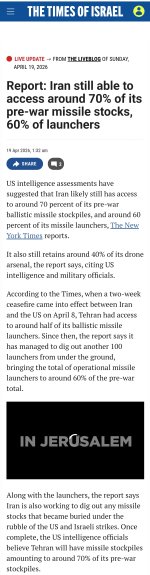
Although the U.S. military was effective in destroying much of Iran’s air defenses, reports suggest that it was only able to eliminate perhaps 50 percent of the country’s missiles and missile launchers and an even smaller portion of its drone production. Indeed, although Iran’s rate of fire collapsed significantly after the first few days of the war, the United States was never able to fully suppress Iran’s missile fire or stop it from launching drones at U.S. and Gulf state targets. U.S. forces are likely to fare much worse in a campaign to disable China’s missile and drone capabilities, given China’s more advanced air defense and deeper missile arsenal.

Moreover, in this type of contested environment, goals like air superiority and sea control are largely out of reach even for the United States. Although the U.S. military did eventually achieve a degree of air dominance over Iran, this did not eliminate risk to U.S. aircraft. The constraints on U.S. naval power were even more extensive. Not only were U.S. warships forced to operate at a distance from Iranian coasts because of missile and drone threats, but the ability of the U.S. Navy to control the waters off Iran’s coast was limited. The U.S. blockade let through at least as many Iranian ships as it diverted.

In a war in Asia, U.S. warships would face even greater challenges. In a worst case scenario, aircraft carriers and destroyers could be forced to operate beyond the second island chain, reducing their value in a defense of Taiwan or an effort to blockade Chinese ports.

Finally, there is the issue of drones. Iran had the clear advantage here, both in the air and undersea. The United States is far from being competitive in the drone space, let alone ready to create a hellscape for China, one of the industry’s leaders.

The bottom line is that the Iran war has cast a spotlight on the flaws and weaknesses in U.S. military strategy, both in general and specifically as it pertains to contingencies in Asia. The United States has for decades assumed that its forward bases will be defensible and that power projection assets such as bombers, aircraft carriers, and fighter jets will allow the United States to prevail in military contests even far from home.

It has assumed that it can dominate the air and the seas and protect assets on the ground, even close to adversary terrain.

If these things were ever true, they are not anymore. Money and time can fix munitions shortages in the medium term, but they cannot solve these more serious and, in many ways, intractable strategic shortcomings. In an increasingly multipolar world where access to military power has been democratized and the United States has a smaller advantage than in the past, what the United States can achieve with military force will be more limited. U.S. strategic aims and ambitions will need to adjust accordingly.
USA (with Israel) has destroyed nearly all the iran army, except ground light troups (the one used to terrify the civilians).
Remain drones and some ballistic missiles. Just enough to made shit for the neighbors.
So it's not a victory as seen in WW2, with a complete surrender, but iran has lost nearly all attack capacity. That was the goal.

China watched the operations with accuracy, for sure. But they saw USA in an attack profile. Around Taiwan, the roles will be reversed : China has to attack and USA has to defend. So the lesson is not useless, but not fully usefull.
 
USA (with Israel) has destroyed nearly all the iran army, except ground light troups (the one used to terrify the civilians).
Remain drones and some ballistic missiles. Just enough to made shit for the neighbors.
So it's not a victory as seen in WW2, with a complete surrender, but iran has lost nearly all attack capacity. That was the goal.

China watched the operations with accuracy, for sure. But they saw USA in an attack profile. Around Taiwan, the roles will be reversed : China has to attack and USA has to defend. So the lesson is not useless, but not fully usefull.
USA + Israel has destroyed all the aliens in all the universe, so they are the winners of all wars future, past and present.

Who let this macaron lose ?
 
USA (with Israel) has destroyed nearly all the iran army, except ground light troups (the one used to terrify the civilians).
Remain drones and some ballistic missiles. Just enough to made shit for the neighbors.
So it's not a victory as seen in WW2, with a complete surrender, but iran has lost nearly all attack capacity. That was the goal.

China watched the operations with accuracy, for sure. But they saw USA in an attack profile. Around Taiwan, the roles will be reversed : China has to attack and USA has to defend. So the lesson is not useless, but not fully usefull.
screenshot_20260430_215725.jpg
Although I was pessimistic about Iran in the early stages of the war, I have to say that the Iranians did a very good job, maintaining a large number of live forces despite the terrifying attacks of the United States and Israel.
 
They have less and less muscle to flex cause they flexed it too much while China has been quietly building up her muscle.
China has proven absolutely nothing with its military except that it can show off its shiny new toys. It didn't even come to Iran's aid, its friend and ally. China needs to do more than build up its muscle.
 
China has proven absolutely nothing with its military except that it can show off its shiny new toys. It didn't even come to Iran's aid, its friend and ally. China needs to do more than build up its muscle.
You see this is the problem with the American approach and with the people who blindly copy them, it's too focused on kinetic action. China is the one buying Iranian oil, keeping the country afloat and also supplying it with the sodium percolate that is critical to Iranian missiles. Here is a more in depth article.

 
Last edited:
You see this is the problem with the American approach and with the people who blindly copy them, it's too focused on kinetic action. China is the one buying Iranian oil, keeping the country afloat and also supplying it with the sodium percolate that is critical to Iranian missiles. Here is a more in depth article.


Now US military is asking for 1500 billion dollars. 52% more than last year. It is now second time USA is in arms race, but this time it is the one loosing.
 
In an increasingly multipolar world where access to military power has been democratized and the United States has a smaller advantage than in the past, what the United States can achieve with military force will be more limited. U.S. strategic aims and ambitions will need to adjust accordingly.

That would hold true as a conclusion only if overwhelming military power is the only way to achieve strategic goals. It is not.
 
People seem to forget that in terms of military power in Iran, the US uses less than 1/3 of its Navy and 1/5 of the Air Force, and no ground troops to achieve complete dominant on a country 8000 miles away. Can China replicate the same vis-à-vis 8000 miles away in places like Africa? If the Chinese can do that using 1/3 of their Navy and 1/5 of their air force, then yes. China will be "Equal" to the US

Just because there are no strategic winnable goals (which is not really a military defeat, but rather a political shortsightedness) does not mean the US military power is useless. Not all goals are achievable by force, that is true whether or not we are talking about the US war in Iran or some other war involving the Chinese in the future.
 
People seem to forget that in terms of military power in Iran, the US uses less than 1/3 of its Navy and 1/5 of the Air Force, and no ground troops to achieve complete dominant on a country 8000 miles away. Can China replicate the same vis-à-vis 8000 miles away in places like Africa? If the Chinese can do that using 1/3 of their Navy and 1/5 of their air force, then yes. China will be "Equal" to the US

Just because there are no strategic winnable goals (which is not really a military defeat, but rather a political shortsightedness) does not mean the US military power is useless. Not all goals are achievable by force, that is true whether or not we are talking about the US war in Iran or some other war involving the Chinese in the future.

It's okay. Let them overestimate their advantages, and underestimate ours. That can only be good. :D
 
People seem to forget that in terms of military power in Iran, the US uses less than 1/3 of its Navy and 1/5 of the Air Force, and no ground troops to achieve complete dominant on a country 8000 miles away. Can China replicate the same vis-à-vis 8000 miles away in places like Africa? If the Chinese can do that using 1/3 of their Navy and 1/5 of their air force, then yes. China will be "Equal" to the US

Just because there are no strategic winnable goals (which is not really a military defeat, but rather a political shortsightedness) does not mean the US military power is useless. Not all goals are achievable by force, that is true whether or not we are talking about the US war in Iran or some other war involving the Chinese in the future.
Once again the major flaw in this thinking is that being able to drop many bombs anywhere in the world is the standard all countries should be aspiring to. The US suffers from a mental disease that began with victory in WW2, with Americans thinking they can ultimately buy or kill their way to any objective. That is one reason America keeps getting involved in one useless war after another.

I would argue that is not thinking or behavior that others should emulate.

America with its addiction to war and debt is now on the same path as the USSR.
 
It's okay. Let them overestimate their advantages, and underestimate ours. That can only be good. :D
Well, over/under estimate is when you say something you might regret, this is basically just outright ignorant
 
You see this is the problem with the American approach and with the people who blindly copy them, it's too focused on kinetic action. China is the one buying Iranian oil, keeping the country afloat and also supplying it with the sodium percolate that is critical to Iranian missiles. Here is a more in depth article.


Trading with Iran, to keep it afloat, is not enough, especially if it's critical to your economy, which Iran clearly is to China; it has to protect it politically and militarily. Simply boasting about your capabilities, it must be demonstrated. China hasn't done that.

Now US military is asking for 1500 billion dollars. 52% more than last year. It is now second time USA is in arms race, but this time it is the one loosing.
Losting what and to whom, and don't say China?

Regardless, the US doubling its defense spending is not even close to what it spent during the Cold War, if this chart is any indication.
 
Once again the major flaw in this thinking is that being able to drop many bombs anywhere in the world is the standard all countries should be aspiring to. The US suffers from a mental disease that began with victory in WW2, with Americans thinking they can ultimately buy or kill their way to any objective. That is one reason America keeps getting involved in one useless war after another.

I would argue that is not thinking or behavior that others should emulate.
depends on how you see things, really.

If you are looking at how you can decapacitate your enemy, then this playbook is what you should follow

On the other hand, if you are looking at this and think "how do I start a war" this is probably not an example I will say we should learn from.
 

Users who are viewing this thread

Back
Top