MNZGamerX
Registered Member

It’s been almost a decade since Bangladesh joined the BRI. What has the Belt and Road actually accomplished in the country?
By Md. Himel Rahman
April 28, 2026
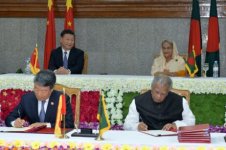
On October 14, 2016, during the historic visit of Chinese President Xi Jinping to Bangladesh, Dhaka and Beijing formally upgraded their relationship to a Strategic Partnership of Cooperation, and Bangladesh became a participant in the Chinese-financed Belt and Road Initiative (BRI). Since then, several Chinese-sponsored major infrastructure projects have been completed in Bangladesh, and several more are underway.
On July 11, 2024, Dhaka and Beijing further elevated their partnership to the level of Comprehensive Strategic Cooperative Partnership. Even the subsequent political upheavals in Bangladesh – including the July Uprising that removed the Hasina government less than a month later, the formation of the interim government, and the victory of the Bangladesh Nationalist Party (BNP) in 2026 general elections – have not hindered Bangladesh’s continued participation in the BRI.
Since 2016, Bangladesh’s involvement in the BRI has been widely discussed and dissected. Depending on their political orientation, some have championed Bangladesh’s growing partnership with China and commended infrastructure development through the BRI, while some others have voiced concerns about possible fallout in relations with India and the United States and a potential “debt trap.” However, the reality is far more nuanced than the simplified polemics presented by many commentators.
BRI Projects in Bangladesh: Expectations versus Reality
Under the BRI, Bangladesh was supposed to receive approximately $40 billion in investments from China: $26 billion for independent projects and $14 billion for joint venture projects. However, most of these investments are yet to be materialized. Chinese Ambassador to Bangladesh Yao Wen stated in 2023 that China had disbursed $4.45 billion – just over one-tenth of the promised amount – for 35 BRI projects in the country. However, the exact amount disbursed by China to Bangladesh under the BRI between October 2016 and April 2026 is not known.
Most of the BRI projects in Bangladesh are related to transport and energy infrastructure, but there are difficulties in determining the exact number of BRI projects in the country based on publicly available data. Most estimates mention 35–40 projects, with one website listing as many as 64 projects under the BRI, albeit mistakenly. Hence, the unavailability of exact data about the BRI in Bangladesh is a major hindrance to examining its real effects. That said, based on the available data, getting a general picture is still possible.
So far, the completed BRI projects in Bangladesh include the Padma Multipurpose Bridge, the Eighth Bangladesh-China Friendship Bridge, the Padma Bridge Rail Link, the Chattogram-Cox’s Bazar Rail Line, the Chattogram Elevated Expressway, the Karnaphuli Tunnel, the Payra Thermal Power Plant, the Banshkhali Coal-fired Power Plant, the Dasherkandi Sewage Treatment Plant, the IV Tier National Data Center, and the Bangladesh-China Friendship Exhibition Center. Partially completed, under-construction, and proposed BRI projects in the country include the Payra Seaport, the Ninth Bangladesh-China Friendship Bridge, the Dhaka Elevated Expressway, the Dhaka-Ashulia Elevated Expressway, the expansion of the Mongla Port, the Maheshkhali Single Point Mooring Project, the development of power supply line under the Power Grid Bangladesh PLC, the development of power supply system under the Dhaka Power Distribution Company (DPDC) the Chinese Economic and Industrial Zone in Chattogram, the extension of the national information technology network, the Teesta River Comprehensive Management Project, the Rajshahi Surface Water Treatment Plant, the Bangladesh-China Friendship General Hospital in Nilphamari, and the Bangladesh-China Maitree Hall at the University of Dhaka.
Meanwhile, several BRI projects in Bangladesh have been canceled. For instance, Dhaka scrapped the Sonadia deep seaport project in August 2020 owing to strong opposition from the United States, Japan, and India coupled with environmental concerns. In February 2021, Dhaka decided to drop five BRI projects – the Dhaka-Sylhet four-lane highway project, the extension of Barapukuria coal mine’s existing underground operations, the distribution zones of the Bangladesh Power Development Board (BPDB), the Gazaria Coal-fired Power Plant, and the rejuvenation of the jute mills under the Bangladesh Jute Mills Corporation (BJMC) – due to power overcapacity and rising costs. At the same time, China informed Bangladesh that it would no longer undertake projects involving high pollution and high energy consumption, such as coal mines and coal-fired power plants, in the country. Moreover, in April 2021, Bangladesh shelved the Payra deep seaport project, and instead decided to construct a regular seaport at Payra, citing high dredging costs, shallow depth, concerns about natural disasters, and the prioritization of the more viable Matarbari Deep Seaport. Similarly, in May 2024, Dhaka put on hold the proposed Dhaka-Chattogram High-speed Railway, citing economic reasons.
Hence, under the BRI, China has completed and is currently implementing numerous infrastructure projects in Bangladesh, particularly in the transport and energy sectors, and Chinese companies have secured contracts worth more than $22.94 billion in the country. However, despite the scale of Chinese involvement in infrastructure development in Bangladesh, this should not be construed as some sort of Chinese infrastructural monopoly over the country. Bangladesh has demonstrated its maneuverability by shelving several Chinese projects, and several other states – including India, Japan, Russia, and Belgium – are involved in major infrastructure and energy projects in the country.
Moreover, while China had pledged massive amounts of investments in Bangladesh in 2016, only a fraction of the pledged amount has been actually invested so far. The slow pace of project implementation, coupled with growing costs of the projects, has hindered Bangladesh’s plans for rapid infrastructure development, while bureaucratic bottlenecks, risks of corruption, and concerns about debt sustainability have affected the country’s decision-making. So, while the BRI has made substantial contributions to Bangladesh’s infrastructure development and economic growth, it is far from being fully implemented and confronts several practical, financial, environmental, and geopolitical challenges.
Bangladesh and the Question of a Chinese “Debt Trap”
Since 2016, numerous alarms have been sounded about Bangladesh’s accumulation of debts to China, generating fears that Dhaka may fail to repay debts to Beijing and eventually lose control of strategic assets. However, an inquiry into the structure of Bangladesh’s foreign debt would suffice to dispel this apprehension. In February 2026, the country’s total external debt stood at $78.067 billion. While the latest data about the sources of Bangladesh’s external debt in 2026 is yet to be released, a June 2025 government report indicated that the World Bank is the largest creditor to Bangladesh, followed by the Asian Development Bank (ADB), and Japan. China is the fourth largest creditor to Bangladesh, and it is the source of only 7 percent of Bangladesh’s foreign debt.
Moreover, the World Bank and the International Monetary Fund (IMF) have pledged to provide Bangladesh with $2 billion financial assistance by June, whereas China has recently made no similar pledges. So, Bangladesh’s debt to international financial institutions is likely to increase, while its debt to China is not projected to rise in the near future.
China is not the largest creditor to Bangladesh; it’s not even in the top three. China’s debt share is too small to exercise systemic control over the economy of Bangladesh Moreover, Bangladesh has not come close to defaulting on its loans to China, nor has it requested restructuring, while China has made no attempt to take over assets from Bangladesh. Dhaka is repaying Chinese loans normally, and unless the country faces a major economic meltdown, it is unlikely to fall into any sort of “debt trap.”
Military Use of BRI Infrastructure in Bangladesh: Ground Reality
Commentators usually view the BRI projects in Bangladesh as part of a wider Chinese strategy through which China is seeking to expand its geopolitical and geostrategic influence in the Bay of Bengal in order to resolve the “Malacca Dilemma,” build a two-ocean blue-water navy, and counter the influence of its opponents in the region. In particular, critics argue that China seeks to utilize Bangladesh’s infrastructure, particularly its seaports, for strategic purposes.
Bangladesh maintains a strong military-technical partnership with China, as more than 70 percent of its military equipment is of Chinese origin, and China has invested in the development of its military infrastructure, including the construction of the BNS Pekua. Yet, Bangladesh has so far painstakingly avoided participation in military blocs and the installation of foreign military bases on its territory so as to not become embroiled in external conflicts.
Bangladesh is not in a formal military alliance with China, and it refused to join a joint working group with China and Pakistan in June 2025 even at the height of Indo-Bangladeshi tensions. Similarly, Bangladesh has so far refrained from signing the Acquisition and Cross-Servicing Agreement (ACSA) with the United States, and the previous Awami League-led government, despite its close ties with India, did not facilitate the installation of Indian coastal surveillance radars on the territory of Bangladesh after an agreement to that effect was signed. This displays Bangladesh’s apprehension of military alliances and foreign bases, and represents a cornerstone of its foreign and security policy.
So, if a great power war involving China breaks out in the region, Bangladesh is unlikely to allow its territory to be used by either side in the war. As such, China is unlikely to be able to use BRI-linked infrastructure in Bangladesh in wartime.
Most importantly, while Bangladesh holds geostrategic value for China, it should be exaggerated. If the Strait of Malacca is closed, China can use Pakistani and Myanmar seaports for the transportation of goods, but Bangladesh can hardly serve as an alternative route. If China ever sought to transport goods via Bangladeshi seaports, it would have to cross Indian or Myanmar territory on the way. Given the current conditions of Sino–Indian relations and the intense conflict in Myanmar’s Rakhine and Chin States, which border Bangladesh, this route is unprofitable, risky, and unviable.
In the context of a Sino-Indian conflict, Bangladesh’s territory is strategically important for China, but Bangladesh’s muted and neutralist reactions to the China-India conflict of 2020 and the India-Pakistan conflict of 2025 demonstrate that Dhaka does not wish to be embroiled in a regional war that may threaten its security. Hence, even if China sought to use BRI-linked infrastructure in Bangladesh for military purposes, it would be practically unfeasible for Beijing.
Conclusion
Over the past decade, Bangladesh’s engagement with the BRI has yielded significant but uneven progress, most visibly in transport and energy infrastructure, while remaining constrained by delays, rising costs, and selective project revisions. Concerns over a Chinese “debt trap” are not substantiated by the country’s external debt structure, where China represents a relatively modest share compared to multilateral and other bilateral creditors. Equally, BRI participation has not translated into strategic dependence, as Bangladesh continues to uphold a consistent posture of foreign policy neutrality and avoids military alignment. In essence, the BRI reflects pragmatic, development-driven cooperation between Bangladesh and China rather than geopolitical subordination.
By Md. Himel Rahman
April 28, 2026
On October 14, 2016, during the historic visit of Chinese President Xi Jinping to Bangladesh, Dhaka and Beijing formally upgraded their relationship to a Strategic Partnership of Cooperation, and Bangladesh became a participant in the Chinese-financed Belt and Road Initiative (BRI). Since then, several Chinese-sponsored major infrastructure projects have been completed in Bangladesh, and several more are underway.
On July 11, 2024, Dhaka and Beijing further elevated their partnership to the level of Comprehensive Strategic Cooperative Partnership. Even the subsequent political upheavals in Bangladesh – including the July Uprising that removed the Hasina government less than a month later, the formation of the interim government, and the victory of the Bangladesh Nationalist Party (BNP) in 2026 general elections – have not hindered Bangladesh’s continued participation in the BRI.
Since 2016, Bangladesh’s involvement in the BRI has been widely discussed and dissected. Depending on their political orientation, some have championed Bangladesh’s growing partnership with China and commended infrastructure development through the BRI, while some others have voiced concerns about possible fallout in relations with India and the United States and a potential “debt trap.” However, the reality is far more nuanced than the simplified polemics presented by many commentators.
BRI Projects in Bangladesh: Expectations versus Reality
Under the BRI, Bangladesh was supposed to receive approximately $40 billion in investments from China: $26 billion for independent projects and $14 billion for joint venture projects. However, most of these investments are yet to be materialized. Chinese Ambassador to Bangladesh Yao Wen stated in 2023 that China had disbursed $4.45 billion – just over one-tenth of the promised amount – for 35 BRI projects in the country. However, the exact amount disbursed by China to Bangladesh under the BRI between October 2016 and April 2026 is not known.
Most of the BRI projects in Bangladesh are related to transport and energy infrastructure, but there are difficulties in determining the exact number of BRI projects in the country based on publicly available data. Most estimates mention 35–40 projects, with one website listing as many as 64 projects under the BRI, albeit mistakenly. Hence, the unavailability of exact data about the BRI in Bangladesh is a major hindrance to examining its real effects. That said, based on the available data, getting a general picture is still possible.
So far, the completed BRI projects in Bangladesh include the Padma Multipurpose Bridge, the Eighth Bangladesh-China Friendship Bridge, the Padma Bridge Rail Link, the Chattogram-Cox’s Bazar Rail Line, the Chattogram Elevated Expressway, the Karnaphuli Tunnel, the Payra Thermal Power Plant, the Banshkhali Coal-fired Power Plant, the Dasherkandi Sewage Treatment Plant, the IV Tier National Data Center, and the Bangladesh-China Friendship Exhibition Center. Partially completed, under-construction, and proposed BRI projects in the country include the Payra Seaport, the Ninth Bangladesh-China Friendship Bridge, the Dhaka Elevated Expressway, the Dhaka-Ashulia Elevated Expressway, the expansion of the Mongla Port, the Maheshkhali Single Point Mooring Project, the development of power supply line under the Power Grid Bangladesh PLC, the development of power supply system under the Dhaka Power Distribution Company (DPDC) the Chinese Economic and Industrial Zone in Chattogram, the extension of the national information technology network, the Teesta River Comprehensive Management Project, the Rajshahi Surface Water Treatment Plant, the Bangladesh-China Friendship General Hospital in Nilphamari, and the Bangladesh-China Maitree Hall at the University of Dhaka.
Meanwhile, several BRI projects in Bangladesh have been canceled. For instance, Dhaka scrapped the Sonadia deep seaport project in August 2020 owing to strong opposition from the United States, Japan, and India coupled with environmental concerns. In February 2021, Dhaka decided to drop five BRI projects – the Dhaka-Sylhet four-lane highway project, the extension of Barapukuria coal mine’s existing underground operations, the distribution zones of the Bangladesh Power Development Board (BPDB), the Gazaria Coal-fired Power Plant, and the rejuvenation of the jute mills under the Bangladesh Jute Mills Corporation (BJMC) – due to power overcapacity and rising costs. At the same time, China informed Bangladesh that it would no longer undertake projects involving high pollution and high energy consumption, such as coal mines and coal-fired power plants, in the country. Moreover, in April 2021, Bangladesh shelved the Payra deep seaport project, and instead decided to construct a regular seaport at Payra, citing high dredging costs, shallow depth, concerns about natural disasters, and the prioritization of the more viable Matarbari Deep Seaport. Similarly, in May 2024, Dhaka put on hold the proposed Dhaka-Chattogram High-speed Railway, citing economic reasons.
Hence, under the BRI, China has completed and is currently implementing numerous infrastructure projects in Bangladesh, particularly in the transport and energy sectors, and Chinese companies have secured contracts worth more than $22.94 billion in the country. However, despite the scale of Chinese involvement in infrastructure development in Bangladesh, this should not be construed as some sort of Chinese infrastructural monopoly over the country. Bangladesh has demonstrated its maneuverability by shelving several Chinese projects, and several other states – including India, Japan, Russia, and Belgium – are involved in major infrastructure and energy projects in the country.
Moreover, while China had pledged massive amounts of investments in Bangladesh in 2016, only a fraction of the pledged amount has been actually invested so far. The slow pace of project implementation, coupled with growing costs of the projects, has hindered Bangladesh’s plans for rapid infrastructure development, while bureaucratic bottlenecks, risks of corruption, and concerns about debt sustainability have affected the country’s decision-making. So, while the BRI has made substantial contributions to Bangladesh’s infrastructure development and economic growth, it is far from being fully implemented and confronts several practical, financial, environmental, and geopolitical challenges.
Bangladesh and the Question of a Chinese “Debt Trap”
Since 2016, numerous alarms have been sounded about Bangladesh’s accumulation of debts to China, generating fears that Dhaka may fail to repay debts to Beijing and eventually lose control of strategic assets. However, an inquiry into the structure of Bangladesh’s foreign debt would suffice to dispel this apprehension. In February 2026, the country’s total external debt stood at $78.067 billion. While the latest data about the sources of Bangladesh’s external debt in 2026 is yet to be released, a June 2025 government report indicated that the World Bank is the largest creditor to Bangladesh, followed by the Asian Development Bank (ADB), and Japan. China is the fourth largest creditor to Bangladesh, and it is the source of only 7 percent of Bangladesh’s foreign debt.
Moreover, the World Bank and the International Monetary Fund (IMF) have pledged to provide Bangladesh with $2 billion financial assistance by June, whereas China has recently made no similar pledges. So, Bangladesh’s debt to international financial institutions is likely to increase, while its debt to China is not projected to rise in the near future.
China is not the largest creditor to Bangladesh; it’s not even in the top three. China’s debt share is too small to exercise systemic control over the economy of Bangladesh Moreover, Bangladesh has not come close to defaulting on its loans to China, nor has it requested restructuring, while China has made no attempt to take over assets from Bangladesh. Dhaka is repaying Chinese loans normally, and unless the country faces a major economic meltdown, it is unlikely to fall into any sort of “debt trap.”
Military Use of BRI Infrastructure in Bangladesh: Ground Reality
Commentators usually view the BRI projects in Bangladesh as part of a wider Chinese strategy through which China is seeking to expand its geopolitical and geostrategic influence in the Bay of Bengal in order to resolve the “Malacca Dilemma,” build a two-ocean blue-water navy, and counter the influence of its opponents in the region. In particular, critics argue that China seeks to utilize Bangladesh’s infrastructure, particularly its seaports, for strategic purposes.
Bangladesh maintains a strong military-technical partnership with China, as more than 70 percent of its military equipment is of Chinese origin, and China has invested in the development of its military infrastructure, including the construction of the BNS Pekua. Yet, Bangladesh has so far painstakingly avoided participation in military blocs and the installation of foreign military bases on its territory so as to not become embroiled in external conflicts.
Bangladesh is not in a formal military alliance with China, and it refused to join a joint working group with China and Pakistan in June 2025 even at the height of Indo-Bangladeshi tensions. Similarly, Bangladesh has so far refrained from signing the Acquisition and Cross-Servicing Agreement (ACSA) with the United States, and the previous Awami League-led government, despite its close ties with India, did not facilitate the installation of Indian coastal surveillance radars on the territory of Bangladesh after an agreement to that effect was signed. This displays Bangladesh’s apprehension of military alliances and foreign bases, and represents a cornerstone of its foreign and security policy.
So, if a great power war involving China breaks out in the region, Bangladesh is unlikely to allow its territory to be used by either side in the war. As such, China is unlikely to be able to use BRI-linked infrastructure in Bangladesh in wartime.
Most importantly, while Bangladesh holds geostrategic value for China, it should be exaggerated. If the Strait of Malacca is closed, China can use Pakistani and Myanmar seaports for the transportation of goods, but Bangladesh can hardly serve as an alternative route. If China ever sought to transport goods via Bangladeshi seaports, it would have to cross Indian or Myanmar territory on the way. Given the current conditions of Sino–Indian relations and the intense conflict in Myanmar’s Rakhine and Chin States, which border Bangladesh, this route is unprofitable, risky, and unviable.
In the context of a Sino-Indian conflict, Bangladesh’s territory is strategically important for China, but Bangladesh’s muted and neutralist reactions to the China-India conflict of 2020 and the India-Pakistan conflict of 2025 demonstrate that Dhaka does not wish to be embroiled in a regional war that may threaten its security. Hence, even if China sought to use BRI-linked infrastructure in Bangladesh for military purposes, it would be practically unfeasible for Beijing.
Conclusion
Over the past decade, Bangladesh’s engagement with the BRI has yielded significant but uneven progress, most visibly in transport and energy infrastructure, while remaining constrained by delays, rising costs, and selective project revisions. Concerns over a Chinese “debt trap” are not substantiated by the country’s external debt structure, where China represents a relatively modest share compared to multilateral and other bilateral creditors. Equally, BRI participation has not translated into strategic dependence, as Bangladesh continues to uphold a consistent posture of foreign policy neutrality and avoids military alignment. In essence, the BRI reflects pragmatic, development-driven cooperation between Bangladesh and China rather than geopolitical subordination.


 , we don't talk about them here. It scare the rats away