Trump scales back US-South Korea drills, cites 'very good' ties with Kim Jong Un

Beijingwalker

VIP Member
Joined
Nov 4, 2011
Messages
93,077
Reaction score
113,545
Reputation
2,136.8
Country of Origin
Country of Residence

Trump scales back US-South Korea drills, cites 'very good' ties with Kim Jong Un​

U.S. ally South Korea has long faced threats from North Korea.

August 17, 2026, 10:36 AM


President Donald Trump announced Sunday that had directed Defense Secretary Pete Hegseth to "substantially reduce" joint U.S.-South Korean military exercises, citing his "very good" relationship with North Korea's Supreme Leader Kim Jong Un.

"Based on my very good relationship with Kim Jong Un, of North Korea, I am not happy with the fact that the United States has, long ago, agreed to participate in Joint Military Exercises with South Korea," Trump wrote on his social media platform.

"Therefore, and based on the fact that it is too late to cancel, I have instructed Secretary of War, Pete Hegseth, to substantially reduce the Joint Military Exercises!" he said.

Trump said the exercises send "inappropriate and hostile" signals to North Korea, a country he says has been "unthreatening and respectful" towards America during his presidency.
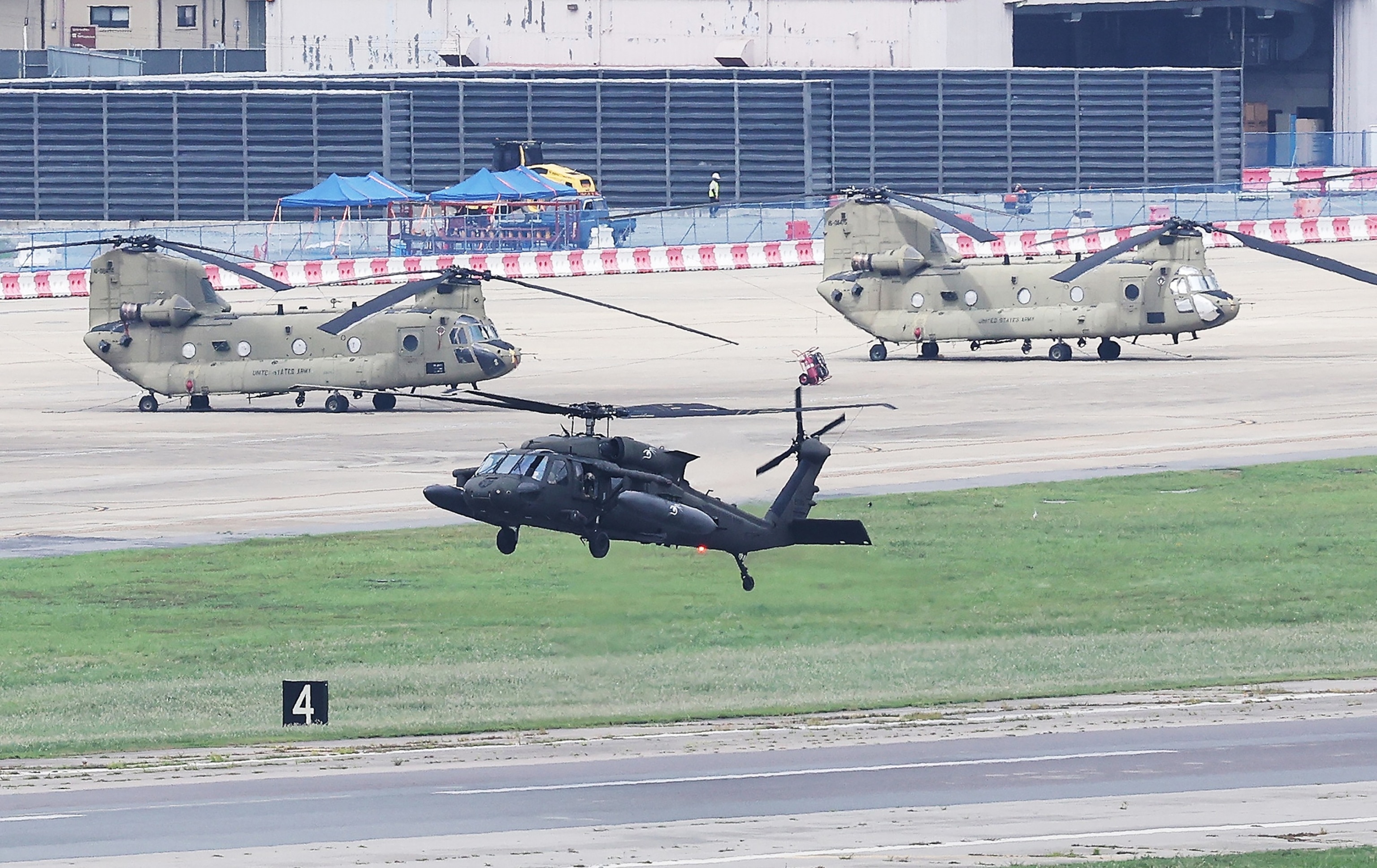
US-SK-drills-DB-260817_1786951340250_hpMain.jpg

A U.S. Army UH-60 Black Hawk helicopter flies at Camp Humphreys in Pyeongtaek, South Korea, on Aug. 17, 2026.
-/YONHAP/AFP via Getty Images

The annual U.S.-South Korea Ulchi Freedom Shield began on Monday. An official from the South Korean Ministry of Defense told ABC News that the military exercise now underway "will be carried on as planned."

South Korea is a longtime U.S. ally and hosts roughly 28,500 American troops. The U.S. presence on the peninsula has traditionally been intended to prevent a resumption of cross-border hostilities, with the Korean War of 1950-1953 having never officially ended.

In 2006, North Korea tested its first nuclear weapon and has since been expanding its atomic weapons stockpile -- despite international condemnation and sanctions led by successive U.S. administrations -- alongside a ballistic missile research program which has produced munitions capable of reaching the continental U.S.

In recent decades, the U.S. presence in South Korea has also become an important point of leverage in the strategic contest between Washington and Beijing, the latter having long served as Pyongyang's prime patron.

Trump's announcement came after North Korea on Friday threatened a strong response against the U.S. and South Korea in response to the planned drills.

In his post to social media, Trump also cited South Korea's refusal to join the U.S. military effort against -- and "denuclearization" of -- Iran, though said the issue was "somewhat unrelated (?)" to his decision to scale back the U.S.-South Korean drills.

In response to Trump's statement, South Korea's Ministry of Foreign Affairs told ABC News it hoped the "friendly relationship between the leaders of the United States and North Korea will lead to meaningful dialogue between Washington and Pyongyang and pave the way for discussions aimed at advancing peace and stability on the Korean Peninsula."

"The South Korean government has actively participated from the outset in international discussions aimed at securing a ceasefire in Iran and restoring freedom of navigation through the Strait of Hormuz," the ministry added.

Trump has long lauded his relationship with Kim, though the president's first term began with an extended period of tensions that saw Trump repeatedly refer to Kim as "little rocket man" and threaten Pyongyang with "fire and fury."
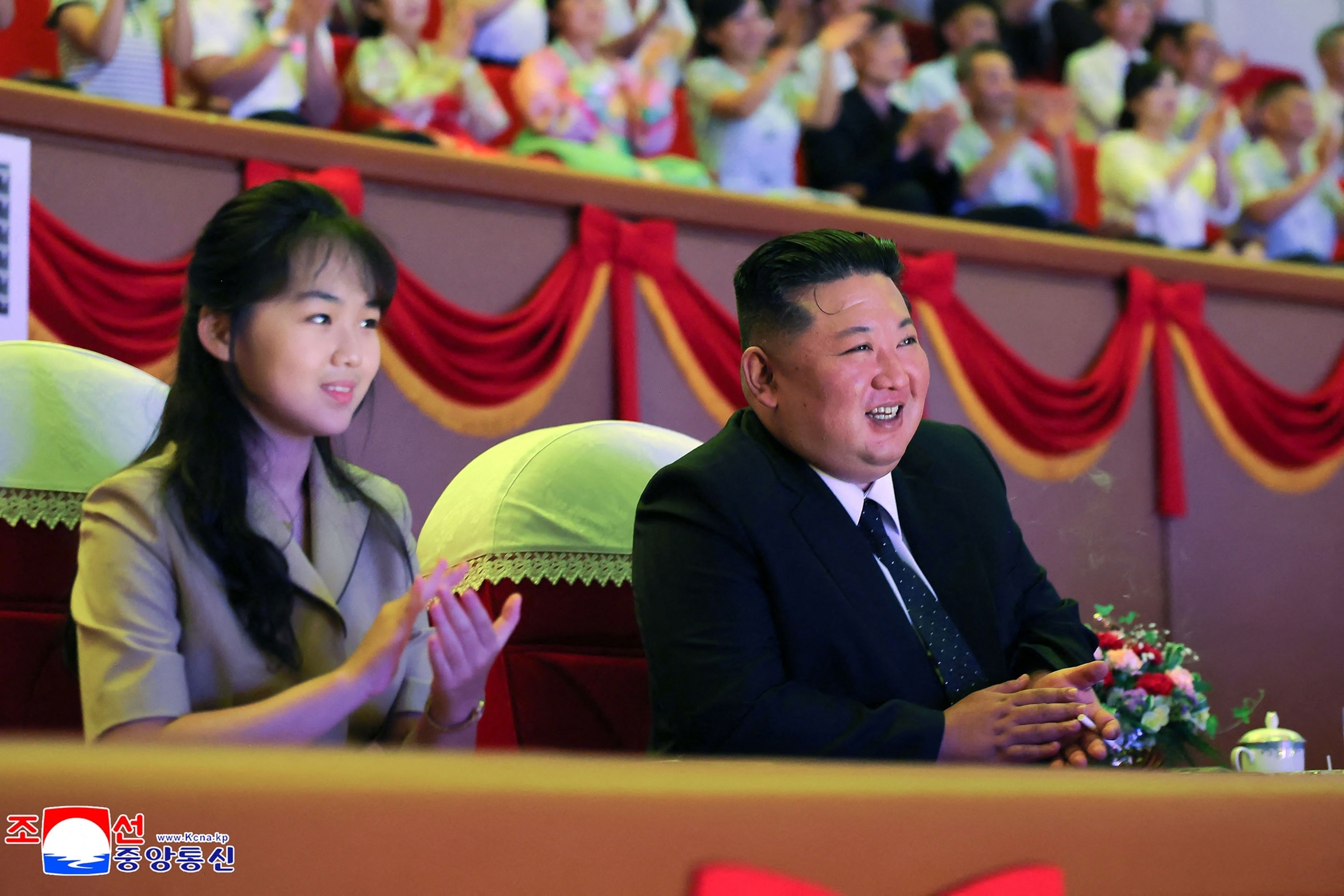
PHOTO: NKOREA-POLITICS-HISTORY-WWII

This picture taken on Aug. 16, 2026 and released by North Korea's official Korean Central News Agency (KCNA) via KNS on Aug. 17, 2026 shows North Korean leader Kim Jong Un and his daughter Kim Ju Ae in Pyongyang.
-/KCNA VIA KNS/AFP via Getty Images

But the discord gave way to a detente that saw Trump and Kim meet in person three times in 2018 and 2019 -- first in Singapore, then in Vietnam and later in the Demilitarized Zone between North and South Korea.

But despite seemingly improved ties and the in-person meetings, Trump failed to achieve his stated goal of North Korean denuclearization.

Since talks with Trump broke down in 2019, Pyongyang has maintained a steady rhythm of ballistic missile tests. Earlier this month and with the U.S.-South Korea military drills approaching, North Korea conducted two ballistic missile launches in quick succession.

Recent years have also seen North Korea pull closer to both Russia and Iran, putting Pyongyang in opposition to the U.S. and its allies in the conflicts in Ukraine and the Middle East.

On Saturday, Russian President Vladimir Putin said that Moscow-Pyongyang ties have reached an "unprecedented level of comprehensive strategic partnership."
 

Trump scales back US-South Korea military drills over China concerns, says ex-CIA officer​

17.08.2026

To view this content we will need your consent to set third party cookies.
For more detailed information, see our cookies page.
 
Trumpet too busy in West Asia fighting a war to bother with East Asia
 

Trump lashes out at South Korea over its refusal to join Iran war

Aug 17, 2026 6:50 PM EDT

To view this content we will need your consent to set third party cookies.
For more detailed information, see our cookies page.


Aug 18, 2026
Exercises between the American and South Korean militaries began as scheduled on Monday, even after President Trump demanded they be scaled back.

Trump said the war games were unnecessarily provocative, and a challenge to North Korean leader Kim Jong Un.
 
Trump trying to cozy up to Kim, looking for some favor in return ? Like Kim get rid of his nukes or agree to meet with Trump, haha. But, I don't think Kim will ever budge or even agree to meet Trump now NK has both Russia and China backing. Last time in Vietnam, Kim boy was humiliated by the mad man.
 
This guy is destroying every alliance that the USA has, and the deep state is allowing him to do it. There are no checks and balances on the orange idiot, he can literally do anything he wants regardless of whether it is in the interests of the USA or not.

This all points to fundamental design issue of "American democracy" and it's setup as a democracy.

All of these actions will have a long term material effect on how these countries view the reliability of the USA going forward, and it will force them to reconsider their own alliance network and that will be to the detriment of the USA. China must be laughing all the way to the bank right now !!!!

The Iranian FM is right, the orange clown is causing deep damage to the strategic interests of the USA.
 
Last edited:
Trump trying to cozy up to Kim, looking for some favor in return ? Like Kim get rid of his nukes or agree to meet with Trump, haha. But, I don't think Kim will ever budge or even agree to meet Trump now NK has both Russia and China backing. Last time in Vietnam, Kim boy was humiliated by the mad man.
Trump is a psycho. Kim will never give up nukes. Look at Ukraine they gave up nukes in exchange for a warm handshake.
 
This is just to punish south Korea for not getting directly involved in war. Trumps one bitter fk lol
 

Trump’s North Korea pivot is a warning for Japan​

The White House’s outreach to Kim Jong Un marks a test for the U.S.-led security order​

North Korean leader Kim Jong Un and U.S. President Donald Trump shake hands during a meeting on the south side of the Military Demarcation Line that divides North and South Korea, on June 30, 2019.  North Korea continues to develop its nuclear weapons and ballistic missile capabilities, while tensions between Japan and China — and between China and the United States — remain high.
North Korean leader Kim Jong Un and U.S. President Donald Trump shake hands during a meeting on the south side of the Military Demarcation Line that divides North and South Korea, on June 30, 2019. North Korea continues to develop its nuclear weapons and ballistic missile capabilities, while tensions between Japan and China — and between China and the United States — remain high. | AFP-JIJI

Aug 19, 2026

U.S. President Donald Trump has long touted his personal relationship with North Korean leader Kim Jong Un. Now that relationship is beginning to affect the military architecture that has underpinned security in Northeast Asia for decades.
As The Japan Times reported this week, Trump said he was scaling back what he called “costly” and “inappropriate” joint U.S.-South Korean military exercises, prompting speculation that he hopes to reopen direct talks with Kim. Citing his “very good relationship” with the North Korean strongman, Trump said he was “not happy” that Washington had agreed to participate in the exercises, which he described as sending an “inappropriate and hostile” signal to Pyongyang.

For Japan, those words carry consequences well beyond the Korean Peninsula. Regular U.S.-South Korean exercises are not simply displays of military power. They are an important measure of readiness and a visible demonstration of Washington’s commitment to its Asian allies. Scaling them back on the basis of a president’s personal relationship with Kim raises a larger question for Tokyo: How much can Japan continue to rely on a regional security architecture vulnerable to sudden changes in Washington?

The answer should not be to distance Japan from the United States. It should be to make Japan more capable of defending itself while making the U.S.-Japan alliance more durable. Tokyo must strengthen its own defense capabilities, deepen strategic cooperation with Washington and other regional partners, and ensure that Northeast Asian security rests on institutions and shared interests rather than the personal relationships of individual leaders.

The stakes are rising. North Korea continues to develop its nuclear weapons and ballistic missile capabilities, while tensions between Japan and China — and between China and the United States — remain high. Relations among China, Japan and South Korea add another layer of uncertainty to an already volatile region.

North Korea’s missile tests make the danger particularly immediate for Japan. Pyongyang’s growing arsenal is not an abstract threat but one that directly affects Japanese territory and the surrounding seas. At the same time, China’s expanding military power and increasingly assertive regional posture are forcing Tokyo to prepare for security challenges on more than one front.

Japan has already begun responding. Its military has steadily modernized, and defense spending has risen sharply. The fiscal 2026 defense budget exceeds ¥9 trillion and includes spending on U.S.-made Tomahawk cruise missiles for Japan’s Aegis-equipped destroyers, as well as domestically developed long-range standoff missiles. Last month, Prime Minister Sanae Takaichi’s Cabinet approved significant increases in military spending, pledging to “transform the country’s defense capabilities within five years.”

The transformation is significant. For decades, Japan’s postwar security policy was defined by a narrow interpretation of the exclusively defense-oriented posture that grew out of Article 9 of the Constitution. That approach has gradually evolved. Japan is now developing what the government calls “counterstrike capabilities,” allowing it, under certain circumstances, to strike an adversary’s missile bases and other military targets if an attack on Japan is under way and no other means of defense is available.

Tokyo maintains that these capabilities are defensive and consistent with the Constitution. But Japan’s neighbors do not necessarily see them that way.

China and South Korea remain particularly sensitive to any expansion of Japanese military power because of the legacy of Japan’s wartime aggression. Elsewhere in Asia, the response has been different. Some Southeast Asian countries increasingly see a stronger Japan as a potential counterweight to China’s growing military power and a contributor to regional stability.

That divergence presents Japan with a difficult challenge. Strengthening deterrence is necessary, but doing so in ways that heighten insecurity among neighboring countries could contribute to the very instability Japan is trying to prevent. A buildup that encourages others to accelerate their own military expansion risks creating a classic security dilemma: Each country takes steps it considers defensive, while its neighbors interpret those same steps as threatening.

Japan therefore needs more than missiles and a larger defense budget. It needs transparency, strategic communication and confidence-building measures designed to reassure its neighbors about the purpose and limits of its expanding capabilities.

Just as important, the stability provided by the U.S.-Japan alliance cannot depend excessively on the personalities of individual leaders or the transactional politics of a particular administration. Alliances are most credible when they are institutionalized. Japan and the United States should deepen joint military planning, conduct regular exercises, strengthen command coordination and maintain sustained political consultations. The objective should be to make the alliance resilient enough to withstand political changes in either capital.

Japan also needs to broaden its network of security partnerships. Stronger ties with South Korea, Australia and the Philippines can reinforce deterrence while demonstrating that Japan’s military expansion is part of a wider regional security framework rather than a return to unilateral militarization.

South Korea is especially important. Historical disputes have repeatedly complicated cooperation between Tokyo and Seoul, but geography leaves both countries facing many of the same threats. Trilateral cooperation among Japan, South Korea and the United States remains essential to deterrence and stability in Northeast Asia. Political differences should not be allowed to undermine cooperation on missile defense, intelligence sharing, military readiness and crisis management.

Yet military deterrence alone cannot produce lasting peace. Even as Japan strengthens its defenses, Tokyo must continue diplomatic efforts to manage its disputes with China, South Korea and North Korea. That means keeping communication channels open even when relations deteriorate and repeatedly making clear that Japan’s expanding defense capabilities are intended to preserve regional stability, not overturn it.

The larger challenge is to combine deterrence with reassurance. Japan must be capable of defending itself without convincing its neighbors that they, in turn, need to defend themselves against Japan.

Trump’s approach to North Korea has made that task more urgent. A U.S. president’s personal relationship with Kim may create opportunities for diplomacy, and dialogue with Pyongyang should be welcomed when it can reduce tensions. But personal diplomacy cannot substitute for a durable security architecture.

Japan is entering a period in which it will have to assume greater responsibility for its own defense while continuing to rely on the United States as its indispensable ally. Those goals are not contradictory. A stronger Japan can make the alliance stronger — provided that Washington’s extended deterrence remains credible and Tokyo’s expanding military capabilities are embedded in a broader strategy of regional cooperation and diplomacy.

That is the balance Japan now has to strike: stronger defenses without an arms race, greater strategic autonomy without abandoning the U.S. alliance, and deterrence without closing the door to diplomacy. In an increasingly uncertain Northeast Asia, Japan can no longer take the regional security order for granted. It must help build one capable of surviving changes in leaders — in Washington, Pyongyang and beyond.

 
Trumpet too busy in West Asia fighting a war to bother with East Asia
It's all because Kim says nice things to him and according to Donald they get along.

Anyone that says nice things or flatters Trump will get pretty much whatever they want.

This is of course temporary so people celebrating shouldn't get too excited.
 
A good decision from President Trump....

Monroe Doctrine 2.0 is being uploaded. The motto is simple: no safe place in the world other than the USA. Therefore, if you're really smart and wealthy enough you know where to move to with your talent and wealth. As for what's happening outside the USA, too bad and can't give a rat's a$$....
 

Trump says will meet North Korea's Kim later this year​

Washington (United States) (AFP) – US President Donald Trump said Wednesday he would meet North Korean leader Kim Jong Un later this year, in what would be their first encounter of Trump's second term.

Issued on: 19/08/2026 - 18:13

Donald Trump defended planning to meet North Korea's Kim Jong Un at the same time as the US president wages a war with Iran
Donald Trump defended planning to meet North Korea's Kim Jong Un at the same time as the US president wages a war with Iran © Jim WATSON / AFP

Trump also said that North Korea had 57 "very powerful" nuclear weapons, in a rare and unusually specific assessment by a US president of Kim's atomic arsenal.

"Yeah, I will be," Trump told reporters during a tour of a new helipad he is building at the White House, when asked if he planned to meet Kim later in 2026.

Trump gave no details, but the Wall Street Journal reported that he was eying a meeting when he travels to China for an Asia-Pacific Economic Cooperation (APEC) summit in November.

Trump defended planning to meet Kim at the same time as the US president wages a war with Iran that he has justified on the grounds of preventing Tehran from getting the bomb.

"He has 57 very powerful nuclear weapons. Should have never allowed it to happen... If I were president, I wouldn't have allowed it," Trump said, referring to the North Korean leader.

"But he's got them. I get along with him very well. I can't let Iran have a nuclear weapon. And I know Kim Jong Un very well, and he's going to be fine."

Trump's announcement comes two days after he ordered the United States to scale back "inappropriate and hostile" military drills with South Korea.

The US leader cited his "good relationship" with Kim in the decision.

Trump and Kim met three times in his first spell in the White House, and at the time he said they "fell in love" after exchanging "beautiful letters." But they haven't met in his second term.

In recent days Trump has dropped growing hints about communications with Kim, although he wouldn't confirm on Wednesday that the pair were exchanging letters.

The powerful sister of Kim Jong Un said Wednesday she was "unaware" of reported communication between her brother and Donald Trump, but said ties between the two remained "excellent."

 
Seems that Trump has found his new long lost younger brother, full of love and affection.
 
Seems that Trump has found his new long lost younger brother, full of love and affection.
Oh yes.. you can feel the love coming off of both of them when they get together

Kim is Trump's soulmate.
 

Users who are viewing this thread

Back
Top