China’s Recent J-36 Heavy Stealth Tactical Jet Testing Offers New Insights Into Its Evolving Design
Recent video footage of the J-36 undergoing flight testing shows continued refinement of its design and new features.
PUBLISHED SEP 23, 2026 5:36 PM EDT
China’s Chengdu Aircraft Corporation continues to press ahead with the development of its
‘J-36’ next-generation tailless heavy tactical jet. Recent flight testing has offered interesting new views of
the still-evolving stealthy design from the top and behind, prompting discussion about the aircraft’s features. There has also been talk recently about whether the jet might receive a laser directed-energy weapon at some point in the future.
The
J-36 first broke cover, along with another next-generation tailless tactical jet design
generally referred to as the J-XDS,
back in December of 2024. There are understood to be at least four, and possibly five, J-36 prototypes flying now. A number of significant changes
between prototypes have already been observed over the past two years, as you can read more about
here.
The most recent video of a J-36 test flight, seen in the social media post below, began circulating online yesterday. The footage shows the aircraft coming in to land, providing good general views of the
uniquely three-engined jet with its two-seat, side-by-side cockpit configuration, especially from the rear aspect. What is seen underscores a previously observed total revision of the exhausts from a trough style to a two-dimensional thrust-vectoring configuration
akin to what is found on the U.S. F-22 Raptor. This and other significant changes to the design, including the addition of
divertless supersonic intakes (DSIs) all around, not just on top,
first emerged last year. The clip also offers a good reminder of
just how wide the aircraft is overall.
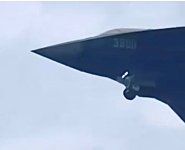
As this particular J-36 passes by, it can be seen to have a lighter-colored radome, as well as at least one relatively large lighter-colored section on top of the dorsal air intake. A similarly colored radome was first spotted on what is said to be the fourth prototype back in July. This coloring could point to the installation of actual radar in the aircraft’s nose. In
TWZ‘s first in-depth analysis of the J-36 back in 2024, we assessed that the jet’s very broad radome area could house an absolutely massive primary array.
The lighter section on top of the fuselage could be an aperture for a conformal antenna tied to a beyond-line-of-sight communications and data-sharing suite.
In 2024, we posited that the heavyweight J-36 could serve as an intelligence-gathering and communications relay platform in addition to performing tasks more typically associated with tactical combat jets. Reliable and multi-faceted connectivity would be key for employing the J-36 as an airborne controller for
advanced air combat drones, as well.
Captures from the video above highlighting the lighter-colored radome and section on top of the center of the fuselage.
Chinese internet captures via X
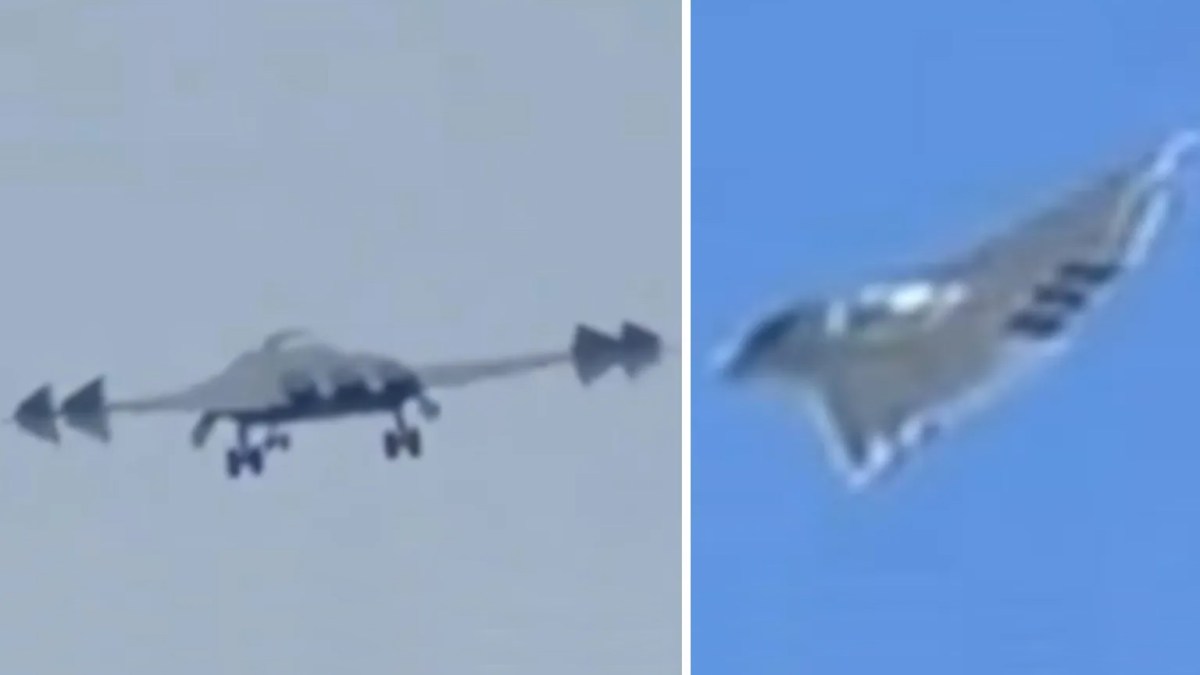
Another J-36 flight testing video that emerged on Monday, seen below, offers an additional view of the top of the jet, showing multiple lighter-colored sections that would appear to be additional conformal apertures for various antennas. There is a lighter-colored rectangular outline painted around part of the intake on top of the center of the fuselage, as well. The jet’s full paint scheme includes lighter-colored leading and trailing edges, which are critical structures on low-observable (stealthy) designs that often contain additional antenna arrays. Overall, the two-tone coloring is very much in line with what is seen on
operational J-20 fighters in Chinese service today. The original J-36 prototype, at least, has notably worn
a splinter-type camouflage paint scheme.
Whether or not the two recent video clips show the same J-36 prototype is unclear. The possibility has now been raised that Chengdu may be
using a single serial number (36011) on
at least some of the J-36 prototypes, a decision that could have been made for counter-intelligence and/or deliberate misinformation/disinformation purposes.
Much still remains unknown about the current or expected future capabilities of the J-36. Aviation Industry Corporation of China (AVIC) did have a placard at its
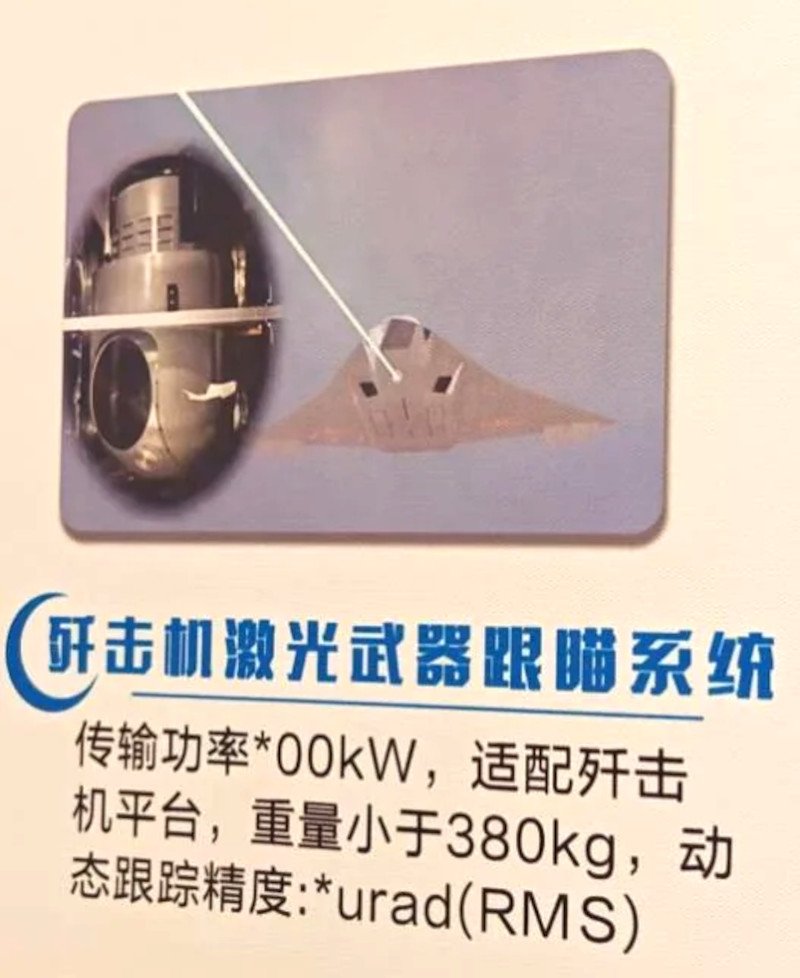
booth at the 14th China International Defence Electronics Exhibition earlier this month that has prompted questions about whether the jet could be equipped with a laser directed-energy weapon. Chengdu falls under the umbrella of AVIC, which is a state-run enterprise. The Chinese-language placard in question describes a “laser weapon tracking system” with a power rating of “*00” kilowatts and a weight of “less than” 837.7 pounds (380 kilograms), per a machine translation. The way the power rating is written appears to mean that it is in the hundreds of kilowatts, which would put it
firmly in a class capable of doing physical damage to objects, such as incoming missiles and drones.
Furthermore, an associated graphic shows a turreted system and a computer-generated rendering of a J-36 projecting a beam. The render appears to be from a video that depicts a J-36 using a laser to destroy other aircraft. Another computer-generated video that shows a J-36 using retractable lasers to shoot down incoming missiles has
been circulating online since at least last year.
AVIC showed this at the 14th China International Defence Electronics Exhibition earlier this month.
Chinese internet via X
It is not immediately clear how official either of the clips depicting laser-armed J-36s might be, or whether they at all reflect real planned capabilities. The full placard presented at the China International Defence Electronics Exhibition, as seen in the video below, shows a variety of different laser systems, and not just for aerial applications.
The fielding of operational laser directed-energy weapons capable of inflicting any real physical damage has
historically proven to be very challenging, and even more so within the size, power-generation, and cooling constraints presented by modern combat jets. As an example, the U.S. Air Force spent roughly a decade working on a podded laser weapon system that tactical jets could use to swat down incoming missiles under its
Self-protect High Energy Laser Demonstrator (SHiELD) program. In 2024, the service confirmed
SHiELD had “concluded” without achieving its goal of an actual flight test. That same year,
the Air Force cancelled plans to test a laser weapon system on an AC-130 gunship.
Despite important U.S. strides more recently when it comes to
fielding ground-based and
naval laser weapon systems, “there’s nothing that’s on the shelf right now that we are ready to put onto an airplane,” U.S. Air Force Brig. Gen. Douglas Wickert, the commander of the Air Force Research Laboratory (AFRL), told
TWZ and other outlets just last week at a roundtable at the Air & Space Forces Association’s (AFA)
2026 Air, Space & Cyber Conference on Tuesday. “The
solid-state lasers and the power density and the different ways that you actually – there’s actually a lot of secret sauce in that. How do you make the beam, and how do you form the beam, and how do you pulse the beam, and all that’s in development.”
‘There’s development of the laser itself, but now the power and thermal management system has progressed so much that we can provide the power needed,” Dr. Michael Gregg, head of AFRL’s Air Warfare Directorate, said at the same roundtable. “We’ve also had new designs and engines that we know have the power … to direct that power in certain areas. So, from a system perspective, it’s much more feasible because everything has matured over the last decade.”
China has certainly made substantial investments of its own
in laser and
other directed-energy weapon capabilities
across domains in
recent years, and this is clearly an area of interest for the People’s Liberation Army (PLA), in general. When it comes to the J-36 specifically,
TWZ has explicitly highlighted in the past how the three-engine configuration could be particularly useful for producing sufficient power to support a host of advanced and electricity-hungry sensors and other capabilities, including directed energy weapons.
Larger questions remain about the exact set of roles the J-36 is expected to fill, as well. The basic design is certainly optimized for straight-line performance, combat radius, and payload rather than maneuverability and agility. The jet has already caused a significant amount of debate just when it comes to taxonomy, as it does not seem to fit inside traditional definitions of ‘fighters’ and ‘bombers,’ something
we have explored in detail previously.
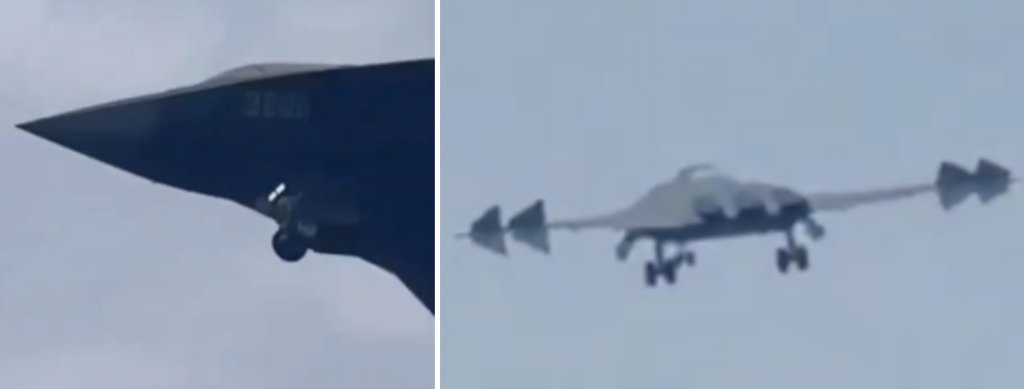
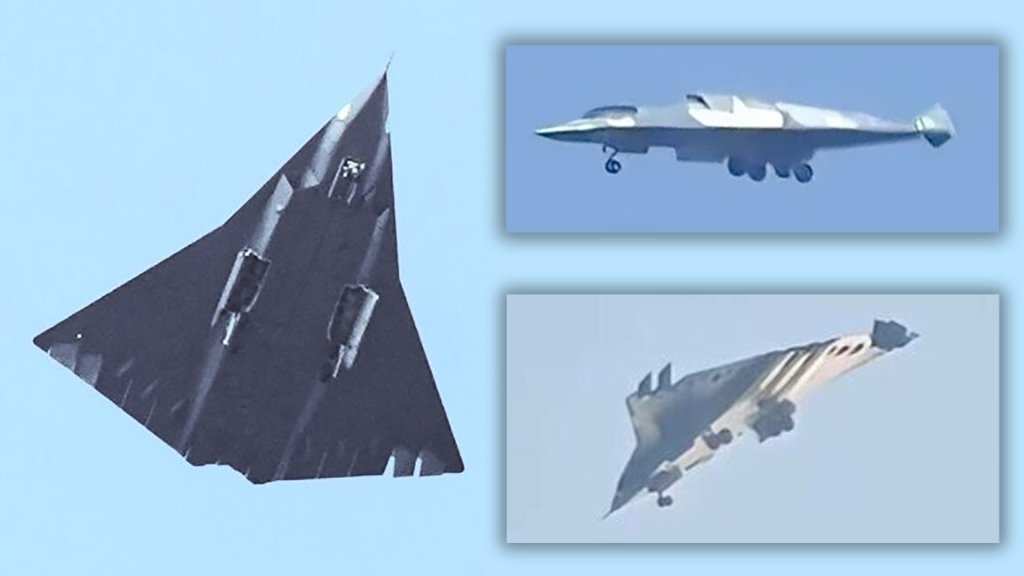
A composite of other views of the J-36 that have emerged since 2024.
Chinese Internet via X
“According to Yang Wei – chief designer of the J-20 –, the new [J-36] fighter can penetrate heavily defended airspace that the J-20 and comparable F-22s or F-35s must avoid, placing it a generation ahead,” Andreas Rupprecht, an analyst specializing in Chinese military aviation and
TWZ contributor, wrote
in a post on LinkedIn last week. “With lower RCS [radar cross section], high speed, and the capacity to control more drones, it could act as a node and command center for systems including J-20s and, especially, unmanned aircraft, while attacking high-value targets from stand-off range with long-range weapons.”
“The type could therefore represent a new class of ‘fighter,'” he added. “Online terms include ‘theater-level deep-penetration command combat aircraft’ and ‘high-performance fighter,’ analogous to a cruiser ranking above a destroyer within the Navy. Recent evidence gives this theory new weight and warrants continued monitoring.”
The J-36, as well as the J-XDS, reflect a larger burst of next-generation air combat developments in China in recent years. This includes an array of new crewed and
uncrewed aircraft designed for
operations from bases on land, as well as
from the PLA Navy’s (PLAN) growing fleet of
aircraft carriers and
big-deck amphibious assault ships. The
Chinese aviation industry’s development of a
growing array of
flying-wing uncrewed aircraft, some of which
are very large, has been particularly notable.
In turn, there is something of an emerging gap between these developments and the pace at which the U.S. military is moving along similar lines, at least publicly.
Boeing’s sixth-generation F-47 for the U.S. Air Force is not expected to take to the skies for the first time until 2028, though preceding
demonstrator designs have been flying for years already. The U.S. Navy still has
yet to officially announce a winner of its F/A-XX next-generation carrier-based fighter competition, and the
current timeline for that program producing an operational aircraft is unclear.
A rendering the US Air Force has released of the F-47.
USAF
As an aside, based on what has emerged publicly to date, there are signs that the F-47 may reflect a distinctly different design philosophy that puts greater emphasis on maneuverability compared to the J-36, and even likely the J-XDS. As mentioned, the J-36 certainly seems much more focused on payload, range, and level flight performance. In July,
TWZ published a deep dive exploring why the U.S. Air Force would pursue a sixth-generation fighter with rear-swept wings, canards, and other features despite steady trends in the opposite direction visible in Chinese designs and ones elsewhere globally.
Regardless,
U.S. officials have downplayed questions about China’s gaining ground in the air combat arena, or even surging into the lead in certain areas,
in the past. “Chinese sixth-generation aircraft are in the nascent stages of development and expected to be operational by 2035,” the Pentagon wrote in its most recent annual report on military and security developments in China, which was published in December 2025.
In the meantime, the J-36’s design is already steadily being refined, and the total fleet of prototypes has been growing, offering new insights into the aircraft’s expected capabilities and roles.
Recent video footage shows continued refinement of the J-36 design, and there has also been talk of laser armament for the jet.

www.twz.com


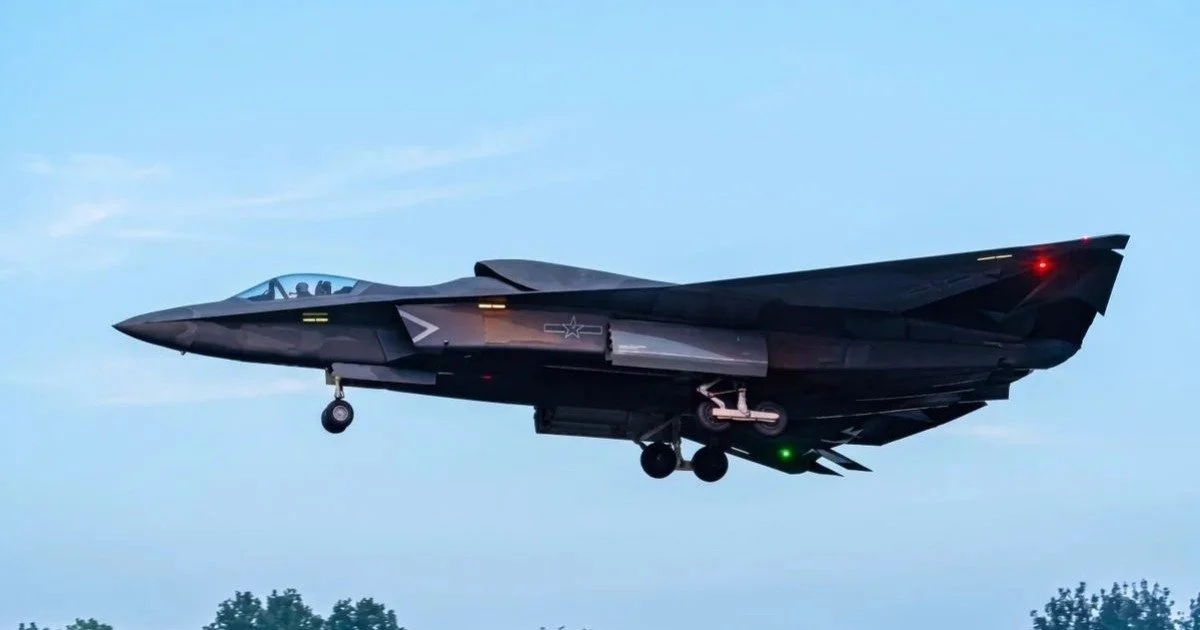 The J-36 is continuing its flight tests; the prototypes have different configurations.