PAF pilot highlights how chinese J10C fighters has edged US F16's

PAF could do that probably but lets look at 2-3 different variations.

1. J-35 induction:
-> F-16 remains at MLU 3/5, ADF and Block 52+
->J-10 stands at 36
->J-35 comes up to 18, which brings in dynamics of stealth in air combat for PAF

2. J-35 isnt inducted
->J-10 reaches 72 in numbers. That gives PAF a true multirole frontline fighter that takes all responsibilities of F-16s squadrons.
-> JF-17 remains as attrition backbone.
-> F-16 status is undecided as universal circumstances dictate if USA offers FMS package for upgradation at a lower cost that PAF accepts

3. J-35 isnt inducted.
-> PAF decides to induct UCAV squadrons instead of a manned fighters. This brings in thousands of LMs along with wingman type UCAVs that can carry PL-17s or PL-19s.
-> PAF considers that 36-40 x J-10 as the frontline fighter.
-> JF-17 and UCAVs combo become the main offensive force of PAF, where JF-17s fly with UCAVs behind a salvo of LMs to conduct strikes.
-> F-16 status as in previous scenario.

Which scenario would you prefer and why ?
I prefer scenario 1.

We will have both J-35s and J-10Cs.

Plus the J-35 is a vastly superior bird to J-10Cs and F-16s.

1792187039594.png
 
Last edited:
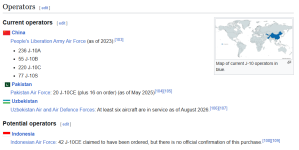
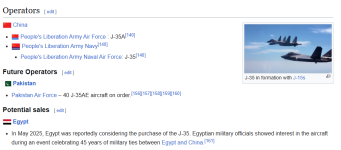
According to Wikipedia Pakistan has already ordered 40 J-35.

This is a great boost to our air force. Insh'Allah.

Current operators of J-10Cs. J-10Cs is a solid product, but this J-35 is much better.

Didn't know Uzbekistan our brotherly nation also operates J-10Cs.

1792196406802.png
 
wiki is one of the most unreliable source, don't believe Wikipedia
Yeah, but with wikipedia you get the basic gist of it.

You can also go to China Daily, Dawn news, Jane's weekly, Xinhua, ARAB NEWS, Al Jazeera, etc.
 
Yeah, but with wikipedia you get the basic gist of it.

You can also go to China Daily, Dawn news, Jane's weekly, Xinhua, ARAB NEWS, Al Jazeera, etc.
These sources that you're referring are saying that that Pakistan already ordered 40 J-35? please post some of the articles from these sources, Thanks
 
These sources that you're referring are saying that that Pakistan already ordered 40 J-35? please post some of the articles from these sources, Thanks
Read this:

Pentagon Confirms China’s Offer of 40 J-35 Stealth Fighters to Pakistan, Reshaping South Asia’s Airpower Balance​

The Pentagon’s 2025 China Military Power Report confirms Beijing’s offer of up to 40 fifth-generation J-35 stealth fighters to Pakistan, marking a decisive escalation in Sino-Pakistani defence cooperation and redefining the strategic airpower equation vis-à-vis India.​

ImageEnglishInternationalNews
By admin On Dec 25, 2025
J-35A
Pengesahan rasmi China terhadap gelaran pesawat pejuang halimunan tentera laut J-35 sebagai “Blue Shark” membawa makna jauh lebih besar daripada sekadar penjenamaan, kerana ia menandakan peralihan daripada simbol prototaip kepada doktrin peperangan kapal pengangkut pesawat yang sebenar.
Explore History

Share
(DEFENCE SECURITY ASIA) — The confirmation by the United States Department of Defense (Pentagon) that China has formally offered Pakistan up to 40 fifth-generation J-35 stealth fighter aircraft represents one of the most consequential inflection points in South Asian airpower since India’s induction of the Rafale, with the revelation embedded in the 2025 “Military and Security Developments Involving the People’s Republic of China” report underscoring a rapidly accelerating Sino-Pakistani defence convergence aimed squarely at reshaping the regional military equilibrium.

This disclosure, which surfaced quietly yet deliberately within the Pentagon’s congressionally mandated assessment, reinforces earlier Pakistani acknowledgements from mid-2025 and elevates them from speculative signalling into a confirmed strategic trajectory, one that fuses China’s export ambitions with Pakistan’s long-standing requirement to offset India’s qualitative and numerical airpower advantages through asymmetric technological leaps.


J-35A
J-35
The Pentagon’s own language captures the strategic breadth of China’s export posture, noting that “China offers three combat aircraft for export, including the fifth generation FC-31 and the fourth generation J-10C multirole combat aircrafts, and the China-Pakistan co-produced JF-17 light combat aircraft,” a formulation that defence planners interpret as implicitly encompassing the J-35 lineage derived from the FC-31 development stream.


Track Defense News


Further contextual clarity is provided by the report’s statement that “J-10C As of May 2025: delivered 20 units—their only J-10C exports—to Pakistan as part of two previous orders totaling 36 since 2020,” a detail that highlights how Islamabad has already been positioned as China’s primary operational testbed for advanced combat aviation exports.


https://clck.mgid.com/ghits/2818657...=1792197190&wrst=1792197219&muid=q2uBNKeh_IPg
It Cleans Your Arteries Better Than Pills! Try It Tonight
Glycogen Control
https://clck.mgid.com/ghits/2818657...=1792197190&wrst=1792197219&muid=q2uBNKeh_IPg
Your Blood Pressure Becomes 120/80 And Your Arteries Clear In 10 Days
Glycogen Control
Crucially, the Pentagon frames these transactions as part of Beijing’s broader reliance on “flexible terms and creative side payments” to expand its defence-industrial footprint, a model that aligns seamlessly with Pakistan’s fiscal constraints while deepening strategic interdependence under the umbrella of China’s Indo-Pacific counter-containment doctrine.

Join the Air Force


The confirmation also signals a doctrinal inflection in Beijing’s export policy, where fifth-generation combat aviation is no longer treated as a strategically sequestered national asset but as a scalable geopolitical instrument intended to hard-wire partner air forces into China-centric operational, logistical, and intelligence ecosystems.

By positioning Pakistan as a launch customer for an export-oriented stealth fighter, China is effectively compressing the traditional maturation curve of fifth-generation platforms, accepting measured technology diffusion risks in exchange for immediate strategic leverage against India and its Western security partners.


For Islamabad, the prospective induction of the J-35 is not merely a force-structure upgrade but a deliberate attempt to reframe the airpower balance from numerical parity toward survivability-centric deterrence, where stealth, first-look advantage, and networked kill-chains offset India’s expanding inventory of high-end fourth-plus-generation fighters.

At the regional level, the Pentagon’s acknowledgement elevates the J-35 offer from bilateral arms diplomacy to a strategic signalling event, implicitly warning that South Asia is entering a phase where fifth-generation capabilities may proliferate asymmetrically rather than symmetrically, increasing escalation uncertainty in crisis scenarios.

Taken together, these dynamics suggest that the J-35 proposal is less about immediate platform numbers and more about reshaping the decision-making calculus of adversaries, compelling India to accelerate costly counter-measures while anchoring Pakistan more deeply within China’s long-term Indo-Pacific military architecture.


Pentagon Assessment Reveals a Strategic Export Doctrine, Not a One-Off Arms Offer​

The 2025 China Military Power Report, released on 23 December 2025, articulates a deliberate shift in Beijing’s defence-industrial behaviour from cautious technology retention toward calculated diffusion of high-end capabilities to trusted partners, with Pakistan occupying a uniquely privileged position within this evolving export hierarchy.


Rather than presenting the J-35 offer as an isolated transaction, the Pentagon situates it within a continuum of Chinese arms exports designed to reinforce alliance resilience, expand operational interoperability, and embed recipient forces within Chinese logistics, training, and sustainment ecosystems.


The report’s explicit enumeration of Pakistan alongside recipients of Caihong and Wing Loong strike-capable UAVs—systems already operationally proven in multiple theatres—underscores how the J-35 proposal complements an existing layered architecture of Chinese-origin ISR, strike, and command-and-control assets within Pakistan’s force structure.


This architecture extends well beyond aviation, encompassing four advanced frigates sold to Pakistan in 2018, intelligence-sharing agreements focused on Afghanistan and Xinjiang-linked security threats, and sustained co-production arrangements that have transformed Pakistan from a passive importer into an active partner within China’s defence-industrial strategy.

The Pentagon’s assessment implicitly acknowledges that the export of a fifth-generation stealth platform to Pakistan would mark the first time China allows a foreign air force to operate a stealth aircraft broadly comparable in mission profile—if not absolute maturity—to Western platforms such as the F-35, thereby signalling growing confidence in its own counter-intelligence controls and technological margins.


Pakistan’s June 2025 Disclosure Framed a Multi-Layered Airpower Leap​

The Pentagon’s confirmation directly reinforces Pakistan’s June 2025 announcement that China had proposed a comprehensive defence package comprising “40 fifth-generation Shenyang J-35 stealth aircraft, Shaanxi KJ-500 Airborne Early Warning and Control (AEW&C), and HQ-19 air defense systems,” a disclosure that immediately redefined Islamabad’s future force-planning assumptions.

Buy Maps


That announcement, initially foreshadowed by controlled leaks in December 2024 and later affirmed by Pakistan’s air leadership in January 2025, was accompanied by indications that deliveries could begin “within months,” a timeline reflecting both urgency and political intent amid rising Indo-Pakistani and Sino-Indian tensions.

The inclusion of the KJ-500 AEW&C, equipped with a fixed AESA radar providing full 360-degree coverage, would dramatically enhance Pakistan’s battle-management capability, enabling the J-35 to operate within a networked sensor-shooter construct that maximises stealth penetration while minimising exposure.

Meanwhile, the proposed HQ-19 missile defence system, often described as China’s functional analogue to the US THAAD, would introduce a new layer of ballistic and hypersonic interception capability, directly complicating India’s evolving missile posture and its reliance on standoff precision strike options.

Together, these systems would constitute a vertically integrated airpower ecosystem, enabling Pakistan to contest airspace, protect critical nodes, and project credible deterrence despite persistent resource asymmetries with India.


Beyond platform counts, the proposed package represents a doctrinal migration toward system-of-systems warfare, where the J-35’s survivability is amplified by persistent airborne sensing from the KJ-500 and layered strategic shielding provided by the HQ-19, collectively compressing Pakistan’s sensor-to-shooter timelines.


Compare Cars


The integration of AEW&C, stealth strike, and missile defence into a single acquisition framework reflects a Chinese preference for exporting complete operational architectures rather than standalone platforms, thereby reducing Pakistan’s dependence on heterogeneous Western-origin command-and-control solutions.

Such a vertically integrated construct would allow the Pakistan Air Force to transition from reactive air defence toward proactive airspace denial, enabling early detection, forward interception, and controlled escalation across contested theatres such as Kashmir and the western sector of the Line of Actual Control.


From a force-planning perspective, the simultaneity of these proposed acquisitions suggests Islamabad is preparing not for isolated contingencies but for sustained, multi-domain confrontation scenarios in which endurance, redundancy, and information dominance are as decisive as raw kinetic performance.

In strategic terms, the June 2025 disclosure indicates that Pakistan views fifth-generation stealth aircraft not as prestige assets but as central nodes within a broader deterrence architecture designed to offset India’s numerical depth through survivability, integration, and escalation control.


The J-35 as a Strategic Equaliser Against India’s Rafale-Centric Doctrine​

The induction of up to 40 J-35 stealth fighters into the Pakistan Air Force would represent a qualitative discontinuity rather than an incremental upgrade, granting Islamabad the ability to conduct low-observable penetration, first-day-of-war strike missions, and advanced counter-air operations previously beyond its reach.

Explore History


Derived from the Shenyang FC-31 programme, the J-35 is a twin-engine, multirole stealth aircraft optimised for air superiority, precision strike, and maritime interdiction, with reported performance parameters including a top speed of approximately Mach 1.8 and a combat radius exceeding 1,200 kilometres.


Its internal weapons bays, reduced radar cross-section, advanced sensor fusion, and datalink integration are designed to operate within China’s broader kill-chain doctrine, a framework Pakistan has steadily adopted through platforms such as the J-10C and JF-17 Block III.

Against India, the strategic implications are stark, as a stealth-enabled PAF would be positioned to contest Indian air dominance by neutralising high-value assets, degrading air-defence networks, and challenging the survivability of platforms such as the Rafale, Su-30MKI, and forthcoming Tejas Mk2.

India’s own response—accelerating the AMCA programme, deepening cooperation on GE F414 engine production, and exploring pathways toward F-35 acquisition—reflects an acknowledgement that the regional airpower balance is entering a new phase defined by stealth-centric escalation dynamics.


A Historical Alliance Enters Its Most Advanced Phase Yet​

The J-35 offer represents the latest evolution in a China-Pakistan military relationship forged in the aftermath of the 1962 Sino-Indian War and consolidated through decades of strategic convergence driven by shared threat perceptions vis-à-vis India.

Over time, China has emerged as Pakistan’s principal arms supplier, accounting for over 70 percent of Islamabad’s major weapons imports between 2018 and 2023, a dominance cemented by landmark programmes such as the JF-17 Thunder, which itself has achieved export success with deals valued at US$4.6 billion (approximately RM21.6 billion).

Naval cooperation, including the induction of advanced Chinese-built frigates and submarines, has reinforced Pakistan’s maritime posture in the Arabian Sea, while intelligence-sharing arrangements formalised in 2020 expanded collaboration against transnational militant networks and regional instability.

Joint exercises such as Shaheen for air forces and Warrior for special operations have further enhanced interoperability, creating an operational familiarity that lowers the integration threshold for platforms as complex as the J-35.

For Beijing, Pakistan functions not merely as an ally but as a strategic proving ground, offering real-world operational feedback while advancing China’s ambition to normalise fifth-generation exports beyond its own borders.


Regional and Global Repercussions Extend Far Beyond South Asia​

The Pentagon’s confirmation of the J-35 offer reverberates across the Indo-Pacific and beyond, signalling China’s arrival as a mature exporter of near-peer military technology and challenging long-standing Western monopolies in advanced combat aviation.

For the United States, the development underscores the limits of technology denial strategies and reinforces concerns articulated in the report that China is rapidly expanding its military influence through export-driven partnerships aligned with initiatives such as the China-Pakistan Economic Corridor (CPEC).

The report’s observation that “The PLA Navy sought to produce six aircraft carriers by 2035, bringing the total count from three to nine, exceeding observers’ expectations,” contextualises the J-35 offer within a broader maritime-aerospace expansion designed to contest US power projection across multiple domains.

Beyond South Asia, interest from countries such as Egypt, Iran, and Uzbekistan in Chinese combat aircraft suggests that Pakistan’s experience with the J-35 could shape future procurement decisions across the Middle East and Africa.

In Southeast Asia, where states like Malaysia and Indonesia are navigating delicate balances between great powers, the operationalisation of a Chinese stealth fighter in Pakistan will inevitably influence threat perceptions, procurement calculus, and regional deterrence architectures.


Despite its strategic allure, the J-35 proposal is not without constraints, as questions persist regarding engine maturity, stealth optimisation, and long-term sustainment costs compared with Western fifth-generation platforms.

Pakistan’s own economic pressures, including IMF-linked fiscal discipline and elevated debt servicing obligations, raise questions about financing timelines, even if China’s “flexible terms” mitigate immediate budgetary strain.

Nevertheless, the strategic logic underpinning the offer suggests that Beijing may prioritise geopolitical returns over commercial profitability, viewing the deployment of J-35s in Pakistan as a force-multiplier for its broader regional strategy.


A Defining Moment in Asian Airpower Evolution​

The Pentagon’s confirmation that China has offered 40 J-35 stealth fighters to Pakistan marks a defining moment in Asian security affairs, one that elevates Sino-Pakistani defence cooperation into the fifth-generation era while compelling India, the United States, and regional stakeholders to recalibrate their strategic assumptions.

As China continues to leverage arms exports as instruments of influence rather than mere transactions, and as Pakistan positions itself at the forefront of this transformation, South Asia’s airpower landscape is poised for a period of intensified competition defined by stealth, networks, and escalation control.


With delivery decisions, timelines, and counter-responses still unfolding, the J-35 offer stands as both a symbol and a catalyst of a rapidly shifting balance of power in one of the world’s most volatile strategic theatres.

At its core, the J-35 offer illustrates how airpower in Asia is no longer evolving through incremental platform upgrades but through abrupt capability leaps designed to disrupt established deterrence equations and force costly, time-sensitive countermeasures.

For India, the prospect of a stealth-capable Pakistan Air Force introduces a new layer of strategic uncertainty, compelling New Delhi to reconsider not only force modernisation timelines but also the survivability of its airbases, ISR assets, and command nodes in the opening phases of a high-intensity conflict.

From Washington’s perspective, the Pentagon’s confirmation underscores a broader concern that China is increasingly willing to externalise advanced military capabilities to trusted partners as a means of stretching U.S. and allied resources across multiple, interconnected theatres.

The development also signals that fifth-generation airpower is no longer an exclusive preserve of Western alliances, but a tradable strategic commodity that Beijing can deploy selectively to shape regional power balances without direct military confrontation.

In operational terms, the introduction of the J-35 into South Asia would compress decision-making timelines during crises, as stealth-enabled platforms reduce warning indicators and increase the risks of miscalculation under conditions of heightened political tension.

The offer therefore represents not just a material enhancement of Pakistan’s combat aviation, but a structural challenge to crisis stability, where ambiguity over detection, attribution, and intent becomes a central feature of escalation dynamics.

Taken together, the J-35 proposal encapsulates a broader transformation in Asian airpower evolution, where technological diffusion, alliance-driven force integration, and strategic signalling converge to redefine how deterrence is established, tested, and potentially contested in the 21st century. — DEFENCE SECURITY ASIA


Pakistan Is Buying More J-35A Fighters from China This Summer​

June 6, 2025
By: Brandon J. Weichert

Share​

Add TNI as a Preferred Source on Google

The J-35A’s stealth and long-range capabilities will enhance Pakistan’s ability to conduct air-to-air combat, penetrate Indian air defenses, and execute deep strikes.​

China’s defense industry is having a great summer. After having proven that its systems are comparable—and far cheaper—than their Western counterparts during the recent Indo-Pakistan War, Beijing is doubling down on its competitive edge.

After Pakistan’s Air Force (PAF) showed that Chinese systems were comparable to their more expensive Western competitors, Beijing is set to hand over a tranche of its fifth-generation J-35 warplanes. This will undoubtedly upset the precarious balance of military power on the subcontinent—as India is still trying to figure out whether they want to purchase Russia’s Su-57 fifth-generation warplane, or the vastly more expensive Lockheed Martin F-35 Lightning II.



All About China’s Remarkable J-35A Fighter​

The J-35A was developed by China’s Shenyang Aircraft Corporation, and is China’s second fifth-generation plane, right behind the Chengdu J-20 “Mighty Dragon.” If the J-20 was China’s answer to America’s F-22A Raptor, then the J-35 is a response to America’s F-35. In fact, some Western analysts have accused China of simply ripping off the F-35 with the J-35.

Pakistan is believed to have acquired up to 40 J-35s from China, and deliveries are expected to begin as early as August this year. It makes sense that Beijing would seek to expedite the offloading of the F-35 to Pakistan, seeing how much damage Chinese-made systems in the hands of the PAF did to China’s major regional foe in India.


Why everyone is quitting Gmail?Sponsored | Proton

The doctor reveals: "The main reason for a big belly is not the calories..."Sponsored | News - Health

The Pillow Trick Almost No One Uses Against Snoring and ApneaSponsored | letstalkhealth.top


By quickly handing over 40 J-35s, Beijing hopes to totally upend India’s position on the subcontinent. Indeed, with Pakistan modernizing its forces to include advanced Chinese systems, China likely senses that it can tag-team marginalizing and containing India as a rising power—challenger—to Chinese power regionally.


The J-35A features advanced stealth technology, reducing its radar cross-section to evade detection. It is equipped with an active electronically scanned array (AESA) radar, electro-optical targeting systems, and advanced avionics, providing superior situational awareness and precision targeting. The jet can carry a range of munitions, including the PL-15 and PL-17 air-to-air missiles, capable of engaging targets over vast distances.

Powered by Russian RD-93 or Chinese WS-19 turbofan engines, the J-35A can achieve speeds as fast as 1,367 miles per hour.

The Strategic Implications of the J-35A Purchase​

For Pakistan especially, the J-35A represents a true quantum leap in airpower, replacing its aging fleet of US-made F-16s and French Mirage fighters. With a reported 50 percent discount and favorable terms for China, Pakistan aims to deploy these new jets within two years. Indeed, Pakistani pilots are already training in China to ensure rapid integration.


Toronto: The value of your house is publicly available (See for yourself)Sponsored | thinkstreamed.com


The J-35A’s stealth and long-range capabilities will enhance Pakistan’s ability to conduct air-to-air combat, penetrate Indian air defenses, and execute deep strikes, potentially altering the aerial balance in South Asia.

India, meanwhile, seems to be stuck in neutral, as it cannot seem to decide whether it should purchase the F-35 or the Su-57. Although the United States and India should be closer, given their shared opposition to China’s rise, New Delhi should favor the purchase of Russia’s Su-57 for reasons of expediency. Time is not on India’s side, and they are far more familiar and integrated with the Russian systems than they are the American ones.

China’s defense industrial sector has caught up with that of the West’s. It is only a matter of time before China acts on this new reality. America’s defense industrial base must either adapt fast to the changing environment, or risk losing the next great power war.


About the Author: Brandon J. Weichert​

Brandon J. Weichert, a Senior National Security Editor at The National Interest as well as a contributor at Popular Mechanics, who consults regularly with various government institutions and private organizations on geopolitical issues. Weichert’s writings have appeared in multiple publications, including the Washington Times, National Review, The American Spectator, MSN, the Asia Times, and countless others. His books include Winning Space: How America Remains a Superpower, Biohacked: China’s Race to Control Life, and The Shadow War: Iran’s Quest for Supremacy. His newest book, A Disaster of Our Own Making: How the West Lost Ukraine is available for purchase wherever books are sold. He can be followed via Twitter @WeTheBrandon.

Image: Shutterstock / Sanit Fuangnakhon

​

The J-35A’s stealth and long-range capabilities will enhance Pakistan’s ability to conduct air-to-air combat, penetrate Indian air defenses, and execute deep strikes.​

China’s defense industry is having a great summer. After having proven that its systems are comparable—and far cheaper—than their Western counterparts during the recent Indo-Pakistan War, Beijing is doubling down on its competitive edge.
After Pakistan’s Air Force (PAF) showed that Chinese systems were comparable to their more expensive Western competitors, Beijing is set to hand over a tranche of its fifth-generation J-35 warplanes. This will undoubtedly upset the precarious balance of military power on the subcontinent—as India is still trying to figure out whether they want to purchase Russia’s Su-57 fifth-generation warplane, or the vastly more expensive Lockheed Martin F-35 Lightning II.


freestar

​

All About China’s Remarkable J-35A Fighter​

The J-35A was developed by China’s Shenyang Aircraft Corporation, and is China’s second fifth-generation plane, right behind the Chengdu J-20 “Mighty Dragon.” If the J-20 was China’s answer to America’s F-22A Raptor, then the J-35 is a response to America’s F-35. In fact, some Western analysts have accused China of simply ripping off the F-35 with the J-35.
Pakistan is believed to have acquired up to 40 J-35s from China, and deliveries are expected to begin as early as August this year. It makes sense that Beijing would seek to expedite the offloading of the F-35 to Pakistan, seeing how much damage Chinese-made systems in the hands of the PAF did to China’s major regional foe in India.


By quickly handing over 40 J-35s, Beijing hopes to totally upend India’s position on the subcontinent. Indeed, with Pakistan modernizing its forces to include advanced Chinese systems, China likely senses that it can tag-team marginalizing and containing India as a rising power—challenger—to Chinese power regionally.


The J-35A features advanced stealth technology, reducing its radar cross-section to evade detection. It is equipped with an active electronically scanned array (AESA) radar, electro-optical targeting systems, and advanced avionics, providing superior situational awareness and precision targeting. The jet can carry a range of munitions, including the PL-15 and PL-17 air-to-air missiles, capable of engaging targets over vast distances.

Powered by Russian RD-93 or Chinese WS-19 turbofan engines, the J-35A can achieve speeds as fast as 1,367 miles per hour.

The Strategic Implications of the J-35A Purchase​

For Pakistan especially, the J-35A represents a true quantum leap in airpower, replacing its aging fleet of US-made F-16s and French Mirage fighters. With a reported 50 percent discount and favorable terms for China, Pakistan aims to deploy these new jets within two years. Indeed, Pakistani pilots are already training in China to ensure rapid integration.


Toronto: The value of your house is publicly available (See for yourself)Sponsored | thinkstreamed.com


The J-35A’s stealth and long-range capabilities will enhance Pakistan’s ability to conduct air-to-air combat, penetrate Indian air defenses, and execute deep strikes, potentially altering the aerial balance in South Asia.

India, meanwhile, seems to be stuck in neutral, as it cannot seem to decide whether it should purchase the F-35 or the Su-57. Although the United States and India should be closer, given their shared opposition to China’s rise, New Delhi should favor the purchase of Russia’s Su-57 for reasons of expediency. Time is not on India’s side, and they are far more familiar and integrated with the Russian systems than they are the American ones.

China’s defense industrial sector has caught up with that of the West’s. It is only a matter of time before China acts on this new reality. America’s defense industrial base must either adapt fast to the changing environment, or risk losing the next great power war.


About the Author: Brandon J. Weichert​

Brandon J. Weichert, a Senior National Security Editor at The National Interest as well as a contributor at Popular Mechanics, who consults regularly with various government institutions and private organizations on geopolitical issues. Weichert’s writings have appeared in multiple publications, including the Washington Times, National Review, The American Spectator, MSN, the Asia Times, and countless others. His books include Winning Space: How America Remains a Superpower, Biohacked: China’s Race to Control Life, and The Shadow War: Iran’s Quest for Supremacy. His newest book, A Disaster of Our Own Making: How the West Lost Ukraine is available for purchase wherever books are sold. He can be followed via Twitter @WeTheBrandon.

Image: Shutterstock / Sanit Fuangnakhon.By quickly handing over 40 J-35s, Beijing hopes to totally upend India’s position on the subcontinent. Indeed, with Pakistan modernizing its forces to include advanced Chinese systems, China likely senses that it can tag-team marginalizing and containing India as a rising power—challenger—to Chinese power regionally.
freestar

​
The J-35A features advanced stealth technology, reducing its radar cross-section to evade detection. It is equipped with an active electronically scanned array (AESA) radar, electro-optical targeting systems, and advanced avionics, providing superior situational awareness and precision targeting. The jet can carry a range of munitions, including the PL-15 and PL-17 air-to-air missiles, capable of engaging targets over vast distances.
Powered by Russian RD-93 or Chinese WS-19 turbofan engines, the J-35A can achieve speeds as fast as 1,367 miles per hour.

The Strategic Implications of the J-35A Purchase​

For Pakistan especially, the J-35A represents a true quantum leap in airpower, replacing its aging fleet of US-made F-16s and French Mirage fighters. With a reported 50 percent discount and favorable terms for China, Pakistan aims to deploy these new jets within two years. Indeed, Pakistani pilots are already training in China to ensure rapid integration.
https://perfectadd.art/click.php?key=bbe7bfb0af954b71aef142e6ce7964a6&ob_click_id={{ob_click_id}}&campaign_id=0016c2d60553107cdc69a145c788215cb9&publisher_id={{publisher_id}}&publisher_name={{publisher_name}}&ad_id=005470d7902f0cb62943cc444cebc9c94d&ad_title=${city}$:+The+value+of+your+house+is+publicly+available+(See+for+yourself)&section_id={{section_id}}&section_name={{section_name}}&req_id=960c350ed3f6068907ffae8fa1ab2aee&promoted_link_id=005470d7902f0cb62943cc444cebc9c94d&time_stamp=20261016203519&obOrigUrl=true


The J-35A’s stealth and long-range capabilities will enhance Pakistan’s ability to conduct air-to-air combat, penetrate Indian air defenses, and execute deep strikes, potentially altering the aerial balance in South Asia.
India, meanwhile, seems to be stuck in neutral, as it cannot seem to decide whether it should purchase the F-35 or the Su-57. Although the United States and India should be closer, given their shared opposition to China’s rise, New Delhi should favor the purchase of Russia’s Su-57 for reasons of expediency. Time is not on India’s side, and they are far more familiar and integrated with the Russian systems than they are the American ones.
China’s defense industrial sector has caught up with that of the West’s. It is only a matter of time before China acts on this new reality. America’s defense industrial base must either adapt fast to the changing environment, or risk losing the next great power war.

freestar

​

About the Author: Brandon J. Weichert​

Brandon J. Weichert, a Senior National Security Editor at The National Interest as well as a contributor at Popular Mechanics, who consults regularly with various government institutions and private organizations on geopolitical issues. Weichert’s writings have appeared in multiple publications, including the Washington Times, National Review, The American Spectator, MSN, the Asia Times, and countless others. His books include Winning Space: How America Remains a Superpower, Biohacked: China’s Race to Control Life, and The Shadow War: Iran’s Quest for Supremacy. His newest book, A Disaster of Our Own Making: How the West Lost Ukraine is available for purchase wherever books are sold. He can be followed via Twitter @WeTheBrandon.
Image: Shutterstock / Sanit Fuangnakhon.


​
 
Read this:

Pentagon Confirms China’s Offer of 40 J-35 Stealth Fighters to Pakistan, Reshaping South Asia’s Airpower Balance​

The Pentagon’s 2025 China Military Power Report confirms Beijing’s offer of up to 40 fifth-generation J-35 stealth fighters to Pakistan, marking a decisive escalation in Sino-Pakistani defence cooperation and redefining the strategic airpower equation vis-à-vis India.​

ImageEnglishInternationalNews
By admin On Dec 25, 2025
J-35A
Pengesahan rasmi China terhadap gelaran pesawat pejuang halimunan tentera laut J-35 sebagai “Blue Shark” membawa makna jauh lebih besar daripada sekadar penjenamaan, kerana ia menandakan peralihan daripada simbol prototaip kepada doktrin peperangan kapal pengangkut pesawat yang sebenar.
Explore History

Share
(DEFENCE SECURITY ASIA) — The confirmation by the United States Department of Defense (Pentagon) that China has formally offered Pakistan up to 40 fifth-generation J-35 stealth fighter aircraft represents one of the most consequential inflection points in South Asian airpower since India’s induction of the Rafale, with the revelation embedded in the 2025 “Military and Security Developments Involving the People’s Republic of China” report underscoring a rapidly accelerating Sino-Pakistani defence convergence aimed squarely at reshaping the regional military equilibrium.

This disclosure, which surfaced quietly yet deliberately within the Pentagon’s congressionally mandated assessment, reinforces earlier Pakistani acknowledgements from mid-2025 and elevates them from speculative signalling into a confirmed strategic trajectory, one that fuses China’s export ambitions with Pakistan’s long-standing requirement to offset India’s qualitative and numerical airpower advantages through asymmetric technological leaps.


J-35A
J-35
The Pentagon’s own language captures the strategic breadth of China’s export posture, noting that “China offers three combat aircraft for export, including the fifth generation FC-31 and the fourth generation J-10C multirole combat aircrafts, and the China-Pakistan co-produced JF-17 light combat aircraft,” a formulation that defence planners interpret as implicitly encompassing the J-35 lineage derived from the FC-31 development stream.


Track Defense News


Further contextual clarity is provided by the report’s statement that “J-10C As of May 2025: delivered 20 units—their only J-10C exports—to Pakistan as part of two previous orders totaling 36 since 2020,” a detail that highlights how Islamabad has already been positioned as China’s primary operational testbed for advanced combat aviation exports.


https://clck.mgid.com/ghits/28186577/i/73400523/0/pp/2/1?h=bSfZZJZd57ZW5PvlCPjBzeF9q3UCqk0EP9z6z9BIbpzuIMxZUum6RO8zEi2gZ8gmkC6HhUko2WhBl3TaUEMOqTIumAXtGZ-33W3gY4cVEAL98GG5aE_oKvjxCwfQzgF7CTKCjlZ5b5Ymlgam2nr7Wg**&rid=4fe63d53-c9c2-11f1-9df3-d404e6faf7f0&ts=en.wikipedia.org&tt=Referral&att=4&crid=28186577&cpm=1&iv=17&ct=1&gdprApplies=0&st=-240&mp4=1&h2=JVDNr4IstGXhc8HTE_tyqTotcHMnYqNGVwm8XjpUrIQ8B1H6nr3Sl7qhKCLJi6kPpCOrbQ-9wIUGFijYb-SSiQ**&ab_test_scenario=1625&k=2080867fc*f!faFHRr89faFHR55ifMmZkYTk4ZmYxNjRmZGU4ZTkyMjk4NjBkOWE0NTJjODc=fMTEyMHw2ODI=f!fNWlhI;fM:fdW5kZWZpbmVkf*fdW5kZWZpbmVkf,*f,*ffQf:faHR0cHM6Ly9kZWZlbmNlc2VjdXJpdHlhc2lhLmNvb$9lbi9wZW50YWdvbi1jaGluY$1qMzUtc3RlYWx0aC1maWdodGVyLW9mZmVyLXBha2lzdGFuLXNvdXRoLWFzaWEtYWlycG93ZXIvfaHR0cHM6Ly9lbi53aWtpcGVkaWEub3JnLw==faHR0cHM6Ly9lbi53aWtpcGVkaWEub3JnLw==f;fMTEyMHwzMTg4*DEwODF8MzEzOA==fMQ==f:f!fcfMTMw*DIzMnw5NjN8NjMyfeAfQ8ff!fTW96aWxsY$81LjAgKFdpbmRvd3MgTlQgMTAuMDsgV2luNjQ7IHg2NCkgQXBwbGVXZWJLaXQvNTM3LjM2IChL$FRNTCwgbGlrZ$BHZWNrbykgQ2hyb21lLzE1N$4wLjAuMCBTYWZhcmkvNTM3LjM2fUERGVmlld2Vy*ENocm9tZVBERlZpZXdlcnxDaHJvbWl1bVBERlZpZXdlcnxNaWNyb3NvZnRFZGdlUERGVmlld2Vy*FdlYktpdGJ1aWx0LWluUERGf!fV2luMzI=fLTI0MA==fMXwxMDA=fMTkyMHwxMDMyfdW5rbm93bnw0Z3wwf!f!fQfZ53JKfCf*(OT.-5~&crst=1792197190&wrst=1792197219&muid=q2uBNKeh_IPg
It Cleans Your Arteries Better Than Pills! Try It Tonight
Glycogen Control
https://clck.mgid.com/ghits/28186573/i/73400523/0/pp/3/1?h=bSfZZJZd57ZW5PvlCPjBzdNNx69cu5Q7AHHX0LmFa17veFLHZW9xEmEcaYYbRbUjkC6HhUko2WhBl3TaUEMOqTIumAXtGZ-33W3gY4cVEAL98GG5aE_oKvjxCwfQzgF766b9xngM5c5IYW_sU6i1HA**&rid=4fe63d53-c9c2-11f1-9df3-d404e6faf7f0&ts=en.wikipedia.org&tt=Referral&att=4&crid=28186573&cpm=1&iv=17&ct=1&gdprApplies=0&st=-240&mp4=1&h2=JVDNr4IstGXhc8HTE_tyqTotcHMnYqNGVwm8XjpUrIQ8B1H6nr3Sl7qhKCLJi6kPpCOrbQ-9wIUGFijYb-SSiQ**&ab_test_scenario=1625&k=2080867fc*f!faFHRr89faFHR5xtfMmZkYTk4ZmYxNjRmZGU4ZTkyMjk4NjBkOWE0NTJjODc=fMTEyMHw2NzQ=f!fNWlhI;fM:fdW5kZWZpbmVkf*fdW5kZWZpbmVkf,*f,*ffQf:faHR0cHM6Ly9kZWZlbmNlc2VjdXJpdHlhc2lhLmNvb$9lbi9wZW50YWdvbi1jaGluY$1qMzUtc3RlYWx0aC1maWdodGVyLW9mZmVyLXBha2lzdGFuLXNvdXRoLWFzaWEtYWlycG93ZXIvfaHR0cHM6Ly9lbi53aWtpcGVkaWEub3JnLw==faHR0cHM6Ly9lbi53aWtpcGVkaWEub3JnLw==f;fMTEyMHwzMzg1*DEwODF8MzMzNw==fMQ==f:f!fcfMTMw*DIzMnw5NjN8NjI2feAfQ8ff!fTW96aWxsY$81LjAgKFdpbmRvd3MgTlQgMTAuMDsgV2luNjQ7IHg2NCkgQXBwbGVXZWJLaXQvNTM3LjM2IChL$FRNTCwgbGlrZ$BHZWNrbykgQ2hyb21lLzE1N$4wLjAuMCBTYWZhcmkvNTM3LjM2fUERGVmlld2Vy*ENocm9tZVBERlZpZXdlcnxDaHJvbWl1bVBERlZpZXdlcnxNaWNyb3NvZnRFZGdlUERGVmlld2Vy*FdlYktpdGJ1aWx0LWluUERGf!fV2luMzI=fLTI0MA==fMXwxMDA=fMTkyMHwxMDMyfdW5rbm93bnw0Z3wwf!f!fQfa2QYj;fCf*(gA_xa&crst=1792197190&wrst=1792197219&muid=q2uBNKeh_IPg
Your Blood Pressure Becomes 120/80 And Your Arteries Clear In 10 Days
Glycogen Control
Crucially, the Pentagon frames these transactions as part of Beijing’s broader reliance on “flexible terms and creative side payments” to expand its defence-industrial footprint, a model that aligns seamlessly with Pakistan’s fiscal constraints while deepening strategic interdependence under the umbrella of China’s Indo-Pacific counter-containment doctrine.

Join the Air Force


The confirmation also signals a doctrinal inflection in Beijing’s export policy, where fifth-generation combat aviation is no longer treated as a strategically sequestered national asset but as a scalable geopolitical instrument intended to hard-wire partner air forces into China-centric operational, logistical, and intelligence ecosystems.

By positioning Pakistan as a launch customer for an export-oriented stealth fighter, China is effectively compressing the traditional maturation curve of fifth-generation platforms, accepting measured technology diffusion risks in exchange for immediate strategic leverage against India and its Western security partners.


For Islamabad, the prospective induction of the J-35 is not merely a force-structure upgrade but a deliberate attempt to reframe the airpower balance from numerical parity toward survivability-centric deterrence, where stealth, first-look advantage, and networked kill-chains offset India’s expanding inventory of high-end fourth-plus-generation fighters.

At the regional level, the Pentagon’s acknowledgement elevates the J-35 offer from bilateral arms diplomacy to a strategic signalling event, implicitly warning that South Asia is entering a phase where fifth-generation capabilities may proliferate asymmetrically rather than symmetrically, increasing escalation uncertainty in crisis scenarios.

Taken together, these dynamics suggest that the J-35 proposal is less about immediate platform numbers and more about reshaping the decision-making calculus of adversaries, compelling India to accelerate costly counter-measures while anchoring Pakistan more deeply within China’s long-term Indo-Pacific military architecture.


Pentagon Assessment Reveals a Strategic Export Doctrine, Not a One-Off Arms Offer​

The 2025 China Military Power Report, released on 23 December 2025, articulates a deliberate shift in Beijing’s defence-industrial behaviour from cautious technology retention toward calculated diffusion of high-end capabilities to trusted partners, with Pakistan occupying a uniquely privileged position within this evolving export hierarchy.


Rather than presenting the J-35 offer as an isolated transaction, the Pentagon situates it within a continuum of Chinese arms exports designed to reinforce alliance resilience, expand operational interoperability, and embed recipient forces within Chinese logistics, training, and sustainment ecosystems.


The report’s explicit enumeration of Pakistan alongside recipients of Caihong and Wing Loong strike-capable UAVs—systems already operationally proven in multiple theatres—underscores how the J-35 proposal complements an existing layered architecture of Chinese-origin ISR, strike, and command-and-control assets within Pakistan’s force structure.


This architecture extends well beyond aviation, encompassing four advanced frigates sold to Pakistan in 2018, intelligence-sharing agreements focused on Afghanistan and Xinjiang-linked security threats, and sustained co-production arrangements that have transformed Pakistan from a passive importer into an active partner within China’s defence-industrial strategy.

The Pentagon’s assessment implicitly acknowledges that the export of a fifth-generation stealth platform to Pakistan would mark the first time China allows a foreign air force to operate a stealth aircraft broadly comparable in mission profile—if not absolute maturity—to Western platforms such as the F-35, thereby signalling growing confidence in its own counter-intelligence controls and technological margins.


Pakistan’s June 2025 Disclosure Framed a Multi-Layered Airpower Leap​

The Pentagon’s confirmation directly reinforces Pakistan’s June 2025 announcement that China had proposed a comprehensive defence package comprising “40 fifth-generation Shenyang J-35 stealth aircraft, Shaanxi KJ-500 Airborne Early Warning and Control (AEW&C), and HQ-19 air defense systems,” a disclosure that immediately redefined Islamabad’s future force-planning assumptions.

Buy Maps


That announcement, initially foreshadowed by controlled leaks in December 2024 and later affirmed by Pakistan’s air leadership in January 2025, was accompanied by indications that deliveries could begin “within months,” a timeline reflecting both urgency and political intent amid rising Indo-Pakistani and Sino-Indian tensions.

The inclusion of the KJ-500 AEW&C, equipped with a fixed AESA radar providing full 360-degree coverage, would dramatically enhance Pakistan’s battle-management capability, enabling the J-35 to operate within a networked sensor-shooter construct that maximises stealth penetration while minimising exposure.

Meanwhile, the proposed HQ-19 missile defence system, often described as China’s functional analogue to the US THAAD, would introduce a new layer of ballistic and hypersonic interception capability, directly complicating India’s evolving missile posture and its reliance on standoff precision strike options.

Together, these systems would constitute a vertically integrated airpower ecosystem, enabling Pakistan to contest airspace, protect critical nodes, and project credible deterrence despite persistent resource asymmetries with India.


Beyond platform counts, the proposed package represents a doctrinal migration toward system-of-systems warfare, where the J-35’s survivability is amplified by persistent airborne sensing from the KJ-500 and layered strategic shielding provided by the HQ-19, collectively compressing Pakistan’s sensor-to-shooter timelines.


Compare Cars


The integration of AEW&C, stealth strike, and missile defence into a single acquisition framework reflects a Chinese preference for exporting complete operational architectures rather than standalone platforms, thereby reducing Pakistan’s dependence on heterogeneous Western-origin command-and-control solutions.

Such a vertically integrated construct would allow the Pakistan Air Force to transition from reactive air defence toward proactive airspace denial, enabling early detection, forward interception, and controlled escalation across contested theatres such as Kashmir and the western sector of the Line of Actual Control.


From a force-planning perspective, the simultaneity of these proposed acquisitions suggests Islamabad is preparing not for isolated contingencies but for sustained, multi-domain confrontation scenarios in which endurance, redundancy, and information dominance are as decisive as raw kinetic performance.

In strategic terms, the June 2025 disclosure indicates that Pakistan views fifth-generation stealth aircraft not as prestige assets but as central nodes within a broader deterrence architecture designed to offset India’s numerical depth through survivability, integration, and escalation control.


The J-35 as a Strategic Equaliser Against India’s Rafale-Centric Doctrine​

The induction of up to 40 J-35 stealth fighters into the Pakistan Air Force would represent a qualitative discontinuity rather than an incremental upgrade, granting Islamabad the ability to conduct low-observable penetration, first-day-of-war strike missions, and advanced counter-air operations previously beyond its reach.

Explore History


Derived from the Shenyang FC-31 programme, the J-35 is a twin-engine, multirole stealth aircraft optimised for air superiority, precision strike, and maritime interdiction, with reported performance parameters including a top speed of approximately Mach 1.8 and a combat radius exceeding 1,200 kilometres.


Its internal weapons bays, reduced radar cross-section, advanced sensor fusion, and datalink integration are designed to operate within China’s broader kill-chain doctrine, a framework Pakistan has steadily adopted through platforms such as the J-10C and JF-17 Block III.

Against India, the strategic implications are stark, as a stealth-enabled PAF would be positioned to contest Indian air dominance by neutralising high-value assets, degrading air-defence networks, and challenging the survivability of platforms such as the Rafale, Su-30MKI, and forthcoming Tejas Mk2.

India’s own response—accelerating the AMCA programme, deepening cooperation on GE F414 engine production, and exploring pathways toward F-35 acquisition—reflects an acknowledgement that the regional airpower balance is entering a new phase defined by stealth-centric escalation dynamics.


A Historical Alliance Enters Its Most Advanced Phase Yet​

The J-35 offer represents the latest evolution in a China-Pakistan military relationship forged in the aftermath of the 1962 Sino-Indian War and consolidated through decades of strategic convergence driven by shared threat perceptions vis-à-vis India.

Over time, China has emerged as Pakistan’s principal arms supplier, accounting for over 70 percent of Islamabad’s major weapons imports between 2018 and 2023, a dominance cemented by landmark programmes such as the JF-17 Thunder, which itself has achieved export success with deals valued at US$4.6 billion (approximately RM21.6 billion).

Naval cooperation, including the induction of advanced Chinese-built frigates and submarines, has reinforced Pakistan’s maritime posture in the Arabian Sea, while intelligence-sharing arrangements formalised in 2020 expanded collaboration against transnational militant networks and regional instability.

Joint exercises such as Shaheen for air forces and Warrior for special operations have further enhanced interoperability, creating an operational familiarity that lowers the integration threshold for platforms as complex as the J-35.

For Beijing, Pakistan functions not merely as an ally but as a strategic proving ground, offering real-world operational feedback while advancing China’s ambition to normalise fifth-generation exports beyond its own borders.


Regional and Global Repercussions Extend Far Beyond South Asia​

The Pentagon’s confirmation of the J-35 offer reverberates across the Indo-Pacific and beyond, signalling China’s arrival as a mature exporter of near-peer military technology and challenging long-standing Western monopolies in advanced combat aviation.

For the United States, the development underscores the limits of technology denial strategies and reinforces concerns articulated in the report that China is rapidly expanding its military influence through export-driven partnerships aligned with initiatives such as the China-Pakistan Economic Corridor (CPEC).

The report’s observation that “The PLA Navy sought to produce six aircraft carriers by 2035, bringing the total count from three to nine, exceeding observers’ expectations,” contextualises the J-35 offer within a broader maritime-aerospace expansion designed to contest US power projection across multiple domains.

Beyond South Asia, interest from countries such as Egypt, Iran, and Uzbekistan in Chinese combat aircraft suggests that Pakistan’s experience with the J-35 could shape future procurement decisions across the Middle East and Africa.

In Southeast Asia, where states like Malaysia and Indonesia are navigating delicate balances between great powers, the operationalisation of a Chinese stealth fighter in Pakistan will inevitably influence threat perceptions, procurement calculus, and regional deterrence architectures.


Despite its strategic allure, the J-35 proposal is not without constraints, as questions persist regarding engine maturity, stealth optimisation, and long-term sustainment costs compared with Western fifth-generation platforms.

Pakistan’s own economic pressures, including IMF-linked fiscal discipline and elevated debt servicing obligations, raise questions about financing timelines, even if China’s “flexible terms” mitigate immediate budgetary strain.

Nevertheless, the strategic logic underpinning the offer suggests that Beijing may prioritise geopolitical returns over commercial profitability, viewing the deployment of J-35s in Pakistan as a force-multiplier for its broader regional strategy.


A Defining Moment in Asian Airpower Evolution​

The Pentagon’s confirmation that China has offered 40 J-35 stealth fighters to Pakistan marks a defining moment in Asian security affairs, one that elevates Sino-Pakistani defence cooperation into the fifth-generation era while compelling India, the United States, and regional stakeholders to recalibrate their strategic assumptions.

As China continues to leverage arms exports as instruments of influence rather than mere transactions, and as Pakistan positions itself at the forefront of this transformation, South Asia’s airpower landscape is poised for a period of intensified competition defined by stealth, networks, and escalation control.


With delivery decisions, timelines, and counter-responses still unfolding, the J-35 offer stands as both a symbol and a catalyst of a rapidly shifting balance of power in one of the world’s most volatile strategic theatres.

At its core, the J-35 offer illustrates how airpower in Asia is no longer evolving through incremental platform upgrades but through abrupt capability leaps designed to disrupt established deterrence equations and force costly, time-sensitive countermeasures.

For India, the prospect of a stealth-capable Pakistan Air Force introduces a new layer of strategic uncertainty, compelling New Delhi to reconsider not only force modernisation timelines but also the survivability of its airbases, ISR assets, and command nodes in the opening phases of a high-intensity conflict.

From Washington’s perspective, the Pentagon’s confirmation underscores a broader concern that China is increasingly willing to externalise advanced military capabilities to trusted partners as a means of stretching U.S. and allied resources across multiple, interconnected theatres.

The development also signals that fifth-generation airpower is no longer an exclusive preserve of Western alliances, but a tradable strategic commodity that Beijing can deploy selectively to shape regional power balances without direct military confrontation.

In operational terms, the introduction of the J-35 into South Asia would compress decision-making timelines during crises, as stealth-enabled platforms reduce warning indicators and increase the risks of miscalculation under conditions of heightened political tension.

The offer therefore represents not just a material enhancement of Pakistan’s combat aviation, but a structural challenge to crisis stability, where ambiguity over detection, attribution, and intent becomes a central feature of escalation dynamics.

Taken together, the J-35 proposal encapsulates a broader transformation in Asian airpower evolution, where technological diffusion, alliance-driven force integration, and strategic signalling converge to redefine how deterrence is established, tested, and potentially contested in the 21st century. — DEFENCE SECURITY ASIA


Did you read this article before you post? OFFERING doesn't mean deal is done and Pakistan is not in a hurry to buy J-35 because we have no threat from our enemy (India) to have 5th gen jet in near future, If India signed a deal let suppose tomorrow for either Su-57 or F-35 these jet won't come to India before 2030 and their indigenous AMCA will not fly before 2035, So why we are in a hurry to get 5th gen jets (J-35 oor Turkish KAAN)?
 
Did you read this article before you post? OFFERING doesn't mean deal is done and Pakistan is not in a hurry to buy J-35 because we have no threat from our enemy (India) to have 5th gen jet in near future, If India signed a deal let suppose tomorrow for either Su-57 or F-35 these jet won't come to India before 2030 and their indigenous AMCA will not fly before 2035, So why we are in a hurry to get 5th gen jets (J-35 oor Turkish KAAN)?
Yes but that is an old article. Who know what deal has been done in 2026.
 

China Will Sell its 5th-Generation Fighters to Pakistan​

.

By Usman Haider and Ramsha

POOL Reuters
Rumors have been circulating that China is not yet ready to provide Pakistan with its 5th-generation
Fighter jets in the near future, citing the rationale that Beijing will hold off on J-35 sales to Pakistan because India currently does not possess any fifth-generation fighters and the arrival of the J-35 will alter the balance of power in South Asia. Moreover, China will prioritize its domestic military needs amid the rising challenges it faces in the South China Sea; Pakistan will be unable to bear the cost of the J-35, and the Chinese will not allow the placement of J-35 at bases hosting US F-16s. However, the article argues that all this is just rhetoric because the on-ground situation reveals a different picture.


Since the Indian Air Force (IAF) lost multiple jets on the night of May 6/7, 2025, including cutting-edge Rafales, it has increased its defense spending. The most significant measure undertaken in this regard by the IAF is to induct an additional 114 Rafale jets costing approximately $31 Bn. This is part of the IAF's broader strategy adopted in the aftermath of Operation Sindoor to boost its offensive capability by adding more advanced fighter jets in its fleet.


In view of this emerging threat, Pakistan’s decision to continue with the procurement of J35s will not come as a surprise because it became a compulsion for the Pakistan Air Force (PAF) to induct J-35s to compete with the IAF. The decision to induct J-35 is grounded in the PAF’s war philosophy, which does not fall for numbers but tries to maintain a qualitative edge, along with refraining from indulging in any arms race. PAF will receive them from China sooner rather than later because the PAF has to first rigorously test its new fighters under various threat scenarios at its Airpower Centre of Excellence (ACE) before deploying them on the front lines in a crisis.

Besides, the argument that the Chinese will not allow the placement of J-35 at bases hosting US F-16s is an absurd rationale because China has a long-established history of never attaching any strings to its weapons sales to Islamabad. This is further affirmed by the likely assistance provided by China to Pakistan, enabling it to produce its indigenous supersonic cruise missile in the form of Fatah-III, which appears to have similar physical traits to the Chinese HD-1 missile.

On the other hand, China’s aviation industry is fully capable of not only providing timely fighter jets to the Chinese military but also to Pakistan because the latter order is of merely 40 J35s. Beijing has all the wherewithal to ensure timely delivery to PAF without affecting its own force modernization to counter emerging threats in the South China Sea.

Recent economic indicators show that Pakistan’s growth rate is rising and is expected to grow further in the coming years. Asian Development Bank report released in April 2026 affirmed this notion by stating that “Pakistan’s economy has stabilized and begun to show stronger momentum, amid a challenging global environment”. This indicates that the concerns around Pakistan’s fiscal capacity to buy and maintain J-35s are based on an agenda-driven campaign rather than facts.

China has a strategic partnership with Pakistan, and history validates that Beijing’s relationship with Islamabad is similar to US-Israel relations. Owing to this nature, Chinese weapons sales to Islamabad have generally been governed by strategic considerations rather than by the kind of political conditionality the rumors imply. China remains the largest armament supplier to Pakistan, with around 81 percent of the latter’s imports coming from the former.

Based on the current philosophy of the current Pakistan air chief, the PAF is likely to induct J35s sooner to counter the IAF in the region. This will be the case as the PAF has already signed an “initial collaborative agreement” for the acquisition of the J-35 stealth fighter. Therefore, in light of this development and the foregoing analysis, the discourse questioning China’s decision to supply J-35 fighters to Pakistan warrants a more critical reading than it has thus far received in open-source commentary.

Looking ahead, the trajectory of J-35 induction will likely serve as a bellwether for Pakistan-China strategic partnership at a moment when regional threat alliances are shifting. Beijing also knows that to counter India, which is advancing its defense partnerships with Israel, France, Russia and the US, it also needs to expand its defense partnership with Pakistan. Therefore, if anyone has any doubt pertaining to the transfer of J-35s to the PAF, it will end soon when the first 6th-generation jet lands in Pakistan.

Usman Haider has an MPhil degree in Strategic Studies from the National Defense University, Islamabad, Pakistan. His articles have been published in The Diplomat, Australian Institute of Affairs, South Asian Voices, South China Morning Post, RealClearDefense, and many others

Ramsha is currently pursuing MPhil degree in Strategic Studies at national Defense University, Islamabad.

 
Yup, kindly allow me to inform PAF the process of procuring an aircraft. Damn, they need guidance on this one.
How does the PAF (Pakistan Air Force) go about procuring fighter jets?
Do they seek your advice?
And how do you offer such advice?

These matters are internal to Pakistan. As a Chinese citizen, I have no right to interfere or inquire into them.

But, it is clearly inappropriate for you to accuse China of failing to supply aircraft to Pakistan without first understanding the proper sequence of events.

BTW, based on my observations of your numerous comments, I believe you lack the competence to provide professional advice to PAF.
 
Last edited:
How does the PAF (Pakistan Air Force) go about procuring fighter jets?
Usually through trials, sending pilots over, sims and real time flying, and then send an EOI. In China's case, they customise the aircraft according to on needs and get a NOC for that.

In USA's case, thats for F-16 and PAF knows F-16s inside out including cost of parts which makes negotiations tough. Pakistan looks for concessions through FMS packages which reduces the price through an aid package. The lack of FMS package later on created problem for optional 18 F-16s Block 52+, then reduced to 8 F-16C Block 52+. Its the same case with AH-1Zs where Pakistan doesnt want to pay full price as the deal was under through FMS package.

Keep asking nicely, i will increase your information and knowledge.
 
According to Wikipedia Pakistan has already ordered 40 J-35.

This is a great boost to our air force. Insh'Allah.

Current operators of J-10Cs. J-10Cs is a solid product, but this J-35 is much better.

Didn't know Uzbekistan our brotherly nation also operates J-10Cs.

View attachment 219568
Uzbekistan just received the first batch few weeks ago.
 

Users who are viewing this thread

Pakistan Defence Latest

Latest Posts

Back
Top