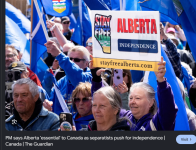
Alberta rejects a move toward independence from Canada in a victory for Carney

Feroze

Trusted Member
Joined
Apr 18, 2023
Messages
7,599
Reaction score
6,049
Reputation
2,171.4
Country of Origin
Country of Residence

Alberta rejects a move toward independence from Canada in a victory for Carney​

Supporters cheer as results begin to display at the pro-Canada watch party in Edmonton, Alberta, Monday, Oct. 19, 2026. (AP Photo)
Short Url
Updated 20 October 2026 11:22
AP
October 20, 202611:22


Follow
  • Voters in Alberta chose to remain in Canada with 75 percent support
  • The referendum was not a direct vote on independence
EDMONTON, Alberta: Voters in oil-rich Alberta province overwhelmingly backed remaining in Canada, with referendum results Tuesday delivering a boost to Prime Minister Mark Carney’s push for national unity as US President Donald Trump’s trade war and annexation threats rally Canadians around their country.

With more than 1.8 million votes counted so far in 81 percent of areas and locations, 75 percent of voters supported remaining in Canada, while 25 percent backed beginning a process toward separation, according to unofficial results from Elections Alberta.

The referendum wasn’t a direct vote on independence, but approval would have set Alberta on a path toward a future vote on separation from Canada.

Speaking to reporters Tuesday before a Cabinet meeting in Ottawa, Carney noted that the roughly one-quarter of Albertans who backed beginning the separation process voted for another referendum, not independence itself.

“Approximately one quarter voted in favor of a process,” Carney said.

“The result is absolutely clear. It’s a vast majority in favor of staying in Canada. And now is the time to work together for all Albertans and all Canadians,” he said.

Carney said he spoke with Alberta Premier Danielle Smith on Tuesday morning about the referendum’s results and greater federal-provincial cooperation, including immigration. He said their first priority was supporting victims and families affected by the deadly military training fire at Canadian Forces Base Wainwright.

Alberta’s separatists, however, saw a silver lining.

“It is fair to say that at least a quarter of Albertans feel that Alberta needs to be treated better,” said Keith Wilson, a leader of the separatist movement.

Smith welcomed the early results, saying they showed widespread support for remaining in Canada.

“Albertans have voted for a stronger Alberta in a united Canada,” Smith posted on social media.

Smith, who called the referendum amid pressure from separatists within her governing United Conservative Party, or UCP, despite opposing independence, said that she would address the province Tuesday evening about the results and Alberta’s future.

“We are a solid country that’s united from coast to coast to coast,” Thomas Lukaszuk, a former Alberta deputy premier who led the Forever Canadian campaign against separation, told supporters.

Results were delayed after late openings forced more than 100 polling stations to extend voting hours Monday.

Alberta, home to the world’s fourth-largest proven oil reserves, is cowboy country and a conservative stronghold whose political culture has long had more in common with the American West than much of Canada. Resentment toward Canada’s federal government in Ottawa runs deep, but hasn’t traditionally translated into widespread support for independence.

Despite the overwhelming rejection, separatist leaders have said they turned a fringe cause into a movement that won’t disappear.

Separatist parties traditionally attracted only 1 percent or 2 percent of the vote, former Premier Jason Kenney said. Anger over COVID-19 restrictions helped mobilize activists who later embraced the separatist movement, he said.

Trump’s trade war and threats to make Canada the 51st US state have helped Carney rally support in Alberta, where Liberal prime ministers have historically been unpopular.

At a separatist referendum night gathering at an Edmonton restaurant, the crowd fell quiet as results rolled in.

“We’re not going anywhere,” said Jeff Rath of the Alberta Prosperity Project. “We’ve dominated the conversation in the last year. We’ve been educating Albertans on the benefits of independence, and we’re going to continue moving forward.”

Rath had said he would be thrilled with 30 percent support. He wants Smith ousted as UCP leader and said the party could splinter, potentially creating a new pro-independence party.

Edmonton voter Shawn Campbell said he voted to begin the separation process even though he doesn’t want Alberta to leave Canada.

“It sends a message to Ottawa that Albertans are not happy,” he said.

Dustin Degenhardt, a voter in the town of Wainwright, said that Albertans have long been mistreated by Canada’s federal government.

“Alberta has essentially been treated as, you know, a colony,” he said after voting Monday. “They want to take and take and take from us, and not return anything.”

Dave Malka, 59, of Edmonton, criticized spending money on a “referendum on a referendum” rather than health care.

With Trump threatening Canada, Malka said, “It seems to be happening at the absolute worst time when we should be united; instead we’re fighting among ourselves.”

 
Any claims of the vote being rigged?
What are you going on about?

Dude the results are as accurate as they can be. The seperatists were largely composed of bored boomer retirees like you.

1792534638791.png

This entire spiel was entirely about immigration. Boomer retirees get annoyed when they see people with my face at Walmart and then they find nasty outlets for their frustration. This crap-show was just one of many....
 
What are you going on about?

Dude the results are as accurate as they can be. The seperatists were largely composed of bored boomer retirees like you.

View attachment 220061

This entire spiel was entirely about immigration. Boomer retirees get annoyed when they see people with my face at Walmart and then they find nasty outlets for their frustration. This crap-show was just one of many....
Sorry it went over your head.

It's ok, we understand.
 
What are you going on about?

Dude the results are as accurate as they can be. The seperatists were largely composed of bored boomer retirees like you.

View attachment 220061

This entire spiel was entirely about immigration. Boomer retirees get annoyed when they see people with my face at Walmart and then they find nasty outlets for their frustration. This crap-show was just one of many....

Boomers are wreaking havoc everywhere. As they grow bitter nearing the end of their lives, their only goal seems to be spreading chaos and destruction. Whether in positions of power or just walking the streets, their objective remains the same.
 
Last edited:
1792539803721.png
Alberta needs Democracy and liberty, its time to free the brave people of Alberta from the tyranny of the Tranny.
 
  • Haha
Reactions: Haz
Boomers are wreaking havoc everywhere. As they grow bitter nearing the end of their lives, their only goal seems to be spreading chaos and destruction. Whether in positions of power or just walking the streets, their objective remains the same.
Really?

I'm a boomer. Not bitter at all. In fact, relatively speaking, when looking at some of the parts of the world I've been to, I've got it pretty good. I'm healthy with a roof over my head.

When I'm out and about walking the streets, I just want to be left alone. Not bothered by little a-holes. If I am, I can deal with it.
 
When I'm out and about walking the streets, I just want to be left alone. Not bothered by little a-holes. If I am, I can deal with it.

You don't want cameras on every corner so big brother can watch and keep you safe from the boogeyman hiding behind every tree waiting to jump out and grab you?
 
You don't want cameras on every corner so big brother can watch and keep you safe from the boogeyman hiding behind every tree waiting to jump out and grab you?
You ridiculous fake American, do you not know at all what is happening in America right now?

Astonishing deployment scale:
Flock’s cameras have been deployed in 49 states—everywhere except Alaska—with more than 120,000 units. Its system processes about 20 billion scans per month.

Far beyond a single company: Flock is only the tip of the iceberg. Industry estimates suggest that the total number of surveillance cameras being installed across the United States may exceed 85 million.

A public-private surveillance network: The surveillance network is not limited to cameras installed by governments. Police increasingly access private cameras such as Amazon’s Ring doorbell cameras, building a vast “private surveillance network.”

The core capability of modern public cameras has upgraded from “recording” to “identification and tracking.”

Automated license plate recognition (ALPR): This is the main driver of current expansion. The cameras not only record license plate numbers but also capture vehicle make, model, color, dents, bumper stickers, and other features, and compare them in real time against law enforcement “hot lists” of wanted or missing persons. Once there is a match, an alert is issued.

Nationwide tracking capability: Data is aggregated into national databases, and law enforcement officers—often without a warrant—can query the movement trajectory of any vehicle at any time and any place. This means local police can easily track vehicles crossing state lines.

Functional expansion: Some systems also integrate gunshot detection, facial recognition, and other functions. For example, Flock also produces facial recognition tools used to track people.

⚖️ Core controversy: the fierce collision between security and privacy

The rapid spread of cameras has triggered strong bipartisan and multi-level backlash. The core conflict lies in the trade-off between “public safety” and “personal privacy.”

Presumption-of-guilt-style mass recording: Supporters see it as a powerful crime-solving tool. But critics point out that the overwhelming majority of what the system records—according to EFF estimates, more than 99.9%—is the daily activity of innocent people. This amounts to building a “comprehensive, retrospective record” of the movement trajectories of the entire population, far beyond ordinary observation in public places.

Data misuse and regulatory vacuum: People worry that such data may be used for non-law-enforcement purposes. For example, it was reported that a Texas sheriff used the Flock network to track a woman involved in an abortion case nationwide. There is also a risk that local data may be accessed by federal agencies such as ICE for immigration enforcement. At present, Congress has not explicitly authorized the creation of such a network, and company internal policies have in effect become the only guardrail.

Disproportionate impact on specific groups: The placement of surveillance cameras is often criticized as unfair. Seattle residents have pointed out that cameras are more often installed in minority communities—such as the Chinatown International District—rather than in affluent neighborhoods. Facial recognition technology has also been widely criticized because of higher error rates for minorities.

Chilling effect and press freedom: Ubiquitous surveillance may inhibit public assembly and freedom of expression and make it harder for journalists to protect anonymous sources, because the government can more easily track meetings between journalists and informants.

🗺️ Local backlash and policy responses

In the face of controversy, reactions across the United States have been sharply divergent.

Divided public opinion: Polls show that public attitudes are not unified. For example, a Reuters poll in September 2026 found that 47% of American adults did not support installing such cameras in their communities, while 38% expressed support. In Harris County, 56% of residents opposed using them for law enforcement.

Retrenchment and bans in some areas: At least 30 local jurisdictions have suspended or canceled contracts with Flock. Some cities in California’s Bay Area are imposing stricter limits, and Virginia also passed a law in 2025 restricting ALPR use. At the congressional level, senators have launched an investigation into Flock, and some lawmakers are pushing to ban the use of federal funds to procure such mass surveillance systems.

Continued expansion inertia: Despite the backlash, many places continue to expand surveillance. For example, Hartford, Connecticut, plans to install cameras at 50 additional intersections by spring 2026; the number of Flock cameras in Suffolk County, New York, grew by 140% in one year; and Torrance, California, received $1.03 million in federal funds to add cameras.

Overall, the public cameras being installed in the United States are essentially a mass surveillance infrastructure driven by private-company technology, starting with license plate recognition, and aimed at nationwide vehicle-trajectory tracing. It significantly enhances law enforcement capabilities, but because of its indiscriminate collection of data on the entire population, potential risks of abuse, and unfairness toward specific groups, it sits at the center of the privacy debate in the United States.
 
Listen you backwards Asian ape go take you schoolyard taunt to some toilet thread where you are a pro.
Facts prove: 1. You don’t know about the hot large-scale camera installation happening in America—the number of cameras in the US has already exceeded one-third of the US population. 2. You don’t know the latest trends in American democratic movements and don’t understand the direction of American political movements. 3. The above proves that you are very likely an Indian monkey living in an American toilet—extremely backward, both physiologically and ideologically.
 

Users who are viewing this thread

Pakistan Defence Latest

Back
Top