U.S. Upgrades Pakistan’s F-16s , India Goes Into Panic!

Every time Japan makes a small move on defence, we often see a forceful reaction from China. It is tempting to interpret such statements literally: China is frightened; therefore it is protesting.
International relations are rarely that simple.
A strong diplomatic protest is not necessarily evidence that a country believes the development will fundamentally alter the military balance. Statements, warnings and objections can themselves be instruments of statecraft. They communicate interests, establish red lines and, importantly, attempt to influence the future calculations of other governments.
The same framework is useful to understand India's objections when another country supplies defence equipment to Pakistan.
The simplistic interpretation is: “If India is so powerful, why is it complaining?”
But that misses the diplomatic purpose.....
India may have several reasons for objecting, and these should not automatically be interpreted as fear of one particular aircraft, missile, ship or defence system. An objection can signal to the supplier: “If you want a deeper strategic and economic relationship with us, understand that your defence relationship with Pakistan is something we take into account.”
That is diplomatic leverage.
This matters particularly when the third country also values its relationship with India. The objective does not have to be cancelling today's transaction. It might be to make the government think more carefully about tomorrow's transaction, the scale of future cooperation, technology transfers, upgrades or the political cost of expanding the relationship.
In international-relations language, this belongs to the broader world of signalling, deterrence and coercive diplomacy. Research on India-Pakistan relations specifically discusses coercive diplomacy and the way external alignments affect escalation dynamics. Recent scholarship also stresses the importance of signalling, competing narratives and external actors in South Asian crises.
There is also a psychological principle worth understanding: the immediate audience is not always the only, or even the most important, audience.
A diplomatic statement can simultaneously speak to:
1.the country supplying Pakistan;
2.other countries considering similar cooperation;
3.India's domestic audience;
4.Pakistan's policymakers; and.
5.the wider international community.
So when India publicly protests a defence sale to Pakistan, It does not automatically mean that India is terrified of the equipment.
But neither does it mean that the protest is meaningless.
The more sophisticated interpretation is: India is using the diplomatic tools available to it to increase the political cost of military cooperation with Pakistan. Whether that pressure actually succeeds is a separate empirical question and will vary from case to case.
Pakistan should understand this without insecurity or triumphalism. Powerful countries routinely use diplomacy, economic relationships, strategic partnerships and public signalling to shape the choices of third countries. That is part of statecraft.
Diplomacy is not only about persuading somebody today. Very often, it is about changing the calculation they make tomorrow.

Countries protest, warn and object not only because of immediate military danger, but because diplomatic signalling itself has strategic value.

A much better question is:
“What behaviour is India trying to influence by complaining?”
India's message to a supplier may effectively be: You want closer economic and strategic relations with us; therefore, understand that the depth of your defence cooperation with Pakistan may form part of our wider relationship.
That does not necessarily mean today's equipment frightens India. The diplomatic objective could be to influence the supplier's future calculations.
This is one reason international relations scholars study concepts such as signalling, deterrence and coercive diplomacy. Academic work specifically examining India-Pakistan relations describes coercive diplomacy as an important part of their strategic interaction.
So Pakistanis should neither celebrate every Indian objection as proof that “India is scared”, nor dismiss it as empty noise.
Study the objective behind the statement.
In geopolitics, what a country says publicly is often intended for several audiences, and sometimes the real target is not the adversary at all. It is the third country listening.

There is an important distinction between military capability and diplomatic influence.
When one state objects to another state's defence cooperation with a rival, we should not automatically assume that the objection reflects military fear. Governments also use diplomatic statements to communicate preferences, establish boundaries and influence third countries.

The mature way to study foreign policy is therefore to ask three questions:
Who is speaking? Who are all the audiences? What future behaviour is the statement intended to influence?
Once we start asking those questions, apparently emotional diplomatic rhetoric often begins to look considerably more strategic.
1793429645367.png
 
This is how Pakistanis have happiness in their lives. they think India has panic over a few F16s and all the rats come out their hole.

US will soon see Chinese steal the information under the noses of US personnel parked next to the F16s in pakistan.
Are you that stupid or did you fell on your head when born? What information will the Chinese steal from decade-old crappy F-16s? This is not India we are talking about, whom can't even get their Tejas to be fully operational despite getting help from across the multiverse, this is China whom is working on 6th gen, has operational 5th gens and their 4th gens beat the crap out of your Rafales, MKI aka Raptor of the east and MiG-29s all combined.
 
there is no hyphenation when one party has to run to the IMF every 2-3 years
Saar! You are the one who said "but but but Pakijjtan also does complaining like India does!".

You must write your very sound advice on avoiding hyphenation down in your morning thoughts notebook and at the exact moment when you are conducting peak yoga breathing exercises, re-read this advice. The rest of your day will be peaceful and inspirational as your mind rids itself of the shackle that binds it to Pakijjtan in perpetual indentured servitude.
 
Both sides routinely 'express concern' over potential sales. It's all diplomacy slop pay it no mind.


We do that, we dont have our DM cry to US DM at a foreign meeting
 
These enhance network warfare capabilities to the f16s, which was important last time around, it's an upgrade and increment
 
I don't trust anything from Urdu Diary; I consider it a propaganda outlet.

There's no panic except among the talking heads. This deal was announced almost one year ago; if there was any panic, people have long since accepted it.

If there's panic in India, it's over the arrival of J-35 fifth-generation fighters, even though India is nowhere close to acquiring one.
No, it's not cute at all. This is how both sides play the game. A weapons sale is made, and the other side complains about it, making statements about an arms race in South Asia and how it disturbs the balance of power. It's SOP for both sides.

India is not the only one that panics:

https://www.thenews.com.pk/latest/1...rbing-delicate-balance-of-power-in-south-asia

I agree with this, but it's a silly position at this stage, your stance of expecting the world to cut out a nation for Indias benefit assumes they have no strategic position with Pakistan, and further silly because Pakistan is not reliant on the Americans

What's curious is just after sindoor this deal was announced, suggests Americans changed their calculations after, but why further strengthen Pak air force

Remember you guys are the bigger country, richer etc

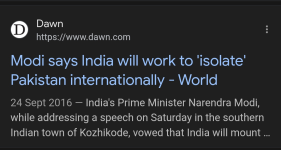
The Indians naively believe they can make Pakistan irrelevant. The Indians believe that through their incredible diplomacy, economic stature and bigger size, they can convince the world to boycott and isolate Pakistan. This is what the Indians truly believe. That is not how the world operates.

The Indians are always stunned when the opposite happens. Indians beg world leaders to shun Pakistan, but it hasn't happened and it obviously will never happen. Imagine what the rejection does to the Indian ego.

The Indians forget that the world doesn't revolve around them. Pakistan is a full fledged sovereign nation with a sizable population and potential of its own. The world is not going to appease India by ignoring and sidelining Pakistan. That just won't happen no matter how much bigger India is compared to Pakistan.
 
The Indians naively believe they can make Pakistan irrelevant. The Indians believe that through their incredible diplomacy, economic stature and bigger size, they can convince the world to boycott and isolate Pakistan. This is what the Indians truly believe.

The Indians are always stunned when the opposite happens. Indians beg world leaders to shun Pakistan, but it hasn't happened and it obviously will never happen. Imagine what the rejection does to the Indian ego.

The Indians forget that the world doesn't revolve around them. Pakistan is a full fledged sovereign nation with a sizable population and potential of its own. The world is not going to appease India by ignoring and sidelining Pakistan. That just won't happen no matter how much bigger India is compared to Pakistan.

100% agree. It's like when you see them enter the Business lounge at an airport for the first time. The mentality is ALWAYS the same, ALWAYS
 
The Indians naively believe they can make Pakistan irrelevant. The Indians believe that through their incredible diplomacy, economic stature and bigger size, they can convince the world to boycott and isolate Pakistan. This is what the Indians truly believe. That is not how the world operates.

The Indians are always stunned when the opposite happens. Indians beg world leaders to shun Pakistan, but it hasn't happened and it obviously will never happen. Imagine what the rejection does to the Indian ego.

The Indians forget that the world doesn't revolve around them. Pakistan is a full fledged sovereign nation with a sizable population and potential of its own. The world is not going to appease India by ignoring and sidelining Pakistan. That just won't happen no matter how much bigger India is compared to Pakistan.

1776425681208.png

Over a decade now after Modi himself formally inaugurated the de-hyphenation plan to much fanfare and coconut smashing no doubt.

@nahtanbob and @nahtanvagene.
 

Users who are viewing this thread

Latest Posts

Back
Top