Navigation
Install the app
How to install the app on iOS
Follow along with the video below to see how to install our site as a web app on your home screen.
Note: This feature may not be available in some browsers.
More options
Style variation
You are using an out of date browser. It may not display this or other websites correctly.
You should upgrade or use an alternative browser.
You should upgrade or use an alternative browser.
Pakistan Space Related News & Discussions
- Thread starter ghazi52
- Start date
More options
Who Replied?



RocketLaw
Trusted Member

Full details:
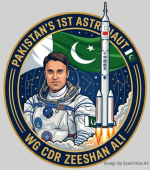
Such a touching and proud moment! Pakistani astronaut Muhammad Zeeshan Ali gently points to his national flag on the spacesuit and salutes the camera. This respectful gesture carries the pride of his nation and the glory of cross-border space cooperation.
Under the starry sky, China and Pakistan chase dreams side by side. Wishing the historic Shenzhou-24 mission tremendous success!

Distant_Observer
Trusted Member


Goenitz
Elite Member
@AeronautIR @JamD
How will it also contribute to our defence? I mean, did we have any other crew there working on something?
Also, JamD, are you in the WhatsApp group "… Aerospace Family"?
How will it also contribute to our defence? I mean, did we have any other crew there working on something?
Also, JamD, are you in the WhatsApp group "… Aerospace Family"?

Victor_CN
Registered Member

Space Meal Is Set! Pakistani Astronaut Gets a Dedicated Space Food Repository
Source: CCTV News | November 26, 2026
URL: news.cctv.cn
The Shenzhou-24 crewed spacecraft was successfully launched on November 25, carrying a three-member crew—Commander Tang Hongbo, Flight Engineer Wu Yi, and Pakistani Payload Specialist Muhammad Zeeshan Ali. Following the successful docking and crew handover, the Shenzhou-23 and Shenzhou-24 crews have officially completed their "space rendezvous," bringing the total to six astronauts aboard the Tiangong space station for a historic six-person on-orbit dining event.
According to the China Manned Space Agency (CMSA), this marks the first time a foreign astronaut has visited China's space station. To ensure that Pakistani astronaut Muhammad Zeeshan Ali could enjoy home-style flavors in orbit, the Chinese research team developed a dedicated space food repository for him, comprising more than 100 customized halal food items.
Chen Junli, a researcher at the Astronaut Research and Training Center, said that the team had conducted extensive research in advance on Pakistani dietary culture, halal standards, and folk customs, while also reviewing the nutritional standards for the local population. On this basis, they established a fully halal food production line and developed over 100 halal food items.
"Taking into account the astronaut's preference for spices such as turmeric and curry, we developed space food items like curried chickpeas and butter chicken, which closely align with local tastes. The entire production process strictly follows a fully halal production line. These food items have undergone repeated taste tests and continuous recipe optimization, and the feedback from the astronauts during the tasting process was very positive," Chen Junli said.
During the research and development process, the team fully incorporated the dietary suggestions put forward by the Pakistani astronaut and made personalized adjustments to the menu.
"In the initial menu design, we planned to provide spiced milk tea, which is popular locally. However, after coming to China and tasting Chinese tea, they found that Chinese black tea was exceptionally good and Chinese rice was particularly delicious. They expressed a hope to have more Chinese rice and tea configured for their flight, so we took this into consideration in the menu design," Chen added.
Chen also noted that the team fully respected Pakistani dietary habits by designing a six-person dining menu for the crew rotation period. During the rest of the time, astronauts can choose their own dining arrangements according to their personal preferences. "The food items selected for this six-person meal are all favorites of both crews, allowing them to enjoy a great meal together."
This customized dietary support for a foreign astronaut has also accumulated valuable practical experience for international cooperation aboard the Tiangong space station.
"This is our first complete practice of providing space nutrition support for astronauts from different dietary and cultural backgrounds. From preliminary research, ingredient selection, food development, and menu design to the selection of on-orbit dining arrangements, we have established a reusable process and operational paradigm. This provides standardized support for future international cooperation in space nutrition assurance aboard the Chinese space station," Chen concluded.
RealNapster
Elite Member
During Pakistani PM’s Moscow visit, Russia-Pakistan will sign Major agreements regarding space cooperation.
Or maybe it would lead to a VONC.
RealNapster
Elite Member
i hope they have him film videos too , best way for pakistani children to be interestedin space
In one of the pictures we did see him using his phone camera (for picture or video).

AeronautIR
HemlockKhalid
Not that I know of.@AeronautIR @JamD
How will it also contribute to our defence? I mean, did we have any other crew there working on something?
Also, JamD, are you in the WhatsApp group "… Aerospace Family"?


Michael
VIP Member
The exploration and development of space technology by countries around the world initially originated from military defense purposes. While the modern aerospace field is often categorized as "scientific research" and "civilian projects," its underlying purpose remains military defense. However, the latter is almost always kept strictly hidden from the public eye.How will it also contribute to our defence?
More precisely, modern space technology research is a large-scale strategic endeavor that encompasses scientific, military, and civilian applications—though its military uses are rarely mentioned.
Goenitz
Elite Member
Thanx.. I meant, like, did China allow any Pak crew/team to observe liquid propulsion or something similar, etc which can enable Pak to develop a launch vehicle. A critical step to launch a small observation and communication satellite or so.The exploration and development of space technology by countries around the world initially originated from military defense purposes. While the modern aerospace field is often categorized as "scientific research" and "civilian projects," its underlying purpose remains military defense. However, the latter is almost always kept strictly hidden from the public eye.
More precisely, modern space technology research is a large-scale strategic endeavor that encompasses scientific, military, and civilian applications—though its military uses are rarely mentioned.
Michael
VIP Member
The issue you’ve raised does not actually exist.Thanx.. I meant, like, did China allow any Pak crew/team to observe liquid propulsion or something similar, etc which can enable Pak to develop a launch vehicle. A critical step to launch a small observation and communication satellite or so.
The technical principles and logic behind both liquid-propellant and solid-propellant rocket engines are entirely public knowledge; they do not involve any obscure or highly esoteric theoretical concepts.
In modern technology, the true challenges almost always boil down to the most fundamental levels—specifically, research into foundational fields like mathematics, physics, and chemistry. In the realm of rocket engines, the core technical secret is no different: materials science is the true heart of the matter. ------ If you are referring to a procurement-based approach for components—rather than building everything entirely in-house—then your question becomes even less of an issue.
In this regard, no one can help you; you must rely solely on yourself.
========
As for Pakistan developing a launch vehicle to put its own satellites into orbit, the country already possesses all the necessary knowledge. The only real issue is money. It is an incredibly capital-intensive endeavor. When funds are insufficient, technical details are often compromised, which leads to project difficulties and concerns regarding technical reliability.
RocketLaw
Trusted Member
Why was Pakistan chosen as the first foreign country to send an astronaut aboard Shenzhou-24?
A lot of people probably thought right away: Pakistan is our ironclad friend, and the two countries have a close relationship.
But after looking through the space cooperation records of recent years, I found that Pakistan has actually done quite a lot.
In 2024, ICUBE-Q, a small satellite jointly developed by Pakistan and Chinese universities, rode aboard Chang’e-6 to lunar orbit and sent back photos of the Moon.
In February 2025, China and Pakistan officially signed an astronaut cooperation agreement, and the selection and training process began.
This April, two Pakistani candidates were selected, and they later came to China for training.
Then, on November 25, Qaisar Ali actually boarded Shenzhou-24 and entered China’s space station.
And this trip also came with scientific research tasks.
China and Pakistan arranged four joint experiments involving biotechnology and materials research.
So Pakistan’s astronaut participation this time was actually part of a cooperation plan that had been in place for a long time, with preparations stretching over quite a while.
Of course, the two countries’ long-standing friendship is also an important backdrop, and this year happens to mark the 75th anniversary of diplomatic relations between China and Pakistan.
In addition, through a cooperation mechanism with the United Nations, China’s space station had already selected nine research projects from 17 countries.
I expect we’ll see more countries getting involved in the future.
I think this is pretty interesting,
In 2024, Pakistan first sent a small satellite it developed to the Moon aboard a Chinese spacecraft.
In 2026, a Pakistani astronaut rode a Chinese spacecraft into the space station.
Going from satellite cooperation to crewed spaceflight, reaching this point in just two years is no small feat.
I bet Pakistani kids who love space, seeing this news today, will start wondering whether they’ll have a chance to go see space for themselves someday

RocketLaw
Trusted Member
Chinese Ambassador calls on the Prime Minister; PM felicitates China on historic Shenzhou-24 mission carrying Pakistan’s first astronaut.
H.E. Mr. Jiang Zaidong, Ambassador of the People’s Republic of China to Pakistan, called on Prime Minister Muhammad Shehbaz Sharif at the Prime Minister House today.
The Prime Minister warmly congratulated the Ambassador and the leadership and people of China on the successful launch of the Shenzhou-24 mission from the Jiuquan Satellite Launch Centre on November 25, carrying Pakistan’s first astronaut, Muhammad Zeeshan Ali, to the Tiangong Space Station.
He highlighted that Pakistan was grateful to its brotherly country, China, for the opportunity to be part of this historic mission, through which a Pakistani has become the first foreign astronaut to visit China’s space station.
The Prime Minister said that this was not merely the journey of an individual astronaut, but that of 240 million Pakistanis, embodying, in particular, the dreams and aspirations of the country’s youth and scientific community.
He described the mission as living proof of the ironclad friendship between Pakistan and China, adding that the cooperation between the two countries had now truly reached the stars.
The Prime Minister expressed his appreciation to the relevant Chinese institutions for training both Pakistani astronauts and paid tribute to SUPARCO, academic institutions, scientists and the Armed Forces for their contributions to this historic achievement.
He said that today’s achievement would inspire Pakistan’s youth to aim for the Moon and beyond.
The Prime Minister requested the Ambassador to convey his warm greetings and best wishes to President Xi Jinping and Premier Li Qiang. He paid rich tribute to the dynamic leadership and sagacious vision of President Xi Jinping, under which China has made remarkable strides in science, technology and space exploration and has opened its space programme to friendly countries for the benefit of humanity.
He underlined that Pakistan remains unwavering in its commitment to work hand in hand with China for the peaceful exploration and utilization of outer space.
The two sides also reviewed bilateral relations, including the activities organised to commemorate the 75th anniversary of the establishment of diplomatic relations this year.
The Prime Minister also handed over congratulatory letters addressed to President Xi Jinping and Premier Li Qiang to the Chinese Ambassador.
Distant_Observer
Trusted Member
Humans currently off Earth:
 China; 5 people (Tiangong space station)
 United States; 3 people (International Space Station)
 Russia; 3 people (International Space Station)
 Pakistan; 1 person (Tiangong space station)
 Canada; 1 person (International Space Station)
Users who are viewing this thread
Total: 14 (members: 5, guests: 9)
Pakistan Defence Latest
Country Watch Latest
-
Iran - Israel/US War: Israel-US declare war on Iran, Iran responds (174 Viewers)
- Latest: ParthianLord
-

-

-

-

Latest Posts
-
-
 Federal cabinet gives nod to imposition of emergency in KP; summary sent to president (10 Viewers)
- Latest: Distant_Observer
-

-

-
Iran - Israel/US War: Israel-US declare war on Iran, Iran responds (174 Viewers)
- Latest: ParthianLord