Navigation
Install the app
How to install the app on iOS
Follow along with the video below to see how to install our site as a web app on your home screen.
Note: This feature may not be available in some browsers.
More options
Style variation
You are using an out of date browser. It may not display this or other websites correctly.
You should upgrade or use an alternative browser.
You should upgrade or use an alternative browser.
Iran launches Operation True Promise - massive missile/drone strikes across Israel, Israel allegedly responds with quadcopters
- Thread starter Mehdipersian
- Start date
- Status
- Not open for further replies.
More options
Who Replied?


F-22Raptor
Elite Member

Both sources American sources ran by The Jewish foundation. Come back to the table with a clinical objective source. We find it difficult to believe when the sources that tell us Iraq had weapons of mass destruction are now saying this…….
Don’t believe won’t believe.
Iraq did have WMDs, 5,000 chemical weapons were found post invasion, Saddam had nuclear and chemical weapons programs for decades. All of this is historical fact. But that’s way off topic and stop using that as an excuse. Thats over 20 years ago.
You fail to mention the US accurately predicting Russias invasion of Ukraine even though Russia was lying about it even the week prior to invasion.
Deep down you know the US military has the satellite intelligence capability to assess this strike accurately.
PakSword
THINK TANK: CONSULTANT


Yet the US is directly involved in killing of children in Gaza.Deep down you know the US military has the satellite intelligence capability to assess this strike accurately.
F-22Raptor
Elite Member
Footage and damage photos.
Sorry no one takes their 'word' for it anymore.
Taking things into account it looks like the Israelis were scared to launch something larger, especially with the US saying no.
Waz, you’re fully aware the US has the satellite intelligence capability to conduct post damage assessment accurately of this site.
PakSword
THINK TANK: CONSULTANT
What's the post damage assessment of Gaza?Waz, you’re fully aware the US has the satellite intelligence capability to conduct post damage assessment accurately of this site.

ziaulislam
Elite Member
Netanyahun was under immense pressure to replyWell I always thought that Iran might never get attacked. May be I was and am right. But let's be realistic. Israel might attack you(Iran) using air power i.e. jet fighters. You guys have already exhausted their defenses, all you need to do is to launch a bigger shower now. But this time target only their air power and concentrate your strike. Dont do the mistake that Egypt did. Make sure you fire at least three projectiles for one target.
This is your time. If you preemptively destroyed their air capability now, you will be save for quite a long time(untill they build it again, but they will come). Make sure to destroy as much as possible (complete destruction will be the best)
@Waz now you see how this thread will disappear. Just keep an eye on that rat on this forum.
He did
Let see after this token reply both sides are done playing domestic games

Persian Gulf
INT'L MOD


they released satellite imagery and CNN said nothing happenedWaz, you’re fully aware the US has the satellite intelligence capability to conduct post damage assessment accurately of this site.
ziaulislam
Elite Member
Disagree hereThen Iran will take some hits, but it will also deliver hits and Israel is a small tiny state at the end of the day
It's already had 6 months of war
It's become a hated pariah in many parts of the world
It's had to Jew about a 100 billion out of the U.S tax payer and the west
It's destroyed its own reputation
All to do what, kill PALESTINIANS who still refuse to move and have the demographic advantage
And all Iran had to do was support and supply the resistance
The reason why the U.S and west doesn't want a war with Iran is because Iran has offensive power, it has the ability to hit multiple target's
So their is nowhere for the U.S or west to base itself or build up forces, without those forces being hit
Could they hit Iran, kill Iranians and cause destruction, the answer is SURE
but in return Iran will hit ever base and target it get hit and wipe them out
even placing ships in range of drones and anti ship missiles is dangerous if they can deplete air defence missiles and go for the kill
so even if they attack Iran, they can only do so in a limited manner and in response Iran will wipe them out in the region and in the end the U.S and west will have to back off, leaving Iran
This doesn't even consider the consequences of oil and gas supply being effected for multiple countries from the entire middle east
Houthis and other proxies creating blockades and attacks
OR what Russia and China will do, say or supply
Anyway you look at it, Israel is forced into a position where the call for a Palestinian state will be stronger then ever, even amongst it's allies and the demographic advantage of the Palestinians IS MASSIVE
Israel gained everything and lost nothing
It has effectively leveled Gaza
With this any hopes of two state solution is dead
Most of Palestinians will leave and pushed into Sinai or killed or drowned which ever they choose and finally peace will come to Israel
Zarathustra
Registered Member


ghazi52
THINK TANK: CONSULTANT
Israel's Iran attack carefully calibrated after internal splits, US pressure
Prime Minister Benjamin Netanyahu's war cabinet had initially approved plans for a strike on Monday nightReuters
April 19, 2024
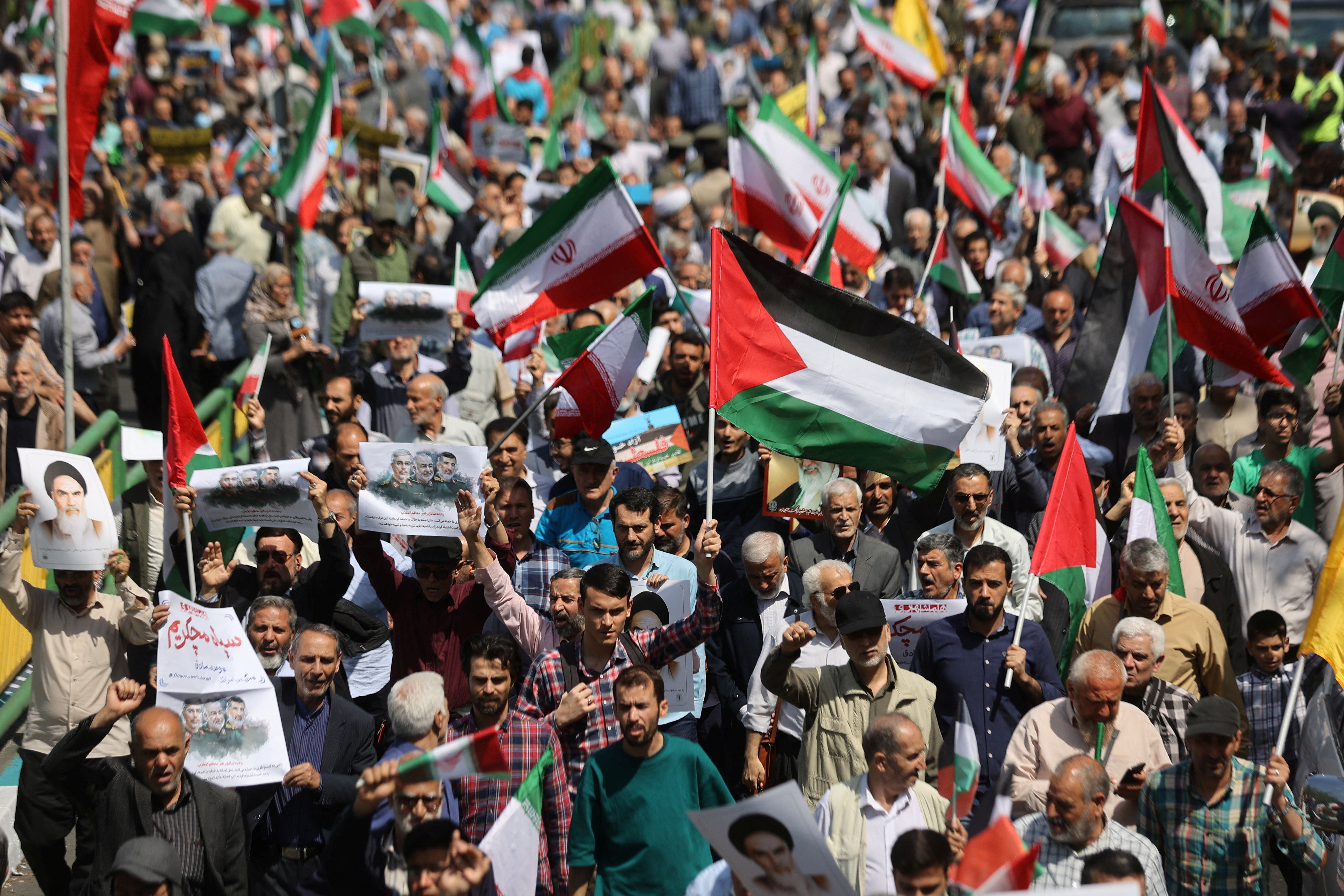
Iranians attend an anti-Israel rally in Tehran, Iran, April 19, 2024. PHOTO: REUTERS
Israel's apparent strike on Iran after days of vacillation was small and appeared calibrated to dial back risks of a major war, even if the sheer fact it happened at all shattered a taboo of direct attacks that Tehran broke days earlier.
Prime Minister Benjamin Netanyahu's war cabinet had initially approved plans for a strike on Monday night inside Iranian territory to respond forcefully to last Saturday's missile and drones from Iran, but held back at the last minute, three sources with knowledge of the situation said.
By then, the sources said, the three voting members of the war cabinet had already ruled out the most drastic response - a strike on strategic sites including Iran's nuclear facilities whose destruction would almost certainly provoke a wider regional conflict.
Facing cabinet divisions and strong warnings from partners including the United States and in the Gulf not to escalate, and aware of the need to keep international opinion on Israel's side, the plans to hit back were then postponed twice, the sources said. Two war cabinet meetings were also delayed twice, government officials said.
Netanyahu's office did not respond to requests for comment for this story. Before the attack, a spokesperson for the government's National Public Diplomacy Directorate cited Netanyahu as saying Israel would defend itself in whatever way it judged appropriate.
Reuters spoke to a dozen sources in Israel, Iran and in the Gulf region, as well as the United States, who described six frantic days of efforts in the Gulf, the US and among some of Israel's war planners to limit the response to Iran's first-ever direct attack on its arch-rival after decades of shadow war.
"We warned against the grave danger inherent in further escalation," Jordan's Foreign Minister Ayman Safadi told Reuters, saying a wider regional conflict would have catastrophic consequences and risked diverting global attention from Israel's ongoing war in Gaza.
Safadi said his country, which borders Israel, had "made it clear to all it will not be a battleground for Israel and Iran. This firm position was unequivocally delivered to all."
Most of the sources asked not to be named to speak about sensitive matters.
The eventual strike on Friday appeared to target an Iranian Air Force base near the city of Isfahan, deep inside the country and close enough to nuclear facilities to send a message of Israel's reach but without using airplanes, ballistic missiles, striking any strategic sites or causing major damage.
Iran said its defence systems shot down three drones over a base near Isfahan early on Friday. Israel said nothing about the incident. US Secretary of State Antony Blinken said the United States had not been involved in any offensive operations.
An Iranian official told Reuters there were signs the drones were launched from within Iran by "infiltrators," which could obviate the need for retaliation.
A source familiar with Western intelligence assessments of the incident also said initial evidence suggested Israel launched drones from inside Iranian territory. Iran's foreign ministry did not respond to a request for comment.
"Israel tried to calibrate between the need to respond and a desire not to enter into a cycle of action and counter-reaction that would just escalate endlessly," said Itamar Rabinovich, a former Israeli ambassador to Washington.
He described the situation as a dance, with both parties signalling to each other their intentions and next steps.
"There is huge relief across the Gulf region. It looks like the attack was limited and proportionate and caused limited damage. I see it a de-escalation," veteran Saudi analyst Abdelrahman al-Rashed told Reuters.
Biden call
The decision to hold back from broader and immediate action this week underlined the competing pressures on Netanyahu's government in the aftermath of the more than 300 drones and ballistic and cruise missiles fired by Iran on Saturday night.
As Iran's barrage unfolded, two members of the war cabinet, Gantz and Gadi Eisenkot, both former armed forces commanders, wanted to respond straight away before agreeing to hold off following a call with US President Joe Biden and in the face of differing views from other ministers, two Israeli officials with knowledge of the situation said.
A spokesman for Gantz, a centrist who joined Netanyahu's emergency government following the Hamas-led attack on Israel last October, did not respond to a request for comment.
The US State Department declined to comment to questions about Israel's decision-making. Washington was working to de-escalate tensions, Blinken said on Friday. The White House did not immediately respond to a request for comment.
Aryeh Deri, the head of one of the ultra-Orthodox parties in Netanyahu's coalition, who has observer status in the war cabinet and who has generally been wary of drastic moves, was firmly opposed to an immediate strike against Iran, which he believed could endanger the people of Israel given the risk of escalation, a spokesperson for his party said.
"We should also be listening to our partners, to our friends in the world. I say this clearly: I see no shame or weakness in doing so," Deri told the "Haderech" newspaper.
Israel's options ranged from strikes on strategic Iranian facilities, including nuclear sites or Revolutionary Guards bases, to covert operations, targeted assassinations and cyber attacks on strategic industrial plants and nuclear facilities, analysts and former officials in Israel have said.
Gulf countries had been increasingly worried the situation would spill into "a grave regional conflagration which might be beyond anyone’s control or ability to contain," said Abdelaziz al-Sagher, head of the Saudi-based Gulf Research Centre.
Saudi Arabia and the United Arab Emirates had publicly called for maximum "self-restraint" to spare the region from a wider war.
Sagher said Gulf countries had warned the United States of the risk of escalation, arguing Israel should conduct only a limited attack without casualties or significant damage that could provoke a major reprisal.
This messaging "was relayed forcefully" in the last few days by the Jordanians, Saudis, and Qataris through direct security and diplomatic channels, one senior regional intelligence source said.
The governments of Qatar, Saudi Arabia and UAE did not immediately respond to requests for comment.
By Thursday, four diplomatic and government sources in the region were expressing confidence that the response would be limited and proportionate.
Ahead of the overnight Israeli strike, one regional source, who had been briefed on Israel's thinking, said the response would aim to minimize or completely avoid casualties and was likely to target a military base.
Flying F-35 fighter jets from Israel to Iran, or launching missiles from Israel would almost certainly violate the airspace of neighbouring countries, angering Arab states who Netanyahu has long sought to cultivate as strategic allies, said a Gulf government source with knowledge of the issues.
He couldn't "just fly F-35 fighter jets across the region and bomb Iran or its nuclear sites," the source said.
Iranian officials had warned a major Israeli attack would trigger immediate retaliation.
Iran's options to respond included shutting down the Strait of Hormuz through which about a fifth of the world's oil passes, urging proxies to hit Israeli or US interests, and deploying previously unused missiles, a senior Iranian official said.
While satisfying Israel's moderates at home, its neighbours and international partners, the measured strike, when it came, was met with dismay from hardliners in Netanyahu's cabinet.
National Security Minister Itamar Ben Gvir, whose ultranationalist party is a key prop in Netanyahu's coalition, posted a single word on X, “Feeble."

Mehdipersian
Trusted Member
- Thread starter
- #5,742
Israel's security is important to America. They are willing to do anything for the security of these terrorists. Lying is easy for themWaz, you’re fully aware the US has the satellite intelligence capability to conduct post damage assessment accurately of this site.
F-22Raptor
Elite Member
An there’s your proof…
F-22Raptor
Elite Member
Footage and damage photos.
Sorry no one takes their 'word' for it anymore.
Taking things into account it looks like the Israelis were scared to launch something larger, especially with the US saying no.
See above, there’s your proof
Kyussis
Trusted Member
What happened to your "99% interception rate" clown?Waz, you’re fully aware the US has the satellite intelligence capability to conduct post damage assessment accurately of this site.
- Status
- Not open for further replies.
Users who are viewing this thread
Total: 2 (members: 0, guests: 2)
Pakistan Defence Latest
-

-
Federal cabinet gives nod to imposition of emergency in KP; summary sent to president (36 Viewers)
- Latest: Blain2
-
-

-

Country Watch Latest

Latest Posts
-

-
-
Federal cabinet gives nod to imposition of emergency in KP; summary sent to president (36 Viewers)
- Latest: Blain2
-
-
