Lebanon-Israel War | 2023-present

Hezbollah fighters meanwhile continued to fire rockets into northern Israel, with the military reporting that 60 projectiles had crossed the border by Monday afternoon.

About 200 projectiles were detected on Sunday, when the military said its warplanes had conducted "an intelligence-based strike on a command centre of Hezbollah's intelligence headquarters and an underground weapons workshop in Beirut".

Also on Sunday, the United Nations Interim Force in Lebanon (Unifil) accused Israeli forces of deliberately demolishing an observation tower and perimeter fence of a UN peacekeeping position in the southern town of Marwahin. It followed similar incidents in recent weeks.

In a separate development, the Lebanese army said three of its soldiers were killed after a military vehicle was hit by an Israeli air strike in Nabatieh, southern Lebanon.

Lebanon's army has historically stayed out of cross-border clashes between Israel and Hezbollah - but a number of its troops have been killed in Israeli attacks since fighting escalated last month.

The Israeli military has not yet commented on the two incidents.
 

‘No life left there’: The suburbs bearing the brunt of Israel’s strikes on Beirut​

Joel Gunter
Reporting from Beirut


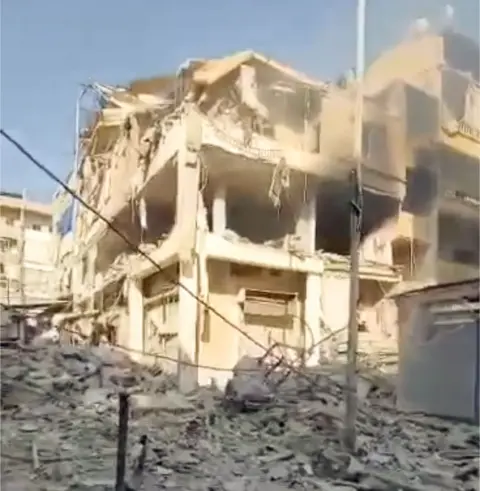
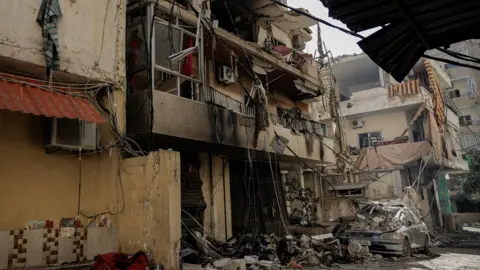
Joel Gunter/BBC An air strike on the edge of the Dahieh area that completely destroyed one building and damaged adjacent buildings, including a large gynaecology clinic


Joel Gunter/BBC

An air strike on the edge of the Dahieh area that completely destroyed one building and damaged adjacent buildings, including a large gynaecology clinic
The air strike that killed the Hezbollah leader Hassan Nasrallah shook the earth for hundreds of metres in every direction.

A few blocks away, in the Beirut suburb known as the Dahieh, Mehdi Moussawi thought his own building was falling down.

From his balcony, the 45-year-old taxi driver and his wife Zahraa – who asked that their names be changed for this story – watched as a thick blanket of smoke and dust enveloped everything around them. In the distance, they could hear debris raining down, and overhead the familiar buzz of an Israeli drone.

The drones had become so common over Dahieh in the previous few days that they barely noticed them anymore. A majority Shia suburb in the south of Beirut, Dahieh was once again under Israel’s watchful eye; its more than half a million residents again under threat of death from above.

“The missiles come down from the sky,” Mehdi said, gesturing the arc of a projectile falling to earth, “and suddenly everything you have is gone.”

He was sitting on a dirty, sun-baked patch of pavement on the edge of Martyrs’ Square in central Beirut – now home for the couple and their teenage boys. Around them were hundreds of others in similar circumstances, many from Dahieh. The suburb has borne the brunt of the recent Israeli bombing of Beirut, prompting a mass exodus of virtually its entire population.

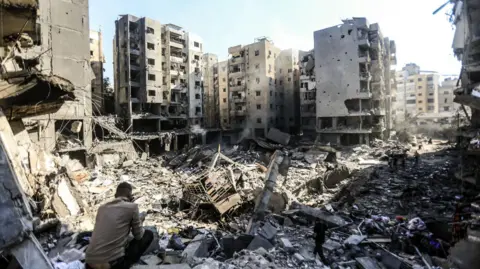
Getty Images A man sits looking out to rubble


Getty Images

The aftermath of the strike that killed Hezbollah leader Hassan Nasrallah, flattening four residential buildings in the process

Dahieh is largely under the control of Hezbollah, the Iran-backed political and paramilitary group that is a powerful force across Lebanon.

Hezbollah refused requests from the BBC for permission to enter the suburb for this story, to see the bomb damage, but a BBC analysis of video footage, Israeli evacuation warnings and recent satellite imagery shows at least 65 air strikes which have severely damaged or completely destroyed buildings. Some of those strikes have comprised dozens of individual bombs, and many have levelled not only the apparent target building but destroyed or severely damaged several adjacent buildings too.

This was the fate of Mehdi and Zahraa’s apartment – to be next door to an Israeli strike. Zahraa wept when she saw footage of their blackened and mangled building. “Look at us,” she pleaded. “Our home is gone. We have no hygiene, we cannot wash. We have nothing.”

The damage to Mehdi and Zahraa's apartment, to the right of the image, was captured by someone filming following the strike.


The damage to Mehdi and Zahraa's apartment was captured by someone filming following the strike

Dahieh is often described as a Hezbollah stronghold. The term does not reflect the totality of the suburb – a densely packed residential area where other political parties operate and where not everyone supports Hezbollah – but the group is certainly the strongest force there. Above ground, it is woven through the suburb’s social and political fabric, and provides services like welfare and education. Below, it has bunkers and tunnels from which it can operate.
https://www.bbc.co.uk/news/articles/ce9j74z7xvmo
The IDF has targeted Dahieh in order to assassinate Hezbollah leaders, and says the group uses its bunkers to store weapons among the civilian population. It says it is targeting Hezbollah in order to safely return 60,000 of its own citizens to the north of Israel, which has come under rocket fire from Lebanon over the past year.

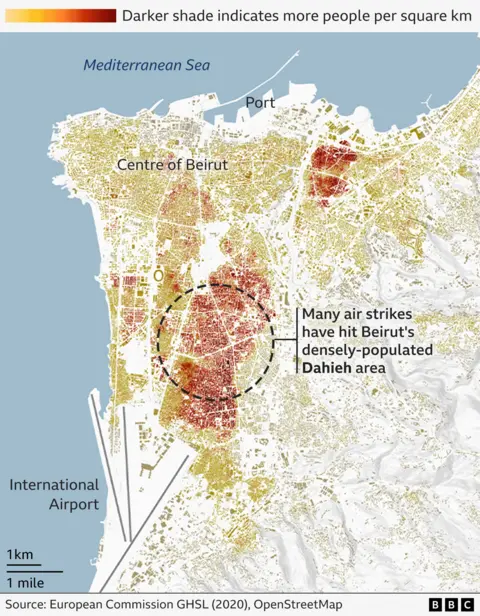
Unlike other parts of Beirut, Dahieh doesn’t have its own name, as such – the word simply means ‘suburb’. It is one of the most densely populated residential areas in all of Lebanon – a place of narrow streets and alleyways, where buildings seem to jostle for available space. It was heavily bombed in the previous war, back in 2006, and still bears scars from it.
 

Israeli strikes hit Dahieh​


A map showing the population density of Beirut. The neighbourhood of Dahieh in the south of Beirut appears as a dark red area, indicating a densely-populated suburb.


“Dahieh was originally a very beautiful place but all the wars have taken their toll,” said Rasha al-Ameer, a novelist and publisher who was born and raised in the suburb and still lives there. Her brother, a prominent critic of Hezbollah, was assassinated in Lebanon in 2021.

“It is still a very vivid place and a diverse place. We have a cultural institution there and a lot of political activity,” she said. “It would be a terrible thing if Dahieh was destroyed. Though the bombing has destroyed much already.”

As well as homes, the Israeli air strikes have destroyed or damaged shops, businesses, restaurants and clinics. “Destruction on destruction,” said Mohaned Khalaf, a 45-year-old Sunni Muslim bakery worker, of his street in Burj El Brajneh, the most heavily targeted part of the suburb.


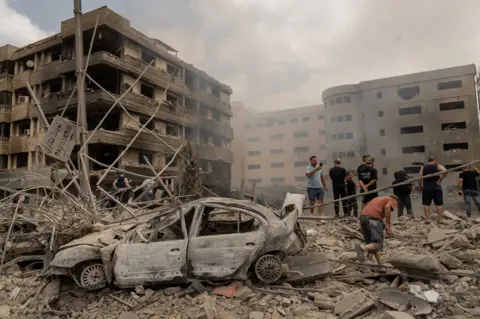
Reuters A damaged vehicle lies amid  rubble after an air strike in the Chiyah area of Dahieh.


Reuters

A damaged vehicle lies amid rubble after an air strike in the Chiyah area of Dahieh
Khalaf, already a refugee once, from Syria, has gone back into Dahieh periodically to check on the apartment he shares with his two brothers and their mother, to see if his furniture remains. “The buildings around ours have been destroyed,” he said. “There is no life left there, not a person to be seen.”

The destruction has tested some Dahieh residents’ patience with Hezbollah – particularly Sunnis and other non-Shias. “This war is hurting everyone,” said Khalaf’s mother, Sameera, who wept on the street. “I am 63 years old,” she said. “I just want a place where I can wash.”

Sameera does not want to return to Dahieh, even after the war. “Yes, we could go back and rebuild, but Hezbollah and Israel will fight this war over and over again,” she said. “And Dahieh will suffer again.”

Shia Muslims, Hezbollah’s more natural support base, took a more supportive view – even those whose lives had been completely upended by the conflict. Members of Hezbollah had handed out food and $100 bills to displaced Shia families on the streets in central Beirut, several families said, and helped assist with shelter places.

“We used to support Hezbollah and we still support Hezbollah,” said Gharib Ali, a 61-year-old janitor who fled the suburb. Around him, his family nodded in agreement. The effect of the war on their lives “changes nothing for the Shia community,” he said. “If anything, it only increases our support. Every Shia feels the same.”

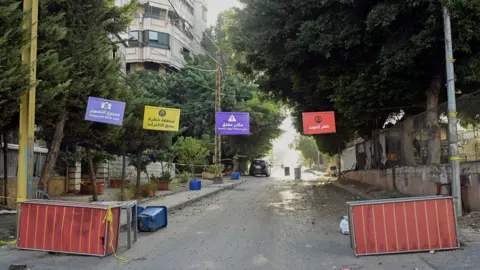
EPA Signs at the entrance to part of the Dahieh warn it is dangerous to enter or take photographs without permission from Hezbollah.


EPA

Signs at the entrance to part of the Dahieh warn it is dangerous to enter or take photographs without permission from Hezbollah

In this way, Mehdi and Zahraa may be something of an outlier – a Lebanese Shia couple, residents of Dahieh for decades, who were critical of Hezbollah for its role in the conflict.

“Dahieh is not Hezbollah, we are not Hezbollah, our building was not Hezbollah,” Zahraa said, angrily. “We went to sleep one night and woke up in someone else’s war.”

The family’s apartment is now uninhabitable, though the building may be salvageable. The Israeli army has sometimes issued social media warnings ahead of its air strikes, but there was no warning for the strike that hit Mehdi and Zahraa’s building. Their eldest son had gone home that day to shower, taking advantage of a seemingly quiet moment, and was knocked over and cut by flying glass when the bomb hit.

International humanitarian law generally requires an effective advance warning ahead of a strike that might affect civilians. But the BBC has found evidence of repeated Israeli strikes against Dahieh and other parts of Beirut where no warning was issued. And where there were warnings, some have been sent as little as 30 minutes beforehand, sometimes in the middle of the night.

“That timeframe is not an effective advance warning for someone who lives in Dahieh,” said Ramzi Keiss, a Lebanon researcher at Human Rights Watch. “These are people are sleeping, they’re in their beds. They are not looking at social media."

Hezbollah was also possibly violating international humanitarian law, Keiss said, by placing its military commanders in and around the civilian population. “But that doesn’t give you a free pass to bomb as heavily as you can,” he added, referring to Israel.

“When you’re using 2000lbs in densely populated areas, you’re going to put civilians at the risk of great harm.”

Lebanese officials estimate that more than 2,400 people have been killed in the country over the past year and more than 1.2 million been displaced. Israel says 59 people have been killed in northern Israel and the occupied Golan Heights over the same period.
 
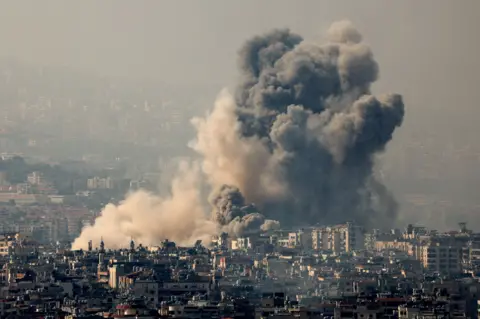
Reuters A cloud of smoke rises over Dahieh after a strike. Israel has bombed the suburb at least 54 times over the past few weeks.


Reuters

A cloud of smoke rises over Dahieh after a strike. Israel has bombed the suburb at least 54 times over the past few weeks

Back in the 2006 war, after Israel had pounded Dahieh and heavily bombed Lebanon’s civilian infrastructure, a senior IDF officer, Lieutenant General Gadi Eisenkot, sketched out what would become known as the “Dahieh doctrine”. It called for applying “disproportionate force” against civilian areas, with the goal of pressuring the people of Lebanon to turn on Hezbollah.

The recent escalation by Israel had gone “beyond Dahieh doctrine”, said Prof Amal Saad, an expert on Hezbollah and lecturer in politics at Cardiff University. “This is more like Gaza doctrine, which is similar, but has the goal of specifically targeting and displacing a community.”

In Dahieh, Israel’s actions were currently “somewhere between its Dahieh and Gaza doctrines”, she said.

The destruction would not bring about, as the Israeli prime minister Benjamin Netanyahu has publicly expressed hope for, a reduction in support for Hezbollah in places like Dahieh, Prof Saad said.

“Whenever Israel invades like this, it only increases support for Hezbollah among Shias,” she said. “After 2006, support skyrocketed. I don’t know much higher it can go now than 90%, but this will solidify it.”

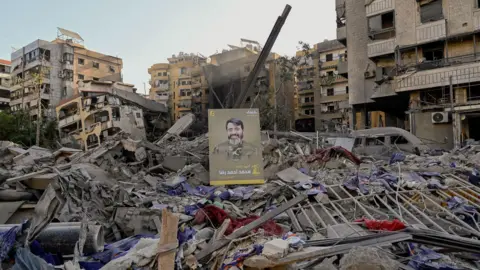
EPA An image of a Hezbollah fighter is displayed on the rubble following an Israeli strike on the suburb.


EPA

An image of a Hezbollah fighter is displayed on the rubble following an Israeli strike on the suburb

Two weeks after the bombing of Dahieh began, the air strikes ceased unexpectedly, following pressure from the US government, which said it had made it clear to Israel it was unhappy with the “scope and nature” of the targeting of Beirut.

One day passed without any strikes, then another, then another. After three days, residents began returning on Monday and Tuesday to check on their apartments and retrieve possessions. Among them was Mehdi, who took his eldest son’s scooter and headed back into the devastated area around their building to grab clothes for the boys.

Then, early on Wednesday morning, Israel began bombing Dahieh again.

“We knew it was only a matter of time,” said Mehdi. He was sitting with Zahraa and the boys, a few hours after the strikes resumed, on the street by their makeshift tent, which was really just two rugs thrown over an improvised frame.

Towering over them was an upscale, new, and completely empty apartment building. It bore a similar name to their apartment building, Zahraa said. “But for the cost of one of these apartments you could buy an entire neighbourhood in Dahieh,” she said.

They would go back and rebuild, she said. She raised her arms in a mock bicep curl, to demonstrate the strength of the people from the Dahieh. “We have no choice,” Mehdi said. “Some people have choices, we don’t.”

They would return the moment the ceasefire was announced, he said. He knew that there would be no electicity, no water, and no windows in the buildings. But it was still better than being on the street. Overhead, an Israeli drone was buzzing. Mehdi looked up at the empty apartments across the street, and down at the tent they were sleeping under. “God willing, the ceasefire will come before the rain,” he said.

Joanna Mazjoub contributed to this report. Paul Brown contributed research
 
To view this content we will need your consent to set third party cookies.
For more detailed information, see our cookies page.


To view this content we will need your consent to set third party cookies.
For more detailed information, see our cookies page.


To view this content we will need your consent to set third party cookies.
For more detailed information, see our cookies page.


To view this content we will need your consent to set third party cookies.
For more detailed information, see our cookies page.


To view this content we will need your consent to set third party cookies.
For more detailed information, see our cookies page.
 
To view this content we will need your consent to set third party cookies.
For more detailed information, see our cookies page.
 
To view this content we will need your consent to set third party cookies.
For more detailed information, see our cookies page.


Hezbollah underground missile bases still functional

Keep it a secret don’t reveal anything the enemy is watching you 24/7 trying to track any source of information.Those missiles will have huge impact if they cause collateral damages and possibly Zionist lives so far Israel been lucky in that regard .Hezbollah should start targeting utilities infrastructure that would hurt mostly.
 
Their is no such thing as a liberal Muslim

Either you are a Muslim and follow it's laws and values or your something else

Why should Muslims tolerate colonial occupation of our people and lands

Let others accept these injustice, our duty is to resist until victory
Correctly pointed out 👊
There’s no place for oppression in islam you have to fight against it it’s very simple.
 
Entity can vacate Golan Heights, Shebaa Farms, West Bank and Gaza and then we can talk about disarmament of Hezbollah.


Looks like the entity likes certain UN resolutions but likes to ignore others.
Sorry to mention this but Lebanese army doesn’t have any men in their force.
 
The wan is ongoin because the number of killed is very disproportionate. Only when it becomes proportionate will Israel end its agression.

A bully wont stop bullying until hes punched right in the face.
 
Saudi Salman missed the BRICS opening, something that is very important to him, to meet Blinken. In the past Salman was happy to blank or ignore him.

It must have been very important. The understanding is that a US/Israel attack on Iran has been decided, and Blinken is reading the riot act to the Saudis as to how to behave.
 
To view this content we will need your consent to set third party cookies.
For more detailed information, see our cookies page.
 
To view this content we will need your consent to set third party cookies.
For more detailed information, see our cookies page.
 

Users who are viewing this thread

Country Watch Latest

Latest Posts

Back
Top