India Economy Thread

Rail India Technical and Economic Service​


RITES Ltd, formerly known as Rail India Technical and Economic Service Limited, is an Indian public sector undertaking and engineering consultancy corporation, specializing in the field of transport infrastructure. Established in 1974 by the Indian Railways, the company's initial charter was to provide consultancy services in rail transport management to operators in India and abroad. RITES has since diversified into planning and consulting services for other infrastructure, including airports, ports, highways and urban planning.

As of 2011, it has executed projects in over 62 countries. The company got listed on both NSE and BSE in July 2018.


Right to Information​

The right to information means access to the information under this act which is held by or under the control of any public authority and includes the right to inspect any material in any form, including records, documents, memos, e-mails, opinions, advices, press releases, circulars, orders, logbooks, contracts, reports, papers, samples, models, data material held in any electronic form and information relating to any private body which can be accessed by a public authority under any other law for the time being in force, taking notes, extracts or certified copies of documents / records and certified samples of the materials.

Tendering an application for informationan​

Citizens of India can make a request/an application for information in writing, clearly specifying the information sought under the Right to Information Act, 2005. An applicant making request for information shall not be required to give any reason for requesting the information. The request/application should provide the contact details (postal address, telephone number, fax number, email address, etc.) that may be necessary for contacting him.

How to submit an RTI Application​

RTI applications can be submitted online by accessing http://rtionline.gov.in and choosing "RITES Limited" as the "Public Authority".

An applicant can also tender an application/ request for information personally or by post or through a messenger accompanied with an application fee of Rs.10/- (Rupees Ten Only) payable, as per the Right to Information (Regulation of Fee and Cost) Rules, 2005 prescribed by the Government of India, under Section 6(1) of RTI Act by way of cash against proper receipt or by Demand Draft (DD) or bankers' cheque or Indian Postal Order payable to "RITES Limited".

Consultancy services for Shivamogga airport


Made-In-India DEMU Trainsets supplied to CFM, Mozambique

Railway Siding, Ghatampur

Project Advisory Consultancy services for the Yamuna Expressway

General consultancy for Ahmedabad metro

Consultancy services for Bogibeel Bridge, across the Brahmaputra at Dibrugarh, Assam

Project Management Consultancy services for the Metro Express Project in Mauritius
Exported Diesel Electric Multiple Units (DEMU) trainsets and locomotives to Sri Lanka

RITES leases locomotives to companies/plants for transport of raw material.
 
@ST1976 You have single handedly destroyed the thread by flooding it with one sided minor accomplishment posts... Used to be a good thread for major Made in India things. Have you noticed no one posts or interacts on the thread anymore like other similar thread started or destroyed by you?

@Nilgiri @Krptonite , should something need to be done for such cases?
 
@ST1976 You have single handedly destroyed the thread by flooding it with one sided minor accomplishment posts... Used to be a good thread for major Made in India things. Have you noticed no one posts or interacts on the thread anymore like other similar thread started or destroyed by you?

@Nilgiri @Krptonite , should something need to be done for such cases?

He isn't breaking any rules, its his interest...forum is full of foibles.
🤷‍♂️
 
India investigating fire at Tata plant, production suspended
Apple may lean on China imports to address shortfalls, analyst and source say
Tata incident latest disruption at India Apple suppliers
India estimated to have 20-25% of total iPhone shipments in 2024
BENGALURU, Oct 1 (Reuters) - Extensive damage from a fire at Tata Group's Apple (AAPL.O), opens new tab iPhone component plant in southern India could hamper production ahead of a festive season sales surge, an industry watcher and a source said, forcing the U.S. firm's suppliers to arrange critical parts from China or elsewhere.
The weekend blaze has caused an indefinite production halt at Tata's Hosur plant in Tamil Nadu, the only Indian supplier of iPhone back panels and some other parts for both contract manufacturer Foxconn in the country and its own iPhone assembly at another plant.


Hong Kong-based Counterpoint Research told Reuters it estimates local sales of 1.5 million units of iPhone 14 and 15 models during the Indian festive season which runs from late October to early November, with Apple struggling to fulfil as much as 15% of that demand due to the fire.
"There will be a 10-15% impact on production of older iPhone models from India. Apple could offset that impact by importing more components, and by re-routing more export inventory towards India," said Neil Shah, a co-founder of Counterpoint, which has for years tracked Apple's global shipments.
Advertisement · Scroll to continue

Report this ad
Apart from local sales, Tata, one of India's biggest conglomerates, also exported iPhones to the Netherlands and United States as well as some parts to China, worth more than $250 million overall, in the year to Aug. 31, commercially available customs data shows.
Tata declined to comment.
Apple suppliers typically carry a three- to four-week stock of back panels, Counterpoint said. An industry source with direct knowledge of the matter estimated, however, that Apple was likely to have stock for eight weeks, and therefore would not see an immediate impact.
Advertisement · Scroll to continue
However, they added that if the production suspension continues, the U.S. company could set up another assembly line in China or add shifts there to secure parts for India's iPhone manufacturers.
Supply chain disruptions more generally have cast a shadow over Prime Minister Narendra Modi's drive to attract foreign investors to "Make in India", especially in the electronics sector.

Apple has been diversifying beyond China but last year separate fire incidents in India caused suppliers Foxlink and Pegatron to briefly halt operations, with authorities finding much of the fire safety equipment at Foxlink's facility was not functional. Contractors Wistron and Foxconn have also been hit by labour unrest in recent years.
"These are temporary setbacks," said Prabhu Ram, vice president at Cybermedia Research. "Continued efforts to improve safety and operational standards are crucial for strengthening India's position as an emerging global electronics manufacturing hub."

Tata is among Apple's newest suppliers in India, which analysts estimate will contribute 20-25% of total global iPhone shipments this year, up from 12-14% last year.

The fire-hit plant employed 20,000 workers. Another unit in the same Tata complex was due to start making complete iPhones later this year and it is unclear if the incident will cause this to be delayed.
Tata has another iPhone plant near Bengaluru, which it acquired from Wistron last year, and a second one in Tamil Nadu near Chennai, which it is set to acquire from Pegatron.
 

Screenshot_20241019_121531_com_UCMobile_InnerUCMobile.jpg
 
To view this content we will need your consent to set third party cookies.
For more detailed information, see our cookies page.
 
To view this content we will need your consent to set third party cookies.
For more detailed information, see our cookies page.


To view this content we will need your consent to set third party cookies.
For more detailed information, see our cookies page.
 
To view this content we will need your consent to set third party cookies.
For more detailed information, see our cookies page.


To view this content we will need your consent to set third party cookies.
For more detailed information, see our cookies page.
 
To view this content we will need your consent to set third party cookies.
For more detailed information, see our cookies page.
 

Services will not keep bailing out India’s merchandise exports forever​

It might sound ironic, but dependence on Chinese imports can be best reduced/eliminated by getting Chinese companies to make the products which India imports from China in India.

Subhash Chandra Garg
Last Updated : 22 October 2024, 14:01 IST

Indian exports recorded good growth of 4.86 per cent in the first half of 2024-2025, as per quick estimates released on October 16, with total exports (merchandise and services) rising from $375 billion in April-September 2023-2024 to $393.2 billion during the same period in 2024-2025.

Merchandise exports grew only 1.02 per cent from $211.08 billion to $213.22 billion. Services exports did exceedingly well, rising 9.66 per cent from $164.14 billion to $180 billion.

The World Trade Organization (WTO) released the world trade outlook earlier this month, projecting 2.7 per cent growth of merchandise trade during 2024. In January-June 2024, the WTO reported Indian merchandise export growth at 4 per cent, against our merchandise export growth of only about 1 per cent during April-September, as per our data.

Is India’s merchandise growth slipping? Will services keep bailing out exports?

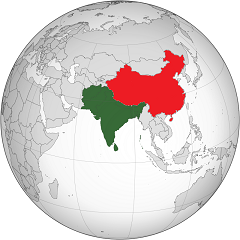
China is our bugbear
Exports to China, our fourth largest export market in the first half of 2023-2024 with India exporting $7.63 billion of goods, recorded a degrowth of 9.35 per cent, downgrading China to fifth place, with exports declining to $6.91 billion.

Our largest export market, the United States, recorded a healthy growth of 5.6 per cent with the first half of 2023-2024 exports growing from $38.23 billion to $40.38 billion. Our next three largest export markets — the United Arab Emirates, the Netherlands, and the United Kingdom — also did very well, recording an impressive growth of 11.45 per cent, 36.73 per cent, and 12.40 per cent respectively.

Our inability to step up exports to China continues to stymie India’s overall export growth.
On the contrary, our import dependence on China has been growing unstoppably. India imported $56.29 billion worth of merchandise from China in the first half of 2024-2025, making 16 per cent of our total imports of $350.66 billion. Worryingly, imports from China recorded a growth of 11.52 per cent, much higher than overall import growth of 6.16 per cent.

This hurts. India’s merchandise trade deficit of $49.38 billion with China during April-September 2024 constituted 41 per cent of the total trade deficit of $119.24 billion.

Unable to capitalise on China+1 policy
Our principal export markets (the US and the European Union) desperately want to reduce dependence on Chinese imports and shift their imports to friendly countries like India. Policies of China+1 and the recent high import tariffs on Chinese electric vehicles (EVs) seek to achieve this objective.

India, unfortunately, has not been able to take advantage of these policies.

There have indeed been a few success stories like Apple contractors establishing a major production base in India resulting in India’s electronics exports growing handsomely ($15.64 billion in the first half of 2024-2025 against $13.06 billion in 2023-2024) recording growth of 19.74 per cent. There is, however, no widespread shift of manufacturing to India from China.

WTO data for January-June 2024 informs that against India’s merchandise export growth of 4 per cent, Vietnam recorded export growth of 16 per cent, Hong Kong, China 14 per cent, Chinese Taipei 11 per cent, Republic of Korea 10 per cent, and Singapore 6 per cent. China’s export growth of 4 per cent equalled India’s.

Most of ‘+1’ shift is in East Asia. India is missing out.

Services exports are bailing us out
India’s services exports at $204.76 billion in 2018-2019 made up 38.28 per cent of total exports of $534.84 billion. In 2023-2024, services exports of $341.25 billion rose to 43.93 per cent of the total exports of $776.89 billion.

In five years, services exports generated a decent CAGR of 10.76 per cent, gaining an additional 1 per cent share every year. In the first half of 2024-2025, the share of services exports rose further to 45.78 per cent. This trend is likely to continue.

Services exports would, most likely, exceed merchandise exports in 2029-2030 when Modi 3.0’s term comes to an end.

Services exports (IT services, GCCs, other commercial services and the likes) have been India’s saviour; but may not bail India out forever. It is time we capitalise on the promise of other services (sports, travel, entertainment, and personal services like education, health and personal care) besides strengthening other under-developed non-personal services (financial, software as service, and the likes).

Revamp export promotion framework
The government runs hundreds of schemes and spends billions of dollars promoting merchandise exports. Data tells you that it is unfortunately making no real difference.

Services exports, on the other hand, have been growing handsomely despite no promotional and financial support from the government. Let the government shift 25 per cent of the resources it spends on merchandise export promotion and invest it in building infrastructure for promoting services export and in providing services tax support.

It might sound ironic, but it is a fact. Dependence on Chinese imports can be best reduced/eliminated by getting Chinese companies to make the products which India imports from China (solar cells and modules, electronic goods, pharmaceutical APIs etc.) in India. Such a strategic shift will also give India a much better ‘control’ if Chinese companies were to invest in setting up manufacturing plants in India. We need to review our restrictive policies of discouraging Chinese investment.

US companies need to be offered a business case to invest in India to marry India’s talent and US technology. A good beginning has been made in semiconductors. Let many more flowers bloom.

The combination of high-technology product manufacturing investments from both China and the US and a very businesslike services promotion policy can turn India into an export powerhouse.
 

Users who are viewing this thread

Pakistan Defence Latest

Latest Posts

Back
Top