

I just wanted to say that I can't understand why you are bringing such lousy source in such a nice discussion.
We are not. It's @MNZGamerX's weird personal obsession.
Follow along with the video below to see how to install our site as a web app on your home screen.
Note: This feature may not be available in some browsers.
I just wanted to say that I can't understand why you are bringing such lousy source in such a nice discussion.

I just wanted to say that I can't understand why you are bringing such lousy source in such a nice discussion.
I much rather take the opinion of IMF/ADB/World Bank any day.
BD will have 1-2 difficult years ahead of it but it will probably come out stronger and a more robust country at the other end.

Bro you're expecting decency and self respect from an awami supporter!Animal firm? Lol.
Man, how ছেঁচড়া one can be? You already said multiple times you were leaving this forum. And then here you are again few days later. Have some self respect.



Yunus: Pay income tax online from home instead of waiting in bank lines
View attachment 75593
Chief Adviser Dr Muhammad Yunus has announced to the nation that taxpayers no longer need to go to banks or tax offices to file their returns, as provisions have been made to enable online filing.
In a video message on Monday, Yunus noted the role of taxes in powering the nation’s economy.
“Your tax contributions drive our economy, yet paying them has often been burdensome. From now on, there is no need to wait in lines at banks or go to tax offices to file returns. You can submit your taxes and file returns directly from home.”
The chief adviser highlighted that this online tax submission system was now mandatory for all officials and employees in Dhaka, Narayanganj and Gazipur, as well as for staff at all scheduled banks, mobile operators and several multinational companies.
He encouraged citizens in the rest of the country to use the e-Return system.
He also proposed a friendly “competition” across districts and cities to recognize organizations filing the most online tax returns with state awards.
Yunus urged citizens to teach friends, neighbours and relatives how to file e-returns from home, especially calling on young people to assist taxpayers in this process.
Addressing future entrepreneurs, he said the preparations for entrepreneurship could begin now. “We are taking steps to enable the online collection of all types of taxes gradually. May your path to paying income tax be smooth and hassle-free.”
The National Board of Revenue (NBR) is committed to establishing a taxpayer-friendly, transparent and accountable tax management system this year. In line with this goal, the process for individual taxpayers filing online returns for the 2024-25 tax year on September 9.
To register for online tax submission, a TIN (taxpayer identification number) and a taxpayer-registered biometrically verified mobile number are required.
Individual taxpayers can register and file e-returns for the 2024-25 tax year on www.etaxnbr.gov.bd by providing their personal information.
The last date to file income tax returns is November 30.
@Al-Zakir @LeonBlack08 @Bengal71 @AbuShalehRumi @Michael Corleone @AbuShalehRumi folks, this is huge. The two most critical sectors that needed the most reform are banking and NBR. The former had the most corruption and the later had the most incompetence. Combination of these two what destroyed the backbone of our economy in the long run. We already saw some visible initiatives and changes in the banking sector. I was eagerly waiting for this one to happen. It has been repeatedly stressed by all the revenue and taxation experts/economists to fully digitize the tax return process for years. And it wasn't that hard at all, but Hassina regime never did it, specially in last 2/3 years when economy was going down. The reason they didn't is because the regime depended on bureaucrats to keep it in power.
And they opposed it every time it was proposed even by policy makers within government. That's because the old process worked like this, you are good citizen and want pay your income tax. So you make your own income tax file and go to the local NBR office. The Officer there will pretend to look at thoroughly and then will ask you indirectly (sometimes directly) for a bribe. If you fail to bribe him, he will refuse to complete the tax submission and put your name and file for an official investigation. And there starts the official and judicial harassment. Which may go on for weeks and months and even if you come out victorious you will be utterly exhausted. Nobody wants to go through that.
Second option for you go to a lawyer. He will prepare the tax file for you and carry out the submission process. It may help you avoid many unwarranted harassment, but then you have to pay your lawyer a good sum to do this very simple job for you along with the tax that your paying to government.
This is exactly why taxation is record low in Bangladesh. Even when compared to our neighbours. (Pakistan and India.)
With this new digitization, you are able to cut off the middle man (any local tax officer or lawyer) and the process improves by an order of magnitude. Everything will be managed online centrally. No more weeks of harassment at the local NBR office, no need to bribe the tax officer or pay your lawyer. It will be done with few clicks form home.
Hence, now income tax revenue set to improve significantly. Of course it doesn't stop there, nor should it. As he said,
“We are taking steps to enable the online collection of all types of taxes gradually. May your path to paying income tax be smooth and hassle-free.”
A much much needed reform initiative. I can't emphasize enough.
Plus of course there would be other initiatives to implement better accountability, etc.
Results are, among others you will need less foreign loan to fund local projects. It can be funded by taxpayers money.
Also, it is set to take the steam off from registered business, small medium and big alike in the long run. Previous and exisitng corporate taxation policy is extremely business unfriendly. Speically for entrepreneurs.
See, given nobody would go through all the hustle to pay their Income taxes before, only thing hassina regime did in attempt to maintain the revenue flow was to squeeze the registered businesses as much as they could.
For example, they will collect tax from you at the beginning of the year on the basis of projected profit which has no gerautnee that you will be able make by the end of that year. And the percentage they have taken from you in advance is not part of the investment anymore. Nor will you get it back if your business face losses and fail to make profits. You can already see how devastating such policy could be for entrepreneurs. Thus, for small business growth.
Another very bad policy that was cancelled by the NBR in early September was whitening of black money.
Which hassina regime put in place to allow both individuals and companies to whiten money without facing scrutiny and by paying a 15 percent tax,
That is frankly insane when legal corporate businesses had to pay some 25-27 percent tax. You can imagine what this could do to free market and fair competition. But Hassina regime kept that in place to benefit her party businessmen. They had the most amount fo black money.
Now within the scope of reform initiatives by the revolutionary government, there needs be emphasis on seperation of executive power between ministry of finance and institutions like NBR and Bangladesh Bank. They must be able to make and implement policy decisions independently with their own institutional inertias without much interference from politicians in the long run. I am sure we will see the detail roadmap in upcoming economic white paper.
So far, the team heading the financial sector in Yunus government has proven to be the most capable one compared to other ministries. They know what they are doing and more importantly, this government has good will.
Also, tagging @Joe Shearer, @Oscar and @Nilgiri (bro, I remember we were talking about BD's tax revenue problem quite a while ago)
This is a good initiative indeed. Digitize and create transparency in NBR operations and by design create accountability.
I remeber when I was in Bangladesh, it was a hassle to file the income tax. There are many who wants to abide by the law, but gets discouraged by the opaque, inefficient and corrupt system.
Although, getting it digitalized will not necessarily remove middle-man. Some people will always need lawyers or accountants to help with the tax, given the complex nature of tax laws.


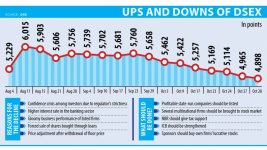

Panic sales send stocks to four-year low
Tue Oct 29, 2024
View attachment 75633
Stocks in Bangladesh plummeted to a four-year low yesterday, just a day after the stock market regulator formed an inquiry committee to investigate the reasons behind the market's sharp decline.
The fresh plunge prompted some investors to protest in front of the old Dhaka Stock Exchange (DSE) building in the Motijheel area of the capital.
The DSEX, the benchmark index of the DSE, fell by 66 points, or 1.34 percent, to 4,898 yesterday, reaching its lowest level since November 2020.
On Sunday, the Bangladesh Securities and Exchange Commission (BSEC) formed a four-member committee to identify the causes of the recent downtrend in the primary index of the Dhaka bourse and to find out individuals involved in spreading market rumours.
The committee has also been tasked with recommending measures to improve investors confidence.
Meanwhile, stock market analysts blamed high interest rates in the banking sector, weak performance of listed companies, trigger selling and a confidence crisis among investors for the market fall.
Earlier, the finance ministry said the listing of weak companies, looting and manipulation over the past 15 years were not accurately reflected in the stock market index due to the floor price and circuit breaker mechanism.
With the removal of these measures, the real impact of the looting is now being reflected in the index, according to the government.
Regardless of the specific reasons, investors are witnessing an erosion of their funds almost every day.
In the first four days after the fall of Sheikh Hasina-led government in early August, the DSE's market capitalisation, meaning the total market value of all listed securities, soared Tk 67,908 crore, or 10.52 percent. After that, it dropped by Tk 69,739 crore, or 9.77 percent.
"While macroeconomic factors contribute to the decline in the share market index, investor fear and panic selling have accelerated the downtrend," said Kazi Monirul Islam, chief executive officer of Shanta Asset Management.
As interest rates are high and corporate earnings are depressed, the stock market has been impacted, said Islam. "As a result, many stocks have become undervalued."
So, selling shares at this time is not a rational decision, he said, adding that investors should consider investing now with a minimum one-year holding period.
"By holding onto their investments, they may be the market winner from a macroeconomic rebound in the coming months," he said. Islam hoped that large investors, who now have ample liquidity, would accumulate blue-chip stocks.
The DS30 Index, which tracks blue-chip stocks, declined by 25 points, or 1.37 percent, to 1,805 yesterday. Similarly, the DSES Index, the index of Shariah-compliant companies, plunged by 20 points, or 1.82 percent, to 1,087.
Emran Hasan, managing director and chief executive officer of Investit Asset Management Limited, also believes that panic selling and forced selling are causing the market to decline almost every day.
"Investors are panicked and fear that the market may fall further. So, they are actually overreacting to the situation," he said.
On the other hand, stockbrokers and merchant banks are compelled to execute forced selling due to a 40-50 percent decline in many marginable stocks over the past two months. These stocks are now facing margin calls and subsequent forced selling, he added.
As investors are not getting any new catalysts from the buyers' side and there is also no encouraging news on the economic or policy front, they remain in a state of panic, Hasan added.
Given that most stocks are now undervalued, institutional investors should seize the opportunity. But some of them are already heavily invested and do not have enough funds for further investment.
Others are adopting a wait-and-see approach, hoping for further price declines, according to Hasan.
Islami Bank's decline alone dragged 25 points from the DSEX, while Olympic Industries accounted for a 9-point drop, according to LankaBangla Securities data.
Stock investors, who staged a demonstration in Motijheel yesterday under the banner of Bangladesh Pujibazar Biniogkari Oikko Parishad, demanded the resignation of Bangladesh Securities and Exchange Commission (BSEC) Chairman Khondoker Rashed Maqsood.
Accusing him of failing to prevent the market's downturn, they said the BSEC chairman has not taken any effective measures to support a rebound in the stock market.
The recent market decline has caused severe financial hardship for many investors, they added.
Panic sales send stocks to four-year low
Stocks in Bangladesh plummeted to a four-year low yesterday, just a day after the stock market regulator formed an inquiry committee to investigate the reasons behind the market’s sharp decline.www.thedailystar.net

Yunus: Pay income tax online from home instead of waiting in bank lines
View attachment 75593
Chief Adviser Dr Muhammad Yunus has announced to the nation that taxpayers no longer need to go to banks or tax offices to file their returns, as provisions have been made to enable online filing.
In a video message on Monday, Yunus noted the role of taxes in powering the nation’s economy.
“Your tax contributions drive our economy, yet paying them has often been burdensome. From now on, there is no need to wait in lines at banks or go to tax offices to file returns. You can submit your taxes and file returns directly from home.”
The chief adviser highlighted that this online tax submission system was now mandatory for all officials and employees in Dhaka, Narayanganj and Gazipur, as well as for staff at all scheduled banks, mobile operators and several multinational companies.
He encouraged citizens in the rest of the country to use the e-Return system.
He also proposed a friendly “competition” across districts and cities to recognize organizations filing the most online tax returns with state awards.
Yunus urged citizens to teach friends, neighbours and relatives how to file e-returns from home, especially calling on young people to assist taxpayers in this process.
Addressing future entrepreneurs, he said the preparations for entrepreneurship could begin now. “We are taking steps to enable the online collection of all types of taxes gradually. May your path to paying income tax be smooth and hassle-free.”
The National Board of Revenue (NBR) is committed to establishing a taxpayer-friendly, transparent and accountable tax management system this year. In line with this goal, the process for individual taxpayers filing online returns for the 2024-25 tax year on September 9.
To register for online tax submission, a TIN (taxpayer identification number) and a taxpayer-registered biometrically verified mobile number are required.
Individual taxpayers can register and file e-returns for the 2024-25 tax year on www.etaxnbr.gov.bd by providing their personal information.
The last date to file income tax returns is November 30.
@Al-Zakir @LeonBlack08 @Bengal71 @AbuShalehRumi @Michael Corleone @AbuShalehRumi folks, this is huge. The two most critical sectors that needed the most reform are banking and NBR. The former had the most corruption and the later had the most incompetence. Combination of these two what destroyed the backbone of our economy in the long run. We already saw some visible initiatives and changes in the banking sector. I was eagerly waiting for this one to happen. It has been repeatedly stressed by all the revenue and taxation experts/economists to fully digitize the tax return process for years. And it wasn't that hard at all, but Hassina regime never did it, specially in last 2/3 years when economy was going down. The reason they didn't is because the regime depended on bureaucrats to keep it in power.
And they opposed it every time it was proposed even by policy makers within government. That's because the old process worked like this, you are good citizen and want pay your income tax. So you make your own income tax file and go to the local NBR office. The Officer there will pretend to look at thoroughly and then will ask you indirectly (sometimes directly) for a bribe. If you fail to bribe him, he will refuse to complete the tax submission and put your name and file for an official investigation. And there starts the official and judicial harassment. Which may go on for weeks and months and even if you come out victorious you will be utterly exhausted. Nobody wants to go through that.
Second option for you go to a lawyer. He will prepare the tax file for you and carry out the submission process. It may help you avoid many unwarranted harassment, but then you have to pay your lawyer a good sum to do this very simple job for you along with the tax that your paying to government.
This is exactly why taxation is record low in Bangladesh. Even when compared to our neighbours. (Pakistan and India.)
With this new digitization, you are able to cut off the middle man (any local tax officer, or even your lawyer for most cases) and the process improves by an order of magnitude. Everything will be managed online centrally. No more weeks of harassment at the local NBR office, no need to bribe the tax officer. It will be done with few clicks form home.
Hence, now income tax revenue set to improve significantly. Of course it doesn't stop there, nor should it. As he said,
“We are taking steps to enable the online collection of all types of taxes gradually. May your path to paying income tax be smooth and hassle-free.”
A much much needed reform initiative. I can't emphasize enough.
(Plus of course there would be other initiatives to implement better accountability and improve taxation. Like gradually including More and more of informal economy within banking system.)
Results are, among others you will need less foreign loan to fund local projects. It can be funded by taxpayers money.
Also, it is set to take the steam off from registered business, small medium and big alike in the long run. Previous and exisitng corporate taxation policy is extremely business unfriendly. Speically for entrepreneurs.
See, given nobody would go through all the hustle to pay their Income taxes before, only thing hassina regime did in attempt to maintain the revenue flow was to squeeze the registered businesses as much as they could.
For example, they will collect tax from you at the beginning of the year on the basis of projected profit which has no gerautnee that you will be able make by the end of that year. And the percentage they have taken from you in advance is not part of the investment anymore. Nor will you get it back if your business face losses and fail to make profits. You can already see how devastating such policy could be for entrepreneurs. Thus, for small business growth.
Another very bad policy that was cancelled by the NBR in early September was whitening of black money.
Which hassina regime put in place to allow both individuals and companies to whiten money without facing scrutiny and by paying a 15 percent tax,
That is frankly insane when legal corporate businesses had to pay some 25-27 percent tax. You can imagine what this could do to free market and fair competition. But Hassina regime kept that in place to benefit her party businessmen. They had the most amount fo black money.
Now within the scope of reform initiatives by the revolutionary government, there needs be emphasis on seperation of executive power between ministry of finance and institutions like NBR and Bangladesh Bank. They must be able to make and implement policy decisions independently with their own institutional inertias without much interference from politicians in the long run. I am sure we will see the detail roadmap in upcoming economic white paper.
So far, the team heading the financial sector in Yunus government has proven to be the most capable one compared to other ministries. They know what they are doing and more importantly, this government has good will.
Also, tagging @Joe Shearer, @Oscar and @Nilgiri (bro, I remember we were talking about BD's tax revenue problem quite a while ago)

 www.theigc.org

hopefully the system has all the kinks ironed out... don't want next government to come to power and shut it down for ease of tax avoidanceYunus: Pay income tax online from home instead of waiting in bank lines
View attachment 75593
Chief Adviser Dr Muhammad Yunus has announced to the nation that taxpayers no longer need to go to banks or tax offices to file their returns, as provisions have been made to enable online filing.
In a video message on Monday, Yunus noted the role of taxes in powering the nation’s economy.
“Your tax contributions drive our economy, yet paying them has often been burdensome. From now on, there is no need to wait in lines at banks or go to tax offices to file returns. You can submit your taxes and file returns directly from home.”
The chief adviser highlighted that this online tax submission system was now mandatory for all officials and employees in Dhaka, Narayanganj and Gazipur, as well as for staff at all scheduled banks, mobile operators and several multinational companies.
He encouraged citizens in the rest of the country to use the e-Return system.
He also proposed a friendly “competition” across districts and cities to recognize organizations filing the most online tax returns with state awards.
Yunus urged citizens to teach friends, neighbours and relatives how to file e-returns from home, especially calling on young people to assist taxpayers in this process.
Addressing future entrepreneurs, he said the preparations for entrepreneurship could begin now. “We are taking steps to enable the online collection of all types of taxes gradually. May your path to paying income tax be smooth and hassle-free.”
The National Board of Revenue (NBR) is committed to establishing a taxpayer-friendly, transparent and accountable tax management system this year. In line with this goal, the process for individual taxpayers filing online returns for the 2024-25 tax year on September 9.
To register for online tax submission, a TIN (taxpayer identification number) and a taxpayer-registered biometrically verified mobile number are required.
Individual taxpayers can register and file e-returns for the 2024-25 tax year on www.etaxnbr.gov.bd by providing their personal information.
The last date to file income tax returns is November 30.
@Al-Zakir @LeonBlack08 @Bengal71 @AbuShalehRumi @Michael Corleone @AbuShalehRumi folks, this is huge. The two most critical sectors that needed the most reform are banking and NBR. The former had the most corruption and the later had the most incompetence. Combination of these two what destroyed the backbone of our economy in the long run. We already saw some visible initiatives and changes in the banking sector. I was eagerly waiting for this one to happen. It has been repeatedly stressed by all the revenue and taxation experts/economists to fully digitize the tax return process for years. And it wasn't that hard at all, but Hassina regime never did it, specially in last 2/3 years when economy was going down. The reason they didn't is because the regime depended on bureaucrats to keep it in power.
And they opposed it every time it was proposed even by policy makers within government. That's because the old process worked like this, you are good citizen and want pay your income tax. So you make your own income tax file and go to the local NBR office. The Officer there will pretend to look at thoroughly and then will ask you indirectly (sometimes directly) for a bribe. If you fail to bribe him, he will refuse to complete the tax submission and put your name and file for an official investigation. And there starts the official and judicial harassment. Which may go on for weeks and months and even if you come out victorious you will be utterly exhausted. Nobody wants to go through that.
Second option for you go to a lawyer. He will prepare the tax file for you and carry out the submission process. It may help you avoid many unwarranted harassment, but then you have to pay your lawyer a good sum to do this very simple job for you along with the tax that your paying to government.
This is exactly why taxation is record low in Bangladesh. Even when compared to our neighbours. (Pakistan and India.)
With this new digitization, you are able to cut off the middle man (any local tax officer, or even your lawyer for most cases) and the process improves by an order of magnitude. Everything will be managed online centrally. No more weeks of harassment at the local NBR office, no need to bribe the tax officer. It will be done with few clicks form home.
Hence, now income tax revenue set to improve significantly. Of course it doesn't stop there, nor should it. As he said,
“We are taking steps to enable the online collection of all types of taxes gradually. May your path to paying income tax be smooth and hassle-free.”
A much much needed reform initiative. I can't emphasize enough.
(Plus of course there would be other initiatives to implement better accountability and improve taxation. Like gradually including More and more of informal economy within banking system.)
Results are, among others you will need less foreign loan to fund local projects. It can be funded by taxpayers money.
Also, it is set to take the steam off from registered business, small medium and big alike in the long run. Previous and exisitng corporate taxation policy is extremely business unfriendly. Speically for entrepreneurs.
See, given nobody would go through all the hustle to pay their Income taxes before, only thing hassina regime did in attempt to maintain the revenue flow was to squeeze the registered businesses as much as they could.
For example, they will collect tax from you at the beginning of the year on the basis of projected profit which has no gerautnee that you will be able make by the end of that year. And the percentage they have taken from you in advance is not part of the investment anymore. Nor will you get it back if your business face losses and fail to make profits. You can already see how devastating such policy could be for entrepreneurs. Thus, for small business growth.
Another very bad policy that was cancelled by the NBR in early September was whitening of black money.
Which hassina regime put in place to allow both individuals and companies to whiten money without facing scrutiny and by paying a 15 percent tax,
That is frankly insane when legal corporate businesses had to pay some 25-27 percent tax. You can imagine what this could do to free market and fair competition. But Hassina regime kept that in place to benefit her party businessmen. They had the most amount fo black money.
Now within the scope of reform initiatives by the revolutionary government, there needs be emphasis on seperation of executive power between ministry of finance and institutions like NBR and Bangladesh Bank. They must be able to make and implement policy decisions independently with their own institutional inertias without much interference from politicians in the long run. I am sure we will see the detail roadmap in upcoming economic white paper.
So far, the team heading the financial sector in Yunus government has proven to be the most capable one compared to other ministries. They know what they are doing and more importantly, this government has good will.
Also, tagging @Joe Shearer, @Oscar and @Nilgiri (bro, I remember we were talking about BD's tax revenue problem quite a while ago)


