Syrian Civil War and The future of Syria after liberation

Neutralising chemical weapons in Syria a ‘top tier priority’, US official says​


Rebecca Hartmann
Reporting from the White House

A senior US administration official has said that they are not currently contemplating US boots on the ground in Syria in order to neutralise any chemical weapons.

According to the senior official, neutralising chemical weapons in Syria is a ‘top tier priority’ and something that the expertise in the US government is focused on right now. But they are exploring other options in order to neutralise that threat.

The senior official added that they are doing everything they can, including working with ‘partners’ in the region to ensure that the material is either not available to anyone or ‘taken care of’.


Bashar al-Assad was a colossal disappointment to the West​


Frank Gardner
Security correspondent

Hopes were high in the West for this young, British-trained opthalmologist when he inherited the presidency of Syria in 2000.

He would be a breath of fresh air, people said, after three decades of stifling, autocratic rule by his late father, Hafez, remembered most for ordering the massacre of over 10,000 citizens in Hama in 1982.

Like other youthful Arab rulers who took power that same year – King Abdullah II in Jordan and King Mohammed VI in Morocco – Bashar was said to be a moderniser keen on pulling Syria into the digital age.

But Syrians we spoke to at his inauguration in Damascus that year had other ideas. "He’s weak," they said. "He won’t last six months."

In fact he lasted 24 years, but only thanks to Russia, Iran and Hezbollah shoring up his rule when it nearly collapsed under rebel advances in 2015.

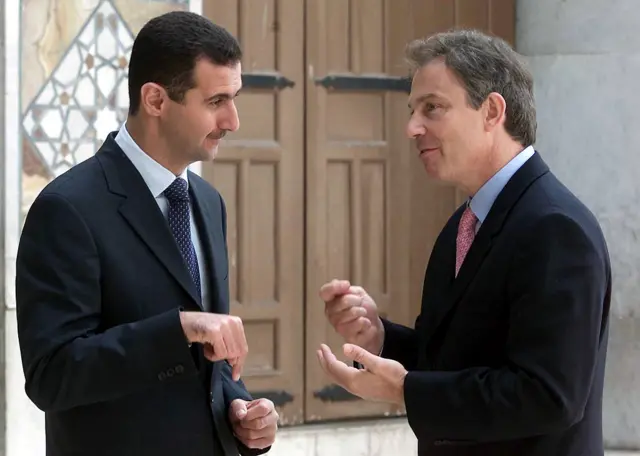
Western disillusionment began long before that, in 2001, as the Syrian President refused to share British PM Tony Blair’s condemnation of all terrorist groups.

"You call them terrorists, we call them freedom fighters," was how Bashar al-Assad referred to the armed Palestinian groups his country hosted.

He soon proved he was no reformer - and when his people asked for change he met their demands with bullets, barrel bombs, sarin gas and torture on an industrial scale.


Assad with then-UK Prime Minister Tony Blair in Damascus in 2001


Assad with then-UK Prime Minister Tony Blair in Damascus in 2001
 
Duh, they are just capturing Damascus. Now goes to coast city to capture Alawite strong hold

Israel wants to weaken Syria and hoping HTS will fight Israel righ away that can weaken HTS

They are not stupid

Israel strike will push Syrian opposition together, they will understand the need of unity

They plan, Allah also plan
 
I remember some people (Syrians and other Arabs) would celebrate Israeli bombings of Syria

are they still celebrating Israeli bombings of Syria now?

In the western world the islamist are giving out sweets and claiming Syria has been liberated by the mujahdeens. But they ignore about Israel invading Syria, these foolish people haven't got a clue that their leadership is infiltrated by agents.
 
How? FSA and SDF are Usa assets, they control alot of Syria. For usa they would want autonomous Kurdish state as an ally and then FSA/HTS/SNA national government. This way they can scare Turkey aswell as protect Israel from attack. Although Israel is already busy invading Syria whilst everyone celebrates.
Ye pagal hae taxi driver da putter gulfy upringing. I wonder what's wrong wid him? He can't see da obvious and refuses to acknowledge the truth.

Being Punjabi he can't step foot in Afghanistan or they'd lop off his head as a hendu-pak convert. Already jahil Afghani call us Kaafir.

Bewquff insaan.
 

US carries out more than 75 air strikes on IS in Syria​

BBC

A short while ago we heard from US President Joe Biden, who warned the Islamic State group against trying to take advantage of any vacuum created by the power transition in Syria. He said the US had carried out around a dozen "precision air strikes" within Syria against IS targets today.

We've now just had an update from US Central Command (Centcom) which is responsible for US interests in the Middle East, Central and South Asia.

Centcom says the US carried out more than 75 airstrikes on Sunday in a bid to "eliminate ISIS camps in central Syria". It says there are "no indications of civilian casualties".

"There should be no doubt - we will not allow ISIS to reconstitute and take advantage of the current situation in Syria," says General Michael Erik Kurilla, Centcom commander.

"All organisations in Syria should know that we will hold them accountable if they partner with or support ISIS in any way."


What might happen to Russia's bases in Syria?​


Olga Ivshina
BBC Russian Service

As we've reported, the Kremlin says they are "maintaining ties" with the Syrian opposition and they have got guarantees for their military bases in the region. But the situation is not that easy.

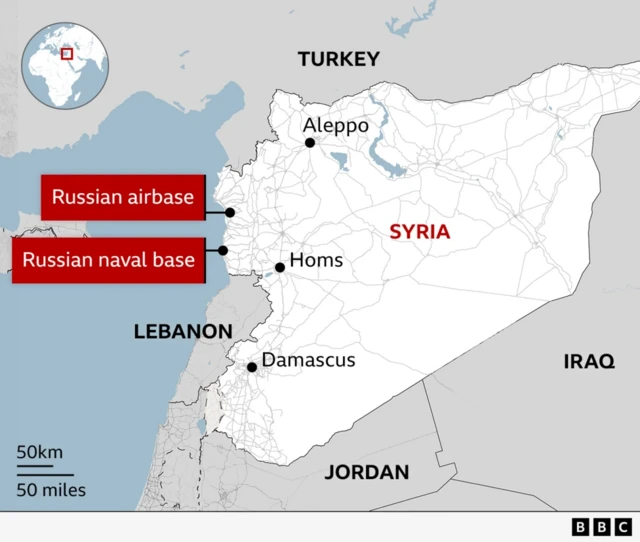
Currently, there are about 7,500 Russian military personnel in Syria, most of whom are stationed at key Russian military facilities in Tartus and Latakia.

But several dozen Russian soldiers - mostly elite special forces operators - are scattered across Syria. Some of these units managed to retreat closer to Russian bases as rebels advanced, but dozens of personnel were cut off from the main group.

This was confirmed by two retired Russian officers who keep close contacts with soldiers serving in Syria. Both of them wrote about it in their blogs.

The future of the military bases is less uncertain. According to satellite images, studied by the BBC Russian, most Russian navy ships left the Tartus naval base on 3 December.

Combat aircrafts in Latakia, on the other hand, remained at the airfield. There are unconfirmed suggestions that the evacuation of the first planes and personnel from that base is expected to begin tomorrow.

Russian officials have yet to comment on these reports.

Russian bases in Syria
 

Russia trying to find dialogue with new Syrian leadership​


Steve Rosenberg
BBC Russia editor

Moscow is trying to find a language and continue a dialogue with Syria's new leadership, and its future relationship with them.

Russia's big concern is the fate of its two military bases - the Hmeimim air base and a naval facility at Tartus, both on the coast - both of which have given Moscow a foothold in the eastern Mediterranean in the last few years.

Even though Moscow had supported Bashar al-Assad for nine years and sent him military assistance to shore him up and keep him in power, now that he's been toppled, Russia is trying to find a dialogue with the new leadership in Syria.

Russia is now stressing that all along they have wanted a political settlement of this crisis.

What's interesting here is that until very recently, the Russian media was referring to what it's calling the "armed opposition in Syria" as "terrorists". That word has gone out of reporting here and they are now being called the "armed opposition" or "opposition".
 

US carries out more than 75 air strikes on IS in Syria​

BBC

A short while ago we heard from US President Joe Biden, who warned the Islamic State group against trying to take advantage of any vacuum created by the power transition in Syria. He said the US had carried out around a dozen "precision air strikes" within Syria against IS targets today.

We've now just had an update from US Central Command (Centcom) which is responsible for US interests in the Middle East, Central and South Asia.

Centcom says the US carried out more than 75 airstrikes on Sunday in a bid to "eliminate ISIS camps in central Syria". It says there are "no indications of civilian casualties".

"There should be no doubt - we will not allow ISIS to reconstitute and take advantage of the current situation in Syria," says General Michael Erik Kurilla, Centcom commander.

"All organisations in Syria should know that we will hold them accountable if they partner with or support ISIS in any way."

Where did ISIS come from, I thought all groups were freedom fighters lol. Usa wants SDF and FSA to have a big say in future government, they probably want to degrade HTS.
 

We weren't asked for help, says Iran's foreign minister​

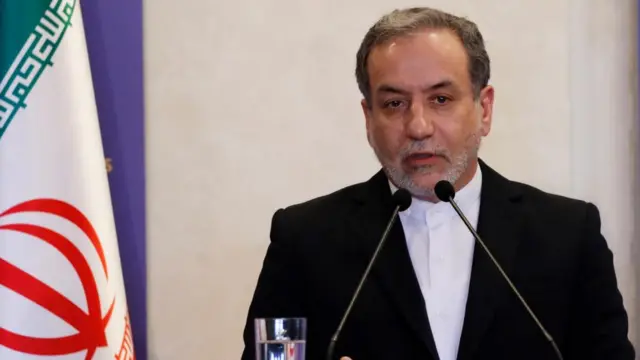
Iranian Foreign Minister Abbas Araghchi in suit and shirt speaking into a microphone


Earlier on Sunday, Iran's Foreign Minister Abbas Araghchi told local media that Iran - an ally of former President Assad - was not asked to intervene as rebels swept towards Damascus.

"We were never asked for help, the duty was the duty of the [Syrian] army basically, we did not consider it a duty for ourselves," he said.

"What was surprising was the inability of the Syrian army to counter this move and the speed of the developments," he added.
Nope, our Akoonds didn't the money nor a viable route to transfer troops and equipment to Syria.
 

Rebel leaders guarantee security to Russian military bases in Syria - reports​


BBC

As Kremlin sources say Syria's ex-president Bashar al-Assad is in Moscow, here's more from Russian state media.

The RIA Novosti news agency reports that the Kremlin is in contact with the leaders of the armed Syrian opposition, "who have guaranteed security to the Russian military bases and diplomatic establishments in Syria".

The agency quotes an unnamed source in the Kremlin as saying Russia has "always called for a search for a political solution in the Syrian crisis".

"We hope the Syrian dialogue will continue in the interests of the Syrian people and the development of bilateral relations between Russia and Syria," the source adds.
 

Assad is in Moscow, Russian state media reports​


Deposed Syrian President Bashar al-Assad and his family have arrived in Moscow, Russian state media agencies report, citing sources in the Kremlin.

Reports also say that Assad and his family have been granted asylum by Russia.

The BBC has not been able to independently verify the information.
 

A scene few could have imagined: Jawlani in the Umayyad Mosque​


Feras Kilani
BBC Arabic Special Correspondent, in Damascus

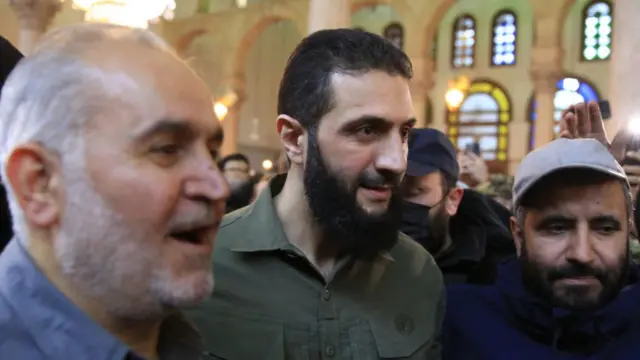
Abu Mohammad al-Jawlani walking in green fatigues surrounded by people during a visit to Great Umayyad Mosque in Damascus


It was a moment no one could have imagined just 24 hours earlier. Without prior warning or arrangements, Abu Mohammad al-Jawlani, the leader of Hay’at Tahrir al-Sham (HTS), made a surprising visit to the Great Umayyad Mosque in Old Damascus.

Seeing him from just a few metres away felt surreal. This mosque had long been a symbolic site where Bashar al-Assad and his late father, Hafez al-Assad, would often perform Eid prayers—a symbolic act for the rulers of the capital.

Surrounded by hundreds of fighters and personal guards, Jawlani entered the mosque, performed the Maghrib prayer, and delivered a brief address to those gathered around him amid chants of victory and “Allahu Akbar".

Earlier, Jawlani had toured key areas of the city, including the iconic Umayyad Square, surrounded by Syria’s most significant government institutions, such as the General Staff Headquarters and state television. There, he prayed before continuing his tour. I was present in the square, but his guards kept everyone at a distance as he approached.

While many Syrians expressed joy at what they see as a turning point, their celebrations were tinged with apprehension about what lies ahead. The acrid smell of gunpowder still fills the air in Damascus, a city locked down and nearly deserted. As Jawlani’s tour unfolded, plumes of smoke rose into the sky, obscuring the future and raising questions about the days and weeks to come.

Dressed in his military attire, Jawlani projected the image of a ruler in Damascus, standing over a city—and a nation—that had been under the grip of Bashar al-Assad and the Baath regime for decades. In less than two weeks, that regime has crumbled, leaving little more than a memory.

Yet, with Jawlani's controversial jihadist past, the question remains: can he succeed in governing the capital and its surrounding territories?
 

Iranian envoy warns developments in Middle East will be beyond "American control"​


From CNN's Ruba Alhenawi

The fallout from the collapse of Bashar al-Assad’s regime will be beyond American control and could lead to a conflict involving regional countries and Turkey, the Iranian ambassador to Syria warned on Sunday.

“I believe the developments in the region will be beyond American control and could seriously disrupt their strategic objectives,” Hossein Akbari said in comments reported by Iranian state news agency IRNA Sunday.

Akbari said the fall of the Assad government – which Iran had supported – had “created a complex alignment between northern and southern forces (in Syria), which could lead to conflict among certain Islamic and Arab countries with Turkey.”

Some context: The rebel coalition led by the former Al Qaeda affiliate Hayat Tahrir al-Sham (HTS) that has taken control of Damascus is only one of numerous armed groups operating in Syria. Other groups controlling territory in the country include the Turkey-backed Syrian National Army and the Kurdish-led Syrian Democratic Forces, elements of which Turkey views as a terrorist organization.

“Given the current circumstances, the diversity of perspectives, and the numerous interventions by various countries, there is a risk of losing security within this (Syrian) society,” Akbari said.

Also on Sunday, Iranian Foreign Minister Abbas Araghchi claimed in a televised interview that Iran’s intelligence and security agencies had been “fully aware” of the rebels’ movements during their lightning advance and had conveyed “all relevant information” to “the Syrian government and the Syrian Army.”

“What was surprising was the inability of the Syrian Army to counter this move and the speed of the developments,” he said.
 
To view this content we will need your consent to set third party cookies.
For more detailed information, see our cookies page.


100%, and people STILL think the US is in decline. SMH

Meanwhile the US economy will surpass $30T next year.
 

Users who are viewing this thread

Pakistan Defence Latest

Latest Posts

Back
Top