Syrian Civil War and The future of Syria after liberation

From Syrian jihadist leader to rebel politician: How Abu Mohammed al-Jawlani reinvented himself​


Mina Al-Lami
Jihadist Media Specialist, BBC Monitoring
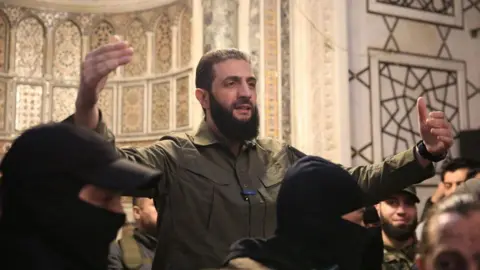
AFP Hayat Tahrir al-Sham (HTS) leader Abu Mohammed al-Jawlani speaks to a crowd at the Umayyad Mosque in Damascus, Syria, after the overthrow of President Bashar al-Assad (8 December 2024)


AFP

Abu Mohammed al-Jawlani spoke to supporters at the Umayyad Mosque in Damascus hours after the overthrow of Bashar al-Assad

Syrian rebel leader Abu Mohammed al-Jawlani has dropped that nom de guerre associated with his jihadist past, and been using his real name, Ahmed al-Sharaa, in official communiques issued since Thursday, ahead of the fall of President Bashar al-Assad.

This move is part of Jawlani's effort to bolster his legitimacy in a new context, as his Islamist militant group, Hayat Tahrir al-Sham (HTS), leading other rebel factions, announces the capture of the Syrian capital, Damascus, solidifying its control over much of the country.

Jawlani's transformation is not recent, but has been carefully cultivated over the years, evident not only in his public statements and interviews with international outlets but also in his evolving appearance.

Once clad in traditional jihadist militant attire, he has adopted a more Western-style wardrobe in the past years. Now, as he leads the offensive, he has donned military fatigues, symbolising his role as the commander of the operations room.

But who is Jawlani - or Ahmed al-Sharaa - and why and how has he changed?

The IS-Iraq link​

A 2021 PBS interview with Jawlani revealed that he was born in 1982 in Saudi Arabia, where his father worked as an oil engineer until 1989.

In that year, the Jawlani family returned to Syria, where he grew up and lived in the Mezzeh neighbourhood of Damascus.

Jawlani's journey as a jihadist began in Iraq, linked to al-Qaeda through the Islamic State (IS) group's precursor - al-Qaeda in Iraq and, later, the Islamic State of Iraq (ISI).

After the 2003 US-led invasion, he joined other foreign fighters in Iraq and, in 2005, was imprisoned at Camp Bucca, where he enhanced his jihadist affiliations and later on was introduced to Abu Bakr al-Baghdadi, the quiet scholar who would later go on to lead IS.

In 2011, Baghdadi sent Jawlani to Syria with funding to establish al-Nusra Front, a covert faction tied to ISI. By 2012, Nusra had become a prominent Syrian fighting force, hiding its IS and al-Qaeda ties.
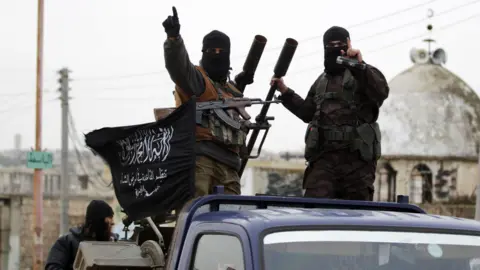
Reuters Al-Nusra Front fighters ride on a pick-up truck carrying an anti-aircraft gun in Idlib province, north-western Syria (2 December 2014)


Reuters
Abu Bakr al-Baghdadi sent Jawlani to Syria to establish Al-Nusra Front

Tensions arose in 2013 when Baghdadi's group in Iraq unilaterally declared the merger of the two groups (ISI and Nusra), declaring the creation of the Islamic State of Iraq and the Levant (ISIL or ISIS), and publicly revealing for the first time the links between them.

Jawlani resisted, as he wanted to distance his group from ISI's violent tactics, leading to a split.

To get out of that sticky situation, Jawlani pledged allegiance to al-Qaeda, making Nusra Front its Syrian branch.

From the start, he prioritised winning Syrian support, distancing himself from IS's brutality and emphasising a more pragmatic approach to jihad.
 

Joining al-Qaeda​

In April 2013, al-Nusra Front became al-Qaeda's Syrian affiliate, putting it at odds with IS.

While Jawlani's move was partly an attempt to maintain local support and avoid alienating Syrians and rebel factions, the al-Qaeda affiliation ultimately did little to benefit this effort.

It became a pressing challenge in 2015 when Nusra and other factions captured Idlib province, forcing them to co-operate in its administration.

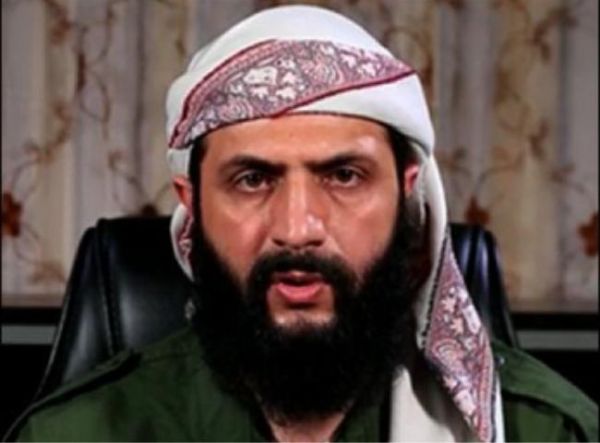
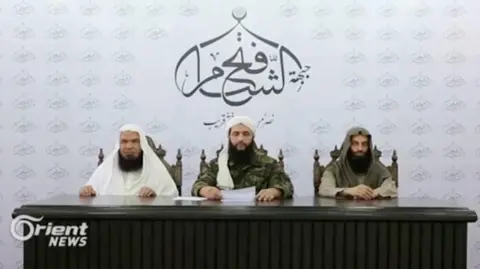
Reuters Screengrab of video showing Abu Mohammed al-Jawlani speaking in 2016 under the banner of Jabhat Fatah al-Sham


Reuters
Jawlani rebranded al-Nusra Front as Jabhat Fatah al-Sham in 2016. The following year it became Hayat Tahrir al-Sham

In 2016, Jawlani severed ties with al-Qaeda, rebranding the group as Jabhat Fatah al-Sham and later as Hayat Tahrir al-Sham (HTS) in 2017.

While initially appearing superficial, the split revealed deeper divisions. Al-Qaeda accused Jawlani of betrayal, leading to defections and the formation of Hurras al-Din, a new al-Qaeda affiliate in Syria, which HTS later crushed in 2020. Members of Hurras al-Din, however, have remained cautiously present in the region.

HTS also targeted IS operatives and foreign fighters in Idlib, dismantling their networks and forcing some to undergo "deradicalisation" programmes.

These moves, justified as efforts to unify militant forces and reduce infighting, signalled Jawlani's strategy to position HTS as a dominant and politically viable force in Syria.

Despite the public split from al-Qaeda and name changes, HTS continued to be designated by the UN, US, UK and other countries as a terrorist organisation, and the US maintained a $10m reward for information about Jawlani's whereabouts. Western powers considered the break-up to be a façade.

Forming a 'government' in Idlib​

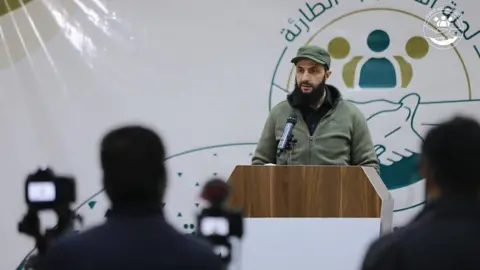
Salvation Government Abu Mohammed al-Jawlani taking questions at a press conference following the February 2023 earthquakes in northern Syria


Salvation Government
Jawlani gave a press conference following the devastating 2023 earthquakes in Syria
Under Jawlani, HTS became the dominant force in Idlib, north-west Syria's largest rebel stronghold and home to about four million people, many of whom were displaced from other Syrian provinces.

To address concerns about a militant group governing the area, HTS established a civilian front, the so-called "Syrian Salvation Government" (SG) in 2017 as its political and administrative arm.

The SG functioned like a state, with a prime minister, ministries and local departments overseeing sectors such as education, health and reconstruction, while maintaining a religious council guided by Sharia, or Islamic law.
 

Anti-HTS protests​

For over a year leading up to the HTS-led rebel offensive on 27 November, Jawlani faced protests in Idlib from hardline Islamists as well as Syrian activists.

Critics compared his rule to Assad's, accusing HTS of authoritarianism, suppressing dissent and silencing critics. Protesters labelled HTS's security forces as "Shabbiha", a term used to describe Assad's loyalist henchmen.

They further alleged that HTS deliberately avoided meaningful combat against government forces and marginalised jihadists and foreign fighters in Idlib to prevent them from engaging in such actions, all to appease international actors.

Even during the latest offensive, activists have persistently urged HTS to release individuals imprisoned in Idlib allegedly for expressing dissent.

In response to these criticisms, HTS initiated several reforms over the past year. It disbanded or rebranded a controversial security force accused of human rights violations and established a "Department of Grievances" to allow citizens to lodge complaints against the group. Its critics said these measures were just a show to contain dissent.


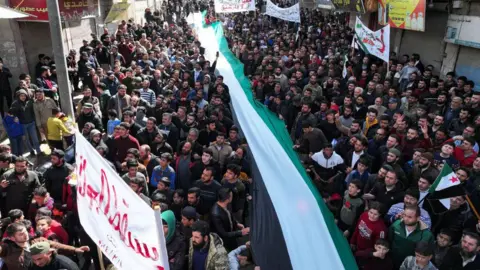
AFP People take part in a protest against Hayat Tahrir al-Sham (HTS) in the rebel-held town of Binnish, Idlib province, north-western Syria (8 March 2024)


AFP
Earlier this year, protesters in Idlib demanded the release of detainees and an end to HTS's rule

To justify its consolidation of power in Idlib and the suppression of plurality among militant groups, HTS argued that unifying under a single leadership was crucial for making progress and ultimately overthrowing the Syrian government.

HTS and its civilian arm, the SG, walked a tightrope, striving to project a modern, moderate image to win over both the local population and the international community, while simultaneously maintaining their Islamist identity to satisfy hardliners within rebel-held areas and HTS's own ranks.

For instance, in December 2023, HTS and the SG faced a backlash after a "festival" held at a glossy new shopping mall was criticised by hardliners as "immoral".

And this August, a Paralympic Games-inspired ceremony drew sharp criticism from hardliners, prompting the SG to review the organisation of such events.

These incidents illustrate the challenges HTS faces in reconciling the expectations of its Islamist base with the broader demands of the Syrian population, who are seeking freedom and coexistence after years of authoritarian rule under Assad.

Leading a new path?​

As the latest offensive unfolded, global media focused on Jawlani's jihadist past, prompting some rebel supporters to call for him to step back, viewing him as a liability.

Although he previously expressed willingness to dissolve his group and step aside, his recent actions and public appearances tell a different story.

HTS's success in uniting rebels and nearly capturing the whole country in under two weeks has strengthened Jawlani's position, quieting hardline critics and accusations of opportunism.
 
.
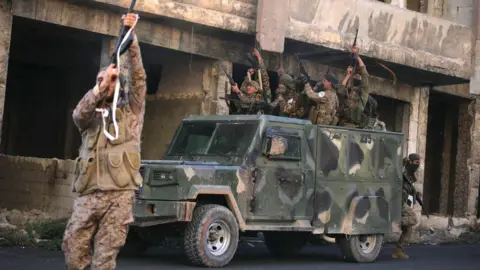
AFP Rebel fighters celebrate after they captured Maaret al-Numan in Syria's north-western Idlib province (30 November 2024)


AFP
HTS and its allies launched the offensive that overthrew Assad at the end of November
Jawlani and the SG have since reassured domestic and international audiences.

To Syrians, including minorities, they promised safety; to neighbours and powers like Russia, they pledged peaceful relations. Jawlani even assured Russia its Syrian bases would remain unharmed if attacks ceased.

This shift reflects HTS's "moderate jihad" strategy since 2017, emphasising pragmatism over rigid ideology.

Jawlani's approach could signal the decline of global jihad movements like IS and al-Qaeda, whose inflexibility is increasingly seen as ineffective and unsustainable.

His trajectory might inspire other groups to adapt, marking either a new era of localised, politically flexible "jihadism" or just a temporary divergence from the traditional path in order to make political and territorial gains.
 
You are true sectarian. Open your eyes.

How I am a sectarian when I have been encouraging unity?

since the beginning of this conflicts, I have been wishing Islamic world would look beyond sunni-shia divisions and unit as 'One Ummah' and rescue Al Aqsa and Palestine form being butchered but what we have been seeing is that Sunni world did iota of jack to make any meaningful impact.

Only Shia Muslims block cause some damaged but they could not do it alone.

BTW I am a sunni, not shia just so you know.
 
Last edited:

Israel seizes Golan buffer zone after Syrian troops leave positions​


Jon Donnison
BBC News, Reporting fromJerusalem

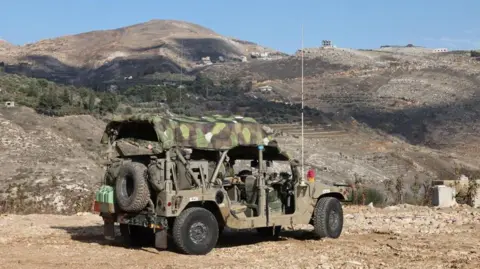
EPA Israeli troops deploy next to the security fence near the Druze village of Majdal Shams, in the Israeli-occupied Golan Heights (8 December 2024)


EPA
Israeli forces near Majdal Shams in the occupied Golan Heights on Sunday
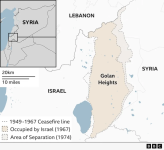
Israel's prime minister has announced its military has temporarily seized control of a demilitarized buffer zone in the Golan Heights, saying the 1974 disengagement agreement with Syria had "collapsed" with the rebel takeover of the country.

Benjamin Netanyahu said he had ordered the Israel Defense Forces (IDF) to enter the buffer zone and "commanding positions nearby" from the Israeli-occupied part of the Golan.

"We will not allow any hostile force to establish itself on our border," he said.

A UK-based war monitor said Syrian troops had left their positions in Quneitra province, part of which lies inside the buffer zone, on Saturday.

On Sunday, the IDF told residents of five Syrian villages inside the zone to stay in their homes until further notice.

The Golan Heights is a rocky plateau about 60km (40 miles) south-west of Damascus.

Israel seized the Golan from Syria in the closing stages of the 1967 Six-Day War and unilaterally annexed it in 1981. The move was not recognised internationally, although the US did so unilaterally in 2019.

The Israeli move in the buffer zone came after Syrian rebel fighters captured the capital, Damascus, and toppled Bashar al-Assad's regime. He and his father had been in power in the country since 1971.

Forces led by the Islamist opposition group Hayat Tahrir al-Sham (HTS) entered Damascus in the early hours of Sunday morning, before appearing on state television to declare Syria to now be "free".

Netanyahu said the collapse of the Assad regime was a "historic day in the Middle East".

"The collapse of the Assad regime, the tyranny in Damascus, offers great opportunity but also is fraught with significant dangers," he said.

He said events in Syria had been the result of Israeli strikes against Iran and the Iran-backed Lebanese armed group Hezbollah, Assad's allies, and insisted Israel would "send a hand of peace" to Syrians who wanted to live in peace with Israel.

The IDF seizure of Syrian positions in the buffer zone was a "temporary defensive position until a suitable arrangement is found", he said.

"If we can establish neighbourly relations and peaceful relations with the new forces emerging in Syria, that's our desire. But if we do not, we will do whatever it takes to defend the State of Israel and the border of Israel," he said.
 
After more than a year of war in the Middle East, Israel already has its hands full.

But the pace of events in Syria, it's northern neighbour, will be of real concern.

The IDF had already moved reinforcements to the occupied Golan.

In normal times, its warning to residents in several villages to stay in their homes because Israel would not hesitate to act if it felt it needed to would be seen as hugely provocative and enough to start a war.

Israel is especially concerned about who might get their hands on Bashar al-Assad's alleged arsenal of chemical weapons.

The leader of the Syrian rebellion is Abu Mohammed al-Jawlani. His family roots are in the occupied Golan Heights, where thousands of Israeli settlers now live alongside about 20,000 Syrians, most of them Druze, who stayed on after it was captured.

Israel will have no intention of giving that land up and is determined to protect its citizens.

During the 2011 Syrian uprising, Israel made the calculation that Assad, despite being an ally of both Iran and Hezbollah, was a better bet than what might follow his regime.

Israel will now be trying to calculate what comes next in Syria. Like everyone, it can only guess.
 
Meet the founder of new Syria, Martyr Yahya Sinwar ❤️
To view this content we will need your consent to set third party cookies.
For more detailed information, see our cookies page.
 
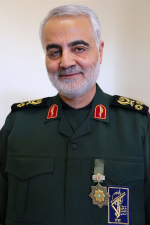
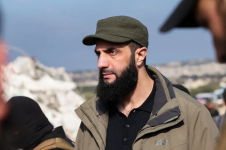
Just compare Soleymani face vs Jalani face.

Face is the best tool to see person heart
1733709007848.png

1733709033778.png

They both look pretty handsome men. One older and other younger. Besides that, what are you suggesting? I am starting to think the new guy is a sharp kid and he may go places.
 
How I am a sectarian when I have been encouraging unity?

since the beginning of this conflicts, I have been wishing Islamic world would look beyond sunni-shia divisions and unit as 'One Ummah' and rescue Al Aqsa and Palestine form being butchered but what we have been seeing is that Sunni world did iota of jack to make any meaningful impact.

Only Shia Muslims block cause some damaged but they could not due it alone.

BTW I am a sunni, not shia just so you know.

Learn Hama Massacre in 1982 conducted by Bashar father that genocided 40 000 Hama civilian

2011, people want democracy. 75 % Sunni, only around 10 % Alawite.

I dont like civil war, but maybe because Assad regime brutal behavior it then become civil war.

Iran present there is foreign present. Iran resistence is just Mullah proxy tactic to hit Israel while sacrificing 42000 Palestinians, mostly women, kids, babies
 
To view this content we will need your consent to set third party cookies.
For more detailed information, see our cookies page.
 
Learn Hama Massacre in 1982 conducted by Bashar father that genocided 40 000 Hama civilian

2011, people want democracy. 75 % Sunni, only around 10 % Alawite.

I dont like civil war, but maybe because Assad regime brutal behavior it then become civil war.

Iran present there is foreign present. Iran resistence is just Mullah proxy tactic to hit Israel while sacrificing 42000 Palestinians, mostly women, kids, babies

For the sake argument, let's agree that Shias are bad and they are enemy of sunni.

Question is, what actions majority sunni nations took to rescue innocents Palestinean since the conflict?

As per I remember, Iran called for OIC meeting early days of this conflict and forwarded a resolation
( something in that line) that cut all ties/cooperation with Zionists entity.

Do you know who opposed that resolution?
 

Users who are viewing this thread

Country Watch Latest

Back
Top