China could dominate the sky with two flying sixth-generation fighter jets as the US struggles to design one

Reposted article, wasn't written by me.

May or maynot be a 6th gen fighter. What I can see is that it's a tailless fighter. for a sub-orbital aerospace flight capabiltity I would have expected a much larger jet to accomodate the additional fuel needed. I would have also expected some kind of ceramic coating for managing high heat levels. Maybe a titanium alloy is used?

Right now I'd say we need to know more.
 
May or maynot be a 6th gen fighter. What I can see is that it's a tailless fighter. for a sub-orbital aerospace flight capabiltity I would have expected a much larger jet to accomodate the additional fuel needed. I would have also expected some kind of ceramic coating for managing high heat levels. Maybe a titanium alloy is used?

Right now I'd say we need to know more.

It looks like a long range strike fighter that prioritizes LO and range to deliver payloads. It’s more of an attempt to counter the B-21 than a true counter air platform like NGAD.
 
@Beijingwalker maybe it is a 6th gen fighter afterall. I thought I had read earlier that it needed some sub-orbital flight capabiltiies(I believe the americans were working towards that). But maybe it isn't a requirement afterall. 6th gen is probably a more advanced 5th gen fighter with optional manned ability.

  • Designed using Digital Engineering (aka Model based Design)<a href="https://en.wikipedia.org/wiki/Sixth-generation_fighter#cite_note-4"><span>[</span>4<span>]</span></a>
  • Advanced digital capabilities including high-capacity networking, AI, data fusion, cyber warfare, D2D and battlefield command, control and communications (C3) capabilities.
  • Optionally manned, with the same airframe capable of conducting piloted, remote controlled or onboard-AI controlled missions.
  • Enhanced human-systems integration, with virtual cockpits presented via helmet-mounted displays which allow the pilot 360-degree vision with AI-enhanced battlefield awareness, and replacing conventional instrument panels.
  • Advanced stealth airframes and avionics.
  • Advanced variable-cycle engines able to cruise economically but still deliver high thrust when required.
  • Increased-range stand-off and BVR weapons.
  • Potential use of directed-energy weapons such as a laser CIWS.
  • Software Architecture with separation of flight critical operations from other functionality<a href="https://en.wikipedia.org/wiki/Sixth-generation_fighter#cite_note-5"><span>[</span>5<span>]</span></a>
 
It looks like a long range strike fighter that prioritizes LO and range to deliver payloads. It’s more of an attempt to counter the B-21 than a true counter air platform like NGAD.
Which one?

布什鸽门,一天来两款啊?双六代机??_1_喜欢放原图_来自小红书网页版.jpg
 
Still don't know which one you are talking about, Shenyang's or Chengdu's?

1735289164-3996.jpg
 

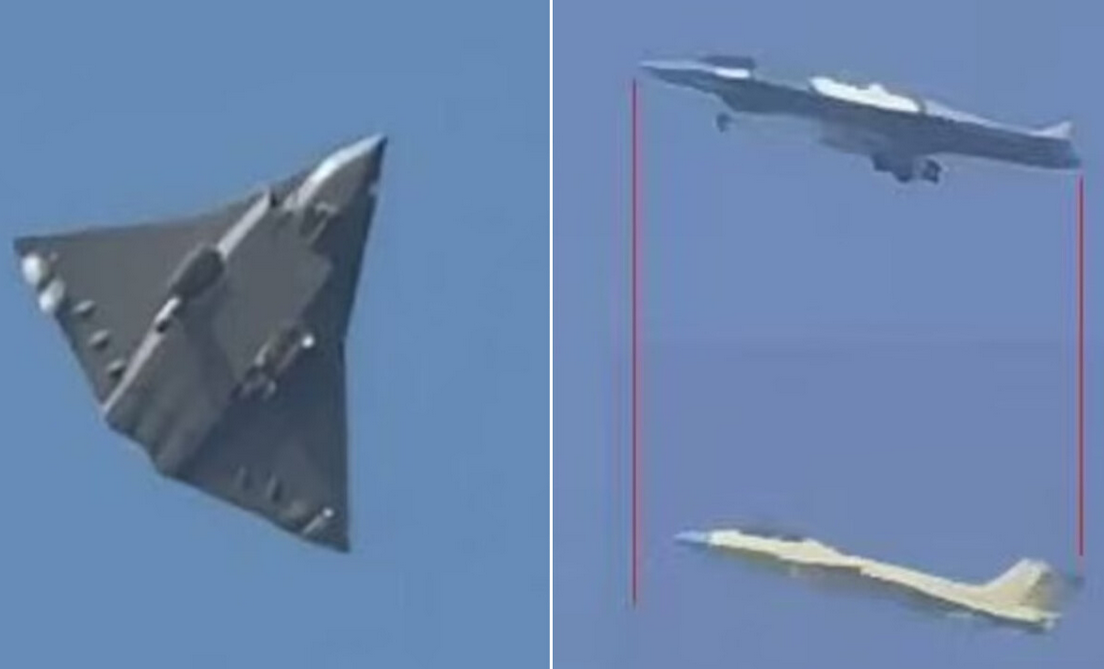
China’s two new 6th Generation fighters are impressive: Tail-less and undetectable by radar​

They do not have vertical stabilizers - Complete absence of 90 degree angles​


ch.png

Newsroom
December 2705:29

Images of two new Chinese military aircraft with stealth features were posted online Friday, with defense experts calling them advanced designs, but without enough details for definitive conclusions.

According to Reuters, the aircraft lack vertical stabilizers, a feature that makes them “tail-less” and dependent on computers to maintain their stability.

The larger of the two features an unusual design with three air intakes – two on the side and one at the top of the fuselage.

The smaller, though more conventional, also lacks a tail. Both are characterized by the absence of 90-degree angles, a feature that reduces detection by radar.

China’s

The development is an indication of the Chinese aviation industry’s willingness to experiment and innovate, according to Australian Strategic Policy Institute analyst Ewan Graham.

“The design is original and deserves credit for that,” he added, stressing that China appears to be attempting to compete with the US and its allies.

China’s defense ministry has not commented on the matter, while the U.S. Defense Department confirmed that it has taken note of the reports, with no further statements beyond its annual report on the Chinese military.

Targeting the sixth generation of fighters</h3 The US has been working for years on the NGAD (Next Generation Air Dominance) program, which focuses on developing sixth generation fighters. At the same time, Europe and Asia are working together to create the Global Combat Air Program. However, the progress of the US program may be affected by the administration of the new president, Donald Trump.

Video verified by Reuters shows the larger of the two new aircraft flying over the city of Chengdu, but the exact date was not confirmed.

To view this content we will need your consent to set third party cookies.
For more detailed information, see our cookies page.


Questions about the possibilities

While the designs are groundbreaking, experts note that the actual capabilities of the aircraft, such as their maneuverability, speed or electronic systems, are not yet known.

China’s previous stealth aircraft, such as the J-20 and J-35, have shown some signs of technological advancement, but their full capability remains unclear.

The flight of these new designs over cities is surprising. According to analyst Kelly Griko, this may be an attempt by China to influence the debate in the US about the future of NGAD.

Meanwhile, on the same day, China’s state media reported the launch of its navy’s newest amphibious assault ship.

 
It's fairly unusual that China takes this nothing-to-hide approach...

To view this content we will need your consent to set third party cookies.
For more detailed information, see our cookies page.
 
I don't know who has claimed this is a 6th gen fighter? What can be seen is that this is a tailless fighter right?

From what I understand 6th should include sb-orbital aerospace flight capabilties and therefore the usage fo scramjet engines right? No chinese agency has claimed it for this deisgn as far as I know.
Yeah, keep denying, Tejas is the best, Chinese new fighter just a copy of Tejas as some Indians claim.
 
At the moment we dont know the purpose of either of these fighter jets/bombers. I would not be suprised if there is something else cooking.
 

China Takes to the Skies with the Future of Warfare: A First Look at the World’s First 6th-Gen ‘Invisible Assassin’ Fighter Jet

by Carl Harrison
December 27, 2024

2024126th-generation-stealthy-fighter-jet-1140x570.png


In a jaw-dropping technological leap, China has sent shockwaves through the global defense community by unveiling what is believed to be the world’s first sixth-generation stealth fighter jet. In a theatrical debut laden with symbolism, the futuristic aircraft—unofficially dubbed the J-36—was seen slicing through the skies above Chengdu on December 26, 2024, a date chosen to commemorate the birth of Mao Zedong. This is more than a plane—it’s a calculated message to the world: China is aiming to dominate the skies of the future.

The Mysterious Flight That Shook the Skies

The aircraft’s appearance was nothing short of extraordinary. Observers and defense analysts spotted the tailless, diamond-shaped marvel accompanied by a two-seat Chengdu J-20S chase plane. With its sleek, UFO-like frame, this airborne enigma showcases a design aimed at ultimate stealth and cutting-edge aerodynamics. Analysts suggest the lack of a tail and the unconventional air intake placement could drastically reduce radar signatures, rendering the jet nearly invisible to modern detection systems.

But the intrigue doesn’t stop there. Experts have speculated the craft may feature a groundbreaking three-engine setup. This configuration would not only boost power but also enable greater speed and range, potentially giving it an unprecedented reach for long-range missions—perfect for projecting power far beyond China’s borders.

Stealth, Power, and Symbolism: A Triple Threat

The timing of the flight is as significant as the aircraft itself. Choosing Mao Zedong’s birthday underscores the Communist Party’s narrative of military strength tied to national pride. This is not merely a technological achievement; it’s a statement of intent. China is signaling to the world that it is not just catching up in military aviation—it is redefining the playing field.

The J-36’s tailless design and aerodynamic brilliance hint at a leap forward in stealth technology, allowing it to evade even the most advanced radar systems. Its large body and strategic design choices suggest a dual capability—one that excels in both dogfighting and strategic bombing roles. This isn’t just a fighter jet; it’s a platform built for multi-role dominance, designed to operate across various theaters of war.

A Game-Changer in the Global Arms Race

This unveiling doesn’t just elevate China’s military capabilities—it sets a new benchmark. While the United States has teased its own sixth-generation fighter, the Next Generation Air Dominance (NGAD) platform, it has yet to reveal anything as tangible as the J-36. Other global powers like Russia and the European Union are still in the early phases of conceptual design, leaving China as the frontrunner in this new aerial arms race.

Analysts are warning that this development could shift the balance of air superiority in ways not seen since the introduction of stealth technology in the late 20th century. If the J-36 delivers on its potential, it could outmaneuver and outgun current fifth-generation fighters like the F-35, F-22, and Su-57.

The Secrecy and Speculation Continue

China, true to form, has revealed little about the aircraft’s technical specifications. This veil of secrecy has only fueled speculation, with global experts dissecting every photo and video clip of the mysterious flight. From its diamond-shaped airframe to its potential hypersonic capabilities, the J-36 has left the world guessing—and worried.

What is certain, however, is that this jet represents a monumental step forward in military aviation. It is not merely a tool for combat; it is a symbol of China’s rising power and ambition. With the world’s eyes now firmly fixed on the skies above Chengdu, the J-36 has set a new standard for what the future of warfare might look like.

The Dawn of a New Era

As the global arms race accelerates, the J-36 could redefine the very concept of air dominance. Its capabilities, though shrouded in mystery, promise a level of sophistication that may challenge even the most advanced militaries. For now, the world can only watch, wait, and prepare as China rewrites the rules of the skies.

This is not just a plane—it’s a bold declaration that the future of warfare is here, and China is leading the charge. The “Invisible Assassin” has arrived, and its shadow will loom large over the world’s airspace for years to come.


China’s groundbreaking 6th gen stealth fighter takes flight: How it could be a 'super weapon' that could alter global power dynamics​


China’s groundbreaking 6th gen stealth fighter takes flight: How it could be a 'super weapon' that could alter global power dynamics

China’s groundbreaking 6th gen stealth fighter takes flight: How it could be a 'super weapon' that could alter global power dynamics

The emergence of China’s new stealth fighter jet, believed to be a 6th-generation model, has caused a stir in military circles globally. The J-36, which made its first appearance in a video circulating on social media, was seen flying in broad daylight over Chengdu, Sichuan province. The aircraft's design and capabilities suggest it may represent a significant shift in aerial dominance, posing a potential threat to global military powers, especially in the Indo-Pacific region.

Unconventional Design and Advanced Features​

The J-36 features a striking tailless triangular configuration, designed to significantly reduce its radar signature and enhance its stealth capabilities. This unique design allows it to potentially evade detection by conventional radar systems, making it harder to track and intercept. The jet's ability to fly at high altitudes over extended distances could give it the upper hand in operations far from its base, with a substantial reduction in reliance on tanker support.

One of the most notable features of the J-36 is its three-engine configuration, believed to be powered by WS-10C turbofan engines. This configuration is designed for high-speed and high-altitude operations, enabling the aircraft to cover long ranges without the need for aerial refuelling. The larger size of the J-36 is also speculated to offer greater fuel capacity, increased payload, and more space for advanced weapons and sensors, making it suitable for a variety of combat and reconnaissance missions.

The stealth capabilities of the J-36 include advanced technologies such as side-looking airborne radar and electro-optical sensors. These systems would enhance its reconnaissance and combat potential, allowing it to operate effectively in contested environments where traditional fighters might struggle.

J-36 and the Regional Power Shift​

The development of the J-36 is part of China’s broader strategy to modernise its military, reflecting significant advances in air combat technology. According to a South China Morning Post report, the aircraft was accompanied by a Chengdu J-20S fighter jet during its maiden flight, suggesting that both aircraft may be part of a new generation of Chinese fighter jets poised to challenge existing global powers in the skies.

The debut of the J-36 could have significant implications for India, which currently lacks a stealth fighter jet. With China already deploying its J-20 stealth fighters close to India’s borders, particularly in Sikkim, the addition of the J-36 could heighten tensions along the frontier. NDTV reported earlier in May that satellite images showed Chinese J-20 jets positioned less than 150 km from India’s border. India counters with its fleet of 36 French-built Rafale fighters, stationed at Hasimara in West Bengal, which lies within striking distance of China’s airbases in Tibet, including Shigatse, where the J-20 is stationed.

While the J-36 is still in its early testing phase, its potential to be a formidable opponent in the skies is clear, especially when paired with the growing fleet of J-20s. If deployed along the India-China border, this stealth fighter could pose an unprecedented threat to India’s aerial defences, which currently rely on the Rafale jets and older fleets.

The Strategic Importance of the J-36​

The unveiling of the J-36 is not just a technological leap for China but also a strategic move to assert its military prowess on the global stage. The test flight, which occurred on the anniversary of Mao Zedong’s birth, appears to have been a deliberate display of China’s growing capabilities. The high-profile nature of the flight suggests that the country is keen to showcase its advancements, especially in military aviation, to the world.

Justin Bronk, a senior researcher at the Royal United Services Institute, remarked that the public display of such an advanced prototype is “fascinating” and noted that China’s military rarely showcases new aircraft without a clear strategic purpose. The development of the J-36 is believed to be part of a broader “system of systems” approach, which integrates manned and unmanned platforms to enhance combat effectiveness, similar to the U.S. Next Generation Air Dominance (NGAD) initiative.

China’s Military Ambitions and Global Implications​

The J-36 is part of China’s larger ambitions to modernise its military under President Xi Jinping’s leadership. The U.S. Department of Defense has already acknowledged China’s air force as the largest in the Indo-Pacific region. The Pentagon’s focus on China as a "top pacing challenge" reflects concerns over Beijing’s rapid advancements in aircraft technology, unmanned aerial systems, and integrated military strategies.

For the United States and its allies, the introduction of the J-36 poses a significant challenge. The stealth capabilities and long-range potential of the J-36 could threaten vital U.S. military assets in the Indo-Pacific, such as tankers, early-warning aircraft, and forward-deployed naval vessels. The U.S. has been investing in the NGAD programme, which aims to develop the next generation of fighter jets that incorporate advanced stealth, adaptive engines, and AI-driven decision-making. The J-36’s capabilities could pose a challenge to U.S. efforts to maintain aerial superiority.

The J-36’s potential also extends beyond conventional combat. It could serve as a testbed for advanced technologies that may be deployed across a variety of platforms, including stealth bombers and unmanned aerial vehicles. This reflects China’s ambition to not only compete with the U.S. but potentially surpass it in key areas of military aviation.

China’s Rapid Military Growth​

China’s rise in military aviation has been swift. When the People’s Republic of China was founded in 1949, it had just 17 aircraft. Today, its air force competes with the most advanced in the world, and the debut of the J-36 is another indicator of this rapid technological evolution. The aircraft is set to alter the balance of aerial power in the Indo-Pacific region and beyond, shifting the power dynamics in favour of China.

The development of the J-36 is a testament to China’s long-term strategic vision. The jet is part of broader efforts to modernise its air and naval forces, ensuring it has the capability to project power beyond its borders. As tensions rise with the United States over issues such as Taiwan and the South China Sea, the J-36 serves as both a symbol of China’s growing strength and a practical asset for expanding its military influence.

What’s Next for the J-36?​

As the J-36 continues its test flights, further information on its capabilities will emerge. Experts expect additional sightings and data in the coming months, which will shed more light on its performance and potential. The aircraft’s integration into China’s air force could signal a significant shift in regional and global security, particularly if it is deployed alongside advanced drones and other autonomous systems.

For the U.S., the J-36’s development likely means an accelerated effort to enhance its own air capabilities. The ongoing race for aerial dominance between China and the U.S. will determine the future of global military power, with both nations pushing the boundaries of what is possible in terms of fighter jet technology.


Users who are viewing this thread

Pakistan Defence Latest

Back
Top