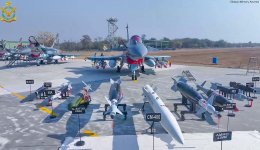
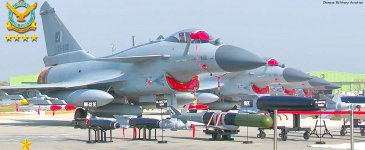
PAF J-10CE News, Updates and Discussion

Status
Not open for further replies.
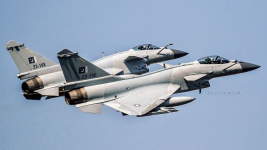
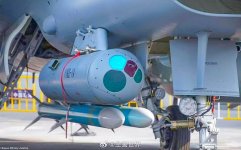
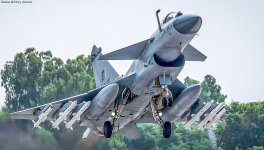
It was rumored in November 2024 that PAF ordered a new batch of J-10CE. They are likely to be constructed at GAIC (09 batch) where a new assembly line has been established. The aircraft can carry a YINGS-IIIA designation pod and have a twin missile pylons (slightly staggered) mounted underneath the centerline station.
J-10C_Yings-IIIA.jpg
 
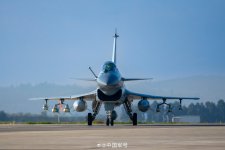
PLAAF's J-10C at full capacity
4x medium-range air-to-air missiles
2x short-range air-to-air missiles
3x heavy load mounting points (sub-tanks/air-to-ground missiles/air bombs)

We can use this to compare the PAF's J-10CE.
View attachment 90383

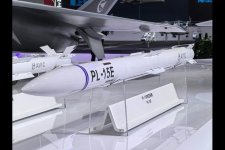
Could the new PL15E with folding fins, allow for three PL15Es to be carried through a triple-rack launcher on the J10CE. ie similar to Boeing’s new AMBER missile racks ?

1735043460230.jpeg

Boeing’s new AMBER missile racks :
1735043566799.webp

Does China have anything in the works that could compare with the AMBER rack? If you look at the series of J11/15/16/30MK derivatives of the Su27 platform, you notice that the missile carrying capabilities of the platform is quite small relative to the size of the platform. China does need something like AMBER for its heavies, aswell as the J10CE.
 
Last edited:
Could the new PL15E with folding fins, allow for three PL15Es to be carried through a triple-rack launcher on the J10CE?
The PL-15 series with folding wings is designed primarily for hidden bomb bay for stealth fighters. It could certainly be carried by the J-10CE, but there is absolutely no need for it.

We don't currently see PLAAF using launchers with more than 2 missiles mounted. Technically, it doesn't have much difficulty. But I'm not sure the PLAAF needs it that way.

China conducts technical studies on all new technologies from the US military, but it does not fully adopt them when they are actually fielded. the PLA usually conducts a lot of studies and demonstrations, and some of the technologies are fielded experimentally and rehearsed in combat, but the military is very cautious about actually adopting them.

China and the U.S. are completely different in terms of military operational doctrine. China will do its best to absorb and master U.S. technology at the technical level, but it will give up a lot of U.S. technology when it is actually deployed.
 
The PL-15 series with folding wings is designed primarily for hidden bomb bay for stealth fighters. It could certainly be carried by the J-10CE, but there is absolutely no need for it.

We don't currently see PLAAF using launchers with more than 2 missiles mounted. Technically, it doesn't have much difficulty. But I'm not sure the PLAAF needs it that way.

China conducts technical studies on all new technologies from the US military, but it does not fully adopt them when they are actually fielded. the PLA usually conducts a lot of studies and demonstrations, and some of the technologies are fielded experimentally and rehearsed in combat, but the military is very cautious about actually adopting them.

China and the U.S. are completely different in terms of military operational doctrine. China will do its best to absorb and master U.S. technology at the technical level, but it will give up a lot of U.S. technology when it is actually deployed.

In the era of drones, and mass UAV attacks, what is becoming evident is that what is required is the ability to carry more missiles and for those missiles to be cheaper and simplier. Drones dont need missiles that can pull 50G etc.


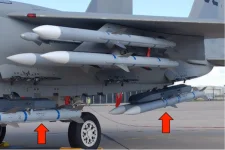
F15E pilots ran out of missiles and resorted to guns, but they were lucky in that Iran did not launch a full mass attack, otherwise they would have gotten through.
 
In the era of drones, and mass UAV attacks, what is becoming evident is that what is required is the ability to carry more missiles and for those missiles to be cheaper and simplier. Drones dont need missiles that can pull 50G etc.


F15E pilots ran out of missiles and resorted to guns, but they were lucky in that Iran did not launch a full mass attack, otherwise they would have gotten through.
1, Manned fighters using air-to-air missiles against cheap small to medium sized drones at low to medium altitude is a contingency/stupidity in itself. We can counter them by carrying electronic jamming pods or directed energy weapon (laser/microwave etc) pods.

2, For high value targets such as medium to large medium to high altitude UAVs, we may want to deploy more fighters if the other side already outnumbers the air-to-air missiles of our own manned fighters. We can also use other means to counter them.

Fighter loads seriously affect the combat performance of fighter aircraft. It needs to be balanced.
 
To view this content we will need your consent to set third party cookies.
For more detailed information, see our cookies page.

That was my hope as well; 100 J-10 would be enough to allow the PAF economies of scale, to have approx. 5 squadrons of J-10s to complement the 10-11 squadrons of JF-17, 4 of F-16 (going down to 2) and 2 squadrons of J-35s. A wholesale modernization, with the last two squadrons of F-16s being replaced with 2 squadrons of the KAAN in the 2030s. The PFX can replace older JF-17s or increase the fleet size if/when there is a need in due time. If the PAF has to expand from 20 squadrons to say 24, a further 2 squadrons of J-10s and one each of the J-35 and KAAN could really maintain a well balanced fleet.

The J-10 is a decent 4th gen platform expected to have relatively modest maintenance costs compared to 5th gen platforms, and with continuous modernizations, could really hold its own against any plane currently in the IAF fleet.

I hope the PAF is working on the PL-21 (said to be around 320 km for the PLAAF, 250 km export for Pakistan) to really show the maximum capability of the J-10. With this missile, the J-10 could really be up there with any fighter in its generation.
 
Last edited:
Status
Not open for further replies.

Users who are viewing this thread

Pakistan Defence Latest

Back
Top