F-22Raptor
Elite Member

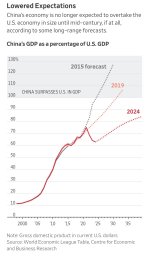
China’s go-go days are behind it as the world’s second-largest economy struggles with the bursting of the biggest real-estate bubble ever. Now, China’s goal of overtaking the U.S. as the world’s largest economy might take decades longer than Beijing expected—if it happens at all.
China’s economy today is burdened with excess: Millions of empty or unfinished apartment blocks, trillions of dollars in debt straining local governments and ballooning industrial production driving an export surge that is igniting trade tensions worldwide.
China still has strengths: It dominates global manufacturing and has commanding positions in new technologies, such as electric vehicles and renewable energy. Policymakers have proven adept at handling past crises, and are readying bold new stimulus to support the economy.
Nonetheless, the scale of the excesses plaguing China’s economy underscores the perilous position Beijing finds itself in as a new trade war looms.
HISTORIC LOSS OF WEALTH
China’s property meltdown has since 2021 destroyed around $18 trillion of Chinese household wealth, according to an estimate by Barclays, eclipsing the losses suffered by Americans in the financial crash of 2008-09. That hit, along with the trauma of Beijing’s heavy-handed response to the Covid-19 pandemic, helps explain why Chinese consumers aren’t spending freely. DESTINY DEFERRED
China’s rapid growth meant that for years forecasters expected China to overtake the U.S. as the world’s largest economy. As recently as 2019, some forecasters were expecting China’s GDP to eclipse the U.S.’s around 2030. Today, it is the U.S. powering the global economy and China that is battling stumbling growth. Few now expect China to catch up with the U.S. before midcentury, if it manages to at all.
TICKING TIME BOMB
China is also facing demographic headwinds that will make it harder to restore its economic vigor. China’s working-age population is shrinking, reversing the demographic dividend that powered its economic ascent.
EXCESSES ALL AROUND
China’s economy has for decades been powered by heady levels of investment. At first, that yielded modern infrastructure and propelled the expansion of China’s manufacturing engine and its megacities. But sticking with that strategy year after year has meant China today is beset by colossal debts, unneeded apartments and industrial overcapacity.Debt: Borrowing by government, households and corporations in China is approaching 300% of its annual GDP. “Hidden” borrowing by local governments—debt held off the books on their behalf by opaque investment companies known as local government financing vehicles—is a major problem. On some measures, the scale of those debts and the burden of servicing them in China is more severe than in the U.S. before the financial crisis or in Europe in the depths of its own debt crisis a decade ago.
Real estate: China’s real-estate boom was unprecedented—and so is the ongoing bust. New construction and sales have cratered since the government took steps to rein in the bubble in 2020. It has struggled to stabilize the market, despite measures to ease purchase restrictions and offer cheap credit to would-be buyers. One sign of the boom’s excesses: There are as many as around 80 million vacant units in China, according to the latest estimates at the end of November, equivalent to half the total housing stock of the entire U.S.
Industrial overcapacity: In response to the slowing economy, and to transform China into a technological colossus, leader Xi Jinping has been funneling investment into China’s already huge factory sector. The result has been a surge in industrial capacity and two years of falling prices for Chinese producers, which are increasingly looking overseas to find buyers for goods they can’t sell at home. That is sparking trade spats with the U.S.-led West and emerging markets such as Brazil and India.