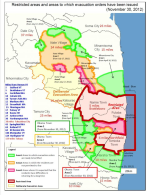
They ran a simulation in 2020 of the risk and exposure due to a nuclear accident involving spent fuel rods or a fire in the fuel pond, there are the results and they are very telling:
View attachment 130403
View attachment 130404
View attachment 130405
View attachment 130406
View attachment 130407
Source:
https://scienceandglobalsecurity.org/archive/sgs29spence.pdf
Fordow (very low; mostly chemical toxicity)
Fordow Fuel Enrichment Plant (Map: Thomas Gaulkin /
Datawrapper. Image: Google Earth)
Fordow is Iran’s second pilot fuel enrichment plant (FFEP). It is located deep underground, at about 80 to 90 meters deep, inside a mountain near the city of Qom in northern Iran. According to the IAEA, the facility hosts 1,044 IR-1 centrifuges as well as 1,740 IR-6 centrifuges of Iran’s most advanced type. Overall, Fordow can produce between 30 and 35 kilograms of highly-enriched (60 percent) uranium per month. The plant could also be diverted to produce 25 kilograms of 90-percent enriched uranium hexafluoride—enough for one weapon—in as little as three days, Stewart says.
As of Friday, June 20, the facility had not been targeted either by air strikes or sabotage operations. Conventional missiles used by Israel are not capable of destroying the facility. But the United States and Israel have reportedly prepared plans to destroy the facility, with an attack believed to possibly occur in the next days, despite doubts about whether destroying the facility is technically feasible and needed to roll back Iran’s nuclear program.
Options to destroy Fordow go as far as including the possibility of using a low-yield nuclear weapon that could deliver enough explosive to destroy Fordow. Past the enormous escalation risk and international norm-breaking from such a move, the explosion of a nuclear weapon would result in vastly more radiation risk from the radioactive fallout of the nuclear explosion itself than from the possible release of uranium from Fordow’s enrichment halls.
Source:
Israel’s attacks create significant risks at Iran's nuclear sites. What could go wrong?

thebulletin.org
TLDR:
It would take
11,520 years for any buried radioactive material to decay and and reduce to levels where they would not pose a risk to the environment or living creatures.
View attachment 130409