Navigation
Install the app
How to install the app on iOS
Follow along with the video below to see how to install our site as a web app on your home screen.
Note: This feature may not be available in some browsers.
More options
Style variation
You are using an out of date browser. It may not display this or other websites correctly.
You should upgrade or use an alternative browser.
You should upgrade or use an alternative browser.
Pakistan Air Force | News & Discussions
- Thread starter ghazi52
- Start date
More options
Who Replied?



Raider 21
Moderator

My apologies, I meant to add probably the only dogfight guns kill against an enemy aircraft. His HUD tape actually had him pulling over 8GsYes Israelis did have gun kills against Arab air forces and quite a few of them ie pre 1980s not with 4th generation planes



PakShaheen_79
Trusted Member
What happened to JF-17 deal with Iraq? Once upon a time there was lot of noise about it.



Fatman17
Moderator
Nixed under pressure from USA IMHOWhat happened to JF-17 deal with Iraq? Once upon a time there was lot of noise about it.
falcon34
Registered Member

@side-winder
Is PAF working on Blue/Silver Sparrow type of missiles for long range strikes.
Or they are content with Raad.
The JF17 Block 1s should be given this role. A 3000kg single stage Air launched long range conventional ballistic missile. Those 50s Jeff's can carry out relentless sorties with these missiles at eastern and central India, they can pick off one city after the other.
Is PAF working on Blue/Silver Sparrow type of missiles for long range strikes.
Or they are content with Raad.
The JF17 Block 1s should be given this role. A 3000kg single stage Air launched long range conventional ballistic missile. Those 50s Jeff's can carry out relentless sorties with these missiles at eastern and central India, they can pick off one city after the other.
Last edited:
PakShaheen_79
Trusted Member
Pressure on Iraqi government I guess.Nixed under pressure from USA IMHO
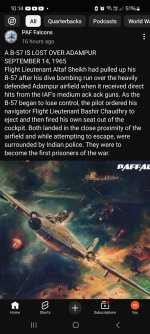
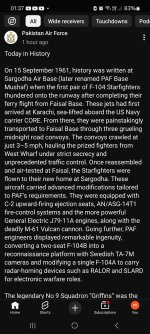
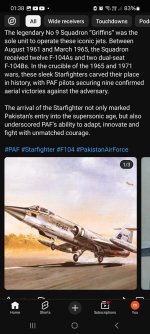
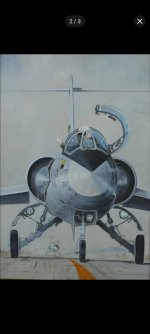

Fatman17
Moderator
Understanding the Rafale kills
- Aviation Features
- Understanding the Rafale kills
16th September 2025
Feature
**World Exclusive**World Exclusive**World Exclusive**
Alan Warnes gained rare and exclusive access to the Pakistan Air Force in mid-July, to understand how it managed to shoot down six Indian Air Force fighters on the night of May 6/7

With vapour streaming from its wing tips, this camouflaged Chengdu J-10C looks every inch the deadly fighter it was on May 6/7
All images Alan Warnes unless stated

PAF Commander, ACM Zaher Ahmed Baber Sidhu has revolutionised the PAF over the past four years.
PAF
“We ambushed them,” a high-ranking PAF officer told me in mid-July. “We trapped them in our kill chain and created chaos.”
That’s how the PAF claims it shot down six Indian Air Force (IAF) fighters in the early hours of May 7, when the biggest beyond visual range (BVR) air battle was contested on Pakistan’s border with India.
The IAF had launched Operation Sindoor (Sindoor being an orange/red powder worn by Hindu women). The PAF retaliated with a counter-operation, Operation Bunyan-un-Marsoos, (an Arabic phrase meaning a solid structure, derived from the Quran.)
More than 114 fighters were involved - 72 IAF and 42 from the PAF - most believed to be fitted with BVR missiles developed by the French, Israelis, Russians and Chinese. The senior officer said: “Fifty-two minutes after the air war had started, the fight was over, we won and they headed home.
“We could have shot down more Rafales than we did, but we held back. An escalation could have led to all-out war between two nuclear nations. During Op Bunyan-un-Marsoos we targeted the Rafales and the S-400s [Russian air defence system] and it worked out well!”

On May 6/7 the two air forces faced off, looking across their borders in formations like this
PAF
Unfolding air war
India had been seeking revenge for the Pahalgam terror attack that took place in Indian-administered Kashmir on April 22, when five armed terrorists killed 26 mainly Hindu civilians. India’s government, led by Prime Minister Narendra Modi, blamed Pakistan for this atrocity and he, along with the majority of the Indian public seemingly, wanted revenge. “We watched while on full alert, waiting for a response,” the PAF officer told me. For six tense days, the PAF monitored the build-up of transport aircraft, supporting large deployments of fighters to several IAF Western Command and South-Western Command bases. They knew an attack was imminent and were prepared for it.
Each of the four Air Commands – North, Central, South and West – operates deployable command and control (C2) centres, capable of directing operations across vast distances. Among their many functions one stood out for the author - the long-range vectoring of hypersonic missiles, like the CM-400AKGs that the PAF JF-17C Thunder jets launched at some of the most formidable assets in India’s arsenal. They included the highly advanced Russian-built S-400 air defence systems (see The S-400 Quandary, pages 38-41).

The PAF Commander’s inner circle in the wake of the air battle with the IAF on May 7. This is the Multi Domain Ops room, where all the data was fed in from different sensors
PAF

The PAF Commander, ACM Zaheer Ahmed Baber Sidhu in the National ISR and Integrated Air Ops Center (NIIACC) during Op Bunyan-un-Marsoos
PAF
The author was granted rare access to one of the deployable C2 centres, witnessing first-hand how it functioned. It is part of the PAF Chief of the Air Staff, Air Chief Marshal Zaheer Ahmed Baber Sidhu’s integrated multi-domain operations philosophy he has pursued since becoming PAF Commander in March 2021 – for more on that see later. An Air Vice Marshal from the newly created Space Force added: “The C2 centres are reliable and robust and can see across the border into India, but I won’t disclose the range due to the sensitive nature. Fusing data with our new unmanned, space, EW and cyber commands means they are effectively our nerve centres.”
PAF’s Space Command has redefined the battlespace. Using indigenous satellites, it delivers round-the-clock intelligence, surveillance and reconnaissance (ISR) support. The Global Navigation Satellite System (GNSS), datalinks real-time information to PAF aircraft bypassing the limitations of the line-of-sight communication. Through secure SATCOM connectivity, pilots not only gain unmatched situational awareness but also offensive capabilities like electronic attack. It’s a central piece of the PAF’s Link 17 (and the enhanced Skyguard system), fed to the JF-17s, J-10Cs and Erieye to provide pilots with the situational awareness needed to win a war.

Fatman17
Moderator
All new air doctrine is created and tested at the PAF’s ACE facility, based at Mushaf, that has a huge tactical training range -one of the best in the world according to the Turkish Air Force (see last month’s Anatolian Eagle exercise report)
This means every cockpit receives a Recognised Air Picture through encrypted datalinks, ensuring PAF aircrew possess the tactical clarity needed to dominate the skies. This fusion of space, cyber, electronic warfare (EW) and kinetic power has turned the PAF into a truly multi-domain combat force, capable of deterring, responding and prevailing in future wars, which seems highly likely. This capability has been built up since the author’s last visit in 2020 and was clearly revolutionising the way PAF the trains and goes to war.
Several military veterans the author spoke to were keen to stress that the PAF is just part of the fighting machine run by the Chief of Army Staff, Field Marshal Asim Munir who made a high-profile visit to the USA in mid-August. He harnesses the combined strengths of Army, Navy and Air Force, but this feature focusses on the PAF.
EW at work
On April 29, a week after the Pahalgam attack, four IAF Rafales departed Ambala Air Force Station. Their mission, to bomb terrorist targets in the north, but according to the PAF, a mobile PAF electronic warfare (EW) unit deployed along the front line saw them approaching and jammed their radars and communications, while cyber-attacks on electric grids in the north, rendered the Rafales helpless. They abandoned their mission and instead diverted to Srinagar Air Force Station.

The PAF operates 20 J-10C Vigorous Dragons in both camouflaged and grey markings. None currently wear squadron markings but that could change soon. This aircraft, with its light blue underbelly, taxies to the end of the Minhas runway for a mission

A grey J-10C with six hard-points under the wings, two equipped with twin missile racks. During the author’s time at Minhas, a grey example always flew with a camouflaged jet
The Dassault 20ECMs of 24 ‘Blinders’ Squadron which had performed so well in Op Swift Retort in February 2019 (see panel) were not used in Operation Bunyan-un-Marsoos because of their lack in wattage power. Trying to overpower a target receiver is heavily influenced by the power output, and a lack of this power will make the jammer less effective at disrupting intended signals. This would have been the case with the S-400 air defence system or Rafale’s Thales RBE2 radar, which MBDA designed to be robust against jamming, and integrated with the passive Thales Spectra EW system.

Three J-10C flying line abreast armed with 18 air-to-air missiles between them. The Chinese People’s Liberation Army Air Force is now keen to understand how the PAF worked their jets so well operationally
The EW mobile units designed by the new NASTP (National Aerospace Science & Technology Park) in recent years, instigated by the PAF’s Commander, ACM Sidhu, were being fielded at various locations to jam targets. Between April 29, when the IAF tried their failed attack, and May 6, the PAF had watched the IAF deploy up to 20 Rafales from Hashimara (home of 101 Sqn in the Eastern Command) to Gwalior and several other bases (Ambala, home of 17 Sqn Rafales in Western Command, Srinagar and Bikaner/Nal in Rajasthan). Several S-400 SA-21 Growler surface-to-air missile batteries were moved to Adampur, Bhuj and Bikaner.
The IAF mobilised around 400 aircraft in late April and early May, with the transport fleet flying over 500 sorties, obviously to move around weapons, logistics and personnel for an attack. The PAF was prepared.
“We could not let the attack go unpunished. No one infringes Pakistani sovereign territory, and we are entrusted to protect it.”

ACM Sidhu has boosted the PAF’s capabilities considerably with his operational and industry visions. He is seen here walking to a F-16 alongside members of his staff and base personnel
PAF
At 1230hrs on May 7, that attack came when the IAF bombed nine sites in Pakistan with long-range Spice 2000 precision-guided bombs. The CAS immediately changed the rules of engagement, with airborne PAF fighters instructed to move from defensive to offensive mode. He spoke directly to all the PAF pilots in the air via radio, commanding them to shoot them down, and according to several sources he told the airborne fighter pilots: “Kill them, kill them, don’t let them enter even an inch into Pakistan.”
The PAF could not let the attack go unpunished, and as the spokesman told me: “No one infringes Pakistani sovereign territory - we are entrusted to protect it.
“When the IAF released those bombs, there were already 72 IAF aircraft in the air, as their numbers had steadily increased. We started the attack on the different strike packages of Rafales, Su-30MKIs and Mirage 2000s.”
Most of the IAF’s 36 Rafales were flying in offensive mode on the Indian side of the border at some point and according to the PAF, they were equipped with MBDA’s highly capable Meteor BVRAAM, backed up by Su-30MKI Flankers armed with Israeli Derby BVR missiles and Spice 2000 precision-guided munitions (PGMs).
According to the ISPR (Inter Services Public Relations) press briefing on May 7, the IAF had eight formations lined up along the eastern border, each strike package comprised eight aircraft: four Su-30MKIs, two Rafales and two Mirage 2000s.

With its front wheel lifting off the runway, this J-10C is set for another mission
Locking on the target
A senior PAF pilot explained how they prepare for war with India, always a real possibility. “It’s in the training,” he said. “Going to theatre, the fighter’s radar cannot see all the targets as they are too far away, but the Saab 2000 Erieye does.”
As a high value asset and undoubtedly a target for India, the Saab 2000 Erieye will keep out of harm’s way flying close to the western border, over 400km (250 miles) from India. He continued: “The operator sitting in front of his screen in the Erieye will label the enemy aircraft into the different groups and assign them to the PAF packages. This will be done in groups of three or four aircraft according to azimuth and altitude, then the operator assesses and relays [the positions] to all the aircraft, but he will still control them.
“The war picture is built through Link 17/ Skyguard, which we see on the displays in our cockpit, and the aircraft we are assigned to shoot – which we term ‘the contract’. The Air Boss and his team [in the Multi Domain Ops Room] will also be looking over the scene on a massive screen in AHQ.
“The fighter pilots have two radios in the cockpit, one to discuss the complete aerial picture and another to talk to members in your formation.
“If I am targeting their no 1 and 2, I would see them on my scope, put my cursor on them and lock my missiles onto them.
“My radar is then locked onto the target and is linking info to the missile until a certain range, when the missile switches on to its own AESA [Active Electronically Scanned Array] seeker within the PL-15’s minimum abort range [MAR].”
The MAR is the closest an engaging aircraft can get to the target and fire the missile before getting out of a fight, before the missile threat is able to run you down.
“Once your missile’s active range (in this case the PL-15) is met, you can turn back (to ensure you don’t fly inside the MAR of a Meteor -let’s say 35 miles). The missile with its AESA seeker will then lock on to target and shoot it down.”
The author was told the Rafale pilots would not have known what hit them until the PL-15Es were about three seconds out.
“Remember, if you miss your designated aircraft, it could get you. We train continuously for this. A mission of 15 minutes can regularly take up to eight hours to debrief!
“In a war theatre you can put as many aircraft as possible up. The IAF sent 72 into the AOR [Area of Responsibility] but it’s a lot for the GCIs [Ground Control Interceptors] to control!”
One of the lessons the IAF must have learnt from that night was the sheer number of aircraft they deployed in the air was too much to handle. Each IAF GCI would have to manage several aircraft in an extremely dynamic situation, particularly as aircraft were being shot down. The PAF Commander said: “We designated an IAF aircraft for every J-10 or JF-17 Block 3 with the battle space being managed much better because of the multi domain ops.”

The Tactics Developments School is where the anti-Rafale ops are rolled out to PAF personnel. The PAF has always worked harder to define tactics against its Indian foe and no stone is left unturned to ensure that they are successful
Going for the kill
This means every cockpit receives a Recognised Air Picture through encrypted datalinks, ensuring PAF aircrew possess the tactical clarity needed to dominate the skies. This fusion of space, cyber, electronic warfare (EW) and kinetic power has turned the PAF into a truly multi-domain combat force, capable of deterring, responding and prevailing in future wars, which seems highly likely. This capability has been built up since the author’s last visit in 2020 and was clearly revolutionising the way PAF the trains and goes to war.
Several military veterans the author spoke to were keen to stress that the PAF is just part of the fighting machine run by the Chief of Army Staff, Field Marshal Asim Munir who made a high-profile visit to the USA in mid-August. He harnesses the combined strengths of Army, Navy and Air Force, but this feature focusses on the PAF.
EW at work
On April 29, a week after the Pahalgam attack, four IAF Rafales departed Ambala Air Force Station. Their mission, to bomb terrorist targets in the north, but according to the PAF, a mobile PAF electronic warfare (EW) unit deployed along the front line saw them approaching and jammed their radars and communications, while cyber-attacks on electric grids in the north, rendered the Rafales helpless. They abandoned their mission and instead diverted to Srinagar Air Force Station.
The PAF operates 20 J-10C Vigorous Dragons in both camouflaged and grey markings. None currently wear squadron markings but that could change soon. This aircraft, with its light blue underbelly, taxies to the end of the Minhas runway for a mission
A grey J-10C with six hard-points under the wings, two equipped with twin missile racks. During the author’s time at Minhas, a grey example always flew with a camouflaged jet
The Dassault 20ECMs of 24 ‘Blinders’ Squadron which had performed so well in Op Swift Retort in February 2019 (see panel) were not used in Operation Bunyan-un-Marsoos because of their lack in wattage power. Trying to overpower a target receiver is heavily influenced by the power output, and a lack of this power will make the jammer less effective at disrupting intended signals. This would have been the case with the S-400 air defence system or Rafale’s Thales RBE2 radar, which MBDA designed to be robust against jamming, and integrated with the passive Thales Spectra EW system.
Three J-10C flying line abreast armed with 18 air-to-air missiles between them. The Chinese People’s Liberation Army Air Force is now keen to understand how the PAF worked their jets so well operationally
The EW mobile units designed by the new NASTP (National Aerospace Science & Technology Park) in recent years, instigated by the PAF’s Commander, ACM Sidhu, were being fielded at various locations to jam targets. Between April 29, when the IAF tried their failed attack, and May 6, the PAF had watched the IAF deploy up to 20 Rafales from Hashimara (home of 101 Sqn in the Eastern Command) to Gwalior and several other bases (Ambala, home of 17 Sqn Rafales in Western Command, Srinagar and Bikaner/Nal in Rajasthan). Several S-400 SA-21 Growler surface-to-air missile batteries were moved to Adampur, Bhuj and Bikaner.
The IAF mobilised around 400 aircraft in late April and early May, with the transport fleet flying over 500 sorties, obviously to move around weapons, logistics and personnel for an attack. The PAF was prepared.
“We could not let the attack go unpunished. No one infringes Pakistani sovereign territory, and we are entrusted to protect it.”
ACM Sidhu has boosted the PAF’s capabilities considerably with his operational and industry visions. He is seen here walking to a F-16 alongside members of his staff and base personnel
PAF
At 1230hrs on May 7, that attack came when the IAF bombed nine sites in Pakistan with long-range Spice 2000 precision-guided bombs. The CAS immediately changed the rules of engagement, with airborne PAF fighters instructed to move from defensive to offensive mode. He spoke directly to all the PAF pilots in the air via radio, commanding them to shoot them down, and according to several sources he told the airborne fighter pilots: “Kill them, kill them, don’t let them enter even an inch into Pakistan.”
The PAF could not let the attack go unpunished, and as the spokesman told me: “No one infringes Pakistani sovereign territory - we are entrusted to protect it.
“When the IAF released those bombs, there were already 72 IAF aircraft in the air, as their numbers had steadily increased. We started the attack on the different strike packages of Rafales, Su-30MKIs and Mirage 2000s.”
Most of the IAF’s 36 Rafales were flying in offensive mode on the Indian side of the border at some point and according to the PAF, they were equipped with MBDA’s highly capable Meteor BVRAAM, backed up by Su-30MKI Flankers armed with Israeli Derby BVR missiles and Spice 2000 precision-guided munitions (PGMs).
According to the ISPR (Inter Services Public Relations) press briefing on May 7, the IAF had eight formations lined up along the eastern border, each strike package comprised eight aircraft: four Su-30MKIs, two Rafales and two Mirage 2000s.
With its front wheel lifting off the runway, this J-10C is set for another mission
Locking on the target
A senior PAF pilot explained how they prepare for war with India, always a real possibility. “It’s in the training,” he said. “Going to theatre, the fighter’s radar cannot see all the targets as they are too far away, but the Saab 2000 Erieye does.”
As a high value asset and undoubtedly a target for India, the Saab 2000 Erieye will keep out of harm’s way flying close to the western border, over 400km (250 miles) from India. He continued: “The operator sitting in front of his screen in the Erieye will label the enemy aircraft into the different groups and assign them to the PAF packages. This will be done in groups of three or four aircraft according to azimuth and altitude, then the operator assesses and relays [the positions] to all the aircraft, but he will still control them.
“The war picture is built through Link 17/ Skyguard, which we see on the displays in our cockpit, and the aircraft we are assigned to shoot – which we term ‘the contract’. The Air Boss and his team [in the Multi Domain Ops Room] will also be looking over the scene on a massive screen in AHQ.
“The fighter pilots have two radios in the cockpit, one to discuss the complete aerial picture and another to talk to members in your formation.
“If I am targeting their no 1 and 2, I would see them on my scope, put my cursor on them and lock my missiles onto them.
“My radar is then locked onto the target and is linking info to the missile until a certain range, when the missile switches on to its own AESA [Active Electronically Scanned Array] seeker within the PL-15’s minimum abort range [MAR].”
The MAR is the closest an engaging aircraft can get to the target and fire the missile before getting out of a fight, before the missile threat is able to run you down.
“Once your missile’s active range (in this case the PL-15) is met, you can turn back (to ensure you don’t fly inside the MAR of a Meteor -let’s say 35 miles). The missile with its AESA seeker will then lock on to target and shoot it down.”
The author was told the Rafale pilots would not have known what hit them until the PL-15Es were about three seconds out.
“Remember, if you miss your designated aircraft, it could get you. We train continuously for this. A mission of 15 minutes can regularly take up to eight hours to debrief!
“In a war theatre you can put as many aircraft as possible up. The IAF sent 72 into the AOR [Area of Responsibility] but it’s a lot for the GCIs [Ground Control Interceptors] to control!”
One of the lessons the IAF must have learnt from that night was the sheer number of aircraft they deployed in the air was too much to handle. Each IAF GCI would have to manage several aircraft in an extremely dynamic situation, particularly as aircraft were being shot down. The PAF Commander said: “We designated an IAF aircraft for every J-10 or JF-17 Block 3 with the battle space being managed much better because of the multi domain ops.”
The Tactics Developments School is where the anti-Rafale ops are rolled out to PAF personnel. The PAF has always worked harder to define tactics against its Indian foe and no stone is left unturned to ensure that they are successful
Going for the kill
Fatman17
Moderator
Waiting for the IAF fighters to make their move in the early hours of May 7 were PAF J-10C Vigorous Dragons and JF-17C Thunders, both armed with Chinese PL-15s (CH-AA-10 Abaddon) BVRAAMs and shorter-range PL-10s (CH-AA-9 Azrael). Behind them were F-16C Block 52s with the shorter range AN/APG-68 radars, equipped with AIM-120C AMRAAMs (Advanced Medium Range Air to Air Missiles).
Highly capable and well-trained pilots from both sides were going into battle with an immense amount of national pride at stake. As they raced towards each other and the missiles of the Indian fighters went ‘hot’, the PAF Commander gave the order from the NAIIOC (National ISR Air Ops Centre) to break their data links, which meant they would lose all situational awareness. Jamming from mobile EW units dotted all along the eastern fringes of Pakistan completed the damage. The Rafale’s cutting edge Thales Spectra integrated electronic warfare system was designed to protect the Indian Air Force’s jet. The pilot should have been warned by Spectra that something was watching them, and they needed to start taking evasive action. Spectra should have detected the radar of the enemy aircraft’s electromagnetic waves. Unless of course the J-10 did not switch on its radar, and the target information was data linked to the fighter that then fired the PL-15. When the missile eventually switched on its AESA seeker in the terminal phase, it would have been too late for the Rafale.

Preparing the PAF for Full Spectrum Air Ops, the Aerospace Power Centre of Excellence has all the elements of the PAF offensive force. The J-35 and ASOJ (Airborne Stand Off Jammer) are both listed. While ASOJ has been contracted with Turkey, the J-35 is still being studied
In the Ops room, the PAF Commander instructed a pilot to fire at their selected adversary, visible on the Comprehensive Complete Air Picture (CCAP) screen. The author was shown a recording of a PL-15E leaving the J-10’s missile rail and tracking towards the red target. Once the target was hit, the signal would blink intermittently, until it disappeared. All the information on the targets was available to the PAF.
As one retired officer stated: “They were sitting ducks - they didn’t stand a chance when our J-10Cs unleashed those PL-15s. Our Multi Domain Ops ensured the IAF pilots couldn’t perform in the air battle.”
The radar range of both the J-10C’s KLJ-10 and the Rafale’s RBE2 is believed to be around 200km (125 miles). According to the PAF, not one Meteor was fired at the PAF fighters. The PL-15Es hit their targets at between 160 and 190km (100 and 120 miles) out (close to the maximum kinetic range of the export version of PL-15), and with the Meteor’s range only being about 150km, you can understand why. The PL-15E had an edge of about 40-50km and the IAF fighters were downed over Indian territory. The PL-15 is certainly faster than the Meteor so that would be another factor. The PAF effectively trapped the IAF pilots in their ‘kill chain’.

Three of the IAF’s satellites were by now under PAF control, using its indigenously developed systems. The downlinks were subsequently severed and the GPS signals were neutralised. At the same time, the PAF’s cyber warriors launched a sweeping offensive, crippling 96% of India’s social networks, penetrating critical systems, and even disrupting the country’s railways, airlines, banks and energy grids to sow chaos. Bold messages flashed across Indian CCTV screens, while websites were defaced and key digital nodes were struck, triggering electricity blackouts across vast regions of India. This was the first time any Air Force in the world had synced its cyber operations with its kinetic operations.
PAF Cyber Ops had shifted into offensive mode. Back in 2019 during Operation Swift Retort, there was no cyber footprint, but by 2021 work had commenced on creating the new command, which opened in May 2023 and started functioning in October 2024. PAF has created a cyber range, where cyber warfare skills are built up by pitching blue and red teams against each other. Elements of the PAF Cyber Force played an active role in achieving the right effects during Op Bunyanun-Marsoos, when cyber was integrated with kinetic ops. PAF kept it all relevant by participating in operations and exercises like Indus Shield 24.

A J-10C sits on the edge of the 15 (Multi Role) Squadron shelter area, armed and looking very dangerous, Clearly visible is the IRST sensor on the nose and the air-to-air refuelling probe
PAF
Breaking the news
News on this clash broke in Europe later that day (May 7) when the ISPR held a press conference.
The PAF’s Deputy Chief of Air Staff (DCAS Operations) and Director General Public Relations (DGPR) took much of the world by surprise, when they claimed the PAF had shot down five IAF fighters. These included three, later increased to four, extremely capable 4.5-generation Rafales fitted with the cutting-edge Thales Spectra electronic warfare systems. The air-to-air kills were backed up by images from social media accounts and included GPS co-ordinates of where they crashed.
As the PAF’s DCAS Ops disclosed at the press conference, attended by both local and international media, the IAF were continuously scrambling their fighters in the early hours, to reinforce and saturate the air defence. “Our strategy was to have force concentration in our selected AORs and fight to our own strength. “Once they saw our numbers, the IAF fighters launched their ground weapons, and we identified them. As soon as this happened, the Chief changed the rules of engagement from ‘deter’ to ‘sure kill’.
“We targeted the Rafales, because the IAF had always said they would make ‘the difference’.”
The DCAS (Ops) talked with the aid of a screen at the conference about the losses and the locations where they were shot down. The PAF had tapped into IAF Rafale communications, and listened to a four-ship ‘Godzilla 1-4’ formation in panic and distress, having discovered one of the French jets was missing.
He ran the recordings to assembled media, which was quite startling at the time, but it seems the Rafale pilots were mistakenly talking on an open frequency rather than a secure one. During the stand-off, the PAF identified 14 Rafales within the 72 aircraft, through its electronic intelligence systems, and then targeted them.
The PAF also struck the radar in the northern ICCS (Integrated Command and Control Centre) at Barnala which effectively stopped all communications between the IAF leadership and their fighters.
PL-15 amazes the world
The export version of the PL-15E was exhibited at Zhuhai in 2021 and again in 2024. The author was told the PAF’s version had a range of around 190km (120 miles). The longest distance that any of the PAF missiles hit their target, was around 190km (120 miles). According to the International Institute of Strategic Studies (IISS) the PL-15 is known for its long-range capabilities and energetic boost-sustain motor. The ‘boost-sustain’ element is believed to refer to a two-stage motor, providing both initial acceleration and sustained flight. It makes it capable of speeds greater than Mach 5. After being fired and entering its terminal phase, the motor’s second pulse will ignite, providing the additional thrust to increase kill probability at long distances. If the missile is launched at supersonic speed, as it would have been by the J-10Cs, it can maintain speeds of Mach 5+ for much of the flight. It will inevitably begin to slow down post motor burn out.
The PL-15/-15E is among a small number of AAMs that is guided by a miniature active electronically scanned array radar seeker that houses both active and passive modes. According to the IISS, Japan fields a BVR fitted with an AESA (AAM-4B) and there are suspicions that the US fields a AMRAAM version with an AESA that it doesn’t export. According to the IISS, the missile features improved resistance to countermeasures and better performance against stealthy targets. It is also thought the hybrid guidance system supports a mini-course two-way datalink led by AEW&C aircraft.
The AEW&C can reportedly guide the missiles to their targets via Chinese XS-3 tactical data links, allowing them to be launched from a stand-off distance and “guided” to their respective targets... to remain undetected.
As a result, the PL-15E can be employed without relying on the onboard AESA radar for most of its flight, significantly reducing the likelihood of detection. The advantage of third-party targeting is in part that the launch aircraft may remain passive in the engagement.
The Indian military fired Brahmos air/surfaceto-ground missiles capable of speeds of 3,000km/h (1,900mph) one after the other. I was told by the PAF there had been ‘soft kills’ and ‘hard kills’ by the Brahmos. There is some suggestion the PAF jammed the Brahmos frequencies but no one would confirm this. During the press briefing, the PAF spokesperson showed the radar signatures of the Brahmos on the screen, which he said missed targets and flew into Afghanistan. After 52 minutes, the IAF fighters fled back to their bases, outwitted by the PAF. A senior officer, told the author: “The Rafale is potent enough, and while we initially declared we had shot down three, BS001 [17 Sqn], BS022, BS027 [both 101 Sqn], we also had it confirmed by HUMINT [human intelligence] in mid-July that BS021 [from 101 Sqn] had been confirmed as shot down, over Srinagar.” The author understands another four aircraft have not returned to the flightline. The PAF has their tail numbers, because they know from their electronic intelligence the jets that were badly damaged. They are endeavouring to confirm from OSINT (Open-Source Intelligence/HUMINT – often spies on the ground). The PAF refrained from attacking further than 2,000km (1,250 miles) away because it felt it could start an all-out war.

Wg Cdr Bilal, Flight Cdr, Ops 15 Squadron, banks his jet to show off the four PL-15 missiles on the twin racks and single PL-10 on the outside hard points. The potent PL-15 struck a Rafale nearly 200km away.
Alan Warnes
Armed and very dangerous

‘Cobras redefined’ – the 15 Squadron patch worn by the J-10C pilots

A
Highly capable and well-trained pilots from both sides were going into battle with an immense amount of national pride at stake. As they raced towards each other and the missiles of the Indian fighters went ‘hot’, the PAF Commander gave the order from the NAIIOC (National ISR Air Ops Centre) to break their data links, which meant they would lose all situational awareness. Jamming from mobile EW units dotted all along the eastern fringes of Pakistan completed the damage. The Rafale’s cutting edge Thales Spectra integrated electronic warfare system was designed to protect the Indian Air Force’s jet. The pilot should have been warned by Spectra that something was watching them, and they needed to start taking evasive action. Spectra should have detected the radar of the enemy aircraft’s electromagnetic waves. Unless of course the J-10 did not switch on its radar, and the target information was data linked to the fighter that then fired the PL-15. When the missile eventually switched on its AESA seeker in the terminal phase, it would have been too late for the Rafale.
Preparing the PAF for Full Spectrum Air Ops, the Aerospace Power Centre of Excellence has all the elements of the PAF offensive force. The J-35 and ASOJ (Airborne Stand Off Jammer) are both listed. While ASOJ has been contracted with Turkey, the J-35 is still being studied
In the Ops room, the PAF Commander instructed a pilot to fire at their selected adversary, visible on the Comprehensive Complete Air Picture (CCAP) screen. The author was shown a recording of a PL-15E leaving the J-10’s missile rail and tracking towards the red target. Once the target was hit, the signal would blink intermittently, until it disappeared. All the information on the targets was available to the PAF.
As one retired officer stated: “They were sitting ducks - they didn’t stand a chance when our J-10Cs unleashed those PL-15s. Our Multi Domain Ops ensured the IAF pilots couldn’t perform in the air battle.”
The radar range of both the J-10C’s KLJ-10 and the Rafale’s RBE2 is believed to be around 200km (125 miles). According to the PAF, not one Meteor was fired at the PAF fighters. The PL-15Es hit their targets at between 160 and 190km (100 and 120 miles) out (close to the maximum kinetic range of the export version of PL-15), and with the Meteor’s range only being about 150km, you can understand why. The PL-15E had an edge of about 40-50km and the IAF fighters were downed over Indian territory. The PL-15 is certainly faster than the Meteor so that would be another factor. The PAF effectively trapped the IAF pilots in their ‘kill chain’.
Three of the IAF’s satellites were by now under PAF control, using its indigenously developed systems. The downlinks were subsequently severed and the GPS signals were neutralised. At the same time, the PAF’s cyber warriors launched a sweeping offensive, crippling 96% of India’s social networks, penetrating critical systems, and even disrupting the country’s railways, airlines, banks and energy grids to sow chaos. Bold messages flashed across Indian CCTV screens, while websites were defaced and key digital nodes were struck, triggering electricity blackouts across vast regions of India. This was the first time any Air Force in the world had synced its cyber operations with its kinetic operations.
PAF Cyber Ops had shifted into offensive mode. Back in 2019 during Operation Swift Retort, there was no cyber footprint, but by 2021 work had commenced on creating the new command, which opened in May 2023 and started functioning in October 2024. PAF has created a cyber range, where cyber warfare skills are built up by pitching blue and red teams against each other. Elements of the PAF Cyber Force played an active role in achieving the right effects during Op Bunyanun-Marsoos, when cyber was integrated with kinetic ops. PAF kept it all relevant by participating in operations and exercises like Indus Shield 24.
A J-10C sits on the edge of the 15 (Multi Role) Squadron shelter area, armed and looking very dangerous, Clearly visible is the IRST sensor on the nose and the air-to-air refuelling probe
PAF
Breaking the news
News on this clash broke in Europe later that day (May 7) when the ISPR held a press conference.
The PAF’s Deputy Chief of Air Staff (DCAS Operations) and Director General Public Relations (DGPR) took much of the world by surprise, when they claimed the PAF had shot down five IAF fighters. These included three, later increased to four, extremely capable 4.5-generation Rafales fitted with the cutting-edge Thales Spectra electronic warfare systems. The air-to-air kills were backed up by images from social media accounts and included GPS co-ordinates of where they crashed.
As the PAF’s DCAS Ops disclosed at the press conference, attended by both local and international media, the IAF were continuously scrambling their fighters in the early hours, to reinforce and saturate the air defence. “Our strategy was to have force concentration in our selected AORs and fight to our own strength. “Once they saw our numbers, the IAF fighters launched their ground weapons, and we identified them. As soon as this happened, the Chief changed the rules of engagement from ‘deter’ to ‘sure kill’.
“We targeted the Rafales, because the IAF had always said they would make ‘the difference’.”
The DCAS (Ops) talked with the aid of a screen at the conference about the losses and the locations where they were shot down. The PAF had tapped into IAF Rafale communications, and listened to a four-ship ‘Godzilla 1-4’ formation in panic and distress, having discovered one of the French jets was missing.
He ran the recordings to assembled media, which was quite startling at the time, but it seems the Rafale pilots were mistakenly talking on an open frequency rather than a secure one. During the stand-off, the PAF identified 14 Rafales within the 72 aircraft, through its electronic intelligence systems, and then targeted them.
The PAF also struck the radar in the northern ICCS (Integrated Command and Control Centre) at Barnala which effectively stopped all communications between the IAF leadership and their fighters.
PL-15 amazes the world
The export version of the PL-15E was exhibited at Zhuhai in 2021 and again in 2024. The author was told the PAF’s version had a range of around 190km (120 miles). The longest distance that any of the PAF missiles hit their target, was around 190km (120 miles). According to the International Institute of Strategic Studies (IISS) the PL-15 is known for its long-range capabilities and energetic boost-sustain motor. The ‘boost-sustain’ element is believed to refer to a two-stage motor, providing both initial acceleration and sustained flight. It makes it capable of speeds greater than Mach 5. After being fired and entering its terminal phase, the motor’s second pulse will ignite, providing the additional thrust to increase kill probability at long distances. If the missile is launched at supersonic speed, as it would have been by the J-10Cs, it can maintain speeds of Mach 5+ for much of the flight. It will inevitably begin to slow down post motor burn out.
The PL-15/-15E is among a small number of AAMs that is guided by a miniature active electronically scanned array radar seeker that houses both active and passive modes. According to the IISS, Japan fields a BVR fitted with an AESA (AAM-4B) and there are suspicions that the US fields a AMRAAM version with an AESA that it doesn’t export. According to the IISS, the missile features improved resistance to countermeasures and better performance against stealthy targets. It is also thought the hybrid guidance system supports a mini-course two-way datalink led by AEW&C aircraft.
The AEW&C can reportedly guide the missiles to their targets via Chinese XS-3 tactical data links, allowing them to be launched from a stand-off distance and “guided” to their respective targets... to remain undetected.
As a result, the PL-15E can be employed without relying on the onboard AESA radar for most of its flight, significantly reducing the likelihood of detection. The advantage of third-party targeting is in part that the launch aircraft may remain passive in the engagement.
The Indian military fired Brahmos air/surfaceto-ground missiles capable of speeds of 3,000km/h (1,900mph) one after the other. I was told by the PAF there had been ‘soft kills’ and ‘hard kills’ by the Brahmos. There is some suggestion the PAF jammed the Brahmos frequencies but no one would confirm this. During the press briefing, the PAF spokesperson showed the radar signatures of the Brahmos on the screen, which he said missed targets and flew into Afghanistan. After 52 minutes, the IAF fighters fled back to their bases, outwitted by the PAF. A senior officer, told the author: “The Rafale is potent enough, and while we initially declared we had shot down three, BS001 [17 Sqn], BS022, BS027 [both 101 Sqn], we also had it confirmed by HUMINT [human intelligence] in mid-July that BS021 [from 101 Sqn] had been confirmed as shot down, over Srinagar.” The author understands another four aircraft have not returned to the flightline. The PAF has their tail numbers, because they know from their electronic intelligence the jets that were badly damaged. They are endeavouring to confirm from OSINT (Open-Source Intelligence/HUMINT – often spies on the ground). The PAF refrained from attacking further than 2,000km (1,250 miles) away because it felt it could start an all-out war.
Wg Cdr Bilal, Flight Cdr, Ops 15 Squadron, banks his jet to show off the four PL-15 missiles on the twin racks and single PL-10 on the outside hard points. The potent PL-15 struck a Rafale nearly 200km away.
Alan Warnes
Armed and very dangerous
‘Cobras redefined’ – the 15 Squadron patch worn by the J-10C pilots
A
Pakistan Defence Latest


Country Watch Latest
-
 Iran - Israel/US War: Israel-US declare war on Iran, Iran responds (173 Viewers)
- Latest: Persian Gulf
-
-

-

-

Latest Posts
-
Iran - Israel/US War: Israel-US declare war on Iran, Iran responds (173 Viewers)
- Latest: Persian Gulf
-
-
-
-
Makkah Defence Alliance: Turkey, Saudi Arabia, and Pakistan, news & updates (54 Viewers)
- Latest: hyperman