Russia-Ukraine War - News, Discussions & Updates

Status
Not open for further replies.

HOW UKRAINE TURNED THE TABLES ON RUSSIA​


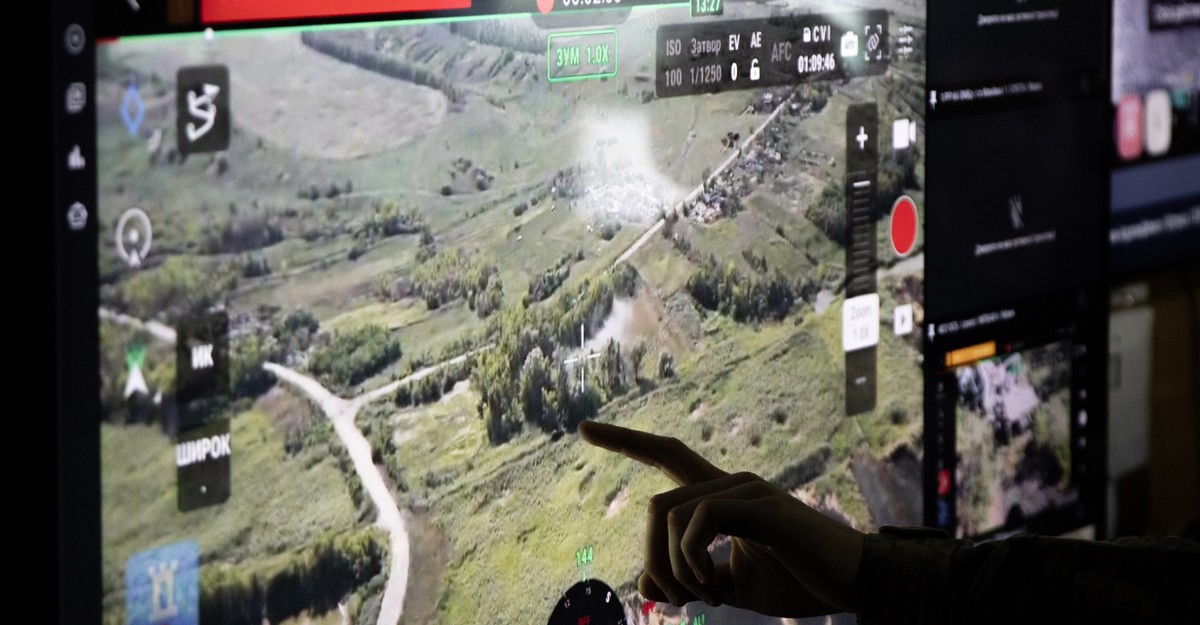
Two Russian soldiers emerged from the woods and walked slowly down a dirt road, seemingly unaware that they were being monitored from the sky. By the time they raised their rifles to fire at a buzzing Ukrainian drone, it was too late: The drone had dropped a bomb that exploded with a bright-orange flash on the ground between them. But as the smoke drifted clear, the soldiers got up and staggered into the trees. The first strike had failed.

I watched all of this on a screen from a Ukrainian command post about 10 miles back from the front line.

“We know the two wounded Russians are in those trees,” said the Ukrainian commander alongside me, a powerfully built man of 39 who goes by the call sign YG. He didn’t look happy. The Russians probe the front line every day in small groups, and his job is to stop them while doing all he can to protect his own, far more limited supply of soldiers. But drones were not his only weapons against these two.

Ukraine is fighting a war of attrition. Any hopes that might have been raised by President Trump’s red-carpet diplomacy with Vladimir Putin have expired, and it is impossible to spend more than a few minutes near the front line without being confronted by Ukraine’s greatest vulnerability: lack of soldiers. Yet I came away from a recent trip to Ukraine believing that the country may actually be able to achieve its military goals.

Despite Russia’s demographic advantage, its efforts to envelop Ukraine’s formidable fortress belt—a string of strategic cities and logistics hubs in the country’s northeast—have had little success. Capturing the belt would take several years of hard fighting, given Ukraine’s recent success in damaging Russia’s oil pipelines and rear bases. Putin tacitly acknowledged Russia’s failure by demanding that Ukraine voluntarily cede the entire region in August, an idea that no one took seriously.

All of the officers I met with, during a week in northeastern Ukraine, told me that the key to keeping the Russians at bay lies in finding better ways to compensate for Ukraine’s desperate shortage of manpower. Part of the answer is drone technology, which has done a great deal to help Ukraine protect itself in an uneven fight. But commanders are now taking a range of other measures to minimize casualties, including more careful use of artillery, more precise troop movements, and better rotation plans. “Our main purpose is to not let direct contact happen, so Ukrainian troops don’t have to engage,” one local commander told me.

When I was last in the country, nine months ago, Ukraine appeared to be in real trouble: Its weapons pipeline was lagging and Russia was grinding forward on the front lines with what Ukrainian infantrymen called “meat waves” of seemingly expendable soldiers and mercenaries. Now there appears to be a new confidence that Ukraine is reorienting its institutions for a long war, learning quickly from the battlefield and continuing not just to inflict steady losses on the enemy but also to limit its own. “Russia cannot win unless we in the West totally quit,” Ben Hodges, a retired general who commanded U.S. Army forces in Europe, told me. Time, which has until now favored the Russians, may be shifting to the Ukrainian side.

when i visited yg’s command post, a branch of Ukraine’s 66th Mechanized Brigade, he told me he had been forced to delay an evacuation of three wounded soldiers from the front because he didn’t have enough men (one of the soldiers had to have an arm amputated as a consequence). He didn’t want to risk any more lives. After we saw the two Russian soldiers survive the Ukrainian drone strike and then hide in the woods, I noticed the frustration on YG’s face. He suspected that the soldiers were concealed in a dugout in the trees, a possible base for deeper incursions into Ukrainian territory. He asked one of his subordinates—they were seated at desks beneath a wall of screens showing parts of the front line—to contact the drone pilot in question and chastise him for not aiming more carefully.

YG then called in artillery strikes. We watched as the first one struck about 20 yards from the trees where the Russians were hiding. The second landed on the opposite side but almost as far away, leaving a visible crater in the earth. It was time to send in an assault team.

The closest Ukrainian soldiers were several kilometers from the site, and the Ukrainians did a careful reconnaissance before sending four men on foot. An elite Russian drone unit was hunting for targets.

Eventually, the Ukrainian infantry team emerged on our screen. The soldiers were making quick, cautious dashes from one patch of tree cover to the next, staying out of sight as much as possible. Their route had been laid out in advance and divided into sections, YG told me; they had a designated time to reach each landmark programmed into their phones, and reconnaissance drones monitored their progress.

All of this caution formed a stark contrast with the obvious recklessness of the two Russians I had seen earlier. “They send guys knowing they will be targeted, as decoys,” YG said. “Some troops they see as disposable. The better-prepared ones attack somewhere else. This caste system of the Russian army also applies to evacuation. If a low-level guy is wounded, 99 percent they will not pick him up.” Not long before, YG said, he had overheard calls from a wounded Russian soldier pleading in vain to be evacuated; in the end, the soldier amputated his own leg.

I had to leave YG’s command post before the assault team reached its target. The following day, I asked a spokesperson for the unit what had become of the two Russian soldiers in the trees. He seemed uncertain which soldiers I was referring to, which isn’t surprising; that part of the front line sees about 43 assault actions by Russian forces every day, and about 100 glide bombs a week, YG had told me. “I’m not sure,” the spokesperson said, “but I think those Russians are not alive anymore.”

YG had pointed out something else to me: Some of the soldiers seated in desk chairs under the screens were set to head out to relieve the drone crews in the field. “Rotation is a way of conserving manpower,” YG said.

This is especially important for infantry soldiers, whose job is the most physically demanding and who can be out for 50 days or more. “If they know they are not stuck there, it helps,” YG said.

Some of these measures may sound rudimentary, but they are not taken systematically across the battlefield, partly because Ukraine doesn’t have enough well-trained commanders, Mykhailo Zhyrokhov, a Kyiv-based military analyst, told me. In some cases, he said, soldiers have deserted from one unit to another “because they know the commanding officer there is using manpower in a more responsible way.”

Even the locations of the command posts I visited reflect the imperative to minimize casualties. They were mostly in private homes, where they couldn’t easily be identified from the air, and they were designed so that they could be evacuated almost instantly if their location was discovered—as had happened recently with one of the units I visited. The commanders always have the next location scouted out in advance.

Members of the military drove me to their bases in ordinary civilian cars, not military vehicles, which can be spotted from above and targeted. I saw very few officers or soldiers in uniform in Ukraine, because the Russians will use drones to chase and kill a single person. Even far from the front line, soldiers tend to dress casually—presumably because of the risk of spies or saboteurs.

Ukraine is also becoming dependent on ground drones: remotely driven robots that run on wheels, tracks, or even legs. Used for resupplying and evacuating troops, these drones often travel more than 10 miles without stopping but are vulnerable to changes in terrain; each trip involves dozens of people behind the scenes. A drone-unit commander at another outpost, who uses the call sign Staryi, told me that soldiers being evacuated by drone also need to be familiar with the machines. Recently, he told me, a soldier with injuries to his arm and his head was being evacuated by a ground drone when the machine unexpectedly stopped. The soldiers monitoring him from the air weren’t sure if he was still conscious (he had suffered a blast injury). But to their surprise, the wounded man got off the drone, pushed it until it started again, and hopped back on.

Staryi’s command post outside Kharkiv looked less like a base than like a tech-industry office, with long-haired young men in T-shirts hunched over screens and sipping espresso drinks. A day earlier, I had met a first-person-view-drone pilot who looked like an adolescent gamer, with a near-skeletal physique and a nerdy grin. He did a demonstration for me in an open area that his brigade uses for target practice, making the drone flip and spin with a skill that was beautiful to see. He had killed about 200 Russians in the preceding year, one of his fellow pilots told me. That is the kind of rate Ukraine will have to maintain in order to survive as a nation.

The drone war’s weird intimacy is startling to witness up close. When a drone operator zooms his camera in on trees by the front line, the magnification is so powerful that you can see a single leaf trembling in the breeze. It is hard to fully take on board the reality that what you are seeing is happening in real time and that a few keystrokes can lead to the death of whoever is hiding among those trees.

One afternoon, I sat on a couch with Lieutenant Leonid Maslov, a former lawyer who leads a drone-reconnaissance unit, as he scanned for potential targets with a MacBook on his lap. It was raining, and his deputies kept glancing around, unsure whether what they were hearing was thunder or an air strike.

“They’re trying to spot infantry,” Maslov said, as the camera zoomed in on a gap in the trees. “Maybe somebody will die now.” He let out a big, hearty laugh.

Maslov’s screen showed 30 little boxes, each of them a camera feed or a live map. One revealed a dozen little yellow dots hovering near the front line: enemy reconnaissance drones. A year ago, Maslov said, there would have been about 50 of them, including several right over our heads. That changed when Ukraine gained the ability to take them out with cheap attack drones.

After 15 minutes of scanning, we hadn’t located any new Russian soldiers, so Maslov showed me footage of some of his unit’s recent exploits. In one, a Russian tank charges along a dirt track, sending up clouds of yellow dust. A Ukrainian drone sails down from the sky and strikes it, sending up a plume of fire and smoke.

“You see that?” Maslov said. “The tank’s hatch is closed. Three Russians are getting slow-cooked.”

I flinched a little at the callousness, which I heard a lot of in eastern Ukraine. The reasons for it aren’t hard to find: This is a place where Russia routinely bombards civilian homes.

Anyone in Ukraine can hear (or read) the Russian state media that portray Ukrainians as rats, hyenas, and filth, and that has had an effect. Once, at a café in Izium, I saw a young woman in a T-shirt that had an image on the back of a masked man holding up a severed head in one hand and a knife in the other. Below were the words kill the russian. No one is the least bit surprised by this kind of thing.

“We hate them for the fact that we have lost our compassion,” Andrii Bazarnyi, the presiding doctor at a field hospital near Kharkiv, told me.

The hatred is a reminder that, for Ukrainians, this war is elemental. Scarcely anyone I met seemed to have any doubt that their way of life would be destroyed by a Russian victory, which would in all likelihood result in their killing or imprisonment.

How much longer can Ukraine maintain the fight? No one has a clear answer. In Kyiv, I asked a recruitment officer, and he seemed to wince a little. “We just mobilized a group of 30 men,” he said. “A few of them fled the country, some others said they were sick, others claimed injuries. In the end, only eight made it to the training center.” But, he said, the people who enlist before turning 25—the age when Ukrainians can be drafted—make very dedicated soldiers.

I put the same question to YG.

“We’ve been at war with the Russians for 300 years,” he said. “We can hold on for a while longer.”
 
To view this content we will need your consent to set third party cookies.
For more detailed information, see our cookies page.


To view this content we will need your consent to set third party cookies.
For more detailed information, see our cookies page.


To view this content we will need your consent to set third party cookies.
For more detailed information, see our cookies page.
 
In 1955, Austria signed a neutrality pact with the Soviet Union and honored it. To this day, Austria is at peace. Ditto with Finland until recently. War is unnecessary and destructive. Ukraine, with a population of 33 million, has a high standard of living. Today, everything is destroyed! And reduced to 20 million people, with the rest dead or living as refugees!
To view this content we will need your consent to set third party cookies.
For more detailed information, see our cookies page.
 
In 1955, Austria signed a neutrality pact with the Soviet Union and honored it. To this day, Austria is at peace. Ditto with Finland until recently. War is unnecessary and destructive. Ukraine, with a population of 33 million, has a high standard of living. Today, everything is destroyed! And reduced to 20 million people, with the rest dead or living as refugees!
To view this content we will need your consent to set third party cookies.
For more detailed information, see our cookies page.

Finland also surrendered a huge chunk of itself to the Soviet Union.
 
In 1955, Austria signed a neutrality pact with the Soviet Union and honored it. To this day, Austria is at peace. Ditto with Finland until recently. War is unnecessary and destructive. Ukraine, with a population of 33 million, has a high standard of living. Today, everything is destroyed! And reduced to 20 million people, with the rest dead or living as refugees!
To view this content we will need your consent to set third party cookies.
For more detailed information, see our cookies page.

LOL, Ukraine tried the neutrality, peace and appeasement approach with Russia, first giving up Nukes and then also Crimea. It only encouraged Mr Putin to keep taking bigger and bigger bites of the apple. Austria doesn't border Russia or the Soviets and is a huge freeloader off NATO.
 
LOL, Ukraine tried the neutrality, peace and appeasement approach with Russia, first giving up Nukes and then also Crimea. It only encouraged Mr Putin to keep taking bigger and bigger bites of the apple. Austria doesn't border Russia or the Soviets and is a huge freeloader off NATO.
Ukraine gives up nukes but wants to join NATO. A red line that affects Russia's security. Imagine NATO stationing missiles in Ukraine, it can fly to Russia in 5 minutes! Russia has signed multiple agreements to keep peace, only to be betrayed by Kiev. Minsk agreement?. Russia was patient for 10 years

Finland's border with the Soviet Union. Did the Soviet Union try to annex Finland?
The Soviet Union occupied Austria at the time. In return for the withdrawal, Austria signed a neutrality pact with the Soviet Union

The Minsk agreements were a series of cease-fire and peace deals intended to end the war in Ukraine's Donbas region, beginning in 2014. The agreements are now defunct, having been unilaterally declared over by Russia in February 2022, just before its full-scale invasion of Ukraine.
The purpose of the agreements
Following Russia's annexation of Crimea in March 2014 and the start of the Donbas conflict, the Minsk agreements aimed to establish a ceasefire and a political resolution. The Trilateral Contact Group, comprising Ukraine, Russia, and the OSCE, along with mediators from France and Germany, led the negotiations.
Minsk I (September 2014)
  • A 12-point peace plan: This initial agreement was signed by the Trilateral Contact Group and leaders from the self-proclaimed DPR and LPR.
  • Key provisions: It included an immediate ceasefire, prisoner exchanges, humanitarian aid, and the withdrawal of heavy weapons.
  • Effect: Minsk I failed to stop the fighting, leading to a clarifying memorandum later that month.
Minsk II (February 2015)
  • A 13-point package: Following another offensive, Ukraine signed a more detailed agreement under pressure. Russia participated while maintaining it was only a mediator.
  • Key provisions:
    • Ceasefire: Called for an immediate and comprehensive ceasefire.
      • Withdrawal of weapons: Both sides were to withdraw heavy weapons to create a security zone.
      • Political reform: Included constitutional reform in Ukraine to grant "special status" to certain Donbas districts, a point of contention.
      • Border control: Ukraine was to regain control of its border with Russia after local elections and a political settlement.
      • Foreign fighters: Required the withdrawal of all foreign armed groups, equipment, and mercenaries.
    • Effect: While fighting decreased, it did not end. Differing interpretations by Ukraine and Russia prevented the political provisions from being implemented. Russia blamed Ukraine for the lack of implementation while solidifying its control over the breakaway regions.
 
Last edited:
Ukraine gives up nukes but wants to join NATO. A red line that affects Russia's security. Imagine NATO stationing missiles in Ukraine, it can fly to Russia in 5 minutes! Russia has signed multiple agreements to keep peace, only to be betrayed by Kiev. Minsk agreement?. Russia was patient for 10 years

Finland's border with the Soviet Union. Did the Soviet Union try to annex Finland?
Follow up on history. Finland had little choice in the matter. It was either surrender part of its territory to the Soviets or lose it all.

What NATO threat to Russian security? Russia has been surrounded by NATO since the creation of NATO.
 
Well, because Finland was Hitler's ally and committed aggression against the Soviet Union! Action has consequences!
As I seem to recall in the Winter War, it was the Soviets who invaded Finland and promptly had their asses handed to them.
 
As I seem to recall in the Winter War, it was the Soviets who invaded Finland and promptly had their asses handed to them.
What were the consequences of the Soviet-Finnish War?
Finland ceded part of Karelia, the entire Karelian Isthmus and the lands north of Lake Ladoga. ...
12 per cent of Finland's population, about 422,000 people ...
The Hanko Peninsula was leased to the Soviet Union as a military base for 30 years;
Soviet losses were heavy, and the country's international reputation suffered
As a result of the war, the USSR achieved one of its strategic objectives: the Soviet-Finnish border was moved 150 km away from Leningrad, and the north-western coast of Lake Ladoga with the cities of Kexholm, Sortavala, Suoyarvi, and the Karelian Isthmus with the city of
 
As I seem to recall in the Winter War, it was the Soviets who invaded Finland and promptly had their asses handed to them.
Ever heard of a buffer zone?. That is the problem, yup, as you said, it was surrounded by NATO It wasn't supposed to be like that when Gorbachev gave consent to the reunification of Germany. NATO was not supposed to be enlarged to Eastern Europe, but as usual, a promise was never honored!
 
Ever heard of a buffer zone?. That is the problem, yup, as you said, it was surrounded by NATO It wasn't supposed to be like that when Gorbachev gave consent to the reunification of Germany. NATO was not supposed to be enlarged to Eastern Europe, but as usual, a promise was never honored!

This is false, NATO never agreed not to expand and you should be asking why Eastern Europe wants to join NATO. They want nothing to do with Russia. Future prosperity lies with the West, not Russia
 
This is false, NATO never agreed not to expand and you should be asking why Eastern Europe wants to join NATO. They want nothing to do with Russia. Future prosperity lies with the West, not Russia
A promise is a promise and should be honored
Multiple verbal assurances against NATO expansion were given to the Soviet Union by U.S. and West German officials in 1990, but no formal, written treaty was ever signed to legally prohibit future expansion. The existence of these promises and what they meant remains a significant historical controversy.
Key details from the 1990 negotiations for German reunification:
  • "Not one inch eastward." The most cited assurance was given on February 9, 1990, when U.S. Secretary of State James Baker told Soviet leader Mikhail Gorbachev that if the USSR agreed to a reunified Germany within NATO, the alliance would expand "not one inch eastward".
  • Contradicting views. While Gorbachev reportedly said at times that no specific promise was made, he later stated that NATO enlargement was a "violation of the spirit of the statements and assurances made to us in 1990".
  • Exploiting Soviet weaknesses. According to declassified documents, U.S. policymakers gave informal assurances while privately planning for a U.S.-dominated post-Cold War system. This has led to the argument that the U.S. misled the Soviets during the negotiations.
  • Focus on East Germany. The only legally binding element was the Treaty on the Final Settlement with Respect to Germany, which limited the deployment of foreign NATO troops and nuclear weapons in the former East German territory.
  • Subsequent changes. After the dissolution of the Warsaw Pact and the Soviet Union, Western officials and NATO stated that no binding, general non-expansion promise was ever made, and expansion beyond Germany was not even discussed at the time.

After the promises
After the initial assurances and the reunification of Germany, the debate surrounding NATO expansion continued.
  • NATO's Open Door Policy. Since its founding in 1949, NATO's charter has always included an "Open Door Policy" that allows any European state that can contribute to the security of the North Atlantic to apply for membership.
  • Russian response. Subsequent waves of NATO expansion to former Soviet-bloc countries in the 1990s and 2000s were met with Russian opposition. Russian leaders like Boris Yeltsin and Vladimir Putin argued that NATO had reneged on the informal commitments.
  • Impact on relations. The historical controversy over NATO expansion, combined with other factors, contributed to the deterioration of U.S.-Russia relations in the decades following the Cold War. The issue is a key component of Russia's justification for its actions in Ukraine.
 
Ukraine can easily sign a neutrality pact like Austria, and 1.6 million people still live there today. The Ukrainian population remains at 33 million, living as prosperous as the Austrian population, with no noticeable change in lifestyle or sovereignty. They can join the EU with no problem.

To view this content we will need your consent to set third party cookies.
For more detailed information, see our cookies page.


The Austria-Soviet Union neutrality pact is a provision within the 1955 Austrian State Treaty (also known as the Treaty of Vienna), where the Soviet Union and the other Allied powers agreed to end Austria's post-war occupation in exchange for Austria's permanent declaration of neutrality.

This declaration, formalized in Austria's Constitutional Law of 1955, committed Austria to not joining military alliances, preventing the country from becoming a Soviet bloc member and instead positioning it as a neutral buffer between East and West.

Key Aspects of the Pact:
  • Austrian State Treaty (May 15, 1955):
    The signing of the treaty by the Soviet Union, the United States, Great Britain, and France was contingent on Austria's commitment to neutrality.

  • Austrian Neutrality Law (November 5, 1955):
    Following the treaty, the Austrian Parliament passed a law declaring the country's permanent neutrality, which included a commitment not to join any future military alliances.

  • Withdrawal of Occupation Forces:
    In return for its neutrality, the Soviet Union withdrew its troops from Austria's eastern occupation zone, along with the other Western powers.

  • Buffer State:
    Austria's neutrality created a buffer zone between the East and West during the Cold War.

  • United Nations Membership:
    Austria's independent and neutral status allowed it to be admitted to the United Nations.
Significance:

  • Sovereignty:
    The pact restored Austria's full sovereignty, ending a decade of foreign occupation.
  • Cold War Influence:
    It was a rare instance where the Soviet Union relinquished control over territory and prevented Austria from falling into the Soviet sphere of influence, unlike other Central European countries.
  • International Relations:
    The neutrality allowed Austria to participate in international affairs without military alliances, similar to Switzerland.
 
Last edited:
A Russian soldier fights five Ukrainian soldiers. This is a scene from a fight between a Russian soldier with the call sign "Mio," from the 60th Separate Motorized Rifle Brigade, 5th Army, and five Ukrainian soldiers. The name of the Ukrainian unit has not been released.
The video was filmed during the battle for Novohryhorivka in the Zaporizhzhia region. A Russian soldier, spotting Ukrainian soldiers in a building, throws a grenade into the building and opens fire with small arms. After two soldiers are killed, the Ukrainian soldiers decide to retreat, but are ambushed by a Russian soldier. Three Ukrainian soldiers, wounded, are killed in a field by Russian drone strikes. The video has been edited, and the drone attack and the soldiers' deaths have been removed.

To view this content we will need your consent to set third party cookies.
For more detailed information, see our cookies page.
 
Status
Not open for further replies.

Users who are viewing this thread

Pakistan Defence Latest

Country Watch Latest

Latest Posts

Back
Top