PAF J-10CE News, Updates and Discussion

Status
Not open for further replies.
so you mean there is no upgrade from 2024 to 2025. I dont think it is possible. Some people with highly reputed say that Pak has more than 180 jf 17 thunder.

Does the list include the 2B Dual seaters? They are combat capable aswell.
 
Sqd No.7 have Mirage III and Sqd No. 17 have F-7s. The CCS Sqd No. 23 with F-7 should also go. These three seem the first three contenders.

Sdq No.25 and Sqd No.27 are H2 and H4 carriers, I doubt they will go first.

Sqd No.50 is just a place to keep all Mirages as they get replaced.
My theory is tactical attack Deltas are being retired first,i.e Mirage 5 variants, since their SOW capability has already been surpassed and taken over by Thunders. Radar equipped Mirage 3 variants still offer air defence capabilities and also the CCS component of Mirages consists of Mirage 3s. These mirages will be the last to retire. I believe PGs would survive for longer as they are newer.

Also what happened to the 'Shooters' squadron, that was raised for DACT training, with retired F-7s??
 
Total are 175 produced to date. This includes 6 prototypes, 8 for Myanmar and 3 for Nigeria.

This data is based on publicly verifiable information. The air force may have acquired more, I don't know.

Until I see a photo/video of the serial, I don't add it to my list.
so that means we still have only 154? its been now almost two year we dont add up any? but in those two or one and a half year i have heard we have retired some? so that means our overall number has been reduced?
 
My theory is tactical attack Deltas are being retired first,i.e Mirage 5 variants, since their SOW capability has already been surpassed and taken over by Thunders. Radar equipped Mirage 3 variants still offer air defence capabilities and also the CCS component of Mirages consists of Mirage 3s. These mirages will be the last to retire. I believe PGs would survive for longer as they are newer.
What military value do the PG's have? What can they do? Appreciate they are "young", but the nature of war has changed so much recently, I am struggling to see where/how Pakistan can/will actually use them against India ?
 
To view this content we will need your consent to set third party cookies.
For more detailed information, see our cookies page.


@8.20 more J10C are being acquired
 
1760319678968.png


Any news about J10 D ???
There is no "J-10D". The previous prototype photos depicting a J-10 with an enlarged dorsal housing, then presumed to accommodate some sort of EW capability, thus dubbed the J-10D, were in fact the J-10CY, a variant of the J-10C designed for the PLAAF's August 1st Acrobatic team, and the dorsal bulk was in fact intended to increase internal fuel volume.

Reality is sometimes disappointing.
 
There is no "J-10D". The previous prototype photos depicting a J-10 with an enlarged dorsal housing, then presumed to accommodate some sort of EW capability, thus dubbed the J-10D, were in fact the J-10CY, a variant of the J-10C designed for the PLAAF's August 1st Acrobatic team, and the dorsal bulk was in fact intended to increase internal fuel volume.

Reality is sometimes disappointing.

J-10CY was a bit perplexing for me. As you said the dorsal bulk was meant to increase fuel volume, very very useful for frontline J-10 units, not so useful for acrobatic team.

My theory is that it was developed with the intention for mass produced frontline units but it was deemed not worth it for whatever reasons and the few units produced was given to the BaYi Team.
 
There is no "J-10D".
Generally speaking, the "J-10D" refers to a dedicated EW fighter modified from the J-10C.
It does exist. China has conducted research and testing on this modification, and photos of the aircraft have been leaked. However, the PLAAF has not officially purchased this version, so it has no official designation.
1760343623691.png
1760343632898.png
However, its most distinctive external feature is a large bulge on the underside.
The back-spine-enhanced version is the J-10CY, not the J-10D.
......and the dorsal bulk was in fact intended to increase internal fuel volume.
This is a misinterpretation.
As a fighter dedicated to air show performances, its fuel requirements are minimal. It only requires additional fuel during ferry flights, but during these times, it can carry auxiliary fuel tanks. During normal flight demonstrations, its fuel requirements are extremely low.
The J-10CY's large back spine serves two purposes:
1. Structural reinforcement. Air show fighters perform many specialized maneuvers, which place high demands on the fighter's structural strength.
2. Accommodating larger colored smoke canisters.
By the way, the J-10CY doesn't use the WS-10B engine widely used on the J-10C, but instead uses the AL-31F engine. This is due to the difference in the power curves of the two engines. The AL-31F engine is more suitable for air show performances.
 
23 Block-3 so far.

Operator
Block
Type
Quantity
Crashed
Pakistan Air Force​
Block-1​
Alpha​
50​
1​
Pakistan Air Force​
Block-2​
Alpha​
59​
2​
Pakistan Air Force​
Block-2​
Bravo​
26​
1​
Pakistan Air Force​
Block-3​
Alpha​
23​
0​
Total
-​
-​
158
4


List of JF-17 Thunders Block-3

Aircraft No.
Number by Block
Block
Serial Number
Year
139​
01​
3A​
??-301​
2019​
154​
02​
3A​
??-302​
2021​
155​
03​
3A​
??-303​
2022​
156​
04​
3A​
??-304​
2022​
157​
05​
3A​
22-305​
2022​
158​
06​
3A​
22-306​
2022​
159​
07​
3A​
22-307​
2022​
160​
08​
3A​
22-308​
2022​
161​
09​
3A​
22-309​
2022​
162​
10​
3A​
??-310​
2022​
163​
11​
3A​
22-311​
2022​
164​
12​
3A​
22-312​
2022​
165​
13​
3A​
22-313​
2022​
166​
14​
3A​
22-314​
2022​
167​
15​
3A​
??-315​
2022​
168​
16​
3A​
??-316​
2022​
169​
17​
3A​
22-317​
2022​
170​
18​
3A​
23-318​
2023​
171​
19​
3A​
23-319​
2023​
172​
20​
3A​
23-320​
2023​
173​
21​
3A​
??-321​
2023​
174​
22​
3A​
??-322​
2023​
175​
23​
3A​
23-323​
2023​

If you spot any errors/anomalies in the data, please point these out.
I thought we had produced 62 Block-IIs and lost 2 to crashes.
 
I thought we had produced 62 Block-IIs and lost 2 to crashes.
Yes, 62 produced in total.

The last 3 with production numbers 2P-60, 2P-61 and 2P-62 went to Nigeria as NAF-720, NAF-721, NAF-722.

JF-17_Nigerian_pilots.jpg

I don't think any of the total 4 crashes have been replaced yet.
 
Skip to contentSkip to footer

Quwa


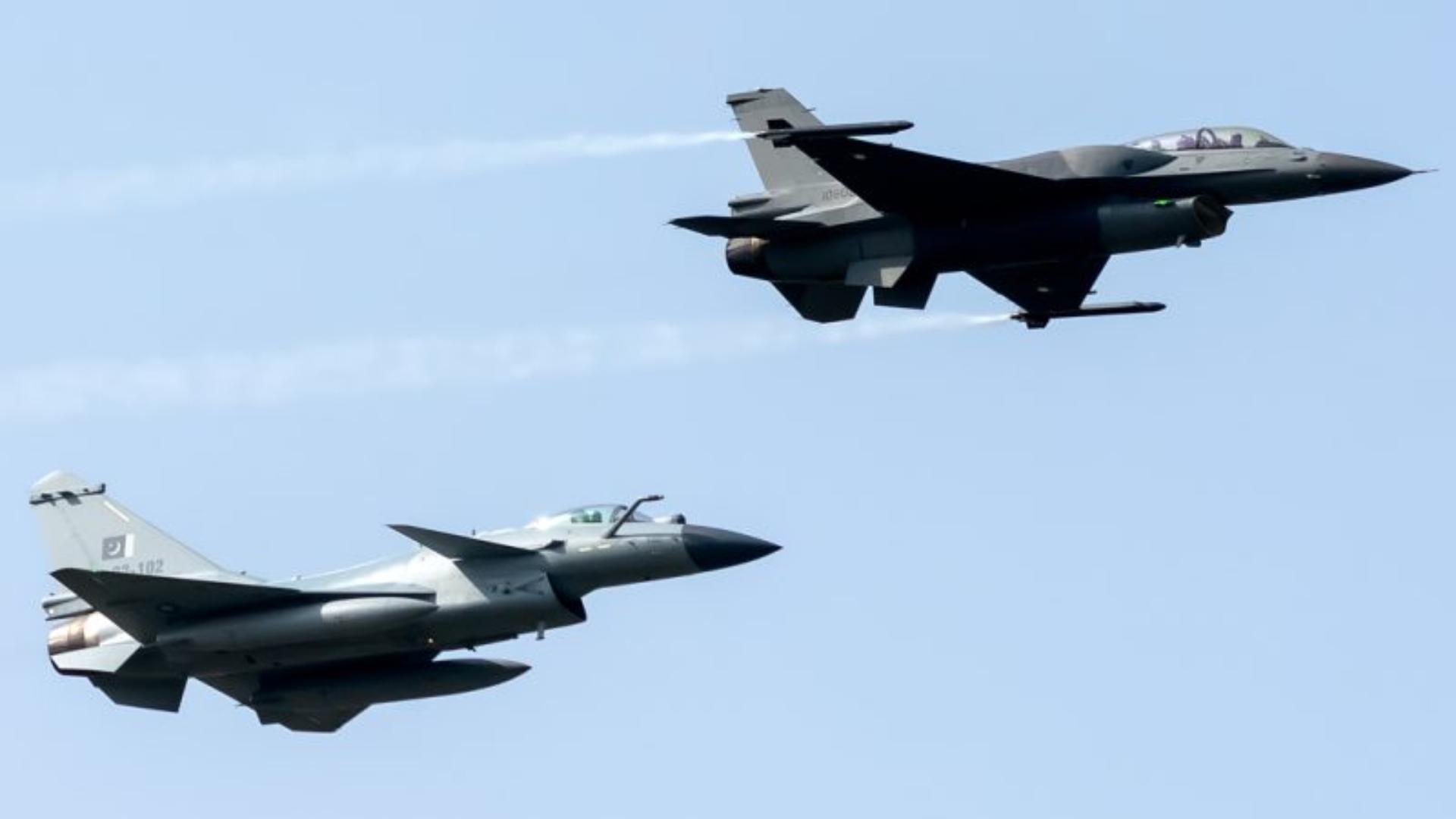
Pakistan-F-16-J-10.jpg

The One Fighter the Pakistan’s Air Force Needs More Than Stealth​

Pakistan Air Force News by Bilal Khan

Bilal Khan​

Main Takeaways:​

  • Stealth Isn’t the Priority: The J-35 stealth fighter is too new, complex, and unproven for the PAF to acquire in the near term.
  • Combat ‘Mass’ is Crucial: Modern airpower doctrine shows that a large number of reliable “workhorse” jets are needed to deliver firepower and support stealth operations.
  • The JF-17 Has Limitations: As a lightweight fighter, the JF-17 lacks the combat radius and payload capacity needed to fulfill this “mass” strike role effectively.
  • The J-10CE is the Solution: The PAF’s most logical step is to expand its medium-weight fleet by procuring more J-10CE fighters to build essential capacity before considering a stealth jet.

With the Pakistan Air Force (PAF) signalling its interest in the Shenyang J-35AE (e.g., recently including an image of the fighter in a display at the Aerospace Power Center of Excellence), the discussion of low-observable (LO) next-generation fighter aircraft (NGFA) understandably draws significant observer attention and focus.

However, while the discussion of LO NGFAs captures immediate attention, the PAF is, in reality, much farther out from inducting such platforms.

First, the J-35A is a new platform and lacks the operational maturity the PAF generally seeks from its new procurements. Being a LO NGFA, the J-35A is also a complex platform with unique attributes and challenges that would not be seen in 4+/4.5-generation aircraft. Thus, between teething issues and the new challenges of supporting a LO NGFA, the groundwork or urgency for induction is not there.
Second, the PAF has also yet to properly evaluate the J-35A within Pakistan to see how the platform fares locally and if feedback needs to be given to Shenyang for user-specific improvements. Third, the PAF has also yet to build the wider capacity to support LO NGFA-led operations.

The most recent live operational use of LO NGFAs happened in the recent conflict between Israel and Iran, with the former deploying its F-35I. In Operation Rising Lion, the F-35Is closely interoperated with Israel’s F-15I and F-16I multirole fighters, with the latter – arguably – delivering most of the payload or munitions bulk against Iran. In other words, where LO NGFAs ostensibly drive initial effects in combat, the older generation multirole fighters ensured a lasting impact.

The F-35I exposed Iranian radar/air defence activity, carried out suppression of enemy air defence (SEAD) operations, and cued targets for the other fighters. However, it was the F-15I and F-16I that seemingly generated the attack volume (e.g., against missile launchers, storage sites, etc), creating a ‘lasting’ impact that could control the direction of the conflict in Tel Aviv’s favour.

This approach is not unique to Israel. Every major employment of LO NGFAs – i.e., US, UK, China, Japan, South Korea, Italy, Spain, Russia, and Israel – involves the tandem use of 4+/4.5-generation aircraft, with the latter likely being used to generate sortie volume and payload output. It seems that inducting LO NGFAs with 4+/4.5-generation platforms seems to be the strategy of air arms that see themselves carrying out independent air operations.

For example, Algeria will soon induct the Su-57 as its LO NGFA. However, in addition to the Su-57, Algeria is also procuring the Su-34, a dedicated strike fighter with a heavy payload capacity. Algeria could also draw on its existing fleet of Su-30s for additional payload output.

Granted, there are many countries that have selected the F-35 as their sole fighter platform. However, the majority – if not entirety – of these countries are NATO powers. In all likelihood, these states likely see themselves pooling their assets into multi-national coalitions. These countries – i.e., Netherlands, Belgium, Denmark, Finland, Norway, and Romania – will not engage in offensive operations alone, but through NATO. Otherwise, they (along with Switzerland) would deploy their assets defensively.

The other F-35 users, however – i.e., South Korea, Japan, Israel, Poland, Singapore, and potentially Turkey – all see themselves as potentially operating offensively alone and, as such, maintain larger numbers of 4+ and 4.5-generation fighters like the F-16, F-15, Typhoon, and (in Korea and possibly Poland’s case) KF-21 fighters to drive volume.

Even China, which does operate large numbers of LO NGFAs, will also draw upon its indigenized Flanker-series. Thus, the PAF will likely model itself on the assumption of utilizing NGFAs to lead operations, but for that doctrine to succeed, it needs a platform for mass.

Why a Stealth Fighter is Not a Near-Term Priority​

The PAF evidently wants to induct a LO NGFA. Indeed, previous Quwa analyses inferred that Air Headquarters (AHQ) is aiming to build its future offensive doctrine around LO NGFAs alongside unmanned combat aerial vehicles (UCAV) and other smart munitions. However, this will not fully materialize in the near term and each input is contingent on the technology maturing and being absorbable to the PAF at the cost and efficiency it would prefer.

The issue with the J-35A at this time is that the PAF has yet to test and validate those factors:

First, the PAF did not test the J-35A in Pakistan, which will matter because the fighter needs to be evaluated for both its performance and maintainability. The J-35A is a LO system with very specific inputs designed to achieve its stealthy capability, like its skin, for example.
 
Status
Not open for further replies.

Users who are viewing this thread

Pakistan Defence Latest

Back
Top