6th Generation Fighter's Ranked

For China to sell its 5th gen J-35, China must be very confident in its technology as we all know China doesn't like to sell its top tier stuff.
 
At present, the only sixth-generation fighter programs worldwide that have truly materialized—with prototype flight tests and entry into live-aircraft validation—are those of China and the United States.

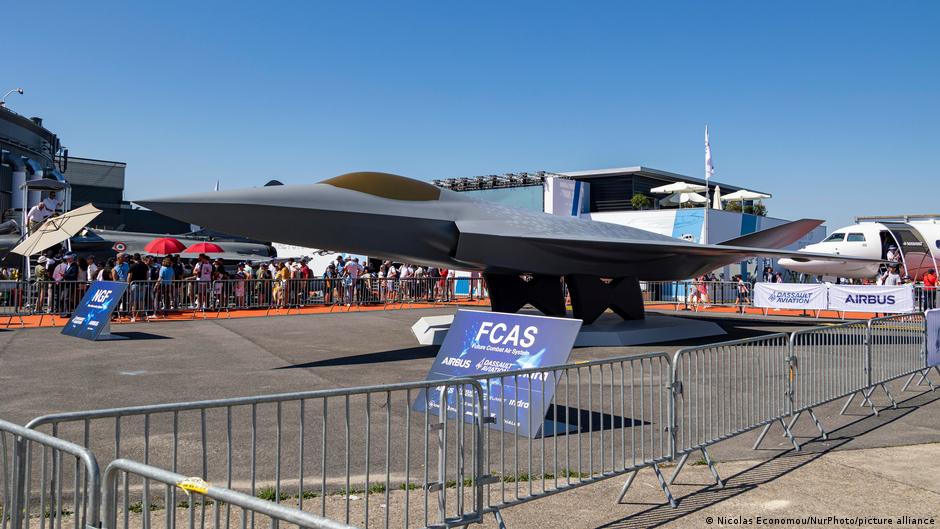
Europe’s FCAS and GCAP remain at the blueprint and model stage, while Russia is still bogged down in the production quagmire of fifth-generation fighters and has long since fallen completely out of the first tier.
 
Allegedly seen over Area 51

To view this content we will need your consent to set third party cookies.
For more detailed information, see our cookies page.

It's probably fake unfortunately there's no heat plume or heat visible what looks like some IR video?
 
Allegedly seen over Area 51

To view this content we will need your consent to set third party cookies.
For more detailed information, see our cookies page.


It must be aliens, because a 6th gen platform cannot have canards !!!
 
Allegedly seen over Area 51

To view this content we will need your consent to set third party cookies.
For more detailed information, see our cookies page.

Seems to be real
To view this content we will need your consent to set third party cookies.
For more detailed information, see our cookies page.
 
There’s no way it’s a sixth-generation fighter. How could a sixth-gen fighter possibly have canards?

According to the narrative from Europe, the U.S., and their bootlickers, canards are a backward feature of fourth-generation fighters. America’s fifth-generation jets, the F-22 and F-35, don’t have canards. The J-20 has canards, so it supposedly isn’t as advanced as American fifth-generation fighters.

So why are they suddenly turning around and copying China, going backward?
 
The J-36 and J-50 are era-defining products.

Originally, the world’s major powers were competing below 20,000 meters, and stealth fighters were designed to be stealthy only from the front, rear, sides, and below. Then China ignored the usual playbook and came up with a “three-high” concept: 30,000-meter altitude, Mach 3 cruising speed, a 3,000-kilometer combat radius, and even three engines.

Fifth-generation fighters only considered stealth from the front, rear, sides, and below. From above, their stealth is not only poor, but their infrared signature is also bad. Leaving everything else aside, even the pilot cockpit has to account for radar reflections from directly overhead. Once the pilot wears a helmet, it can immediately reflect as a target roughly the size of a basketball.

A sixth-generation fighter against a fifth-generation fighter is completely like a higher-dimensional slaughter, let alone against fourth-generation fighters.
 
The J-36 and J-50 are era-defining products.

Originally, the world’s major powers were competing below 20,000 meters, and stealth fighters were designed to be stealthy only from the front, rear, sides, and below. Then China ignored the usual playbook and came up with a “three-high” concept: 30,000-meter altitude, Mach 3 cruising speed, a 3,000-kilometer combat radius, and even three engines.

Fifth-generation fighters only considered stealth from the front, rear, sides, and below. From above, their stealth is not only poor, but their infrared signature is also bad. Leaving everything else aside, even the pilot cockpit has to account for radar reflections from directly overhead. Once the pilot wears a helmet, it can immediately reflect as a target roughly the size of a basketball.

A sixth-generation fighter against a fifth-generation fighter is completely like a higher-dimensional slaughter, let alone against fourth-generation fighters.

Actually 5th gen stealth is still mostly frontal and below focused. Frontal arc of approx 20 to 40 degrees depending on how well the 5th gen is designed but pretty much frontal and from below only because side stealth is not possible from most side arcs due to how radar interacts with the wing and rear stabilisers, particularly the vertical stabs.

Yes you can make it much less visible from many side angles but not all side angle arcs.

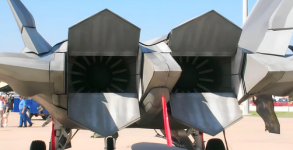
Rear stealth is also pretty much non existent for 5th AND 6th gen. Engine internals are still exposed even on 6th gens. Petals and general design can be great like F-22 but radar will bounce around 100x and then back to source when it goes down the engine shaft.

1780971289598.png

Just as bad for stealth as completely exposed engine fan and blades behind fan when viewed from front.

So rear stealth doesn't exist for even 6th gen using VCE but 6th gen take care of the side stealth aspect and enhance all other aspects with reduced gaps, fewer surfaces and new materials.
 
The J-36 and J-50 are era-defining products.

Originally, the world’s major powers were competing below 20,000 meters, and stealth fighters were designed to be stealthy only from the front, rear, sides, and below. Then China ignored the usual playbook and came up with a “three-high” concept: 30,000-meter altitude, Mach 3 cruising speed, a 3,000-kilometer combat radius, and even three engines.

Fifth-generation fighters only considered stealth from the front, rear, sides, and below. From above, their stealth is not only poor, but their infrared signature is also bad. Leaving everything else aside, even the pilot cockpit has to account for radar reflections from directly overhead. Once the pilot wears a helmet, it can immediately reflect as a target roughly the size of a basketball.

A sixth-generation fighter against a fifth-generation fighter is completely like a higher-dimensional slaughter, let alone against fourth-generation fighters.

I doubt J-50 is mach 3 capable. J-36 is unknown but the hints are high speed above Mach 2.5 and pushing supercruise to well beyond the previous 5th gen supercruise champs F-22 and J-20 which cruise between 1.6 and 1.8 based on official statements for both these fighters.

J-50 still only has 2 engines and even if we assume China's VCE for J-50 is a leap beyond WS-15 in optimised performance (based on altitude and fuel consumption) and its wing sweep angle, it's hard to imagine it's Mach 3 capable. It is designed to be the super-manoeuverable one of the two where J-36 is pure stealth, altitude, speed, sensor package, EW and payload capacity focused, J-50 retains the more traditional fighter role of being able to pull relatively tight turns like 3rd gens at least if not 4th and 5th gen level which I think will be difficult for it given the complete lack of vert stabs.

US F-47 also appears to emphasis next generation stealth at the expense of 4th/5th gen edge of human tolerance level agility.

The main difference is J-36 is a power generating beast with 3 super heavy VCEs which would be producing considerably more power than even the WS-15.
 
Allegedly seen over Area 51

To view this content we will need your consent to set third party cookies.
For more detailed information, see our cookies page.

I like the avatar, white bear with a sword.
 
Most pointless ranking of the week: we don't know anything about any of these programs. All the non-Chinese jets are also still on PPT (maybe F47 has secretly test flied but we don't know for sure). There is also a high change GCAP and FCAS will end up as 5.5 gen jets after the deployment of true 6th gen jets (ala Rafale / Typhoon in the age of F22). Oh, FCAS was recently cancelled.
 
I read that earlier on TWZ. Not surprised there were irreconcilable differences between the French and the Germans.
In the logic of business cooperation in China, there is a taboo!

Any project should absolutely prohibit multiple partners with similar capabilities from joining with a balanced shareholding structure.

Both FCAS and GCAP violated this taboo! Therefore, the FCAS project came to an end. Let's see how long GCAP can last...
 

Users who are viewing this thread

  • Back
    Top