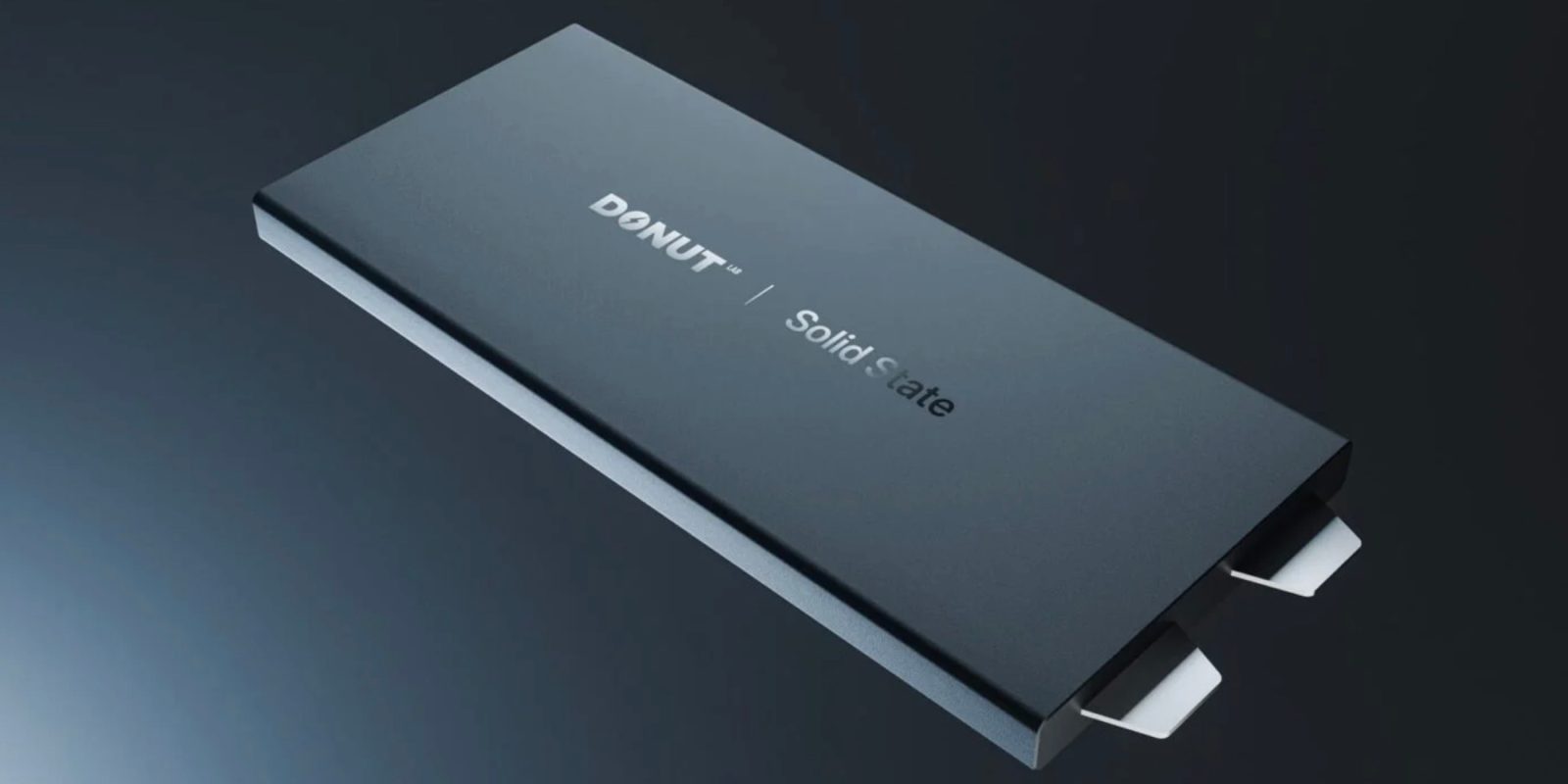
Finland; World’s First Production Solid-State Battery Charges in Just 5 Minutes

Hamartia Antidote

Elite Member
Joined
Nov 17, 2013
Messages
46,996
Reaction score
26,870
Reputation
622.0
Country of Origin
Country of Residence

Faster charging, greater durability, cheaper production, more energy density, and improved safety.

Key Points​

  • Donut Lab unveiled a production-ready solid-state EV battery at CES 2026 that recharges fully in five minutes.
  • The battery offers double Tesla’s energy density, a much longer lifespan, and operates in extreme temperatures.
  • Verge Motorcycles will launch the first all-solid-state EV, extending range and reducing charging time.
An outfit called Donut Lab has revealed the world’s first production-ready solid-state battery. Designed specifically for electric vehicles, the battery can be recharged to full capacity in just five minutes, and that’s a big deal. While some early adopters have been willing to deal with the inconveniences of EV ownership, the vast majority of those who are agnostic about what powers their cars remain unwilling to deal with the long wait times that recharging an electric vehicle requires; even if charging stations are prolific in your area, refilling the battery takes a certain amount of planning. With this technology, however, recharging an EV could take no more time than filling a combustion-powered car’s gas tank. In fact, Donut Lab’s CEO says the company’s goal is to “make electric vehicles so good that combustion becomes irrelevant.”

The World’s First Solid-State-Powered EV is Imminent​


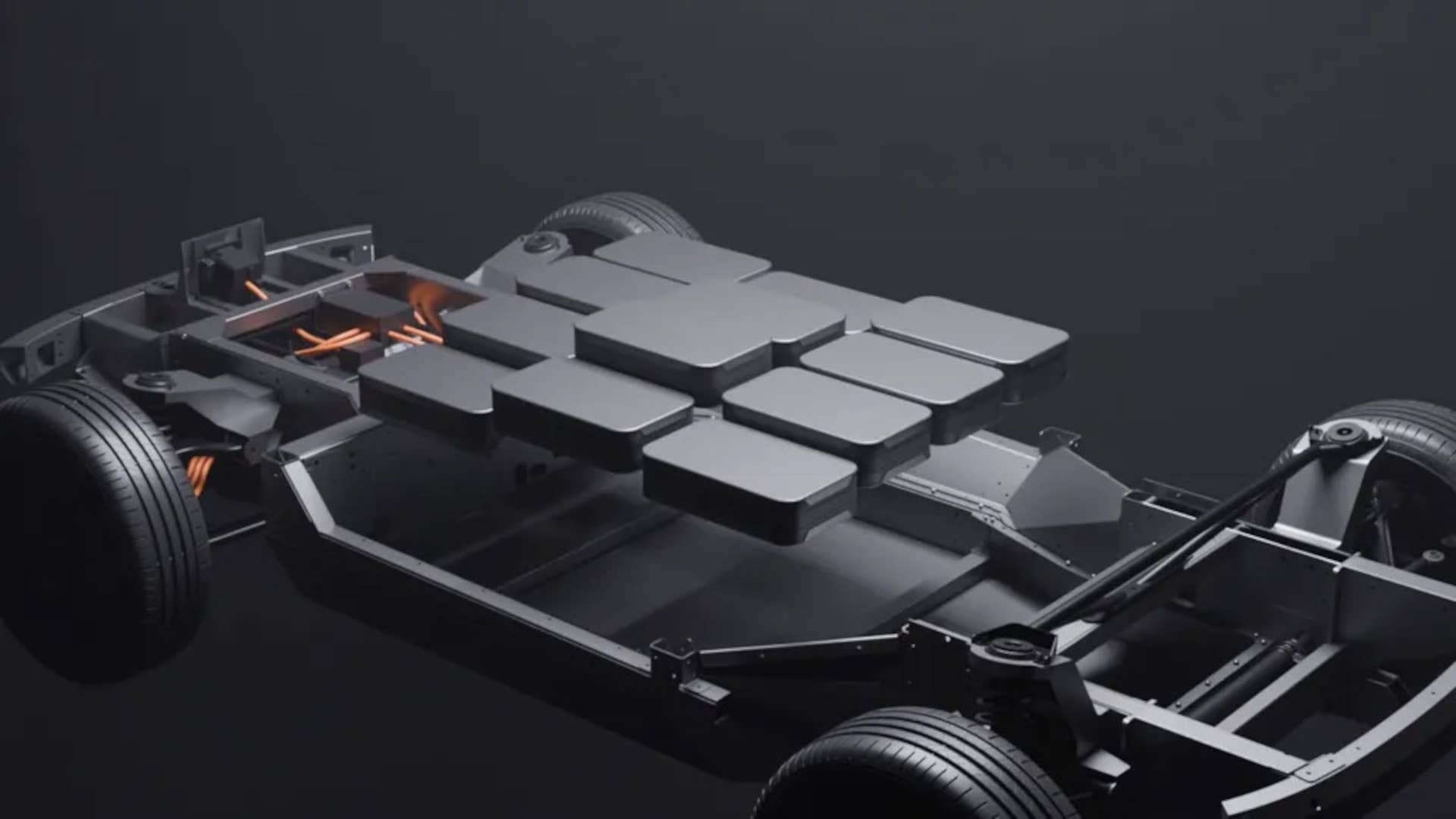
The startup says its liquid-free battery cells and modules are now available at a gigawatt-hour level of production capacity, and it’s inviting companies all over the world to take advantage. Verge Motorcycles, which already uses Donut Lab’s futuristic in-wheel motor on its electric motorcycles, says the updated version of its TS Pro two-wheeler, scheduled to reach customers in the first quarter of 2026, will be the world’s first production all-solid-state-powered EV. Donut Lab says the battery has an energy density of 400 watt-hours/kilogram, which is double the density of a typical Tesla battery, and can be fully charged – not just to 80%, as is ideal for conventional batteries – in five minutes for as many as 100,000 cycles. According to InsideEVs, the best traditional lithium-ion batteries available today only manage a density of around 250-300 Wh/kg and can only last up to 5,000 full cycles while limiting the maximum state of charge to 80%. In other words, this battery is a game-changer.

Donut’s Battery is Safer, Faster, and Cheaper​

Donut Lab Solid-State Battery

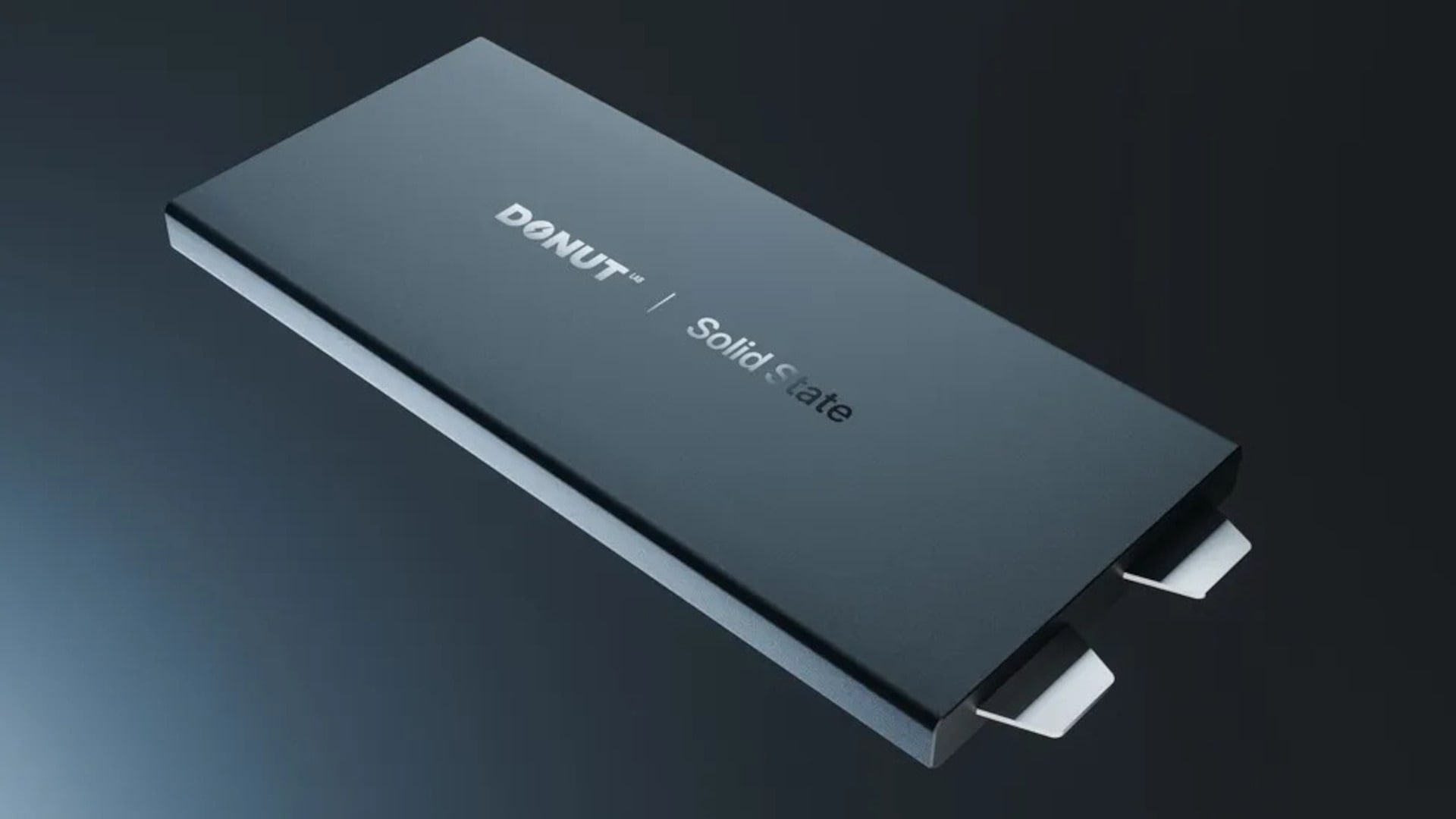
Donut Lab Solid-State Battery

Donut Lab’s solid-state battery is not only more energy-dense, faster-charging, capable of providing more range, and lighter, but it’s also safer, with the company claiming that extreme temperatures have little to no effect. Donut Lab says the battery retained more than 99% of its capacity at temperatures as low as -22°F (-30°C) and as high as 212°F (100°C). Furthermore, the company says the battery won’t ignite if it’s damaged, and although it didn’t reveal what materials go into it, Donut says it’s “100% green, made from materials that are found everywhere,” meaning it can be built worldwide and have a minimal impact on the environment while costing less than comparable lithium-ion batteries.

Donut Labs adds that Verge’s TS Pro motorcycle, formerly capable of a city driving range of 217 miles with a conventional battery, can now do up to 370 miles with a solid-state battery in the same cradle. With this Large Battery option, recharging takes less than 10 miutes, with Verge saying it deliberately designed the new bike to take longer to charge to allow riders to have a coffee while waiting. This battery has been unveiled at the 2026 Consumer Electronics Show, where future tech is always on display, but Donut Lab co-founder and CEO Mark Lehtimäki says its answer to when solid-state batteries will be ready for use in OEM production vehicles “is now, today, not later.” Would this make you more willing to go electric?

To view this content we will need your consent to set third party cookies.
For more detailed information, see our cookies page.
 
Last edited:

Faster charging, greater durability, cheaper production, more energy density, and improved safety.

Key Points​

  • Donut Lab unveiled a production-ready solid-state EV battery at CES 2026 that recharges fully in five minutes.
  • The battery offers double Tesla’s energy density, a much longer lifespan, and operates in extreme temperatures.
  • Verge Motorcycles will launch the first all-solid-state EV, extending range and reducing charging time.
An outfit called Donut Lab has revealed the world’s first production-ready solid-state battery. Designed specifically for electric vehicles, the battery can be recharged to full capacity in just five minutes, and that’s a big deal. While some early adopters have been willing to deal with the inconveniences of EV ownership, the vast majority of those who are agnostic about what powers their cars remain unwilling to deal with the long wait times that recharging an electric vehicle requires; even if charging stations are prolific in your area, refilling the battery takes a certain amount of planning. With this technology, however, recharging an EV could take no more time than filling a combustion-powered car’s gas tank. In fact, Donut Lab’s CEO says the company’s goal is to “make electric vehicles so good that combustion becomes irrelevant.”

The World’s First Solid-State-Powered EV is Imminent​


The startup says its liquid-free battery cells and modules are now available at a gigawatt-hour level of production capacity, and it’s inviting companies all over the world to take advantage. Verge Motorcycles, which already uses Donut Lab’s futuristic in-wheel motor on its electric motorcycles, says the updated version of its TS Pro two-wheeler, scheduled to reach customers in the first quarter of 2026, will be the world’s first production all-solid-state-powered EV. Donut Lab says the battery has an energy density of 400 watt-hours/kilogram, which is double the density of a typical Tesla battery, and can be fully charged – not just to 80%, as is ideal for conventional batteries – in five minutes for as many as 100,000 cycles. According to InsideEVs, the best traditional lithium-ion batteries available today only manage a density of around 250-300 Wh/kg and can only last up to 5,000 full cycles while limiting the maximum state of charge to 80%. In other words, this battery is a game-changer.

Donut’s Battery is Safer, Faster, and Cheaper​

Donut Lab Solid-State Battery

Donut Lab Solid-State Battery

Donut Lab’s solid-state battery is not only more energy-dense, faster-charging, capable of providing more range, and lighter, but it’s also safer, with the company claiming that extreme temperatures have little to no effect. Donut Lab says the battery retained more than 99% of its capacity at temperatures as low as -22°F (-30°C) and as high as 212°F (100°C). Furthermore, the company says the battery won’t ignite if it’s damaged, and although it didn’t reveal what materials go into it, Donut says it’s “100% green, made from materials that are found everywhere,” meaning it can be built worldwide and have a minimal impact on the environment while costing less than comparable lithium-ion batteries.

Donut Labs adds that Verge’s TS Pro motorcycle, formerly capable of a city driving range of 217 miles with a conventional battery, can now do up to 370 miles with a solid-state battery in the same cradle. With this Large Battery option, recharging takes less than 10 miutes, with Verge saying it deliberately designed the new bike to take longer to charge to allow riders to have a coffee while waiting. This battery has been unveiled at the 2026 Consumer Electronics Show, where future tech is always on display, but Donut Lab co-founder and CEO Mark Lehtimäki says its answer to when solid-state batteries will be ready for use in OEM production vehicles “is now, today, not later.” Would this make you more willing to go electric?

To view this content we will need your consent to set third party cookies.
For more detailed information, see our cookies page.

World’s First ?

1767797955144.png
 
The biggest issue with battery isn't charging or capacity, both are making leaps and bounds over the years.

It's the battery's capacity to not degrade as fast as previously.

You can charge it quickly, but if the battery is only as effective as 80% after a few years since you bought it, then you run into the same old problem with EVs and range anxiety.
 

almost!

Dongfeng postponed mass production of solid-state batteries to 2027​

In November 2025, Dongfeng Automobile shared that it will commence the mass-production of solid-state batteries with an energy density of 350 Wh/kg in September 2026. The company had already established a 0.2 GWh pilot production line.
However, the mentioned road map was adjusted during the official visit of the Dongfeng Motor Corporation delegation of external directors at the solid-state battery plant. They conducted on-site inspections of the solid-state battery cell and module production lines.


almost!

Dongfeng postponed mass production of solid-state batteries to 2027​

If you want to learn about or verify the latest developments in this field, you might try visiting Chinese websites. English-language websites are often significantly delayed in reporting this type of news, or simply don't publish it at all.
1767803178052.png
1767803199046.png
 
If you want to learn about or verify the latest developments in this field, you might try visiting Chinese websites. English-language websites are often significantly delayed in reporting this type of news, or simply don't publish it at all.
View attachment 170621
View attachment 170622

how about posting the link instead of just pics so we can all look into it.
The pages i find with that first pic are all in November before the delay in December was announced.

China's first large-capacity all-solid-state battery production line has been completed and is undergoing small-batch testing and production.​

 
Last edited:

Donut Lab’s ‘solid-state’ battery exposed as regular li-ion in damning investigation​

Fred Lambert| Jun 8 2026 - 12:18 pm PT

Donut Lab solid state battery


A comprehensive investigation by battery researcher Ziroth, involving over 20 independent battery experts, has produced what amounts to definitive proof that Donut Lab’s “miracle” solid-state battery is actually a lithium-ion cell. The company raised approximately $25 million from over 1,300 mostly small investors based on claims that now appear to be false.

The investigation traces the battery technology back to a German company called CT Coatings, reveals a web of companies hiding behind aggressive NDAs, and presents electrochemical evidence — including voltage curves and cell expansion data — that conclusively identifies the tested cell as lithium-ion, not the revolutionary sodium-ion solid-state chemistry Donut Lab promised.

From skepticism to confirmation​

We have been covering Donut Lab’s claims with skepticism since the company shocked the battery world at CES 2026 with claims of a 400 Wh/kg, 100,000-cycle, 5-minute-charging solid-state battery. In January, I interviewed CEO Marko Lehtimäki and told him directly that he was either going to lose all his credibility or revolutionize the world. It looks like it was the former.

At the time, the incentives to lie weren’t clear to me, and the short timeline to delivery gave the claims some credibility. But as we tracked the independent testing results, the red flags kept piling up. Five tests from VTT and not a single one addressed the two claims that actually mattered: the 400 Wh/kg energy density and the 100,000-cycle life. Then came the whistleblower complaint from Nordic Nano’s former CCO, alleging the battery specs were never achieved.

Now, Ziroth’s investigation fills in the gaps with hard electrochemical evidence.

To view this content we will need your consent to set third party cookies.
For more detailed information, see our cookies page.


The evidence: voltage curves and cell expansion prove lithium-ion​

The investigation consulted over 20 independent battery experts, including Julian Zanau from the Fraunhofer Research Institute, Dr. Yahim San from Justus-Liebig University, Tom Bicha from Leona, and Dr. Yuo Hesca from Seinäjoki University of Applied Sciences. Every single one confirmed the tested cell is lithium-ion.

There are two key pieces of evidence. First, the voltage curves from VTT testing match high-nickel lithium-ion cells (NCM chemistry). The cell sits at 3.7-3.8 volts at 50% state of charge — right where lithium-ion cells operate. Sodium-ion cells don’t go significantly past 3.5 volts at 50% SOC.

The second piece of evidence is even more damning: VTT’s cell expansion data. When a battery charges, ions squeeze into the anode material, causing it to expand in a predictable pattern. A graphite anode produces a distinctive “kink” in the expansion curve around 50-70% state of charge, caused by how ions reorder themselves in graphite’s layered structure. The Donut Lab cell shows exactly that kink.

This is critical because sodium ions are physically too large to fit into graphite layers. The graphite anode signature proves the cell uses lithium ions. The investigation puts it well: “it’s like we have a slightly noisy fingerprint and a picture of the suspect’s face. And yet again, it’s a match.”

The calculated energy density? About 298 Wh/kg — what you’d expect from a good lithium-ion cell, not the 400 Wh/kg claimed.

The web of companies behind the fraud​

The investigation reveals that the battery technology traces back to CT Coatings, a German company with an “eclectic” array of patents — including inventions for screen-printed paving slabs, menu folders, and warning triangles. CT Coatings promised Nordic Nano and Donut Lab a screen-printed sodium-ion solid-state battery. What it delivered was a lithium-ion pouch cell.

The relationship works like this: CT Coatings was the technology provider, Nordic Nano was supposed to be the manufacturer, and Donut Lab was the commercializer. Nordic Nano has reportedly never manufactured a single battery cell.

Julian Zanau from Fraunhofer described meeting with CT Coatings representatives and being unimpressed: “The first impression I got was that these people have no idea how a battery actually works. They were talking about no rare earth metals in their batteries and therefore no lithium, and to any chemist lithium has nothing to do with rare earth minerals.”

Meanwhile, Donut Lab performed its own technical due diligence instead of getting independent validation — an approach that former Nordic Nano CCO Lauri Peltola described as deeply inadequate given that neither company had battery chemistry expertise.

Verge ‘production vehicle’ claim was verifiably false​

Beyond the chemistry, the investigation documents clear-cut lies. Donut Lab claimed to have a production vehicle shipped to consumers in Q1 2026. On the last day of the quarter, they announced the “first production motorcycle” off the line.

But an internal video to reservation holders told a different story: the first bikes would be for Verge’s internal fleet, with the purpose of refining the manufacturing process before shipping to customers. That is, by definition, a pre-production vehicle.

In an interview with Finnish media, Lehtimäki then admitted that the 400 Wh/kg cells were not in the bikes and that the cell tested by VTT “is not even the cell that’s going to be shipped to customers.” Leaked emails showed Donut Lab asking CT Coatings when they would actually receive proof of the claimed specs. Apparently, no proof was ever provided.

$25 million raised from 1,300+ small investors​

The most troubling aspect of the investigation centers on how the money was raised. Donut Lab has over 1,300 shareholders, with over 900 holding 50 or fewer shares — likely representing investments between $3,000 and $23,000 per person. Many came from a crowdfunding exercise on Finland’s Springvest platform in 2023 for Verge Motorcycles.

When Verge was restructured and Donut Lab was spun out, the company’s valuation jumped from a struggling motorcycle company to a parent company of a “half a billion euro portfolio” — all because of the miracle battery. An investor letter from Lehtimäki promised “a potential return on investment of up to 10x in just 12 to 18 months” and urged investors that “it is not yet too late to invest more.”

The investigation argues that this approach — using self-validated due diligence to raise money from investors who lacked the means to scrutinize the technology — was chosen deliberately to avoid the kind of technical scrutiny that venture capital firms would demand.

The valuation was later inflated to $1.25 billion after the CES presentation. Finnish financial authorities and criminal authorities are reportedly investigating.

45 Comments
 
Last edited:
The biggest issue with battery isn't charging or capacity, both are making leaps and bounds over the years.

It's the battery's capacity to not degrade as fast as previously.

You can charge it quickly, but if the battery is only as effective as 80% after a few years since you bought it, then you run into the same old problem with EVs and range anxiety.
LFP batteries have a lifespan of 4000-8000 cycles and even after that it retains 70-80% of original capacity. A 200 km range EV with 4000 cycle battery means 800,000 km of battery life. The battery should be the last thing to wear out in a vehicle.
 

Users who are viewing this thread

Latest Posts

Back
Top