Chinese Society and Infrastructure

Status
Not open for further replies.

CHINA YOU HAVEN'T SEEN BEFORE! *border to N. Korea and Russia* 🇨🇳


To view this content we will need your consent to set third party cookies.
For more detailed information, see our cookies page.
 
兄弟,我很佩服你发那么多帖子向世界介绍中国,但是你看那些人的评论就知道,这些帖子没有任何意义。这些肮脏愚蠢的白猪感觉不到,他们唯一感觉到的就是自己在逐渐失去对世界的掌控,所以才害怕,才造谣!!真理永远在大炮的射程之内。我们宋朝不是繁荣富足吗?有什么用?靖康之耻还没有洗刷干净!!我们只能加速自己的经济建设和军事建设!!如果他们不懂文明的语言,就用大炮和导弹来说话吧!!!

Well, this forum is still considered fine.

At other English forums, it's far worse than this forum.
 
China has nearly finished yet another massive highway tunnel (22 km) in Xinjiang, said to be the longest in the world. Said to open in October 2025 as part of the Urumqi-Yuli Expressway.

Is the “Sea-Highway-Railway” transport plan a formal plan to connect to nearby countries or just a term for all the different efforts under one umbrella?

To view this content we will need your consent to set third party cookies.
For more detailed information, see our cookies page.
 
To view this content we will need your consent to set third party cookies.
For more detailed information, see our cookies page.
 
Guys, if you think YouTubers and travel vloggers only show off the flashiest parts of China, they don't.

China really does look like this.

Nowadays, a lot of rural areas are seeing insane investments in infrastructure, housing, facilities, etc. In the past, all the major cities got priority in development. That project has been a huge success, China has urbanised really fast, and urbanisation has filled economic growth. TThe government wants more young people to move to the suburbs and country side.

Where I live (rural Huzhou, a tier III city, near Hangzhou), it is more developed, cleaner, better facilities (malls, shops, recreation centres, scenic areas, restaurants, hospitals and specialist clinics, libraries, etc) than virtually all Western countries.

I showed some pictures of my rural town to my friends back home (UK). They all thought I was in Japan.
 
Guys, if you think YouTubers and travel vloggers only show off the flashiest parts of China, they don't.

China really does look like this.

Nowadays, a lot of rural areas are seeing insane investments in infrastructure, housing, facilities, etc. In the past, all the major cities got priority in development. That project has been a huge success, China has urbanised really fast, and urbanisation has filled economic growth. TThe government wants more young people to move to the suburbs and country side.

Where I live (rural Huzhou, a tier III city, near Hangzhou), it is more developed, cleaner, better facilities (malls, shops, recreation centres, scenic areas, restaurants, hospitals and specialist clinics, libraries, etc) than virtually all Western countries.

I showed some pictures of my rural town to my friends back home (UK). They all thought I was in Japan.

Total urbanisation like Japan or South Korea is not a good thing.

You need a realistic amount of people in the countryside or in the villages as farmers.
 

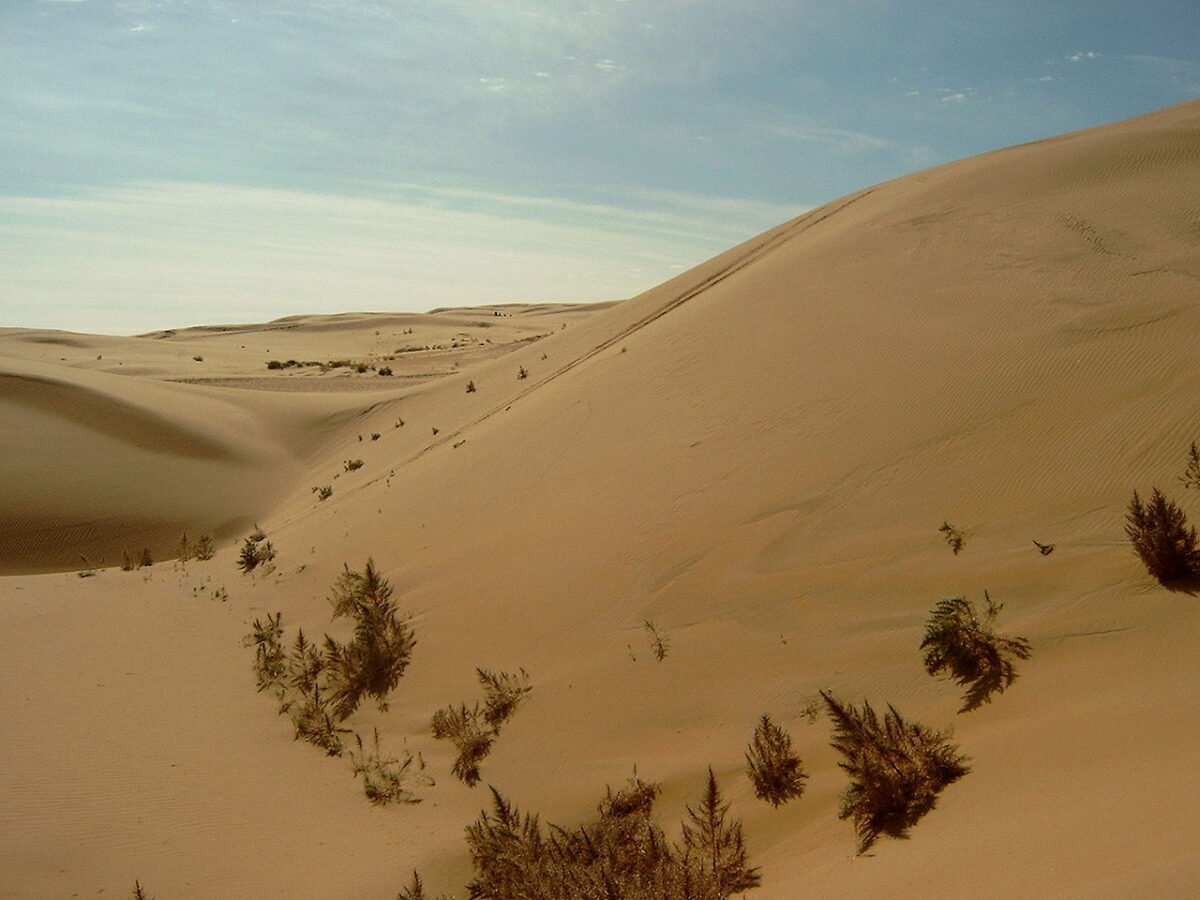
China to deploy 253 GW of PV for desert control in arid north​

China plans to install 253 GW of solar capacity and restore more than 670,000 hectares of degraded land by 2030 under a large-scale desert PV program in its northern and northwestern regions. It aims to curb desertification and expand renewable energy deployment.

June 30, 2025

China has approved a new plan to tap its vast desert solar potential while addressing land degradation.

The Photovoltaic Desertification Control Plan (2025-30) – released by the National Forestry and Grassland Administration, the National Development and Reform Commission (NDRC), and the National Energy Administration (NEA) – aims to install 253 GW of solar capacity and rehabilitate 1.66 million acres (673,670 hectares) of desertified land by 2030.

The initiative targets the “Three North” region – northern, northeastern, and northwestern China – which includes eight major deserts and four sandy regions spanning more than 100 million hectares. These areas receive some of China’s highest solar irradiation but face extreme ecological fragility, with limited water, sparse vegetation, and high wind erosion.

Authorities said solar deployment must follow “ecological priority and coordinated development.” The plan divides the region into three climate zones and five priority development areas, including the fringes of the Taklimakan and Tengger deserts. It calls for pilot projects that integrate solar with land rehabilitation and includes safeguards for site selection, construction, and operations to limit ecological impact.

While the economic advantages are clear – desert solar farms offer low land costs, high irradiation, and favorable electricity prices – the plan also targets reduced afforestation costs. Conventional tree-planting can cost up to CNY 12,000 ($1,650) per acre, while solar-linked approaches can lower that to CNY 1,800 to CNY 3,000, due to revenue from electricity generation.

Additional income could come from carbon credits, government subsidies for land restoration, and co-located agriculture or livestock. The Kubuqi project in Inner Mongolia, for example, combines 2 GW of solar with tomato and desert herb cultivation, generating over CNY 1 billion per year. Battery storage and hydrogen facilities further boost the projects’ economic and energy value.

Challenges remain. Grid infrastructure in remote areas is often inadequate to handle added generation, and some developers focus on capacity rather than ecological integration.

To address this, Beijing directed local governments to adopt integrated planning, involve farmers and communities, and encourage innovation. If successful, the plan could serve as a model for sustainable development in fragile environments.

As with other major infrastructure projects in China, the plan’s rollout will be guided by detailed actions under the upcoming 15th Five-Year Plan. Large state-owned energy firms are expected to lead implementation, potentially providing strong support for China’s solar supply chain.
 

How Southeast Asians Experience Chinese-Built Infrastructure

Published 12 Jun 2026

This Long Read reports the findings of an online survey on perceptions of Chinese-built infrastructure in Southeast Asia. It reflects both the tangible benefits of these projects and broader considerations shaping regional views of China as an infrastructure development partner.

JBHSR1-e1780903000458.jpg

The Jakarta-Bandung High-Speed Railway (WHOOSH), connecting Jakarta and Bandung, is one flagship project that has synergised China’s Belt and Road Initiative with Indonesia’s national strategy of improving connectivity.

POSITIVE PERCEPTIONS OF CHINESE-BUILT INFRASTRUCTURE

Impression of Chinese-built Infrastructure Quality


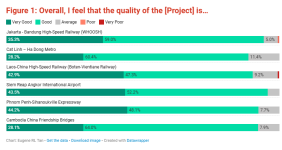
About 90% of respondents across almost all six projects feel that the Chinese-built projects are of “very good” or “good” quality (Figure 1). Respondents who have used WHOOSH, the LCHR, or the CLHD Metro enjoy their “comfort”, “cleanliness”, and “good service”. Cambodian respondents, in turn, praise the quality of the PPS Expressway and CCF Bridges, explaining that they are well-constructed and make their commutes safer and more comfortable. Given the enhanced travel speed and comfort, some respondents state that the ticket prices across the different Chinese-built railways are “affordable” or “fair”.

搜狗截图20260612163352.png
Personal Benefits from Chinese-Built Infrastructure

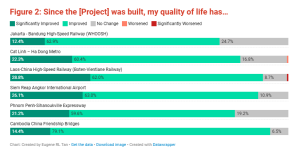
Respondents are largely appreciative that these projects have improved connectivity within their country and enabled local economic growth. Across the six projects, more than 75% believe that the projects have either “improved” or “significantly improved” their lives (Figure 2). More specifically, respondents indicate that these railway, highway and bridge projects have made their commutes more convenient, eased traffic congestion on overcrowded roads, and reduced their travel time. Cambodian respondents also describe how the SRAI Airport has enhanced the country’s international air connectivity, making it easier for them to travel abroad. Overall, over 90% of the respondents “strongly agree” or “agree” that these projects have eased travel for their respective cities or countries (Figure 3).
搜狗截图20260612163431.png
 
Status
Not open for further replies.

Users who are viewing this thread

Pakistan Defence Latest

Back
Top