Reusable Rocket Success in China 🚀

View attachment 205554

No, the key SpaceX capability was to land the Starship back at the launch tower for a quick turnaround time of refueling and re-launching
SpaceX cannot directly refuel and launch; it needs to return to the factory for monitoring, replacing damaged and vulnerable components, testing, and preparing for launch. This process currently takes 7 to 14 days.
 
SpaceX cannot directly refuel and launch; it needs to return to the factory for monitoring, replacing damaged and vulnerable components, testing, and preparing for launch. This process currently takes 7 to 14 days.

That’s the Falcon 9 turnaround time. The goal for the Starship first stage booster will eventually be multiple times a day…especially for the dedicated orbital refuelers which will probably have their own specialized refueling pads. Considering the booster flight time is measured in minutes while the top stage is in hours due to the slowness of transferring fuel in orbit to the depot I would expect the same booster to be shared by 5 or more refuelers. They will probably have a fleet of 10 refuelers with 2 boosters...plus backups of course. They'll launch a refueler into orbit, land the booster within minutes back at the pad, drop a second empty refueler on the top of the landed booster, refuel both, repeat. They have experience in reusing boosters...one Falcon 9 has flown 36 times.

A dedicated transfer ship will move some of the depot fuel to the moon.
 
Last edited:
Still not good enough to join the first tier league race though, where India, US and Russia rule.

India vs Russia vs USA: Who Leads in Space?

Jul 16, 2026
In today's episode, we sit down with Group Captain Shubhanshu Shukla IAF test pilot, Gaganyaan astronaut, and the first Indian to reach the International Space Station for one of the most extraordinary conversations we have ever had.

To view this content we will need your consent to set third party cookies.
For more detailed information, see our cookies page.
 
someone with more knowledge of Relevant Physics please tell me why not go for a parachute for reduced decent in the sea for retrieval?
 
someone with more knowledge of Relevant Physics please tell me why not go for a parachute for reduced decent in the sea for retrieval?
"The current record for parachute recovery is 7 tons, whereas the net weight of a reusable rocket is around 40 tons. Moreover, it would need to land within a 10-square-meter area."
 
"The current record for parachute recovery is 7 tons, whereas the net weight of a reusable rocket is around 40 tons. Moreover, it would need to land within a 10-square-meter area."
I get you .its a non-starter .. not that it hasent been tested. e.g. the Appolo re-entry modules returning back has these parachutes deployed as they landed in the sea.,

. I did some reasearch as well. you are correct, an averge weither is around 20 to 30 tons . we will need much bigger parachutes... they will add to the weight as well and need to be deployed in thick air to be effective and by then its too late as well even if they dont fail to deploy in the first place.
 
I get you .its a non-starter .. not that it hasent been tested. e.g. the Appolo re-entry modules returning back has these parachutes deployed as they landed in the sea.,

. I did some reasearch as well. you are correct, an averge weither is around 20 to 30 tons . we will need much bigger parachutes... they will add to the weight as well and need to be deployed in thick air to be effective and by then its too late as well even if they dont fail to deploy in the first place.

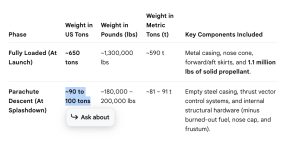
His parachute "7 ton record" answer is totally wrong...as the Space Shuttle boosters are 90 tons empty. it is likely more to do with crushing the liquid engines during impact and if that didn't get them then the salt water ingestion into them would. Do you want to bet your life on a car engine that was once submerged in dirty salty ocean water?


Space Shuttle solid rocket booster
shuttlebooster.png

The Long March 10B is estimated to weigh between 30 and 40 tons empty.

silver-hawk-2.jpg

So why the big weight difference between the two? Remember the Shuttle solid rocket booster is basically a scaled up "bottle rocket". It has to handle all the combustion pressure shooting through the length of it so the walls of it are built like a tank to handle the force. Even though it is smaller than a LM10B it is very HEAVY.


To view this content we will need your consent to set third party cookies.
For more detailed information, see our cookies page.
 
Last edited:

Users who are viewing this thread

  • Pakistan Defence Latest

    Back
    Top