“It has nothing to do with fake production” At a roundtable meeting at the Federation Council on May 21 on the development of the use of electric vehicles in Russia and the creation of the necessary infrastructure, Sergei Gromak, AvtoVAZ vice president for external relations and interaction with...

socialbites.ca
“The wheels are screwed on, that’s all”: AvtoVAZ called the assembly of Chinese electric cars in Russia a fake “AvtoVAZ” called the assembly of Chinese electric cars in Russia a fake 06/03/2024, 08:05

By
ANIKA
June 4, 2024
“It has nothing to do with fake production”
At a roundtable meeting at the Federation Council on May 21 on the development of the use of electric vehicles in Russia and the creation of the necessary infrastructure, Sergei Gromak, AvtoVAZ vice president for external relations and interaction with shareholders, said: Localization criterion for electric vehicle manufacturers’ access to state supports. He called unacceptable the current approach, according to which all manufacturers of such cars in the Russian Federation have equal access to government money allocated for the development of electric transport.
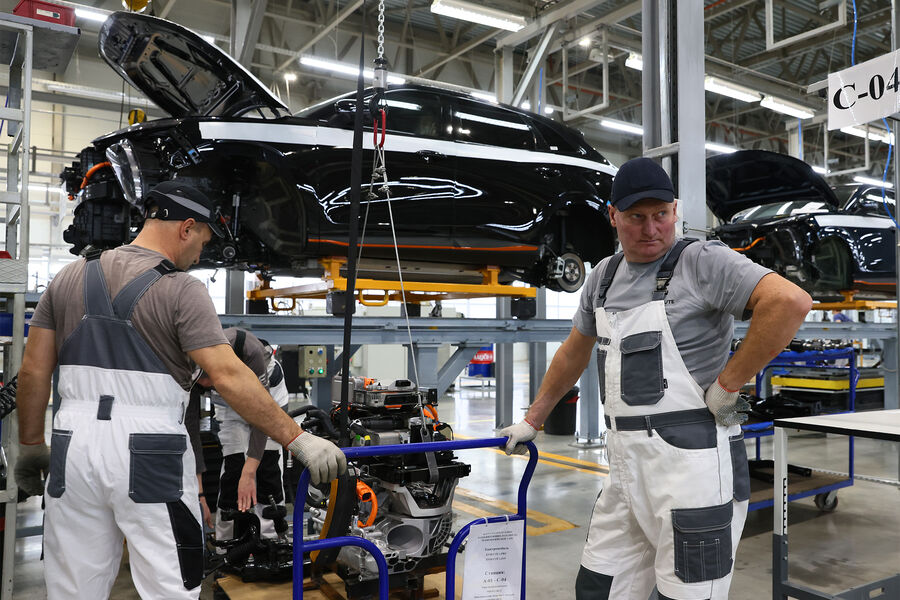
“Today, both an electric car produced entirely in Russia and an essentially Chinese electric car that comes here in a package with screwed-on wheels have the same access to government concessional loans. Well, this is fake, sorry, this is fake, it has nothing to do with Russian production,” Gromak said in his speech at the round table (recording available on socialbites.ca).
He added that taxpayers give a rebate for a company to purchase an electric car designed abroad with a foreign battery and that they want localization requirements to be introduced as soon as possible:
“It’s a step-by-step, increasing scale, not prohibitive. Let them grow slowly, but let everyone see that they need to be localized. Everyone should include in their investment plans the need to purchase a Russian battery within three years, and they are already allocating money for this. “Until that happens, we won’t have our own electric vehicles.”
In his opinion, it is no longer profitable to buy domestic components for electric vehicles, since the current legislation “establishes absolutely the same rules of state support for those who assemble a fake screwdriver in Russia, screw windshield wipers, screw in wheels, and those who are engaged in deep localization.”
socialbites.ca contacted the AvtoVAZ press service with a request to comment on the statement of the top manager. They noted that they support the efforts of Russian automobile factories committed to localizing electric vehicles.
“We think it is important to include ever-increasing requirements for the localization of electric vehicles in preferential car loans and leasing regulations, so that state support measures are concentrated on such car factories. The company’s press service noted that this step will further promote the formation of the domestic electric vehicle series and their component base.
AvtoVAZ emphasized that important work is ongoing on the production of Russian batteries and that encouraging the localization of electric cars will increase the demand for them. At the same time, it is important that the basic principle enshrined in the development strategy of the automotive industry continues to operate in the sector – the correlation of all monetary and non-monetary measures of state support with the actual level of localization of the product.
“If state support is cut, there will be no jobs”
Anton Shaparin, deputy chairman of the National Automobile Association, noted in an interview with socialbites.ca that some electric vehicle assembly projects in Russia actually have very low localization.
“I must admit that for the first time I agree with the top management of AvtoVAZ. Because, for example, I can’t call Evolute anything other than fake. It is clear to everyone what they will mount there; they screw the wheels and that’s it,” said the expert.
He added that a car becomes domestic only when its parts are produced in Russia, and this is not the case at the moment. In addition, electrification of transportation should be targeted where needed.
“I suspect that the public attack carried out by AvtoVAZ will have serious consequences. We have many big and serious lobbyists in our country. It is clear that this conflict is directly related to recycling collection and government subsidies,” Shaparin explained.
According to him, there is no point in sponsoring Evolute for 925 thousand rubles, because everything in it is Chinese. Likewise, there is no point in subsidizing EVM Pro (Russian plant of Electric Vehicle Production, where UAZ Profi electric cars are assembled)because this is not car production but re-equipment using Chinese units.
The adjective “fake” suits, first of all, the Evolute car assembly project carried out by Motorinvest, Sergei Tsyganov, the author of the Telegram channel “Russian Automobile”, agrees with Shaparin.
“A project like Motorinvest has little connection with the business world. It is not possible to pay for the installation with the minimum amounts they currently make. Moreover, these volumes do not fit into the plan. If you cut off all aid and aid there will be no jobs left there. Apparently they have some kind of agreement to go out in a taxi,” Tsyganov shared with socialbites.ca.
He noted that companies that base their business plans solely on incentives and subsidies have come to the same conclusion as the now-closed Zetta electric car project. creators
accused On charges of fraud with money received from the Ministry of Industry and Trade.
“All other projects, both Avtotor and others, are still in their early stages. There is no mention of them as a startup business yet. The author of the book “Russian Automobile” emphasized that the project that actually started was “Motorinvest”.
He added that if the state tries to require electric vehicle manufacturers to undertake localization obligations, they will actively resist this, because Russia does not yet have a parts industry for such cars:
“Although it is difficult, it is not possible to create a sub-industry with the will of the state. This is a business mission. This industry will emerge when it becomes profitable and the market needs it. “Such commitments can only be made when you know exactly where to get the components.”
According to automobile expert and radio presenter Alexander Pikulenko, the effect of state preferential loan programs for the purchase of electric vehicles by compensating part of the price from the state budget is currently small, since such cars in Russia are purchased by government agencies or enthusiasts. They fall within the scope of state support of the “electric” theme that buys vehicles that are not included.
“Our main electric vehicle production today is Motorinvest in Lipetsk, where large-scale assembly of Evolute electric vehicles continues. This is a private enterprise, it produces cars and will gradually follow the path of localization, but this is not a quick process. There are still more promises: Atom from AvtoVAZ. The project they tried to create has ceased to exist – this is Zetta,” Pikulenko explained to socialbites.ca.
He added that Atom is actually a machine developed by a large team, going through the entire engineering work cycle, and the Amber project in Kaliningrad looks more like a “project”.
The auto expert concluded: “The development is currently following the normal path prescribed for the Russian auto industry, but I cannot say that this is so with the “fake”.”
“It is impossible to produce completely Russian cars immediately”
AvtoVAZ’s competitors agree that the level of equipment with Russian parts is not the highest at the moment, but they promise to solve this problem later. At the Moskvich plant, they told socialbites.ca that after the departure of the French concern Renault from the Russian Federation, the production of cars, including electric ones, at its former factories had to start from scratch.
“Today it is impossible to immediately produce completely Russian cars: first we will have to develop our own modern universal platform and create the production of important domestic automobile components. Therefore, in the first stage, from November 2022, the automobile factory started large-scale assembly of Moskvich 3 cars and Moskvich 3e electric vehicles, gradually increasing the share of localization,” said a company representative.
MAZ Moskvich started welding and painting of body parts and minor assembly operations in mid-May 2024, the plant added. Thanks to this, the share of operations in Russia increased 18 times. More than 900 parts will be used to assemble the finished cars. The third stage of the development of the enterprise includes the installation of domestic batteries, body parts, controls, braking systems and other things.
At the Lipetsk plant “Motorinvest” they assured that their level of localization is confirmed by examination certificates of the Russian Chamber of Commerce and Industry (CCI).
“Projects for localization of components for these models have been ongoing since the very beginning of the operation of the business; This concerns traction batteries, power units, inverters and other important components. It is planned to receive approval on the level of localization from the relevant state institutions (Chamber of Commerce and Industry and the Ministry of Industry and Trade) at the beginning of the second quarter, the press service of the Lipetsk plant told Gazeta. Ru.
They also emphasized that the electric vehicle market in Russia is still in its infancy at the current stage. In this regard, there is no need to introduce a protective tax as it could have the opposite effect. Motorinvest stated that competition will enable the appropriate development of technologies for the production of automotive components.
A representative of Kaliningrad Avtotor refused to comment on AvtoVAZ’s statement.
Government subsidies for electric cars will be adjusted
The Ministry of Industry and Trade reported that today all domestic enterprises producing electric vehicles (including MAZ Moskvich, Avtotor, Motorinvest) have special investment contracts that ensure the gradual deepening of localization. And now the ministry has come to the decision to tie the granting of money for the purchase of electric cars to the level of localization.
“Currently, programs to increase the demand for domestic electric vehicles aim to popularize this transportation and increase its market share. However, the Ministry of Industry and Trade of Russia is already developing a balanced approach to setting the conditions for access of Russian electric vehicles to this mechanism, providing for the inclusion of additional requirements at the required level of localization,” the ministry’s press service told Gazeta .Ru.
The Ministry of Industry and Trade cited the MAZ Moskvich plant, which has already switched to full-cycle assembly, as an example.
AvtoVAZ has called for the introduction of a localization criterion for access to state subsidies for the sale of electric cars: the company considers the production of electric vehicles at some Russian factories as “fake screwdriver assembly”. Automobile experts opposed the statement made by AvtoVAZ’s top management, and the Ministry of Industry and Trade promised to cut the money allocated for electric cars to manufacturers who will not equip their products with domestic parts.
Source: Gazeta