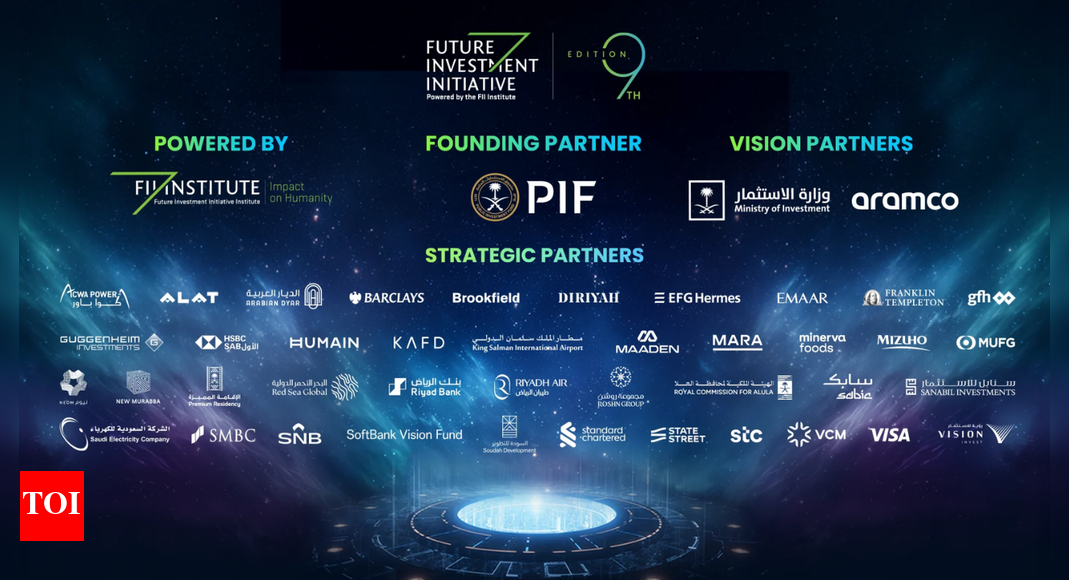
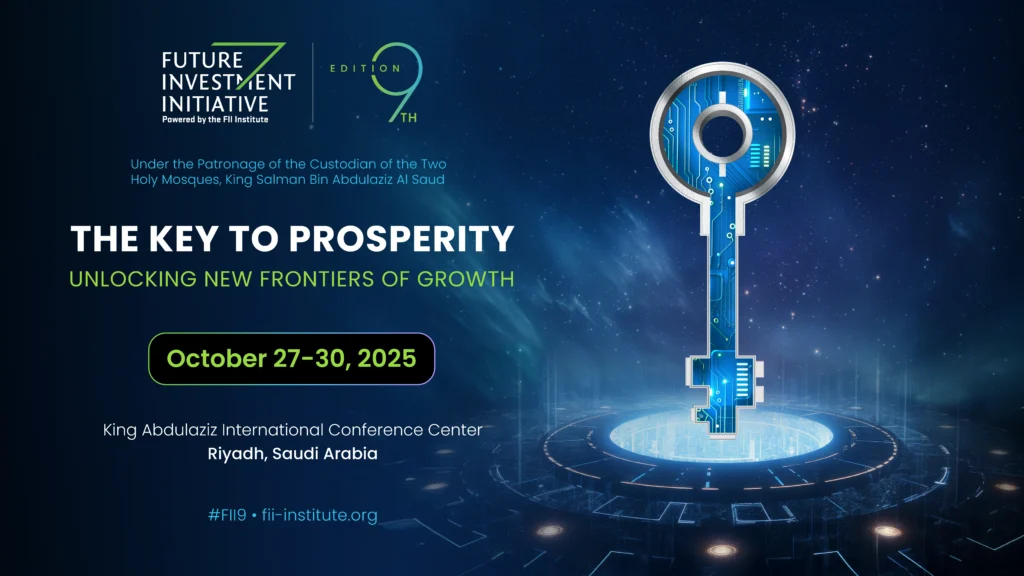
Saudi Arabia gears up for FII9, gathering 8,000 global leaders to drive investment and innovation

_Arabia_

Trusted Member
Joined
Dec 9, 2024
Messages
2,315
Reaction score
2,218
Reputation
779.5
Country of Origin
Country of Residence

FII9 a ‘turning point’ as tech and global leaders converge in Riyadh, says event chairman​

FII9 a ‘turning point’ as tech and global leaders converge in Riyadh, says event chairman

This year’s FII summit runs from Oct. 27 to 30. FII

MIGUEL HADCHITY
October 27, 2025

RIYADH: The ninth Future Investment Initiative marks a “turning point” in global innovation focus with technology leaders set to make up over half of speakers at the event in the Saudi capital.

In an interview with CNBC, Richard Attias, chairman of the FII Institute’s executive committee, said this year’s conference represents a major shift as a range of sectors seek to get to grips with the impact of artificial intelligence.


Launched in 2017, the Future Investment Initiative — often referred to as “Davos in the Desert” — has become a key platform for Saudi Arabia to showcase its economic diversification strategy under Vision 2030.

This year’s event, running from Oct. 27 to 30, brings together global policymakers, investors, and corporate leaders to discuss trends shaping the world economy and explore partnerships across emerging industries.

“FII9 is a turning point,” Attias told CNBC, adding: “This year, 52 percent of our speakers are coming from the tech industry. It is showing you the importance, of course, of AI, but not only AI, innovation in general, because all sectors in all industries are impacted by technology now.”

Attias highlighted three defining factors for this year’s edition: the dominance of technology, the presence of more than 20 world leaders and 50 ministers representing 90 countries, and the event’s growing reputation as one of the most inclusive platforms for international collaboration.

“This will be a fantastic platform for public private partnership,” Attias added, emphasizing that such collaboration is “probably one of the solutions of all the major issues that the global economy is facing.”

Attias called FII “probably the most inclusive platform in the world,” noting the presence of delegates from rival nations such as Russia and Ukraine, along with the US, China, and strong participation from the Global South and young entrepreneurs.

“Riyadh is becoming the economic capital of the world, at least for the week,” Attias said, noting that FII has expanded from a three-day conference into a full week of events, with attendees arriving prior to the event and to capitalize on the opportunities within the Kingdom.

The scale of activity, he admitted, is a “good problem to have,” but requires a “navigator” to manage the countless meetings and sectors on display.

He pointed to Saudi Arabia’s Vision 2030, stating it is no longer a future plan but a reality “in motion,” encompassing sectors from sport and entertainment to food security, tourism, energy, and infrastructure.

Attias stressed that FII has moved beyond symbolic memorandums of understanding. “Real deals are happening. Very concrete deals are signed,” he added in the interview.

He linked this spirit of optimism and action to the institute’s resilience, recalling that FII was among the few major conferences held during the COVID-19 pandemic in 2020. This mindset, he said, reflects the FII Institute’s mission of creating an “impact on humanity.”

This year’s event has attracted 9,000 delegates from nearly 100 countries, including participation from all Gulf Cooperation Council sovereign wealth funds. Attias said that by bringing together these funds with private equity firms, banks, financial institutions, and global CEOs, FII has created the “perfect equation” for driving global investment and collaboration.


PIF Governor opens FII9, says over $250bn in deals signed since platform was launched​

PIF Governor opens FII9, says over $250bn in deals signed since platform was launched

Yasir Al-Rumayyan addressing FII9.

NOUR EL-SHAERI
October 28, 2025

RIYADH: More than $250 billion in deals have been signed through the Future Investment Initiative platform since its launch less than a decade ago, according to Yasir Al-Rumayyan, governor of the Public Investment Fund and chairman of the FII Institute.

Opening the ninth edition in Riyadh, he said this year’s gathering seeks to elevate the initiative’s global effectiveness.

Al-Rumayyan described FII as the world’s largest forum convening leaders, decision-makers, and investors to influence the trajectory of the global economy, Al Arabiya reported.

He said attendees from government and the private sector collectively represent significant capital and responsibility, alongside greater opportunities to help shape economic outcomes.

Al-Rumayyan urged participants to act with that responsibility in mind and to capitalize on the opportunities at hand.

Over the past year, he noted, investor and corporate ambitions have shifted amid rapid economic and technological change.

He argued traditional economic models are no longer sufficient and called for governments and businesses to operate as true partners to advance a new model of international cooperation and global prosperity.

PIF serves as a cornerstone of Saudi Arabia’s Vision 2030 economic transformation strategy, driving diversification and sustainable growth beyond the oil sector.

As one of the world’s largest sovereign wealth funds, PIF manages assets exceeding $1.15 trillion, up from about $925 billion a year earlier, according to official data.

The fund’s investments span multiple sectors and geographies, with a growing focus on technology, infrastructure, and green energy.

PIF’s mandate aligns with the Kingdom’s broader ambition to position Saudi Arabia as a leading global investment destination, supported by large-scale projects and international partnerships designed to accelerate non-oil gross domestic product growth.

Al-Rumayyan said FII has become the venue where global leaders and investors discuss shared opportunities and challenges.

He pointed to a widening gap between individuals’ optimism about their personal futures and their pessimism about the world’s outlook, adding that technology can help bridge this divide if deployed inclusively.

He cautioned that artificial intelligence could widen educational disparities unless governed fairly and responsibly.

He identified inequality as a major impediment to human progress and cited expectations that around 10 percent of the global population could be living in extreme poverty by 2025.

Nonetheless, he expressed confidence that the leaders gathered at FII can convert today’s challenges into opportunities that benefit society.

Addressing Saudi Vision 2030, Al-Rumayyan said the program has set a new global benchmark for economic transformation.

He noted foreign direct investment in the Kingdom has grown 24 percent to $31.7 billion, and said Saudi Arabia has emerged as a major global destination, supported by its megaprojects and preparations to host Expo 2030 and the 2034 FIFA World Cup.

He urged that true wealth is measured by the prosperity of people rather than numbers, and encouraged participants to use the three-day forum to forge cross-border partnerships that unlock transformative opportunities for the benefit of humanity.

To view this content we will need your consent to set third party cookies.
For more detailed information, see our cookies page.


Richard Attias, acting CEO of the FII Institute, highlighted the growing scale and inclusivity of this year’s edition, which brought together more than 9,000 participants, including delegates, members, and media representatives from around the world.

He emphasized that the 2025 program builds on the institute’s mission to foster collaboration across sectors, with discussions centered on artificial intelligence, health, and human development under the theme “The Key to Prosperity.”

Attias said: “Our dream at the inception of FII Institute was simple: to bring together world decision makers not to compete but to collaborate, not just to talk about the future, but to shape the future.”


Livestream:

To view this content we will need your consent to set third party cookies.
For more detailed information, see our cookies page.


How Saudi Arabia is diversifying away from oil — and betting big on AI

PUBLISHED MON, OCT 27 2025 10:53 PM EDTUPDATED 4 HOURS AGO
thumbnail

Lim Hui Jie@IN/HUI-JIE-LIM-A7371176/

KEY POINTS

  • While oil is still the primary driver of Saudi Arabia’s economy, the kingdom is now diversifying its growth drivers into areas such as artificial intelligence, tourism and sports.
  • Saudi ministers told CNBC that the kingdom is increasingly being decoupled from oil-derived growth.

President and CEO of Saudi's Aramco, Amin H. Nasser, speaks during the Future Investment Initiative (FII) in Riyadh, Saudi Arabia October 29, 2024. REUTERS/Hamad I Mohammed

President and CEO of Saudi’s Aramco, Amin H. Nasser, speaks during the Future Investment Initiative (FII) in Riyadh, Saudi Arabia October 29, 2024.
Hamad I Mohammed | Reuters

Think of Saudi Arabia and the first thing that comes to mind might be its massive, oil-derived wealth.

While oil continues to drive Saudi Arabia’s economy, the kingdom is now expanding into areas such as artificial intelligence, tourism and sports to diversify its growth avenues.

According to Saudi Arabia’s Minister for Investment Khalid Al Falih, more than half — 50.6% — of the Saudi economy is now “completely decoupled” from oil.

“This percentage is growing,” Al Falih told CNBC’s Dan Murphy, adding that government revenue used to be almost completely derived from oil money, but now, 40% of its revenue comes from sectors and sources that “have nothing to do with oil.”

“We’re seeing great results, but we’re not satisfied. We want to do more. We want to accelerate the kingdom’s diversification and growth story,” he said.

Saudi Arabia is doubling down on fast-growing sectors such as artificial intelligence, naming it one of its new growth areas, with Al Falih saying the kingdom will be a “key investor” in developing AI applications and large language models. Saudi Arabia would also build data centers “at a scale and at a competitive cost not achieved anywhere else.”

“AI has emerged [in] the last three, four years, and it’s definitely going to define how the future economy of every nation. Those who invest will lead, and those who lag behind, unfortunately, will lose,” he pointed out.

On Monday, AI chip company Groq’s CEO, Jonathan Ross, told CNBC that for AI infrastructure thanks to its energy surplus. The country could see more than $135 billion in gains by 2030 thanks to AI, according to PwC.

Saudi Arabia’s quarterly budget performance report revealed that total government revenue for the first half of 2025 came in at 565.21 billion Saudi riyals ($150.73 billion), with oil making up 53.4% of the country’s overall revenue, down from 67.97% in the same period in 2019.

In 2024, the country reported a 1.3% rise in full-year GDP, mainly driven by a 4.3% increase in non-oil segments. Oil activity, on the other hand, fell 4.5% year on year.

The country’s sovereign wealth fund — the Public Investment Fund — has acquired stakes in tech giants, video game publishers and football clubs as it uses oil revenues to diversify into other sectors.

PIF has acquired stakes in video-game heavyweight Electronic Arts,establishing the SoftBank Vision Fund with Masayoshi Son’s SoftBank Group Corp in 2017, and a takeover of English Premier League club Newcastle United in 2021.

 
Last edited:

Saudi Arabia, Rich With Oil, Wants to Be Known as the A.I. Exporter

The kingdom is pouring money into data centers and working with U.S. and Chinese tech giants, landing its A.I. ambitions in the middle of a geopolitical tussle for tech power.

1761647408276.png
Credit...Photo Illustration by Mark Harris; source photographs by Spencer Lowell for The New York Times, Tamir Kalifa for The New York Times, Katarina Premfors for The New York Times, Doug Mills/The New York Times, Hamad I Mohammed/Reuters, iStock

By Adam Satariano and Paul Mozur

Adam Satariano reported from Riyadh, Saudi Arabia, and Paul Mozur from Taipei, Taiwan.
  • Oct. 27, 2025
In northwest Saudi Arabia near the Red Sea, a planned $5 billion data center would provide enough computing muscle for coders as far away as Europe to build artificial intelligence. On the country’s opposite coast, another planned multibillion-dollar complex could be used by A.I. developers in Asia and Africa.

For generations, Saudi Arabia exported oil. Now it wants to export one of the digital era’s most coveted resources: computing power.

Crown Prince Mohammed bin Salman is seizing a chance to turn Saudi Arabia’s oil wealth into tech influence. Few nations can match the kingdom’s cheap energy, deep pockets and open land — the ingredients that tech firms need to operate the vast, power-hungry data centers that run modern A.I.

Already, Saudi Arabia has been negotiating with American tech giants about using its future data centers and deepening their ties. Executives from OpenAI, Google, Qualcomm, Intel and Oracle are attending the country’s annual Future Investment Initiative conference that begins Monday, nicknamed Davos in the Desert. Next month, Prince Mohammed is scheduled to visit the United States.

One potential deal in the works would provide computing power to Elon Musk’s xAI, said Saeed Al-Dobas, a senior executive at Humain, a new state-backed company coordinating many A.I. projects.

“Amazon was here yesterday. Microsoft we had this morning,” he said in an interview this month, adding that what was being negotiated with Mr. Musk was a “way, way bigger plan.”

Prince Mohammed created Humain in May and wants it to handle about 6 percent of the world’s A.I. workload in the coming years. That could take Saudi Arabia, which handles less than 1 percent now, from bit player to trailing only the United States and China in providing computing power, according to Synergy Research Group, which studies the data center industry.

The kingdom is building three major data center complexes aimed at foreign companies, which could be at least 30 percent cheaper for A.I. work than the United States, Saudi executives said. Construction permits are granted in weeks, and undersea cables and fiber-optic networks put roughly four billion people on three continents within reach of the hubs.

To overcome security concerns in the authoritarian state, Saudi Arabia is also considering “data embassy” zones, where foreign firms could operate under their own national laws rather than Saudi law.

Amazon said it was working with Humain to “accelerate Saudi Arabia’s vision to become a global A.I. leader.” Microsoft declined to comment, and xAI did not respond to requests for comment.


Many are skeptical that Saudi Arabia can deliver. The kingdom has a shallow pool of A.I. expertise. Some warn of a global glut in computing capacity as governments and companies race to build data centers faster than they can profit from them.

“You can never say never, but I can’t imagine any circumstances that would enable Saudi to achieve 6 percent of the world’s A.I. compute capacity,” said John Dinsdale, a senior analyst for Synergy.

As an oil exporter, the kingdom has benefited from collaborating with energy-rich countries through OPEC Plus, the oil-producers cartel. In A.I., no such cooperation exists, and Saudi Arabia trails in a regional race against the United Arab Emirates, which announced a multibillion dollar project with OpenAI in Abu Dhabi this year.

The kingdom’s plans also test a U.S. foreign policy that uses access to advanced A.I. chips to steer nations away from China. During President Trump’s visit to Riyadh in May, American firms like Nvidia were given the go-ahead to sell A.I. chips to Saudi Arabia. But Washington has yet to issue final clearance amid concerns over Riyadh’s ties to Beijing.

Image
SAUDI-TECH-alSaud-pjtf-articleLarge.jpg

President Trump with Crown Prince Mohammed bin Salman in Riyadh in May.Credit...Doug Mills/The New York Times

Prince Mohammed has been careful not to pick sides in the U.S.-Chinese tussle. The kingdom has deep ties to Mr. Trump — most recently becoming partners with Jared Kushner, his son-in-law, on a $55 billion deal for the video game company Electronic Arts — while welcoming Chinese investment. DeepSeek, the Chinese A.I. company, uses data centers owned by Aramco, the Saudi state oil giant.

At stake is more than just Saudi Arabia’s ability to transform its economy from that of a petrol state. Prince Mohammed wants to use A.I. to wield the same influence that his kingdom has enjoyed from oil.

“It’s easy to say this is just another example of the Saudis’ throwing money at the latest shiny thing, but that could also underestimate the level of ambition,” said Vivek Chilukuri, a senior fellow at the Center for a New American Security. “They won’t get all their goals, but they may get more than many of their critics think.”

The Crown Prince Is Calling​

In August 2024, Tareq Amin, an Aramco executive, got a call at 2 a.m. while on a birthday trip in Dubai. “You need to fly back to Riyadh,” he was told.

The caller was an aide for Prince Mohammed, who wanted to meet immediately with business and government leaders to discuss Saudi Arabia’s A.I. strategy, Mr. Amin said. He boarded a flight a few hours later and drove straight to the royal court in Riyadh.

It was not the first time the crown prince had sought an A.I. strategy. In 2019, he established a government agency, the Saudi Data & A.I. Authority, to develop tools like an Arabic chatbot. In 2023, Aramco formed a digital unit to focus on A.I. and other technologies.

fter the 2024 meeting, Prince Mohammed started Humain to be the A.I. equivalent of Aramco. Backed by Saudi Arabia’s roughly $1 trillion sovereign wealth fund, Humain combined A.I. initiatives already underway with expansions into new areas. In May, the company said it would build data centers, invest in start-ups and develop A.I. services. Prince Mohammed made himself chairman, and Mr. Amin was appointed chief executive.
Image
SAUDI-TECH-Tareq-Amin-vltz-articleLarge.jpg

Tareq Amin, the chief executive of Humain, with Jensen Huang, the chief executive of Nvidia, in Riyadh in May.Credit...Hamad I Mohammed/Reuters

“I knew that we were behind in every facet,” Mr. Amin said. “The goal is to create a national entity that is focused on the A.I. total value chain.”

Since then, Humain has announced deals to buy semiconductors from Nvidia, AMD and Qualcomm. It struck a $5 billion deal with Amazon to build A.I. infrastructure. It also released a self-described “helpful and harmless” Arabic chatbot that avoids delicate political and cultural issues, as well as an A.I. laptop and a tool that takes notes during meetings.

Qualcomm said it saw Saudi Arabia as “a digital bridge between continents.” Nvidia said the agreements supported U.S. interests, while AMD said partnering with Humain drove “U.S. leadership in the global A.I. race.”

Human rights concerns, once a deterrent for some companies, have largely faded. Saudi Arabia is betting that tech firms will not be able to resist its cheap electricity, which would make A.I. less expensive to build and deploy.

“If you lower the cost by 20 to 40 percent and offer this to a global market, people will come,” Mr. Amin said.

The kingdom is expanding its electrical grid, and Humain said its sites near Riyadh and Dammam, in the Eastern Province, would deliver 6.6 gigawatts of capacity by 2034, which would require the equivalent of more than six nuclear reactors to power. DataVolt, a company owned by a Saudi industrial conglomerate, is building the data center next to the Red Sea that will be phased in starting in 2028.

1761647504099.png

SAUDI-TECH-Oxa-03-mobileMasterAt3x.jpg

A rendering of the planned DataVolt data center complex on the Saudi coast.Credit...via NEOM

“Right now there are two epicenters — the United States of America and China,” said Rajit Nanda, DataVolt’s chief executive. “There’s room for someone to be the third epicenter and the fourth epicenter.”

The U.S.-China Dance​

Saudi Arabia’s plans could be derailed by one major hurdle: U.S.-made A.I. semiconductors, which power data centers but are scarce and difficult to obtain.

To get the components, Saudi Arabia needs Mr. Trump’s support. This year, as Saudi officials prepared for Mr. Trump’s trip to the Persian Gulf, they participated in talks in Washington to broker purchases of A.I. chips.

In the meetings, U.S. officials worried that Saudi Arabia was not taking their concerns about security threats from China seriously enough, two people with knowledge of the negotiations said.

At one point, Saudi officials questioned why they should commit to U.S. export control rules that would limit how the chips could be used. They also proposed housing Chinese chips in areas of data center complexes different from those of U.S. chipmakers like Nvidia, three people with knowledge of the talks said.

When Mr. Trump visited Riyadh in May, Humain was given a preliminary go-ahead to buy 18,000 A.I. chips from Nvidia, with more to follow. DataVolt would receive a different allotment. Yet five months later, the final sales have not been approved.

Saudi Arabia is in limbo along with other gulf countries. The Emirates appeared on track for its allotment of A.I. chips after recently announcing plans to move forward with a data center with OpenAI. Last year, the Emirati company G42, which is involved in the project, agreed to pull technology from the Chinese tech company Huawei in exchange for A.I. chips.

The White House’s Office of Science and Technology Policy and the Commerce Department did not respond to requests for comment.

Humain and DataVolt said they would not allow Chinese companies to use their data centers. But ties between China and Saudi Arabia have deepened since at least 2019, when Chinese firms helped upgrade the kingdom’s telecommunications network. In February, DeepSeek agreed to use Aramco data centers. An investment firm partly owned by Aramco has invested in a prominent Chinese A.I. company, ZhipuAI.

Chinese researchers with ties to Chinese military-linked universities have access to a powerful A.I. computer at Saudi Arabia’s King Abdullah University of Science and Technology.

Some U.S. officials argue it is best to have American technology compete against Chinese technology without security constraints. If so, Saudi Arabia could be one of the first countries where major American and Chinese A.I. infrastructure exist, and compete, side by side.

On Riyadh’s outskirts this month, construction crews flattened a patch of land that would be a data center for DataVolt. Trenches were being prepared for networking cables and electrical connections. On the other side of a security fence, Amazon was completing another facility.

“Everyone is investing,” said Hani Rabi, a manager for the Saudi construction firm Comatec. “It’s booming.”

Vivian Nereim contributed reporting from Riyadh.


Have in mind that New York Times is heavily anti-KSA for reasons well-known.
 
AI is a bubble, even the tech oligarchs that lead all the big tech companies, all say it is a bubble... that is why they are paying each other with shares for services/products/ip, and not real money!
 
Last edited:
AI is a bubble, even the tech oligarchs that lead all the big tech companies, all say it is a bubble... that is why they are paying each other with shares for services/products/ip, and not real money!
I don't see anything remotely pointing to that being the case. AI is here to stay and is only going to accelerate and increase in importance in every major field. You cannot stop technology. Same thing with every other underlined technology and related ones.
 
Have in mind that New York Times is heavily anti-KSA for reasons well-known

Thank you... the extent to which saudi is doing considered independent investments versus following where the dollars are is maybe a better distinction to make

The New York times is likely to approve because it's propping the dollar further

Many would love to see Saudi develop its own indigenous industries, the data centres coupled with renewable solar it's clearly a good booming area

Of course Asia is rising and I am not sure balance between West and East on Saudi investment
 
I don't see anything remotely pointing to that being the case. AI is here to stay and is only going to accelerate and increase in importance in every major field. You cannot stop technology.

It is here, to stay, but betting "big" on "AI" as a diversification tact is crazy, bet small on it and bet on other things !!!

The only real winners from AI, will be the tech oligarchs in the USA. Everyone else will always be playing catch.
 
Thank you... the extent to which saudi is doing considered independent investments versus following where the dollars are is maybe a better distinction to make

The New York times is likely to approve because it's propping the dollar further

Many would love to see Saudi develop its own indigenous industries, the data centres coupled with renewable solar it's clearly a good booming area

Of course Asia is rising and I am not sure balance between West and East on Saudi investment
If you read the New York Times article you will read that both major US and Chinese firms are already investing heavily in KSA while we speak. Simply due to KSA being able to offer the whole package unlike most rivals out there. Immensely cheap energy, all the land you need and political will. As long as private firms from both US and China will enjoy economic benefits by doing that, they will continue.

The Trump administration is very close to KSA leadership. First country he visited back in 2017 was KSA. The first leader he called after he was reelected in January this year was MbS. China-KSA ties (regimes) is also excellent and strategic of nature. I don't think they can succeed with what they are doing with UAE (forcing their hands) as the New York Times articles also talks about.

Saudi Arabia launches Mostaqbali program to train 50,000 Saudis in AI, digital skills​


National program to upskill 100,000 Saudis in AI ‘crucial,’ says official

Luke Kawa20H

Qualcomm surges after revealing new AI chips with Saudi Arabia’s HUMAIN as first big buyer​

QualcommQCOM$186.50 (11.11%) took over leadership of the semiconductor rally this morning after announcing new AI chips for data centers, sending shares soaring.

The AI200 and AI250 are expected to be available in 2026 and 2027, respectively. These new solutions are “redefining what’s possible for rack-scale AI inference,” per Senior Vice President Durga Malladi.

In a separate press release, Qualcomm said Saudi Arabia’s HUMAIN is poised to deploy 200 megawatts in these upcoming models starting next year for inference, formalizing an announcement made earlier this year. HUMAIN previously also revealed a deal in May with Nvidia to build “AI factories of the future.”

The AI boom remains more constrained by demand than supply, and this launch represents Qualcomm’s foray to take more market share.

NvidiaNVDA $191.33 (2.78%), the leader in AI GPUs, pared some of its gains on the announcement, while competitor Advanced Micro DevicesAMD$257.10 (2.70%) turned negative after the news hit the wires.


Saudi Arabia eyes top spot in global AI race, aims to be a leading ‘exporter of data’

By Shubhangi Chowdhury
October 27, 2025
AI in the media

Saudi Arabia is fast emerging as the next big hub for artificial intelligence infrastructure, fueled by its massive energy reserves, Groq CEO Jonathan Ross said, positioning the kingdom as a key player in the global AI race.

The kingdom’s abundant energy resources have made it an attractive destination for major tech companies, many of which are now unveiling large-scale infrastructure projects in the region. These initiatives align with Saudi Arabia’s Vision 2030, an ambitious roadmap aimed at transforming its oil-dependent economy into a diversified, innovation-driven powerhouse.

In an interview with CNBC’s Dan Murphy at the Future Investment Initiative (FII) conference in Riyadh, Ross said Saudi Arabia’s energy advantage could enable it to evolve into a global exporter of data, positioning the Kingdom as a central player in the next wave of AI infrastructure development.

“One of the things that’s hard to export is energy. You have to move it, it’s physical, it costs money. Electricity, transporting it over transmission lines is very expensive,” he said.

Speaking about the data, “is very cheap to move,” Ross, who earlier worked on AI chips at Google’s parent company Alphabet, added. “So since there’s plenty of excess energy in the Kingdom, the idea is move the data here, put the compute here, do the computation for AI here, and send the results.”

“What you don’t want to do is build a data center right next to people, where it’s expensive for the land, or where the energy is already being used. You want to build it where there isn’t, where there aren’t too many people, where the energy is underutilized. And that’s the Middle East, so this is the ideal place to build out.”

PwC estimates that artificial intelligence could add as much as $320 billion to the Middle East’s economy and Saudi Arabia is determined to seize that opportunity, making AI a core pillar of its long-term growth and modernization plans.

The CEO of Humain, a state-backed AI and data center company collaborating with Groq earlier told CNBC that the firm aims to become the “third-largest AI provider in the world, behind the United States and China.”

Still, Saudi Arabia’s AI ambitions come amid intense regional competition, particularly from the United Arab Emirates, which has so far taken the lead in advancing AI adoption. PwC projects that by 2030, AI could add around $96 billion to the UAE’s economy (13.6% of its GDP) and about $135 billion to Saudi Arabia’s (12.4% of GDP). If these forecasts hold, the UAE could edge out its larger neighbor, leaving Saudi Arabia in fourth place on the global AI stage.

Yet, Saudi Arabia’s climate and talent landscape pose real challenges to its AI ambitions. Data centers require heavy cooling and significant water resources, a difficult feat in one of the world’s hottest and driest regions. On top of that, the Kingdom continues to grapple with a shortage of tech and AI specialists, though government initiatives aimed at upskilling the local workforce are steadily gaining momentum.

Despite those hurdles, Saudi Arabia’s momentum in AI shows no signs of slowing. Groq has partnered with Aramco Digital, the tech division of Saudi Aramco, to develop what it calls the “world’s largest inferencing data center.”

Ross noted that chips, manufactured in upstate New York are purpose-built for AI inference, the process of deploying trained models into real-world applications.

Earlier this year, the California-based firm received $1.5 billion in funding from Saudi Arabia to scale its operations and deepen its presence in the region. Groq is also contributing to the Saudi Data and AI Authority’s efforts to build its own large language model, further cementing the kingdom’s growing footprint in the global AI ecosystem.

“It’s optimized for interfacing with the kingdom, so if you need to be able to ask about something here, it has all the data that you need to get the appropriate answers. Whereas other LLMs haven’t been tuned, they don’t have access to a database that’s as rich with information about the local region,” Ross said.

As nations increasingly harness AI, the push for localized data has become crucial. Many countries are realizing that models trained primarily on English-language datasets from industrialized economies often fail to reflect their own cultural, linguistic, and social contexts underscoring the growing importance of developing region-specific AI systems.


It is here, to stay, but betting "big" on "AI" as a diversification tact is crazy, bet small on it and bet on other things !!!

The only real winners from AI, will be the tech oligarchs in the USA. Everyone else will always be playing catch.
PIF alone (main sovereign wealth fund in KSA) has 1 trillion USD in assets. KSA is investing just a tiny fraction on that on AI. It is not like they are going all-in on AI and nothing else, lol. Only if you don't have any AI firms of your own, KSA is not like that. KSA is building an indigenous AI infrastructure WHILE attracting the best Western and Chinese firms at the same time and hosting some of the world's largest data centers due to the competitive advantages that KSA has such as much cheaper electricity and energy, large landmass and a government willing to invest and make it easy for companies to invest in. Pretty much the right strategy as of now.

But of course time will tell but personally I see it as intelligent steps ahead.

EDIT: The articles talk about possible water shortages as an issue. Not sure how relevant that is in KSA which has almost 3000 km long coastline and is the largest user of desalinated sea water in the world which only gets cheaper by each year and more advanced and bigger. If you build data centers next to the coastline this problem becomes irrelevant. Local tech talent is not a problem either less so given how STEM/tech/AI focused the new education curriculum is. Children from age 5-6 are already starting to learn the basics. Given the population size and future one, this should not be a problem at all. Also you can always import/attract key specialist like the US and others have been doing since forever if you are missing something. Not like there is a shortage of talented people from abroad in KSA or willing to move. If you have the local infrastructure in place, local AI firms combined with outside investments and support from both US/West and China (as is happening) rest should come naturally.
 
Last edited:
It would be great to see Saudi develop deep expertise in the growth areas. With all those dollars, you can throw money at cultivation to begin with.
I don't see anything remotely pointing to that being the case. AI is here to stay and is only going to accelerate and increase in importance in every major field. You cannot stop technology. Same thing with every other underlined technology and related ones.


You are correct that AI is here to stay, but that is all together different to valuations of the overall ecosystem.

The proportion of market growth attributed to AI is huge, it is starting to look like having the characteristics of some bubble, that is to say intrinsic value versus market value
 
It would be great to see Saudi develop deep expertise in the growth areas. With all those dollars, you can throw money at cultivation to begin with.


You are correct that AI is here to stay, but that is all together different to valuations of the overall ecosystem.

The proportion of market growth attributed to AI is huge, it is starting to look like having the characteristics of some bubble, that is to say intrinsic value versus market value
An ongoing process that is already bearing fruit. AI is applied more actively within KSA than in most places of the world, including the West, in particular Europe which is falling behind. From personal experience and available data.

A recent good example of its practical use in the healthcare system.

To view this content we will need your consent to set third party cookies.
For more detailed information, see our cookies page.


To view this content we will need your consent to set third party cookies.
For more detailed information, see our cookies page.
v

Whether there will be a bubble or not, none of us knows, but what is certain is, as you also admitted, that AI/technology is here to stay and only going to increase in importance in the future. KSA betting on it in this clever way is not something that I can criticize. At least not now.

I am personally very optimistic about this field and about the AI/tech infrastructure within KSA with several talented local startups emerging on a weekly basis and with the government and private sector heavily supporting them and the overall field.

I have a younger brother who is part of one such tech startup and they just received around 6 million USD in support/investment from private venture capitalists and from the state. Already signed deals with private firms to sell their product and are now looking to scale up hence the support from the outside. 100's of such tech startups emerging all over KSA.

But obviously how the future will unfold we cannot know but if you are not willing to invest in key fields and take some risks you are never going to achieve anything in any field.
 
With all due respect, building lots of data centres does not make one a leader in AI. These are heavily commoditized and at the lowest level of value addition when it comes to the AI ecosystem.
 
With all due respect, building lots of data centres does not make one a leader in AI. These are heavily commoditized and at the lowest level of value addition when it comes to the AI ecosystem.
With all due respect, how did you reach such a conclusion by reading the articles posted? Seems to me that you have not read them at all if you think this is just about KSA building some data centers, lol. KSA is building an entire local AI infrastructure, a field that is already booming within KSA and globally.

KSA potentially hosting some of the largest data centers in the world, from main AI firms on the planet, both Western and Chinese (deals signed already and some already established - if you read the articles) is no small feat by itself either.

"On Monday, AI chip company Groq’s CEO, Jonathan Ross, told CNBC that for AI infrastructure thanks to its energy surplus. The country could see more than $135 billion in gains by 2030 thanks to AI, according to PwC."


Even for the likes of KSA this is huge additional income within just 5 years.
 
With all due respect, how did you reach such a conclusion by reading the articles posted? Seems to me that you have not read them at all if you think this is just about KSA building some data centers, lol. KSA is building an entire local AI infrastructure, a field that is already booming within KSA and globally.

KSA potentially hosting some of the largest data centers in the world, from main AI firms on the planet, both Western and Chinese (deals signed already and some already established - if you read the articles) is no small feat by itself either.

"On Monday, AI chip company Groq’s CEO, Jonathan Ross, told CNBC that for AI infrastructure thanks to its energy surplus. The country could see more than $135 billion in gains by 2030 thanks to AI, according to PwC."


Even for the likes of KSA this is huge additional income within just 5 years.
What is the IP coming out of or owned by the Saudi government or companies ? That is where the real value is.
 
What is the IP coming out of or owned by the Saudi government or companies ? That is where the real value is.
The IP is strictly tied to local Saudi Arabian governmental and private firms. Deals signed with major foreign AI firms (Western and Chinese) is shared IP and for hosting major data centers, KSA is gaining an economic and geopolitical advantage.

I don't think that the likes of PwC (largest accounting firm in the world) are making up false data when they claim that KSA is set to gain 135 billion USD in gains thanks to AI by 2030.

Most importantly an entire Saudi Arabian generation is being taught AI/tech/STEM aggressively from as young as 5-6 nowadays. This will only accelerate in the future.

So by all accounts KSA is winning on this investment unless something completely unexpected occurs and its turns out that AI/new tech is just one big hoax which is not going to be the case.

Thanks to AI the likes of KSA are already performing groundbreaking achievements in the healthcare system as I posted already in this thread.

KSA is also investing heavily in supercomputers, another very promising field.

“AI has emerged [in] the last three, four years, and it’s definitely going to define how the future economy of every nation. Those who invest will lead, and those who lag behind, unfortunately, will lose,” he pointed out."


I firmly believe in this statement. Can be applied to any sector out there.

KSA is taking a very proactive and aggressive stand in order to consolidate our position as one of the main centers of AI. I believe that this strategy is a clever one as KSA has many advantages compared to our rivals which we are taking advantage of.
 
Most importantly an entire Saudi Arabian generation is being taught AI/tech/STEM aggressively from as young as 5-6 nowadays. This will only accelerate in the future.
This is a great initiative, Ai Is fast moving, sensitising educated to this sounds smart. stem standards are going to get tougher because ai will do so much
 

Users who are viewing this thread

Latest Posts

Back
Top