SBP - Banking Sector / Federal Board of Revenue

Moody’s upgraded the BCA and the Adjusted BCA of MCB to caa1 from caa2 and the long-term deposit ratings to Caa1 from Caa2.

MCB’s ratings capture the improving operating environment, the bank’s strong profitability with a return on assets of 1.7% during the first quarter of 2025, stable deposit base and good liquidity buffers; but also its high asset risks, modest adjusted capitalisation metrics with tangible common equity representing 5.7% of the adjusted risk weighted assets as of March 2025, and its high exposure to government securities that links its credit profile to that of the government.

The upgrade of the long-term deposit ratings to Caa1 reflects the BCA upgrade and our assessment of a high probability of government support, which results in no uplift as the bank’s caa1 BCA is at the same level as Pakistan’s long-term issuer rating of Caa1.
 
Moody’s upgraded the BCA and Adjusted BCA of ABL to caa1 from caa2 and the long-term deposit ratings to Caa1 from Caa2.

ABL’s ratings capture the improving operating environment, the bank’s relatively low stock of problem loans reflected by the 1.6% reported NPLs as of March 2025, well below the system average, stable deposit-based funding and ample liquid buffers; but also its modest adjusted capital buffers, and its high exposure to government securities that links its credit profile to that of the government.
 
The upgrade of the long-term deposit ratings to Caa1 reflects the BCA upgrade and our assessment of a high probability of government support, which results in no uplift as the bank’s caa1 BCA is at the same level as Pakistan’s long-term issuer rating of Caa1.

Pakistani banks’ ratings could be upgraded following a material strengthening of the operating environment and in the government’s credit profile, and provided that the banks maintain their resilient financial performance.

Pakistani banks’ ratings could be downgraded if (1) Pakistan’s sovereign rating of Caa1 is downgraded; and/or (2) there is a deterioration in the banks’ financial performance, specifically asset quality, profitability and capital adequacy.
 

Digitalisation: all govt payments will go via Raast by FY26, says SBP


Over Rs11 trillion of cash available in Pakistan economy, says central bank official

Salman Siddiqui
October 2, 2025

KARACHI: In a major step towards making big payments through digital channels, the State Bank of Pakistan (SBP) said on Thursday it had chalked out plans to move all the government payments through Raast – the country’s instant payment system – by the end of ongoing fiscal year 2025-26.

“We have plans that with the close of this fiscal year we will be having all government payments go to Raast. We are working very aggressively,” SBP deputy governor Saleem Ullah said this while speaking at the launch of a study titled ‘Merchant Payments on RAAST: Responsible Pricing for Impact and Inclusion.’

He further said the government had announced subsidy for merchants in Raast to share their cost and encourage them to join the digital payment platform.

The subsidy programme for person-to-merchant/P2M QR Code based transactions is not limited only to the ongoing fiscal year (FY26), but this is a three-year programme. The government has already allocated Rs3.5 billion subsidy for September 2025 to June 2026 about a week ago.

“The subsidy would ensure merchants face zero or minimal cost in adopting digital platforms. It shall be paid at the rate of 0.5% of the value of each Raast P2M QR Code based transaction or Rs100, whichever is lower,” the official said.

“There is more than Rs11.2 trillion to Rs11.3 trillion available of cash in the economy. If Rs2.5 trillion to Rs3 trillion of this is brought back into the banking system, it will benefit everybody – banks, fintechs and all stakeholders – and help overcome the huge undocumented and the informal economy, the deputy governor said.

“The ultimate goal is to win the war against cash and that can only be achieved through partnerships and collaborations among stakeholders. This will help accelerate digitalisation of the economy and expedite inclusive growth.”

The United Nations (UN)-based Better Than Cash Alliance conducted the study in consultation with SBP, financial service provider and industry stakeholders. The study recommends a fee to be paid to merchants on P2M transactions on Raast.

‘Pakistan may go cashless in 3-year’

Better Than Cash Alliance, managing director, L. Nshuti Mbabazi said Pakistan might go cashless within the next three years.

“Pakistan has everything required to go cashless in less than three years,” Mbabazi said while addressing the occasion.

“You have everything. The banks present here show that appetite. Infrastructure, the connectivity to get it going, I am sure when the business case is making sense infrastructure investors will invest.”

She urged the regulators and the government to make effective policies that build an ecosystem that leaves no one behind and drives financial inclusions and they mobilise trillions of cash in the economy.

Fee on Raast recommended

Raza Matin of Pakistan Leads, Better Than Cash Alliance, said the study had recommended a 0.35% MDR (Merchant Discount Rate) floor across most sector to protect the business models of acquirers that couldn’t monetise beyond transactional income.

Other recommendations were including to set specific rates for price-sensitive segments like fuel, education, and utilities, as well as higher-risk sectors such as e commerce; eliminate issuers interchange fees entirely to reduce merchant burden; introduce a zero fee for microtransactions (below Rs300) and assure merchants that P2M data would not be used for tax enforcement in the early phase.

While talking to journalists, Matin said they had recommended pricing, as there was a cost in doing on online transactions. “However, there is no price on person-to-person (P2P) transactions on Raast, nor is there a recommendation to price P2P transactions.”
 

Former SBP governor Ishrat Husain calls Islamic banking ‘economic necessity’


Peerzada Salman
October 4, 2025

1759579487156.png

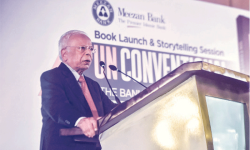
Former SBP governor Dr Ishrat Husain speaks at the event. —Fahim Siddiqi / White Star


KARACHI: A book titled Unconventional — The Bank No One Saw Coming by Sibtain Naqvi on the success story of Meezan Bank was launched at a local hotel here on Friday evening.

Delivering the keynote address, former State Bank of Pakistan (SBP) governor Dr Ishrat Husain commended the author for spending five years on putting together material for the book.

He said it’s an honour and privilege for him to reflect on a journey that not only transformed an institution but has reshaped the contours of Pakistan’s financial landscape.

Sharing the lessons that he’s learned from the bank, he said he’d divided them into three parts: (a) as a model for the banking industry; (b) as a pioneer in Islamic banking; (c) and leadership and human resource development.

Dr Husain, commenting on the first part, said starting from ground zero in 2002, the bank has risen from one of Pakistan’s top financial institutions in a remarkably short span. It has outpaced its competitors, a clear reflection of its exceptional performance.

Sibtain Naqvi’s Unconventional — The Bank No One Saw Coming launched

He said in the world of corporate leadership, we often see two archetypes: “We encounter those who are brilliant strategists but falter in execution, and those who are operationally sound but lack a clear sense of direction.

Rarely do we find a leader who embodies both. Irfan Siddiqui is one such rarity… Professionalism, meritocracy and integrity are the cornerstone of trust in building any institution. When nepotism and favouritism creep in, they erode this very ethos that sustains excellence.”

With respect to the second lesson, Dr Husain said before he joined the SBP, he was intellectually convinced that Islamic banking was not just a religious imperative, it was an economic necessity.

“Conventional banking places the entire burden on the borrower. Islamic banking, by contrast, introduces sharing, equity and fairness. It is not merely a financial model, it is a moral framework.

Islamic banking has the potential to derive financial inclusion, alleviate poverty, support small farmers and invest in human capital… Unlike capitalism which often leads the marginalised behind or socialism which collapses under its own weight, Islamic finance offers a balanced path.”
 
To view this content we will need your consent to set third party cookies.
For more detailed information, see our cookies page.
 

Pakistan’s RDA inflows up 20%, clock in at $196mn in September 2025


BR Web Desk
October 14, 2025

Inflows through the Roshan Digital Account (RDA) clocked in at $196 million in Septemeber, reflecting an increase of 20% compared to $164 million in August 2025, the State Bank of Pakistan (SBP) said on Tuesday.

Out of the total September inflows, $19 million has so far been repatriated, while funds to the tune of $117 million have been utilised locally.

The central bank shared that the total number of RDA accounts opened reached 862,357 from 851,756 a month ago at the end of August, showing a month-on-month increase of 10,601 accounts.

As per the latest data available on the SBP’s website, the cumulative RDA inflow clocked in at $11.11 billion by the end of the previous month, out of which $1.878 billion has so far been repatriated, while funds to the tune of $7.118 billion have been utilised locally.

Consequently, total net repatriable liability stands at $2.112 billion as of September-end.

Out of the total outstanding liability, an amount of $1,469 million is with Naya Pakistan Certificates, with $490 million in conventional NPCs and $979 million in Islamic instruments.

Similarly, an amount of $495 million is ‘balances in accounts’, the SBP data showed.

Meanwhile, Roshan Equity Investments stood at $95 million, registering a monthly increase of 16%.
 
RDA is a significant source of foreign exchange inflows for Pakistan, which is grappling with liquidity challenges.

The initiative was launched in September 2020 by the SBP for non-resident Pakistanis to open and operate bank accounts in Pakistan digitally, without needing to visit a branch.

These accounts, available in various currencies like PKR, USD, GBP, and EUR, allow for banking, payment, and investment activities in Pakistan through participating commercial banks
 
Per Monthly Economic Update and Outlook October 2025, released by the Finance Division here on Monday.

During July-August fiscal year 2026, net federal revenues surged by 231.4 percent to Rs. 3,269.8 billion, compared to Rs. 986.7 billion in the same period last year. This improvement was driven by a 721.1 percent jump in non-tax revenues and a 14.1 percent rise in FBR tax collections.

The surge in non-tax revenues was mainly led by higher State Bank of Pakistan profits, supplemented by increased receipts from dividends, defence receipts, Windfall Levy against crude oil, the Gas Infrastructure Development Cess, and the petroleum levy. During July-September fiscal year 2026, FBR’s tax collection rose to Rs. 2,884.4 billion, up 12.5 percent.

On the expenditure side, total outlays increased modestly by 7.6 percent to Rs. 1,760.6 billion, reflecting prudent fiscal management. Consequently, the federal fiscal balance recorded a surplus of Rs. 1,509.2 billion, compared to a deficit of Rs. 648.8 billion last year. The primary balance also improved sharply, posting a surplus of Rs. 2,938.9 billion, up from Rs. 49.4 billion in the corresponding period.

The current account recorded a deficit of $594 million, during July-September fiscal year 2026, compared to $502 million last year. However, in September fiscal year 2026, the current account turned to a surplus of $110 million. Goods exports rose 6.5 percent to $7.9 billion, while imports increased 8.3 percent to $15.4 billion, resulting in a trade deficit of $7.5 billion during July-September fiscal year 2026 compared to $6.8 billion last year.
 
Per Monthly Economic Update and Outlook October 2025, released by the Finance Division here on Monday.

During the period 01st July–03rd October, FY2026 money supply (M2) showed negative growth of 2.6 percent as compared to negative growth of 1.9 percent last year. Within M2, Net Foreign Assets (NFA) of the banking system increased by Rs. 173.8 billion as compared to an increase of Rs. 188.6 billion last year.

Whereas Net Domestic Assets (NDA) of the banking system decreased by Rs. 1245.5 billion as compared to a decrease of Rs. 863.9 billion last year. Under the borrowing for budgetary support, government has retired Rs.2039.6 billion against the retirement of Rs. 1282.0 billion last year. Private sector has retired Rs 18.6 billion as compared to retiring of Rs. 297.0 billion last year.

In the capital market, the Pakistan Stock Exchange (PSX) continued its bullish momentum in September 2025, with the KSE-100 Index climbing 16,875 points to close at 165,493. The Market capitalization expanded by Rs.1,608 billion, reaching Rs. 19,264 billion by month-end. As of October 22,2025, the KSE-100 Index stood at 166,553 points, with total market capitalization recorded at Rs. 19,212 billion.
 
During July-September fiscal year 2026, led by inflows from Saudi Arabia (24.2% share) and UAE (20.8%).

Net FDI inflows declined, recording at $568.8 million.

Main sources remained China ($188.6 million) and Hong Kong ($96.0 million). Sector-wise, power ($244.3 million) and financial services ($180.2 million) attracted the most FDI.

Private and public FPI recorded net outflows of $121.5 million and $511.8 million, respectively.

As of October 17, 2025, foreign exchange reserves stood at $19.9 billion, including $14.5 billion with SBP.
 
During the period 01st July–03rd October, FY2026 money supply (M2) showed negative growth of 2.6 percent as compared to negative growth of 1.9 percent last year. Within M2, Net Foreign Assets (NFA) of the banking system increased by Rs. 173.8 billion as compared to an increase of Rs. 188.6 billion last year.

Whereas Net Domestic Assets (NDA) of the banking system decreased by Rs. 1245.5 billion as compared to a decrease of Rs. 863.9 billion last year. Under the borrowing for budgetary support, government has retired Rs.2039.6 billion against the retirement of Rs. 1282.0 billion last year. Private sector has retired Rs 18.6 billion as compared to retiring of Rs. 297.0 billion last year.

In the capital market, the Pakistan Stock Exchange (PSX) continued its bullish momentum in September 2025, with the KSE-100 Index climbing 16,875 points to close at 165,493. The Market capitalization expanded by Rs.1,608 billion, reaching Rs. 19,264 billion by month-end. As of October 22,2025, the KSE-100 Index stood at 166,553 points, with total market capitalization recorded at Rs. 19,212 billion.
 
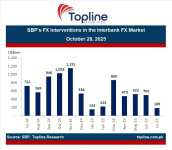
KARACHI: Pakistan’s central bank slowed down the purchase of US dollars to five-month low at $189 million from the inter-bank market in July 2025, summing up the cumulative purchases worth $7.15 billion in 12 months (August 2024–July 2025), brokerage house Topline Securities reported on Tuesday, citing the State Bank of Pakistan’s (SBP) data.

The central bank reports the US dollars’ purchase data with a lag of three month.

1761681210750.png
 

FIA registers case against FBR ex-chairman Shabbar Zaidi​

By Zeeshan Shah
October 31, 2025


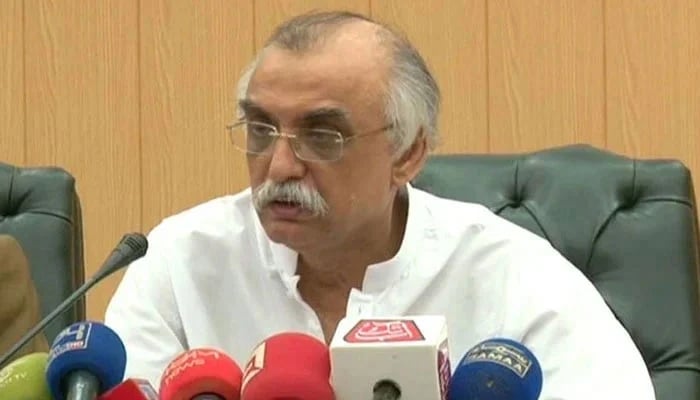
Former Federal Board of Revenue Chairman Shabbar Zaidi speaks at a press conference. — State Media/File


Former Federal Board of Revenue Chairman Shabbar Zaidi speaks at a press conference. — State Media/File

KARACHI: A case has been registered against former Federal Bureau of Revenue (FBR) chairman Shabbar Zaidi. The FIR was registered at the Federal Investigation Agency’s (FIA) Anti-Corruption Circle, Karachi.

Zaidi is accused of misusing his authority as FBR chairman. Unauthorised payments of Rs16 billion were made, according to the text of the FIR. The money was allegedly transferred to Zaidi’s clients as refund.

Advertisement

The funds were transferred to Habib Bank, Engro and DG Khan Cement among other companies, according to the FIR, which states that the FBR and bank officials misused their authority.
 

Users who are viewing this thread

Pakistan Defence Latest

Latest Posts

Back
Top