SBP - Banking Sector / Federal Board of Revenue

SBP surprises with hold on key policy rate at 12pc


Dawn.com
March 10, 2025

The State Bank of Pakistan (SBP) announced on Monday that it has decided to keep the policy rate unchanged at 12 per cent, assessing the current real interest rate to be adequately positive on the forward-looking basis to sustain the ongoing macroeconomic stability.

The central bank’s policy rate, after being slashed by 1,000bps from 22pc since June 2024 in six intervals, now stands at 12pc.

February inflation stood at a near-decade low of 1.5pc, largely due to a high base a year ago. A Reuters survey of 14 analysts suggests that the central bank may further reduce rates, with a median forecast for a cut of 50 bps. Of the 10 analysts expecting a rate cut, three estimated its size at 100 bps, one at 75 bps, and six at 50 bps. The rest saw no change.

According to a notification issued by the State Bank of Pakistan today, the Monetary Policy Committee (MPC) decided to keep the policy rate unchanged at 12pc, noting that inflation in February turned out to be lower than expected, mainly due to a drop in food and energy prices.
 
SBP to announce monetary policy decision on Monday (May 5).

Markets anticipate a 50bps rate cut to 11.5% amid easing inflation.
 
The SBP policy rate, a key tool for managing Pakistan's monetary policy, is currently 11.00% p.a.

The SBP, Pakistan's central bank, set this rate at its May 2025 meeting, surprising market expectations by cutting it by 100 basis points.

This rate is the target for the overnight money market repo rate.
 

SBP maintains 11pc interest rate amid Mideast conflict


Dawn.com
June 16, 2025

The State Bank of Pakistan (SBP) maintained its policy rate on Monday at 11 per cent, after many analysts cited inflation risks from rising global commodity prices amid Iran-Israel tensions.

The central bank’s policy rate, after being slashed by 1,000bps from 22pc since June 2024 in seven intervals, was cut to 11pc last month.

Several brokerages had initially expected a cut but revised their forecasts after the Israeli strikes sparked fears of a broader conflict.

“The Monetary Policy Committee (MPC) decided to keep the policy rate unchanged at 11 per cent,” the SBP said in a statement.

The committee noted that the recent uptick in inflation in May to 3.5pc year-on-year was in line with its expectation, whereas core inflation declined “marginally”.

The headline inflation had hit an all-time low of 0.3pc YoY after declining for several months from around 40pc in May 2023.

The escalating hostilities after Israel’s attacks on Iran on Friday had triggered a sharp spike in oil prices — a worry for Pakistan given the broader impact on imported inflation from a potentially prolonged conflict and tightening of crude supplies.

Eleven of 14 respondents in a snap poll by Reuters expected the SBP to leave the benchmark rate unchanged at 12pc. Two forecast a 100 basis-point (bps) cut and one predicted a 50bps cut.

“There remains an upside risk of a rise in global commodity prices in light of geopolitical tensions, which could mark a return to inflationary pressures,” said Ahmad Mobeen, senior economist at S&P Global Market Intelligence.
 

Pakistan moves to retire PKR 500 billion SBP debt early​

By Staff Reporter | Profit
Jul 7, 2025

Pakistan’s Ministry of Finance has announced the early retirement of PKR 500 billion in debt owed to the State Bank of Pakistan (SBP), originally scheduled to mature in 2029. This proactive move, executed by the Debt Management Office (DMO), is aimed at reducing refinancing risk, extending debt maturities, and bolstering macroeconomic stability.

This latest early payoff builds on a December 2024 milestone when the government bought back PKR 1 trillion in market debt—the first such operation in Pakistan’s history. Combined, these actions amount to PKR 1.5 trillion in early debt retirements in FY25, signalling renewed fiscal confidence.

Officials highlighted several benefits resulting from the move: Pakistan’s debt‑to‑GDP ratio has fallen from 75 percent in FY23 to approximately 69 percent in FY25; the average time to debt maturity has increased from 2.7 to 3.75 years; and refinancing risks have eased. Moreover, the government’s disciplined debt strategy has reportedly saved PKR 830 billion in interest costs in FY25.

Khurram Schehzad, Advisor to the Prime Minister on Economic and Financial Reforms, shared the update on social media platform X (formerly twitter) that the early retirement “reflects the government’s strong commitment to proactive, disciplined, and forward‑looking financial governance.” He noted the milestone as “a decisive, future‑focused economic management aimed at building a resilient, credible, and fiscally sustainable Pakistan.”
 

State Bank keeps monetary policy rate unchanged at 11pc


Dawn.com
July 30, 2025

1753874504537.png

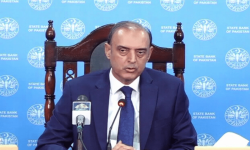
State Bank of Pakistan (SBP) Governor Jameel Ahmed is holding a press conference in Islamabad to announce the monetary policy on July 30, 2025. — DawnNews TV


The State Bank of Pakistan (SBP) kept its policy rate unchanged on Wednesday at 11 per cent.

The central bank’s policy rate, after being slashed by 1,000bps from 22pc since June 2024 in seven intervals, was cut to 11pc in May. The bank had kept the rate unchanged on June 16 as well.

The Pakistan Business Forum (PBF) had claimed that both interest and exchange rates were being kept artificially high without economic justification, and appealed to Prime Minister Shehbaz Sharif to ensure a correction to support growth and stability.

The PBF also criticised the current interest rate of 11pc, calling it unjustifiable given that the Consumer Price Index-based inflation had dropped to 4pc. It urged the State Bank of Pakistan (SBP) to reduce the policy rate to at least 9pc in its upcoming monetary policy announcement scheduled for July 30.
 
Interest rates should have come down to 5 - 6 % atleast, unless they know that are manipulating actual figures, and bringing down interest rate would have a negative effect and the actual inflation rate is far higher then what is being officially quoted, which is the reality on the ground.
 

SBP partners with Japan’s Soramitsu for digital currency rollout: report


BR Web Desk

In a major step towards digitisation, the State Bank of Pakistan (SBP) is working with Soramitsu, a Japanese blockchain technology developer, to pilot a central bank digital currency (CBDC) in the country this year, reported Nikkei Asia on Tuesday.

As per the report, the digital Pakistani rupee pilot will be run on Soramitsu’s CBDC platform with funding from the Global South Future-Oriented Co-Creation Project of Japan’s Ministry of Economy, Trade and Industry.

“Many transactions in rural areas are cash-based, even for wage payments, and the rate of people with bank accounts is low,” Masato Toriya, associate professor at Tokyo University of Foreign Studies and specialist in Pakistan, told Nikkei Asia.

As per the report, the CBDC intends to address the problem of high cash distribution costs.

Soramitsu, which developed Cambodia’s Bakong digital currency, says the Pakistan initiative - covering 250 million people and a $400 billion economy - is its largest to date.

The Tokyo-based company is also developing offline CBDC capabilities to enable smartphone transactions without internet access, positioning the initiative as a potential model for other developing economies.

Last month, SBP Governor Jameel Ahmad informed that the central bank is preparing to launch a pilot for a digital currency and is finalising legislation to regulate virtual assets.

Speaking at the Reuters NEXT Asia summit in Singapore, Ahmad said Pakistan was “building up our capacity on the SBP digital currency” and hoped to roll out a pilot soon.

He added that a new law would “lay down the foundations for the licensing and regulation” of the virtual assets sector and that the SBP was already in touch with some tech partners.

In recent months, Pakistan has ramped up efforts to modernise its financial system with the establishment of the government-backed Pakistan Crypto Council (PCC), set up in March to drive virtual asset adoption.

The PCC is exploring bitcoin mining using surplus energy and has appointed Binance founder Changpeng Zhao as a strategic adviser and plans to establish a state-run bitcoin reserve.

It has also held talks with US-based crypto firms, including the Trump-linked World Liberty Financial.

In May, the SBP clarified that virtual assets were not illegal. However, it advised financial institutions not to engage with them until a formal licensing framework was in place.
 

Moody’s upgrades deposit ratings of five Pakistani banks


The agency changes the outlook on long-term deposit ratings of all banks from positive to stable

Tahir Amin
August 19, 2025

ISLAMABAD: Moody’s Ratings (Moody’s) has upgraded to Caa1 from Caa2 the local and foreign-currency long-term deposit ratings of five Pakistani banks: Allied Bank Limited (ABL), Habib Bank Ltd. (HBL), MCB Bank Limited (MCB), National Bank of Pakistan (NBP) and United Bank Ltd. (UBL).

The rating agency also upgraded the Baseline Credit Assessments (BCAs) and Adjusted BCAs for ABL, HBL, MCB and UBL to caa1 from caa2, and of NBP to caa2 from caa3. The outlook on the long-term deposit ratings of all banks has been changed from positive to stable.

Today’s rating actions follow Moody’s decision to upgrade the government of Pakistan’s local and foreign currency issuer and senior unsecured debt ratings to Caa1 from Caa2, reflecting Pakistan’s improving external position, supported by its progress in implementing reforms under the IMF Extended Fund Facility (EFF) program.

“Our decision to upgrade Pakistani banks’ ratings reflects (1) the country’s improving operating environment, as captured by our raising of its Macro Profile for Pakistan to “Very Weak+” from “Very Weak”; (2) the Government of Pakistan’s improved capacity to support the banks in case of need, as indicated by the sovereign rating upgrade; and (3) banks’ own resilient financial performance”, said the rating agency.
 
The revised Macro Profile score for Pakistan is underpinned by Pakistan’s improving external position, supported by its progress in reform implementation under the IMF Extended Fund Facility (EFF) program.

Nonetheless, Pakistan’s external position remains fragile. Its foreign exchange reserves remain well below what is required to meet its external debt obligations, underscoring the importance of steady progress with the IMF programme to continually unlock financing.

Improvements to Pakistan’s external position contribute to a stable macroeconomic environment, which has a positive impact on Pakistani banks that are significantly exposed to the sovereign through their large holdings of government securities – these account for around half of total banking assets – as well as through their local banking operations and exposure to Pakistani corporates, businesses and retail consumers, it added.

Moody’s said that Pakistani banks are also displaying a resilient financial performance, as reflected by their stable, deposit-based funding profile, high liquidity buffers and generally good earnings-generating capacity.

The decline in inflation from 30.8% for 2023 to 12.6% for 2024 and State Bank of Pakistan’s (SBP) series of rate cuts from the peak of 22% as of May 2024 to 11% as of May 2025 will also support a drop in problem loans, reduce borrowing costs and stimulate credit demand, particularly in the SME and consumer segments.

Nonetheless, profitability will face some downward pressure on the back of compressed net interest margins driven by the rate cuts, while asset risks remain elevated as, despite the improvements – operating conditions remain fragile given the government’s high liquidity and external vulnerability risks. The stable outlook on all banks’ long-term deposit ratings is in line with the stable outlook on Pakistan’s government and partly also reflects solid loan loss provisions and capital buffers.

The stable outlook also reflects continued improvements in the operating environment following a steady disinflation process with moderating profitability and adequate levels of liquidity, although encumbered government securities form a significant part of this.
 
Moody’s upgraded NBP’s BCA and Adjusted BCA to caa2 from caa3, as well as the bank’s long-term deposit ratings to Caa1 from Caa2.

NBP’s BCA captures the improving operating conditions, and the bank’s strong deposit-funded profile and enhanced earnings generation capacity, with net income making 1.3% of tangible assets during the first quarter of 2025, despite previous challenges from one-off litigation expenses.

However, the bank’s adjusted capital buffers remain modest—particularly when Pakistani government securities are risk-weighted at 150%. Its significant exposure to the sovereign also underscores the bank’s elevated asset risk, as reflected in its reported NPLs, which stood at 14.2% as of March 2025—significantly above the sector average.

The bank’s deposit ratings continue to incorporate one notch of government support uplift, based on our assessment of a very high probability of government support, driven by the bank’s systemic importance and large market share of deposits, 75% government ownership (through Pakistan Sovereign Wealth Fund) and track record of government support.
 
Moody’s upgraded the BCA and Adjusted BCA of HBL to caa1 from caa2, as well as the bank’s long-term deposit ratings to Caa1 from Caa2.

HBL’s BCA captures the improving operating conditions, the bank’s good liquidity buffers, strong deposit-funded profile and solid asset quality position, reflected by its 5.3% reported NPLs as of March 2025; but also the high asset risks, given the bank’s high exposure to government securities that links its credit profile to that of the government, as well as its modest adjusted capital buffers, with tangible common equity representing 5.7% of adjusted risk weighted assets as of March 2025.

The upgrade of the long-term deposit ratings to Caa1 reflects the BCA upgrade and our assessment of a very high probability of government support, which results in no uplift as the bank’s caa1 BCA is at the same level as Pakistan’s long-term issuer rating of Caa1.
 
Moody’s upgraded UBL’s BCA and Adjusted BCA to caa1 from caa2, and the long-term deposit ratings to Caa1 from Caa2.

UBL’s ratings capture the improving operating conditions, as well as the bank’s stable deposit base, strong liquid buffers and moderate profitability.

These strengths are balanced against the high nonperforming loans (14.7% of gross loans as of March 2025) following the acquisition of Silk Bank, but which remain fully covered by loan loss provisions; weak adjusted capitalisation levels; and its very high exposure to government securities that links its credit profile to that of the government.

The upgrade of the long-term deposit ratings to Caa1 reflects the BCA upgrade and our assessment of a very high probability of government support, which results in no uplift as the bank’s caa1 BCA is at the same level as Pakistan’s long-term issuer rating of Caa1.
 

Users who are viewing this thread

Pakistan Defence Latest

Country Watch Latest

Latest Posts

Back
Top