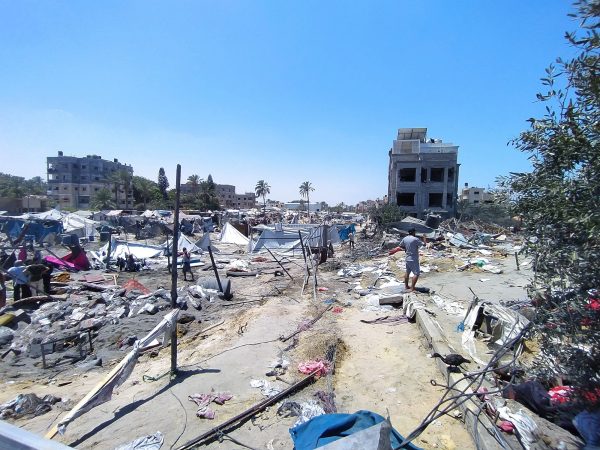
Israel Genocide in Gaza - 2023 to present - Part ll

All the proxies that fighting against i$rael does it under his command
LOL, what proxies ? Palestinians aren't proxies of anybody. Don't include us. You guys didn't know Toofan Al-Aqsa was gonna happen and you saw it as a scheme against Iranian interests.

Iraqis aren't firing anything at Israel nor have any desire to fight Israel. They just run a ponzi scheme in name of 'resistance '.

Firing stuff at Israel isn't 'fighting Israel'. The only actual ones who's policy is to fight Israel are the Palestinians because their survival counts on it.

Iran is looking for popularity, it doesn't want to fight Israel.
Every missile and drone that hit i$rahell has his signature

And BTW he is a grandson of prophet
He is grandson of Prophet, same with King of Morocco, king of Jordan, etc .... I don't believe them

They don't look like anything like the family of the Prophet. All their physical features are far from it.
 
UAE plays a big role in genocide of Gaza, UAE is the Israel of the Middle East.

This Emirati Israeli genocide supporter is squirming like a weasel now. Before, he used to deflect Israeli genocide by saying Palestine supporters only talk about Gaza but no sympathies for Sudan. Now, he is playing defense because the floor is being wiped with these UAE traitors for their role in the genocide of Sudan. They are trying so hard to blame it on the “Muslim Brotherhood”.

Moron blocked me because he can’t take the heat.

Many of us don’t just speak for Palestine but for Sudan, Congo, etc because any genocide or oppression should always be spoken up for.


View attachment 157397

Please don't waste your breath on him; his ancestors are cursing the dirty seed that was born out of them. See below:

To view this content we will need your consent to set third party cookies.
For more detailed information, see our cookies page.


Everything for him starts and ends with the Muslim Brotherhood, must've been one from the group that slept with his mother.
 
LOL, what proxies ? Palestinians aren't proxies of anybody. Don't include us. You guys didn't know Toofan Al-Aqsa was gonna happen and you saw it as a scheme against Iranian interests.

Iraqis aren't firing anything at Israel nor have any desire to fight Israel. They just run a ponzi scheme in name of 'resistance '.

Firing stuff at Israel isn't 'fighting Israel'. The only actual ones who's policy is to fight Israel are the Palestinians because their survival counts on it.

Iran is looking for popularity, it doesn't want to fight Israel.

He is grandson of Prophet, same with King of Morocco, king of Jordan, etc .... I don't believe them

They don't look like anything like the family of the Prophet. All their physical features are far from it.
If it wasn't because of Khamenei Palestinians were fighting with empty hands , or with stones

And the king of Morocco who is a hardcore anti-islam and and the king of Jordan (the brirish born christian king from her mother) who protects i$rael and the guy is put in his eternal power to support angelo-saxon interests against Palestinians have no connection to Prophet Muhammed (PBUH) let alone Islam

They are all tools of zions, west and jews
 
France and Spain renew push to curb UN veto power
——
France and Spain have renewed calls to limit the use of veto powers at the UN Security Council, arguing the mechanism has repeatedly paralyzed global action in the face of humanitarian crises like Gaza. French Foreign Minister Jean-Noel Barrot said the council must be restructured to reflect current geopolitical realities, advocating permanent seats for African nations as well as Japan, Germany, and Brazil.

Barrot noted that France and Mexico have long championed an initiative to restrict veto rights in cases of mass atrocities, with the backing of over 20 countries, criticizing the council’s failure to act collectively on Gaza. “We must unlock decisions that are blocked by veto when basic human rights are at stake,” he said.

Spanish Foreign Minister Jose Manuel Albares echoed the call, stressing that Spain’s position on upholding international law applies equally to Gaza, and Sudan. He urged unhindered aid access to Gaza, accountability for attacks on humanitarian workers, and respect for International Court of Justice rulings. “Israel cannot have a right of veto,” Albares said, as the Red Cross warned that Gaza’s fragile so-called ceasefire remains “highly complex, sensitive, and dangerous.”


To view this content we will need your consent to set third party cookies.
For more detailed information, see our cookies page.

lol, I said this 2 years ago.
 
Please don't waste your breath on him; his ancestors are cursing the dirty seed that was born out of them. See below:

To view this content we will need your consent to set third party cookies.
For more detailed information, see our cookies page.


Everything for him starts and ends with the Muslim Brotherhood, must've been one from the group that slept with his mother.

Some Indians want to show that they are more Indian by drinking more cow wee.
 
How the Gaza War Changed Arab Elites’ Perception of China

The Gaza War has shattered Arab illusions about China as a normative power and recast it as a transactional actor.

By Behrouz Ayaz
October 13, 2025

View attachment 153815

The Gaza conflict has been one of the most horrific crises to test human rights commitments and adherence to ethics. It has become a defining moment in reshaping Arab political elites’ perceptions of global powers. Although the United States’ influence in this war is decisive, Arab elites’ focus was not limited to Washington and the West. China also became a central subject in Arab intellectual and strategic debates.

China had previously sought to project itself as a neutral and constructive force through initiatives such as the Global Security Initiative and its mediation between Iran and Saudi Arabia. Yet Beijing adopted a notably cautious approach toward the Gaza crisis. From the Arab perspective, China is viewed as an attractive economic and anti-Western partner, yet its relative silence regarding Israel’s actions has cast doubt on the sincerity of its morally oriented discourse.

This raises a key question: Do Arab elites still see China as a benevolent neutral power, or as a pragmatic, self-interested and balancing power lacking moral commitment?

Before the Gaza War, China’s image in the region was that of a non-interventionist power – the mediator of the March 2023 Iran–Saudi rapprochement, the signatory of hundreds of billions of dollars in contracts with the Persian Gulf states, and the strategic partner behind the Belt and Road Initiative. This approach gave Arab nations the impression that, unlike the United States, China prioritized stability and development over ideology and political coercion. Yet the Gaza War challenged this perception.

In the early weeks of the conflict, Beijing maintained an ambiguous stance: condemning violence in general, calling for a ceasefire, and mildly criticizing Israel. For many Arab political elites, this position appeared overly cautious. They had expected China to take a moral and explicit stand in support of the Palestinians. Although Chinese media gradually shifted from neutral wording to accusing Israel of gross violations of international law, Beijing refrained from taking concrete steps to pressure Israel to end the war. This created a dual image of China among Arab leaders: Beijing is still seen as an economic alternative to the West, yet is increasingly viewed as politically hesitant and lacking geopolitical assertiveness.

However, Arab elites’ attitudes were far from uniform. Their reactions ranged from admiration to skepticism and even outright criticism. It is obvious that political elites have refrained from overtly criticizing China due to diplomatic considerations and national interests, but the position of these countries can be understood from the statements of their intellectual and media elites. Let’s look at four important Arab countries: Qatar, the United Arab Emirates, Saudi Arabia, and Egypt.

Qatar has arguably been the most critical of China’s approach to the Gaza War. Given Qatar’s close alignment with the Palestinian cause, Al Jazeera and Qatari think tanks criticized China’s passivity amid the massacres in Gaza. While officials diplomatically described Beijing’s role as constructive, Qatari media viewed Beijing’s stance as largely symbolic. Al Jazeera argued that China’s position was “more rhetorical than practical.”

An Arabic article titled “China and the Palestinian Issue: Verbal Support without Pressure on Israel” published on Al-Araby, explicitly stated that China’s stance toward the Palestinians is one of verbal support only. The article noted that Beijing is not putting pressure on Israel. However, even in these criticisms, there is a kind of realistic acceptance: Qatari elites acknowledge that China is becoming part of the inevitable power equation in the region.

In contrast, the United Arab Emirates (UAE) adopted a distinctly pragmatic stance. For Abu Dhabi, China should not be judged or measured by Western standards. Rather, Beijing symbolizes a “futuristic power” – one that promotes stability, trade, and technocratic governance. Emirati officials view China’s neutrality in Gaza not as weakness but as a deliberate policy of “profitable impartiality.”

“China remains a key player in the global economy and its economic trajectory is very important for Abu Dhabi,” Massimo Falcioni, chief competitiveness officer at the Abu Dhabi Investment Office (ADIO), said in a recent interview with China Daily.

This view has led Emirati analysts to consider China as a potential mediator in resolving critical regional issues. Mohammed bin Al Nahyan, Emir of the United Arab Emirates, stressed at the opening session of the 10th Ministerial Meeting of the China-Arab States Cooperation Forum that the UAE believes that peace in Gaza is possible through cooperation between Arab countries and China, along with international efforts.

In Saudi Arabia, political leaders considered Beijing’s cautious position a calculated move, aware that any explicit stance could jeopardize joint investments. Yet Saudi intellectuals and media figures – particularly after Washington’s overt support for Tel Aviv – called on China to take a clearer position to establish genuine strategic balance. Independent Arabia argued that “Beijing exploits the Gaza crisis to advance its strategic interests while maintaining rhetorical solidarity with Palestinians.”

In Egypt, reactions were complex. Veteran journalists and analysts with a pan-Arab background described China’s restraint as consistent with its “soft diplomacy.” The Al-Ahram Center for Political and Strategic Studies (ACPSS) noted that China supports Palestinian refugees and calls for ending the war but cannot fully meet Arab expectations due to its own strategic limitations.

Meanwhile, younger Egyptian scholars in international relations argued that China is quietly building a “gradual soft influence” through economics, culture, and technology – an influence less immediate but more enduring than U.S. military intervention. These scholars also believe Beijing, with Egyptian and Iranian backing, aims to erode U.S. dominance in the Middle East.

Two competing discourses have thus emerged among Arab elites regarding China’s role. One portrays China as a cautious yet indispensable partner; the other sees it as a morally insufficient but balancing power.

Ultimately, the Gaza War pushed Arab elites from idealism toward realism in their perception of China. For them, Beijing is not a savior but a balancing instrument – a way to manage dependency without severing ties with the United States.

Apart from the critical view of some Arab media, the Gaza crisis caused Arabs to look at China as an alternative power. Although its position is ambiguous, the fact that China was raised alongside the U.S. in the discourse of Arab elites indicates the breaking of the U.S. monopoly on shaping regional narratives.

At the same time, the Gaza War demonstrates that China still avoids assuming political and security responsibilities in the region – a necessary step if it wishes to become a credible geopolitical actor. Beijing’s passive position provides an opportunity for the United States to play a major role and keep the Arab countries on its side.

For its part, China seeks presence without deep engagement and influence without responsibility. This strategy, while cost-effective, risks undermining its international prestige as a global leader. Unless China redefines its normative diplomacy, it will remain an economic giant but a geopolitical dwarf in the Arab imagination.


China has no real interest in babysitting the Arabs. They expect countries to look after their own interests.
 
China has no real interest in babysitting the Arabs. They expect countries to look after their own interests.
Chinese are far more smarter than the Indians and their strategists are on a different level. They will bleed US resources dry via Israel to make taking over Taiwan a walk in the park. US urgently needs to abandon Israel and focus on its own security interests and issues else Israel will take the US down with them. US is already being shunned by the world because of Israel and soon , if nothing is done, the house is going to come crashing down like a pack of cards.
 
National Interest warns that the lack of real US pressure on Netanyahu endangers Palestinians in Gaza, making Trump’s plan largely ineffective.

Haaretz notes the plan focuses on security while neglecting civilian reconstruction and integration, increasing the risk of failure.

The Guardian cites Qatar calling for an international force to facilitate Israeli withdrawal and start reconstruction, warning of a “neither-war-nor-peace” scenario.

Le Monde argues the ceasefire mainly benefits Israel, describing Gaza’s situation as a “Lebanese model” of low-intensity control under US approval.

To view this content we will need your consent to set third party cookies.
For more detailed information, see our cookies page.
 
🚨 Israel Violates the Deal — Starvation Continues in Gaza

During the truce period, only 3,203 trucks entered Gaza — including 639 commercial and 2,564 aid trucks.

That means just 145 trucks per day, instead of the agreed 600 — only 24% compliance.

Fuel and power deliveries were even worse:
Gaza received only 115 fuel/energy trucks out of 1,100 promised — just 10%.

Breakdown of commercial trucks:
293 food
220 mixed goods
82 clothing
23 household supplies
10 equipment
6 fuel
4 medical
1 spare-parts

These figures expose Israel’s continued blockade — restricting food, fuel, and essentials for hospitals, bakeries, and vital services.
A deliberate policy to starve and break Gaza, in blatant violation of the agreement and international humanitarian law.


To view this content we will need your consent to set third party cookies.
For more detailed information, see our cookies page.
 
To view this content we will need your consent to set third party cookies.
For more detailed information, see our cookies page.
 
Urgent| Renewal of Israeli artillery shelling and intense gunfire east of Khan Younis, southern Gaza Strip


To view this content we will need your consent to set third party cookies.
For more detailed information, see our cookies page.
 
#Watch | This is how one of the occupation army's vehicles that it left behind became, after its withdrawal from areas in Jabalia in the northern Gaza Strip.


To view this content we will need your consent to set third party cookies.
For more detailed information, see our cookies page.
 
#Follow-up | Jabalia Municipality:

- Nearly 20 thousand tons of rubble have been removed as part of the municipality's efforts to open the streets of Jabalia city, with support from the Arab International Agency for Reconstruction in Palestine and the Qatari Committee in the Gaza Strip sector, where both donors provided heavy machinery consisting of 5 bulldozers and 5 trucks to remove and transport the rubble from the streets.

- The municipality's efforts continue, both in the field and in coordination with the outside world, in order to accelerate the rescue of Jabalia from the disaster due to the destructive war that has affected all cities and areas of the Gaza Strip sector.


To view this content we will need your consent to set third party cookies.
For more detailed information, see our cookies page.
 

Users who are viewing this thread

Latest Posts

Back
Top