Pakistan Telecom, IT, Tech updates

ISLAMABAD: The National Database and Registration Authority (NADRA) has identified more than 250,000 fake Pakistani Computerized National Identity Cards (CNICs), most of which were reportedly issued to Afghan nationals. A specially developed software revealed that many of these fake CNICs were obtained through agents who added foreigners to the family trees of Pakistani citizens in exchange for money.

Authorities have begun blocking the fraudulent CNICs and instructed affected individuals to visit NADRA offices for verification. Those impacted must submit family tree documents to confirm their identities, after which legitimate CNICs will be reactivated.

Read More: NADRA expands global access for overseas Pakistanis


In a bid to make the CNIC process more convenient, NADRA has launched an online facility allowing citizens to apply for their ID cards from home via the Pak ID website or mobile app. Once processed, the CNICs will be delivered directly to applicants through courier, saving them time and avoiding long queues at centers.

Additionally, the government has announced that citizens can now obtain their first CNIC free of cost within 15 days. NADRA also updated its CNIC renewal fee structure: Rs 400 for normal, Rs 1,150 for urgent, and Rs 2,150 for executive processing. Citizens aged 18 and above are eligible for a CNIC, which also grants them voting rights.
 
ISLAMABAD: The National Database and Registration Authority (NADRA) has identified more than 250,000 fake Pakistani Computerized National Identity Cards (CNICs), most of which were reportedly issued to Afghan nationals. A specially developed software revealed that many of these fake CNICs were obtained through agents who added foreigners to the family trees of Pakistani citizens in exchange for money.

Authorities have begun blocking the fraudulent CNICs and instructed affected individuals to visit NADRA offices for verification. Those impacted must submit family tree documents to confirm their identities, after which legitimate CNICs will be reactivated.

Read More: NADRA expands global access for overseas Pakistanis


In a bid to make the CNIC process more convenient, NADRA has launched an online facility allowing citizens to apply for their ID cards from home via the Pak ID website or mobile app. Once processed, the CNICs will be delivered directly to applicants through courier, saving them time and avoiding long queues at centers.

Additionally, the government has announced that citizens can now obtain their first CNIC free of cost within 15 days. NADRA also updated its CNIC renewal fee structure: Rs 400 for normal, Rs 1,150 for urgent, and Rs 2,150 for executive processing. Citizens aged 18 and above are eligible for a CNIC, which also grants them voting rights.
Nothing is new in it.
First NIC without chip was always free but previously it was in urdu only and now is urdu+english and delivery time is reduced from 30 days to 15 days with free for first card and 400 for modification/renewal/reprint lost etc. 15 days to 12 days for urgent with a fee of 1150 for all first timer or renewal/modification/reprint lost. And from 7 days to 6 days for a fee of 2150 either applicant is applying for first card or for modification/renewal/reprint.
Persons already in possession of SNIC (Smart Card), NICOP or POC can't apply for CNIC but for SNIC only.
NADRA's online self service application was launched a few years back With the name of Pak Identity.
You can apply for renewal/reprint/modification/conversion of your ID cards, Child Registration Certificates (CRCs mostly known as B Forms), FRC, Cancellation of ID documents of your deceased family members etc.
Now option of registering Birth, Marriages, Divorces, Deaths has also been integrated in this application with cooperation of Civilian Registration Management System (CRMS) of local Govt.
And as for NADRA's new system of revealing fake documents it is mostly a pain for general public as it is not so well developed.
 
Federal Minister for IT & Telecommunication Shaza Fatima Khawaja on Saturday announced that Google, the global tech giant, has completed its registration in Pakistan and will soon establish a local office, as the manufacturing of Google Chromebooks has commenced in Haripur.

“Google has announced its entry into Pakistan, having completed its registration, and will soon establish its office here,” said Shaza, while addressing a press conference.

Meanwhile, the manufacturing of Google Chromebooks has commenced in Haripur, she shared.


“Around 500,000-600,000 Google Chromebooks will be manufactured in Pakistan annually,” Shaza said, adding that this will pave the way for technology transfer, best practices and the creation of direct employment.

“Our target is to export these Chromebooks from Pakistan, following which we will further extend and expand this assembly line,” she added.

On November 04, the Chromebook assembly line was established through a collaboration between Google for Education’s local partner Tech Valley, the NRTC, and Australia-based Allied, with operations based in Haripur, Khyber Pakhtunkhwa.

Earlier, Prime Minister Shehbaz Sharif said that the local assembly of IT products, such as Chromebooks, would not only reduce costs for Pakistanis but also strengthen the country’s foreign exchange reserves by developing an export-oriented tech sector.

Meanwhile, Shaza, during the presser, informed that a memorandum of understanding (MoU) has been finalised between Google and the Ministry of IT, under which tech training would be provided to youth, particularly in the field of Artificial Intelligence (AI).

She added that the government is also in discussions with Google to establish AI labs in Pakistan.

Talking about discussions with Meta, the federal minister shared that Meta Llama has been launched in Urdu and is now available in Pakistan.

“The availability of Meta’s Llama AI platform in Urdu is something that has not been rolled out for many countries, but it was done for Pakistan because of the strong engagement we’ve had with Meta,” she said.

Meta Llama is a family of large language models (LLMs) developed by Meta AI that can understand and generate human-like text.

Moreover, the TikTok STEM feed was also made available in Pakistan, Shaza informed. The feed is a dedicated section for science, technology, engineering, and mathematics content that users can turn on in their settings.

“Through this feed, people in Pakistan can access free educational content, turning TikTok into a platform for positive and productive use,” Shaza said.

The minister said Go Telecom, a Saudi Arabian company, has established a presence in Pakistan by launching an AI Hub—an online platform connecting Saudi companies seeking technology services with Pakistani firms.

“Pakistani freelancers and small tech companies can now access Saudi markets remotely without needing physical offices there. This initiative will generate employment, boost exports, and open new business opportunities,” she said.
 
Federal Minister for Information Technology and Telecommunication Shaza Fatima Khawaja on Saturday said Google will manufacture approximately 600,000 Chromebooks annually in Pakistan, marking a major milestone for the country’s technology sector.

Speaking to media, she said Google has completed its registration in Pakistan and plans to open its office soon.

She said Pakistan’s engagement with leading global technology and social media companies has entered a new and productive phase under the prime minister’s leadership.

Khawaja revealed that Google, in collaboration with the Ministry of Defence Production and the National Radio & Telecommunication Corporation, has begun Chromebook manufacturing in Haripur. Launched as a public-private partnership with a local company, the project is expected to significantly boost Pakistan’s IT manufacturing industry.

The initiative aims to provide affordable, high-quality devices, particularly for students and the education sector.
 

Pakistan launches Rs4.5bn program to train 7,200 semiconductor professionals​


IT Minister highlights AI’s national security role and workforce development initiatives at Margalla Dialogue 2025
By
Monitoring Desk

Global-semiconductor-shortage-696x392.jpg


The government of Pakistan is rolling out a Rs4.5 billion program to train 7,200 professionals in semiconductor chip design, Federal Minister for Information Technology and Telecommunication Shaza Fatima Khawaja announced on Wednesday. The initiative aims to strengthen Pakistan’s domestic semiconductor capabilities and prepare the workforce for future technological challenges.


Speaking at the Margalla Dialogue 2025, themed “The Algorithmic War: How AI is Redefining Influence and Security,” Shaza said Prime Minister has launched multiple multi-billion-rupee programs, including the ‘Inspire’ initiative, to develop national semiconductor expertise. She noted that existing public-sector high-tech training programs already train over half a million young people annually, building critical human resources across technology and non-technology sectors to enhance Pakistan’s competitiveness.

Highlighting the global AI revolution, the minister said artificial intelligence has evolved beyond technology or economic efficiency, now serving as a matter of national security with geostrategic implications affecting all aspects of national life. She noted AI is transforming Pakistan’s economy, finance, healthcare, agriculture, and manufacturing, making it central to the country’s future trajectory.


Shaza emphasized the importance of cyber defense resilience, calling for proactive decision-making, predictive analysis, stronger threat intelligence, and international cooperation to counter evolving digital threats. She highlighted collaboration between industry, academia, and the public sector as essential for safeguarding against cyber risks.

The minister also outlined government measures, including the establishment of high-performance computing infrastructure, the launch of the National Artificial Intelligence Advancement Initiative, and support for private-sector efforts to bolster Pakistan’s digital security.
 

Pakistan launches Rs4.5bn program to train 7,200 semiconductor professionals​


IT Minister highlights AI’s national security role and workforce development initiatives at Margalla Dialogue 2025
By
Monitoring Desk

Global-semiconductor-shortage-696x392.jpg


The government of Pakistan is rolling out a Rs4.5 billion program to train 7,200 professionals in semiconductor chip design, Federal Minister for Information Technology and Telecommunication Shaza Fatima Khawaja announced on Wednesday. The initiative aims to strengthen Pakistan’s domestic semiconductor capabilities and prepare the workforce for future technological challenges.


Speaking at the Margalla Dialogue 2025, themed “The Algorithmic War: How AI is Redefining Influence and Security,” Shaza said Prime Minister has launched multiple multi-billion-rupee programs, including the ‘Inspire’ initiative, to develop national semiconductor expertise. She noted that existing public-sector high-tech training programs already train over half a million young people annually, building critical human resources across technology and non-technology sectors to enhance Pakistan’s competitiveness.

Highlighting the global AI revolution, the minister said artificial intelligence has evolved beyond technology or economic efficiency, now serving as a matter of national security with geostrategic implications affecting all aspects of national life. She noted AI is transforming Pakistan’s economy, finance, healthcare, agriculture, and manufacturing, making it central to the country’s future trajectory.


Shaza emphasized the importance of cyber defense resilience, calling for proactive decision-making, predictive analysis, stronger threat intelligence, and international cooperation to counter evolving digital threats. She highlighted collaboration between industry, academia, and the public sector as essential for safeguarding against cyber risks.

The minister also outlined government measures, including the establishment of high-performance computing infrastructure, the launch of the National Artificial Intelligence Advancement Initiative, and support for private-sector efforts to bolster Pakistan’s digital security.
Except there is no semi conductor industry to speak of neither is there a serious long term vision to establish one so these individuals are either going to remain jobless or move abroad so essentially a net loss, the Genius minds of Qom-e-patwar strike again
 
Can Pakistan’s IT Sector Save the Economy?

To view this content we will need your consent to set third party cookies.
For more detailed information, see our cookies page.


From political instability and digital neglect to short-term thinking and corporate complacency, Pakistan’s challenges run deep. In a rare and insightful conversation, Asad Umar, Ather Imran Nawaz, and Syed Ahmad break down why our institutions underperform, why the corporate sector failed to innovate, and how the IT industry lost decades of potential. Yet, amid the criticism lies hope, a belief that with the right mindset, long-term vision, and investment in people and technology, Pakistan can still rewrite its digital destiny.

00:00:00 – Highlights
00:02:10 – Asad Umar Sitting with Non-Political People
00:02:43 – Evolution of the Corporate Sector
00:03:50 – Where Is Pakistan’s IT Industry Standing
00:06:00 – Where Did We Miss an Opportunity
00:07:15 – Where We Made a Mistake
00:11:20 – Lack of Consistency in Pakistan
00:16:50 – Where the Corporate Sector Failed
00:21:30 – Urge to Do Things Independently
00:25:54 – Top Three Industries with Higher Potential
00:29:15 – Not Training Children for the Future
00:36:03 – What Are You Trying to Achieve
00:48:10 – Can Pakistan Produce Unicorns
00:51:50 – What India Has Done Right
00:53:57 – Core Skills for a CEO
00:59:13 – How to Learn
01:00:00 – Is a Degree Important
01:00:06 – Advice for Gen Z Entrepreneurs
01:16:00 – Meaning of Life
01:19:29 – Advice for Talha
01:30:35 – Outro
 
Let make products, not export and sell human labour like Indians do. The IT sector is built upon staffing, outsourcing, and consulting. Lets make technology, not be the ones to service it.
 
IT+freelancing exports will cross $6bn this year from $4.5bn last year. Few more years of good growth and $10bn will be crossed.

Can it save Pakistan economy? Not really. Unless exports of goods also increase substantially.
 
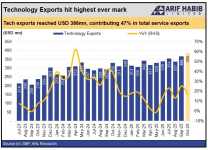
Pakistan Technology - IT Exports hit all-time high of US$386mn in Oct-25; 4MFY26 exports up by 20% YoY.
1763404499485.png
 
KARACHI:
Pakistan's information technology (IT) exports reached an all-time high of $386 million in October 2025, up 17% year-on-year (YoY) and 5% month-on-month (MoM), according to data released on Monday. The figure was higher than the 12-month average of $332 million and marked the fifth consecutive month of YoY growth since June 2025.

This pushed IT exports for the first four months of FY26 to $1.4 billion, reflecting a strong 20% YoY increase. Export proceeds per day were recorded at $16.78 million in October, compared with $16.64 million in September.

The YoY growth in IT exports during the month was attributed to IT companies expanding their client base globally, particularly in the GCC region, and to the State Bank of Pakistan (SBP)'s decision to increase the permissible retention limit from 35% to 50% in Exporters' Specialised Foreign Currency Accounts. Other contributing factors included the allowance of equity investment abroad through these accounts and stability in the Pakistani rupee, which encouraged exporters to repatriate a higher portion of their profits.

According to a Pakistan Software Houses Association (P@SHA) survey, 62% of IT companies are maintaining specialised foreign currency accounts. Topline Research's Sania Irfan stated that, "SBP's introduction of Equity Investment Abroad (EIA), allowing IT exporters to acquire interest in entities abroad using up to 50% proceeds from specialised foreign currency accounts, will continue to boost the confidence of IT exporters to remit proceeds back to Pakistan."

Net IT exports (exports minus imports) stood at $335 million in October, up 12% YoY and 2% MoM, higher than the 12-month average of $292 million. The government has set an IT export target of US$5 billion for FY26, while "Topline expects exports to grow by 18-20% to around $4.5 billion," said Irfan.
 
export is good but it would be even better that all that software talent could be used for internal pakistani needs in industry, society and state infrastructure.
 

80pc work completed on Islamabad IT Park​

By Staff Reporter | The Nation
Nov 16, 2025

ISLAMABAD - Around 80 percent of work on the Islamabad IT Park project has been completed, and it is expected to be completed within its revised deadline of December 31, 2025.

An official of the Ministry of Information Technology and Telecommunication said that the Prime Minister has issued clear directions to ensure the project’s completion within the current year.

The official further informed that the ministry is establishing Special Technology Parks in smaller cities through the private sector, under which interest-free loans are being provided to support such initiatives. “These projects are aimed at facilitating entrepreneurs and local investors while promoting technology-based industries in underdeveloped regions,” the official added.
 

Users who are viewing this thread

Latest Posts

Back
Top