Navigation
Install the app
How to install the app on iOS
Follow along with the video below to see how to install our site as a web app on your home screen.
Note: This feature may not be available in some browsers.
More options
Style variation
You are using an out of date browser. It may not display this or other websites correctly.
You should upgrade or use an alternative browser.
You should upgrade or use an alternative browser.
Chinese LHD / LAH Carriers - Type 075 & 076 and the future
- Thread starter Hendarto
- Start date
More options
Who Replied?

Beijingwalker
VIP Member
China: World’s first drone carrier maybe testing magnetic catapults to launch jets
The ship was seen facing the open waters of the Yangtze River, with its catapult launch rail pointed toward the river, indicating that it was preparing for launch testing.
Updated: Oct 23, 2025 05:07 AM ESTKapil Kajal

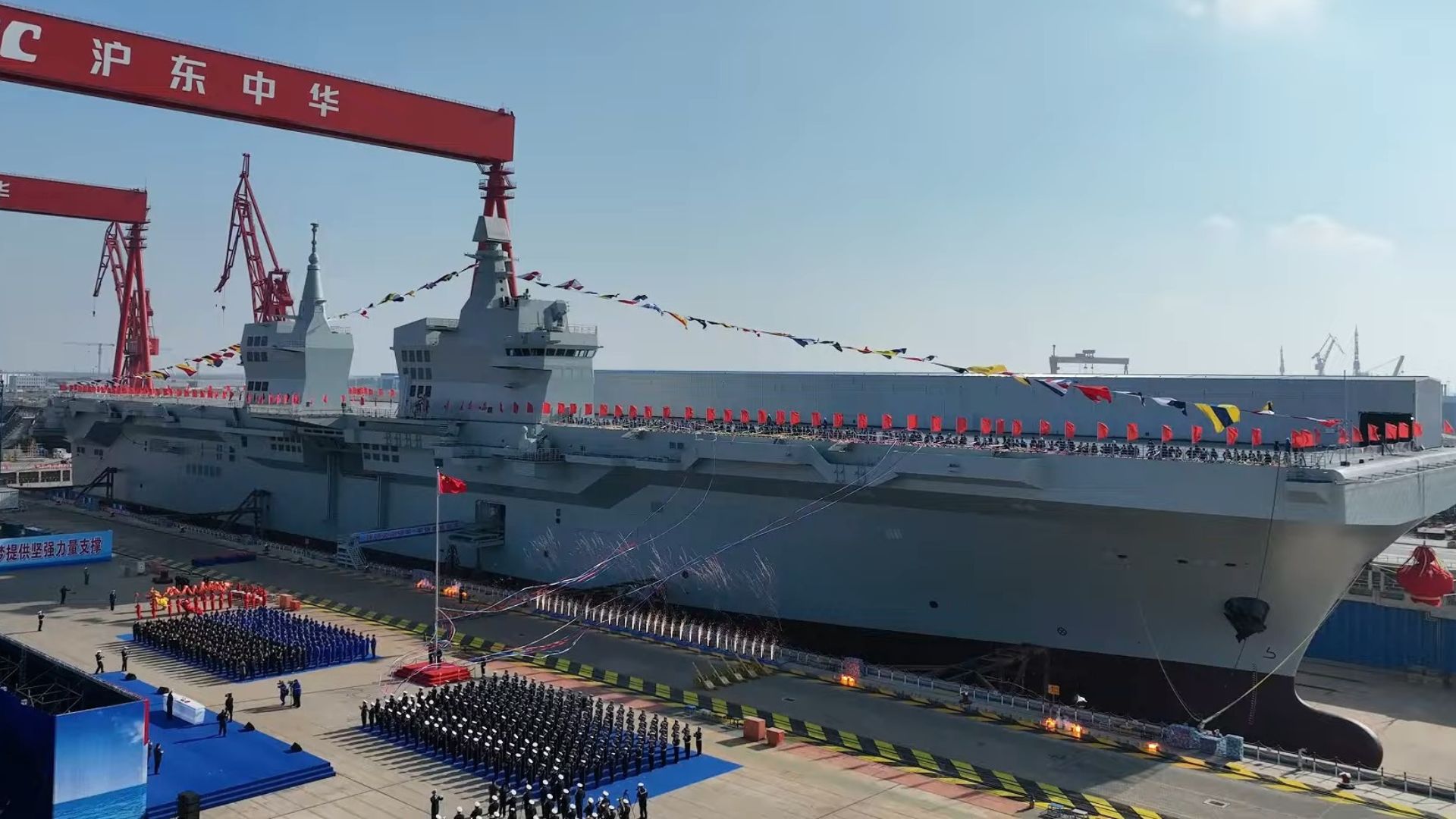
Photo from the launch ceremony of the Type 076 Sichuan vessel.
Wikimedia commons
China’s newest amphibious assault ship, the Type 076 Sichuan, seems to have started testing its electromagnetic aircraft launch system (EMALS), a technology only found on the world’s most advanced aircraft carriers.
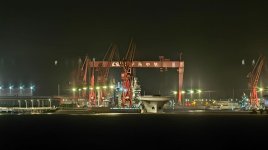
This week’s satellite images and social media posts show the ‘drone carrier’ at the Hudong-Zhonghua Shipyard in Shanghai.
The ship was seen facing the open waters of the Yangtze River, with its catapult launch rail pointed toward the river, indicating that it was preparing for launch testing.''
The image, reportedly taken Tuesday night and shared online early Wednesday, showed the ship’s bridge and dock area brightly illuminated, hinting at activity during nighttime hours, according to a report by the South China Morning Post.
Electromagnetic fighter jet launch system
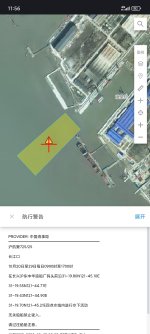
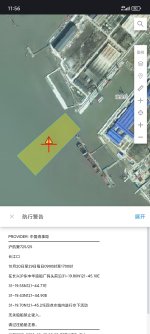
The Shanghai Maritime Safety Administration has informed mariners about a no-entry zone at the shipyard’s dock. which will be active from October 20 to October 29. The notice further stated that underwater activities will take place daily from 9 am to 5 pm.Analysts say the location and timing of the exclusion zone suggest Sichuan may be conducting “sled tests” of its EMALS, a process in which a weighted metal carriage is accelerated down the catapult to simulate the launch of an aircraft.
The sled, which is later recovered from the water, allows engineers to evaluate the system’s performance and stress tolerance without risking an actual aircraft.
Earlier images of the Sichuan showed the catapult covers removed and a radar array installed, signs that the vessel was nearing sea trial readiness.
If confirmed, the tests would make Sichuan the world’s first amphibious assault ship equipped with an electromagnetic catapult.
The technology is operational only on the U.S. Navy’s USS Gerald R. Ford-class carriers and China’s Type 003 carrier, the Fujian, which began sea trials earlier this year.
The EMALS system provides greater launch control than traditional steam catapults, allowing faster, more frequent crewed and uncrewed aircraft takeoffs.
It is also more energy-efficient and capable of launching lighter drones and heavier fighter jets, offering operational flexibility across a range of mission profiles.
World’s first drone carrier
Last month, the People’s Liberation Army Navy released a video showing three fixed-wing aircraft being launched and recovered by the Fujian during testing, a signal of China’s rapid progress in electromagnetic launch technology.Launched in December 2023, the Sichuan is believed to displace more than 40,000 tons and features a full-length flight deck with one EMALS catapult similar to those on the Fujian.
The vessel is part of China’s expanding fleet of large-deck amphibious ships intended to project power across the Western Pacific and beyond.
The Chinese navy has described the Sichuan as a “drone carrier,” designed primarily to deploy uncrewed aircraft such as the stealthy GJ-11 combat drone.
However, its catapult and deck configuration suggest it could operate manned aircraft if required, blurring the line between an amphibious assault ship and a light aircraft carrier.
If the current tests are successful, the Sichuan would represent a major leap in China’s naval aviation capability, signaling advances in drone warfare and the continued evolution of electromagnetic launch systems from experimental use to operational deployment.
Magnetic catapults likely being tested on world's first drone carrier
China's newest amphibious assault ship, the Type 076 Sichuan, seems to have started testing its electromagnetic aircraft launch system.
 interestingengineering.com
Beijingwalker
VIP Member
China’s Type 076 blurs line between carrier and assault ship
by Gabriel HonradaOctober 24, 2025

China’s new amphibious assault ship – a drone-launching, catapult-powered hybrid that combines carrier punch with assault ship flexibility to project power like never before – is rewriting the rules of amphibious warfare.
This month, the South China Morning Post (SCMP) reported that China’s first Type 076 amphibious assault ship, the Sichuan, is believed to have commenced electromagnetic catapult testing at the Hudong-Zhonghua Shipyard in Shanghai.
If so, it marks a key step in the vessel’s development as the world’s first drone-centric warship equipped with an Electromagnetic Aircraft Launch System (EMALS).
Satellite and social media imagery showed the ship’s catapult aligned toward the Yangtze River, suggesting outward launch capability. The Shanghai Maritime Safety Administration concurrently issued a no-entry maritime notice, citing daily “underwater activities.”
The warning may be indicative of sled tests—where a weighted carriage simulates aircraft launches to evaluate EMALS performance, with sleds ejected into the river and recovered afterward.
The Sichuan, launched in December 2024 and displacing over 40,000 tons, features a full-length flight deck and a catapult system matching the size of that on the Type 003 aircraft carrier Fujian. While optimized for uncrewed systems such as the GJ-11 stealth drone, the vessel can also accommodate manned aircraft.
The EMALS offers higher launch frequency and payload flexibility compared to traditional steam catapults, underscoring China’s ambition to modernize naval aviation and project power through next-generation amphibious capabilities.
Yasuhiro Kawakami mentions in a March 2025 article for the Sasakawa Peace Foundation that the Type 076 represents a leap in naval innovation, conceived as a “joint unmanned special warfare carrier” rather than a conventional troop transport.
Kawakami notes that the ship – equipped with EMALS, the first of its kind on any amphibious vessel—can launch heavier, longer-range aircraft and drones such as the GJ-11, WZ-7 and Caihong unmanned combat air vehicles (UCAVs).
He notes that the ship integrates air, surface and underwater unmanned vehicles with special operations forces, enabling self-contained covert missions including decapitation strikes and precision landings.
Furthermore, Matthew Funaiole and other writers mention in an August 2024 article for the Center for Strategic and International Studies (CSIS) that the Type 076 amphibious assault ship marks a strategic leap in the People’s Liberation Army’s (PLA) power projection.
They note the ship’s expansive flight deck and dual elevators optimize sortie rates, while a floodable well deck supports ship-to-shore operations. They also state that the ship’s scale and multifunctionality position it between a Landing Helicopter Assault (LHA) ship and a full carrier, enabling joint command.
In a Taiwan scenario, the Type 076 would deploy drone swarms and special forces to paralyze command centers and disrupt defenses before a large-scale assault. Acting as a light carrier, it would disperse China’s naval aviation across multiple platforms, enhancing survivability and operational flexibility compared to supercarriers.
The Type 076’s hybrid role—combining drone carrier, amphibious transport, and air-support ship—bridges China’s carrier and landing ship gap, addressing its limited sealift capacity for a cross-strait invasion.
Setting the Type 076 into a larger operational and capability picture, the US Department of Defense’s (DoD) 2024 China Military Power Report mentions that the People’s Liberation Army Navy’s (PLAN) amphibious warfare component consists of eight Type 071 Yuzhao-class landing platform docks (LPDs) and at least three commissioned Type 075 Yushen-class LHAs, with a fourth Type 075 undergoing trials in 2024.
The report notes these large-deck assault ships can embark landing craft, armor, helicopters and marines for long-distance expeditionary missions. It adds that with the Type 076, these ships replace older landing craft, providing greater capacity, endurance and flexibility for regional or global amphibious operations.
Beyond a Taiwan contingency, Jennifer Rice mentions in a November 2024 report for the China Maritime Studies Institute (CMSI) that the PLAN’s large-deck amphibious warfare ships enable far-seas deployments for counterpiracy, humanitarian relief, joint training, and naval diplomacy missions.
Rice notes these vessels have participated in operations across the Indian Ocean, Gulf of Aden and Southeast Asia, providing lift, logistics and command functions for multilateral exercises and disaster relief. She adds that their endurance and range extend China’s power projection, reinforce overseas bases like Djibouti and advance its goal of a globally present, quick-reaction force capable of safeguarding its strategic and economic interests.
But even with those formidable capabilities, an amphibious assault to take Taiwan is a daunting military challenge. Highlighting these challenges, Lyle Goldstein argues in a December 2022 article for the peer-reviewed Asian Security journal that China would face profound challenges in using its amphibious warfare ships for a Taiwan invasion despite its buildup and doctrinal learning.
Goldstein points out that the PLA has not conducted a large-scale landing in over half a century, and its amphibious fleet would confront immense logistical and operational burdens in transporting, supplying, and protecting troops across the Taiwan Strait.
He also notes that China’s ships would be vulnerable to undersea threats, mines and air attack, while sustaining control of sea lanes would be difficult under enemy fire. He stresses that these vulnerabilities, combined with possible US and allied intervention, underscore the extraordinary risks of such an operation.
Also, China’s lack of foreign military bases for resupply and logistics may limit its capacity for regional and global power projection, with possible vulnerabilities being a compelling reason why China has not yet established such.
Citing Chinese military analysts, Howard Wang and Nathan Beauchamp-Mustafaga state in a June 2024 RAND report that overseas bases would be highly vulnerable in wartime, making China reluctant to establish more of them, despite seeking access agreements in various locations such as Cambodia and the Solomon Islands.
Wang and Beauchamp-Mustafaga say that PLA researchers cite weak defenses, lack of hardened infrastructure, limited command structures and dependence on unreliable host nations as significant risks.
They note that bases such as that in Djibouti could be easy targets for enemy precision strikes and challenging to sustain due to fragile supply chains and insufficient military-civil integration.
They also point out that China’s overseas outposts also face environmental hazards, limited medical and logistical capacity, and uncertain local political stability—all factors that could make foreign bases into liabilities rather than assets during conflict.
Whether for storming beaches or shaping distant seas, the Type 076 signals that China’s subsequent battles won’t just be fought with ships and soldiers—but with swarms and circuits.

China’s Type 076 blurs line between carrier and assault ship - Asia Times
China's new amphibious assault ship – a drone-launching, catapult-powered hybrid that combines carrier punch with assault ship flexibility to project
 asiatimes.com
Aziqbal
Elite Member


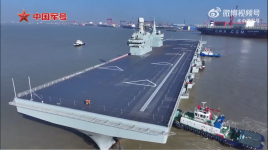
Type 076 LHA is also a twin island design
the wind dynamics involved brings all sorts of issues but seems like China can master anything
not only does it have a well deck it also has a EMALS which in theory can launch a J-35
there nothing like Type 076 in the world right now not even close
the wind dynamics involved brings all sorts of issues but seems like China can master anything
not only does it have a well deck it also has a EMALS which in theory can launch a J-35
there nothing like Type 076 in the world right now not even close
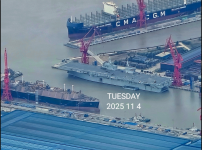
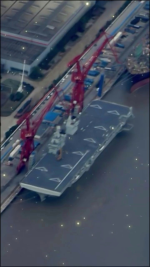


The location of the suspected barrier cable has been identified.
View attachment 159306
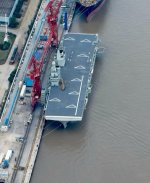
A better one ...

Michael
VIP Member


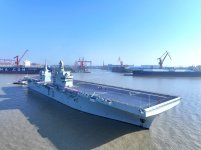
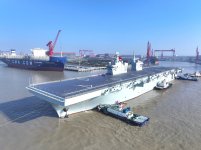
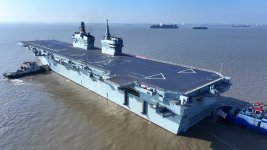
wangdefa
Registered Member
I'm curious about what aircraft they'll be carrying for the 076.
cir
Registered Member
Three types of UAVs by 601,611 and 611,respectively.I'm curious about what aircraft they'll be carrying for the 076.
Aziqbal
Elite Member
I'm curious about what aircraft they'll be carrying for the 076.
Future Chinese carrier strikes groups will have a hybrid set of aircraft
A mix of manned and unmanned
Full carriers can launch the J35 and Type 076 can launch the GJ-21 UCAVS
This is the hybrid war system China is building
And after they have worked out the Type 076 no doubt more units will be built
Michael
VIP Member
We have not found any facilities on the Type 076 LHD (Sichuan) related to the takeoff and landing of manned carrier-based aircraft, including key facilities such as auxiliary landing and control command systems.Future Chinese carrier strikes groups will have a hybrid set of aircraft
A mix of manned and unmanned
Full carriers can launch the J35 and Type 076 can launch the GJ-21 UCAVS
This is the hybrid war system China is building
And after they have worked out the Type 076 no doubt more units will be built
This is the Fresnel lens optical aid system on the Fujian aircraft carrier. It is one of the key pieces of equipment for carrier-based fighter aircraft takeoff and landing operations. However, we did not find it on the Type 076 LHD.
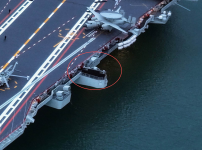
Therefore, the topic of manned carrier-based aircraft (J-15T, J-35 carrier version, KJ-600, etc.) operating on the Type 076 LHD can be temporarily set aside. Unless one day in the future we discover these facilities on this type of warship.
Last edited:
Users who are viewing this thread
Total: 2 (members: 0, guests: 2)
Pakistan Defence Latest
-
-

-
-
-
Bangladesh PM’s daughter Zaima Rahman’s appointment as UN Legal Officer raises recruitment questions (3 Viewers)
- Latest: Fallstuff
Country Watch Latest


Latest Posts
-

-

-
-
 Iran’s President says Tehran can’t even access its own money sitting in China (12 Viewers)
- Latest: Watandar
