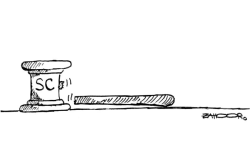
Pakistan Constitutional Amendments:

Tallal Chaudhry says parliament can bring another constitutional amendment for ‘stability’


News Desk
November 16, 2025

1763294188276.png

Minister of State for Interior Tallal Chaudhry speaks addresses media in Faisalabad on Nov 16, 2025. — DawnNewsTV

Minister of State for Interior Tallal Chaudhry on Saturday said the ruling coalition could introduce another constitutional amendment if needed to “maintain stability” in the country.

His remarks come just three days after the 27th Amendment was signed into law after passage from the National Assembly and the Senate, amid strong opposition by the opposition parties.
 
Insisting that the 26th and 27th Amendments brought “stability” to the country, Chaudhry said, “If another amendment is needed to maintain this stability, we will definitely bring it together with other parties.”

“The parliament will bring amendments whenever it wants, and the parliament should do them. The parliament should be seen as a parliament,” the PML-N leader said while addressing a media briefing in Punjab’s Faisalabad.

Responding to a query, Chaudhry termed the recent resignations of superior court judges as “political”.

On November 13, the day the 27th Amendment was enacted into law, the Supreme Court’s then-senior puisne judge Justice Mansoor Ali Shah and Justice Athar Minallah resigned, censuring the legislation as an “assault” on the Constitution and as weakening the judiciary.

A day later, Justice Shams Mehmood Mirza quit the Lahore High Court, also citing the 27th Amendment as the reason, and the Islamabad High Court might also see some departures.
 
The state minister asserted that making amendments to the Constitution was the parliament’s right.

“Judges take oath under the Constitution; they are not a political party that they will resign if the Constitution is amended,” the PML-N leader said. “The Constitution will not be as per their (judges’) wishes, but of the parliament and the people of Pakistan,” he asserted.

“Their (judges’) every single thing — from their salaries to their decisions — is decided by the parliament,” the state minister said.

He further accused the senior judges who resigned of being “biased” and of handing “political” judgments.

“There have been many extensions of ‘good to see you’, but the environment is not the same anymore,” Chaudhry quipped, referring to the renowned remark made by former Chief Justice of Pakistan (CJP) Umar Ata Bandial in May 2023, when he said “good to see you” to ex-premier Imran Khan upon his court appearance.
 

Impact of 27th on jailed leader


Abbas Nasir
November 16, 2025

FEAR was the main reason behind the passage of the 26th Amendment. Fear that the Supreme Court would somehow free jailed former prime minister Imran Khan and even go as far as to annul the last election in which, many believed, the will of the people at the ballot box may not have reflected in the final result. The 27th Amendment takes that thought to its logical conclusion.

The move gives constitutional cover to what the defence minister has called a ‘hybrid’ system and also acknowledges and institutionalises the senior partner’s lead role which will extend beyond the term in office of the junior, civilian partner.

When critics say the superior courts will now be under the executive’s influence, even control, they mean that given the balance of powers between the civilian and the uniformed, parts of the courts will now find themselves in the vice-like grip of the establishment.

While that may be true, it is not out of place to say that what has happened has given constitutional cover to a fait accompli; except for very brief and insignificant periods of independence, the superior judiciary has rarely stood its ground in the face of establishment pressure.

Starting with the Supreme Court’s predecessor the Federal Court, chief justice Munir’s infamous verdict, which overturned the Sindh Chief Court’s ruling in favour of Moulvi Tamizuddin, the Speaker, who had challenged the dissolution of the assembly by Governor-General Ghulam Mohammed, to the present day, the superior judiciary’s crucial verdicts have reflected more the will of the power centre(s) than the rule of law, or the spirit and supremacy of the Constitution.

So far, a lot of the blame has been put on the political class for its failure to deliver.

I can rattle off events in the Ayub era to the upholding of Zulfikar Ali Bhutto’s ouster to his death sentence and his execution to the dismissal of many governments starting in 1988 and continuing till the military takeover in 1999. When has the Supreme Court stood its ground and stood with law, justice and the people? If the Supreme Court was actually ‘hollowed out’, it happened way before the 27th Amendment became part of the Constitution.
 
It sent two elected prime ministers home more recently and followed the establishment’s lead. What has happened now is seen as outrageous simply because it formalises what many justices appear to have long been comfortable with.

Honourable exceptions being exceptions and nothing more. For every justice who refused to bow to the will of the gun and decided to step aside, there were, arguably, dozens who were more than willing to fill the breach.

That’s the tragedy. As for the international environment today, democracy, the rule of law, human rights and individual liberty all seem to be under siege or attack. These cherished values seem to be in retreat.

In the day and age of social media-shaped narratives and decline in the influence of legacy media, especially those elements of the legacy or traditional media that believed in truth, objectivity, balance and fairness, a whole new equilibrium is emerging. Where it takes us or is taking us is another story.

In our case specifically, with so many external dangers and the resurgence of terrorism, and having discarded a relatively better form of democracy in favour of the hybrid variety, all authority and power now vests in one individual. Or, some would argue, the individual has been facilitated by politicians lacking in legitimacy to take total control.

From now on, the onus of delivery is on him and accolades or the opposite will be his alone. I, for one, earnestly hope that in the area of national defence, he can repeat the wins of the May conflict with India and improve the performance of the SIFC, which has not managed to achieve what it was intended to.
 
Going forward, the only thing that guarantees national security and stability in a hostile environment is economic development and provision of jobs and basic services to the people, a vast majority of whom have nothing. Literally. Our people have been badly let down.

So far, a lot of the blame has been put on the political class for its failure to deliver. Even if there are glaring examples of the political class having been blocked or removed from decision-making when the economy was doing well. Individual ambitions of unelected power wielders overwhelmed what was in the interest of the teeming multitudes.

By its very definition, this hybrid set-up devolves common responsibility where the senior partner cannot blame civilian junior partners for failures. Any shortcomings will have to be jointly shouldered.

This 27th Amendment seems to make the task of the politicians and political parties out of power even harder to stage a comeback. Having tried to take to the streets to force a change in the status quo and failing, perhaps the one hope that flickered in what was a strong wind was legal, judicial relief coming via the superior courts. That too has been extinguished.

Sympathisers and supporters in other powerful institutions have been purged or sidelined. This calls for a change in the opposition strategy as no assistance will be forthcoming from within power centres in the country.

Imran Khan’s supporters and believers say his position is unshakeable, principled, while others at the very least feel he has so far displayed resilience and stubbornness in not talking to the junior hybrid partner as he has often been told to.
 

Judges depart

Editorial
November 15, 2025

TWO upstanding justices of the Supreme Court have chosen to exit honourably rather than remain part of a “mute” entity.

This was not unexpected, given how extensively the regime has managed to abase the judiciary. How can principled individuals who have dedicated a lifetime to their profession be expected to continue as part of an institution whose credibility is now in question? Perhaps the judges realised that it was futile to expect different results in the prevailing environment.

Just a few years ago, one would have expected an uproar over what the International Commission of Jurists has decried as “a flagrant attack on the independence of the judiciary and the rule of law”. Today, such ideals do not seem to matter, not even to those expected to uphold them. Sadly, many believe the nation’s social, moral and political conscience is on the decline.

Senior justices Syed Mansoor Ali Shah and Athar Minallah gracefully resigned once it became clear that the deeply contentious 27th Amendment would now be considered law.

Critics say the amendment, which has reconfigured the country’s justice system to place a new Federal Constitutional Court above all other forums of justice, has reduced the Supreme Court to no more than a glorified district court. Given the extensive powers handed over to the FCC, that assessment is not off the mark.

Rather than be rendered second-class judges, they may have thought it fit to depart with their prestige intact. It would also have been clear to the judges, given the precedent set with the Constitutional Bench, that the regime would not be interested in picking independent-minded judges for the new court.
 
FEAR was the main reason behind the passage of the 26th Amendment. Fear that the Supreme Court would somehow free jailed former prime minister Imran Khan and even go as far as to annul the last election in which, many believed, the will of the people at the ballot box may not have reflected in the final result. The 27th Amendment takes that thought to its logical conclusion.
Not fear. It was Bughaz-e-Imran that made them do the said "constitutional" amendments because he wouldn’t bow down to this illegitimate military dictatorship.
 
Imran Khan’s supporters and believers say his position is unshakeable, principled, while others at the very least feel he has so far displayed resilience and stubbornness in not talking to the junior hybrid partner as he has often been told to.
"Partner"? You mean, Imran Khan should have a talk with any of those partners in crime? 🙄
 
Insisting that the 26th and 27th Amendments brought “stability” to the country, Chaudhry said, “If another amendment is needed to maintain this stability, we will definitely bring it together with other parties.”

“The parliament will bring amendments whenever it wants, and the parliament should do them. The parliament should be seen as a parliament,” the PML-N leader said while addressing a media briefing in Punjab’s Faisalabad.

Responding to a query, Chaudhry termed the recent resignations of superior court judges as “political”.

On November 13, the day the 27th Amendment was enacted into law, the Supreme Court’s then-senior puisne judge Justice Mansoor Ali Shah and Justice Athar Minallah resigned, censuring the legislation as an “assault” on the Constitution and as weakening the judiciary.

A day later, Justice Shams Mehmood Mirza quit the Lahore High Court, also citing the 27th Amendment as the reason, and the Islamabad High Court might also see some departures.
Stability is more important than high sounding constructs embellished with high fallutin and colorful words.
 

Users who are viewing this thread

Pakistan Defence Latest

Country Watch Latest

Back
Top