SMASH SLBM Testing - Nov 2025

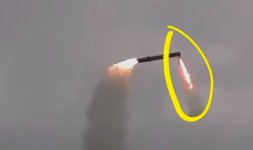
@Qadeer chaudary janab...can you look at the following photo of Russian cruise missile launch where I marked the secondary gas pressure based stabilizer....normally all Russian cruise and ballistic missile systems use this secondary stabilizer on cold launch ( brahmos also uses it) ....

If you look at SMASH missile launch it is little skewed on flight trajectory....is it possible that we use similar stabilizers to obtain accurate flight course.
Screenshot_20251127_002607_YouTube.jpg

Taken from:
To view this content we will need your consent to set third party cookies.
For more detailed information, see our cookies page.
 
If we can create a 1000km shore based anti ship ballistic or hypersonic option and back it up with multiple drone and cruise missile options to target ships or carrier groups in a single attack, then it would be suicide for any navy to come within range of the Pakistani coast

India may still have the advantage with a larger navy, but they would struggle to enforce any blockade and the risk to their navy would be enormous and if they actually lost a ship, it would be humiliating

Perhaps we do have a missile of that sorts derived from C-401. C-401 is the export variant of the infamous Chinese carrier killer DF-21D. It's a mean stick albeit a short one with sub 300 km range (thanks to MTCR) - besides, C-401 can be launched using the VLS system available on Tughril Class. So in theory it is possible that Pakistan might already have a variant of SMASH based on C-401, with MaRV and Hypersonic (Mach 5-6) in terminal phase, and extended range.

The DF-21D is TEL launched. So it is also possible that we may have derived something similar e.g. HGV derived from DF-21D integrated with our BMs. The mystery of those Lenticular Clouds still remain haha.

If we assume something like that is already available in the arsenal or is in testing phase - in either case I don't think Pakistan will disclose because of the ongoing threat environment.
 
Last edited:
Perhaps we do have a missile of that sorts derived from C-401. C-401 is the export variant of the infamous Chinese carrier killer DF-21D. It's a mean stick albeit a short one with sub 300 km range (thanks to MTCR) - besides, C-401 can be launched using the VLS system available on Tughril Class. So in theory it is possible that Pakistan might already have a variant of SMASH based on C-401, with MaRV and Hypersonic (Mach 5-6) in terminal phase.

If we assume something like that is already available in the arsenal or is in testing phase - in either case I don't think PN will disclose because of the ongoing threat environment.

I am sure we have multiple surprises for India and the Indian navy

The Pakistani navy may eventually become a world class navy to be reckoned with, it's still growing and multiple assets are being inducted, waiting to be inducted or would be inducted in future

But at this point in time, like many have said Pakistan navy isn't our strongest arm and it can't go toe to toe with the Indian navy and it can't operate too far from our coast or it risks being overwhelmed

Eventually I'm sure the navy aims to rectify that and grow into a real beast if the economy allows

But as a defensive navy, where the main aim is to disallow any blockade of Pakistan and protect Karachi and our coast
Our main offensive asset is the sub force we are accumulating so the 13 or so subs we have or will come soon will ensure operating in Pakistani waters would be very difficult

Unless and until our subs are dealt with, the Indian navy can't enforce a blockade or operate freely, the amount of time it would take to try and counter Pakistani subs will more then likely see the war already over


I would think Pakistan would aim to protect our naval assets and keep them out of the way and under coastal A.D, so I don't think any of our ships will venture out too far

Apart from the subs our main offensive options will be anti ship missiles, drones, cruise missiles and these new ballistic missiles

Like I said if we can get smash up to 1000kms, then alongside drones, cruise missiles and subs, India would be effectively nullified on the naval front
 
  • Like
Reactions: hnn
I am sure we have multiple surprises for India and the Indian navy

The Pakistani navy may eventually become a world class navy to be reckoned with, it's still growing and multiple assets are being inducted, waiting to be inducted or would be inducted in future

But at this point in time, like many have said Pakistan navy isn't our strongest arm and it can't go toe to toe with the Indian navy and it can't operate too far from our coast or it risks being overwhelmed

Eventually I'm sure the navy aims to rectify that and grow into a real beast if the economy allows

But as a defensive navy, where the main aim is to disallow any blockade of Pakistan and protect Karachi and our coast
Our main offensive asset is the sub force we are accumulating so the 13 or so subs we have or will come soon will ensure operating in Pakistani waters would be very difficult

Unless and until our subs are dealt with, the Indian navy can't enforce a blockade or operate freely, the amount of time it would take to try and counter Pakistani subs will more then likely see the war already over


I would think Pakistan would aim to protect our naval assets and keep them out of the way and under coastal A.D, so I don't think any of our ships will venture out too far

Apart from the subs our main offensive options will be anti ship missiles, drones, cruise missiles and these new ballistic missiles

Like I said if we can get smash up to 1000kms, then alongside drones, cruise missiles and subs, India would be effectively nullified on the naval front

Yes PN needs massive asset boost, and it's already in process. As for the Naval Blockade - I don't think IN is at present capable of Distant Naval Blockade (reasons explained in my very earlier post) - for a Close Naval Blockade they'll be in range of Harbah and SMASH from PN, and then also from our land based BMs. It's why I think and mentioned earlier as well that for the next couple of years the SMASH we publicly showed is enough deterrence for IN. Until they can fulfil their ambition of 300+ BrahMos for IN (planned goal by 2030 and that is for the whole IN, 30 frontline Destroyers and Frigates, which they can't all bring near Pakistan) and receive Rafale-Ms - they don't really have much to enforce a Distant Naval Blockade.
 
Can we get back to discussing SMASH? why are people smashing this thread with off topic stuff...

on topic I think @Ak01 talking about potentially turning smash into something which our future subs can carry, that will be a nice development.
 
I suspect the length and diameter of the Smash are under 7 meters and 0.85 meters so they can fit in a Chinese UVLS. Hopefully the goal is to reach a 1000 km range, so it can be a potential universal missile for the new rocket force of Pakistan. Keeping the Indian navy as far from Karachi will allow the other services to focus on their missions and not focus on the naval axis.

As for a 2000 ton ship being blue water, that has to do with the shape of the hull. Will endurance be limited, sure, and will sensors be limited, yes again, but with Cooperative engagement capability and optimizing for an endurance that allows the ships to operate during a few weeks of high tensions, in the Northern Arabian Sea, it likely they should not need refueling for the duration of the mission.

Sure the ship is experiential but it is an indication of things to come. China doesn’t build ships unless it plans to have something near about at least on offer for the export market.
Follow up, the length of the missile on the poster is 7500 mm, so we will probably see it shortened to 7000 meters to fit the UVLS. 16 of these missiles on a 2000-2500 ton corvette would allow the PN to field a few of these corvettes alongside an air defense destroyer to mix and match any configuration India tries to throw at Pakistan. With a corvette armada, Pakistan can afford to go with 64 cell 6000 ton air defense destroyers and not feel under equipped for a naval engagement, all due to cooperative engagement capability. Smaller ships, smaller signatures, and cheaper to mass produce.
 
  • Like
Reactions: hnn
Can we get back to discussing SMASH? why are people smashing this thread with off topic stuff...

on topic I think @Ak01 talking about potentially turning smash into something which our future subs can carry, that will be a nice development.
i predicted this as far back as when PN announced the development.

Just remember, after hangor, its an original submarine program, with a partner.

Now the two choices are Italy or Turkey, what i wonder is whether either of them would be interested in handing us VLS boats because they know theyd be used for nukes, but, maybe we'll develop capacity somehow to modify the successive flights ourselves
 
i predicted this as far back as when PN announced the development.

Just remember, after hangor, its an original submarine program, with a partner.

Now the two choices are Italy or Turkey, what i wonder is whether either of them would be interested in handing us VLS boats because they know theyd be used for nukes, but, maybe we'll develop capacity somehow to modify the successive flights ourselves
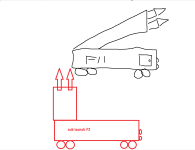
Please don't laugh lol but I have a question, can we do this with Fatah 2 ?
1764198920864.png
first drawing is how we see F2 in action during Operation BuM, but can we turn the F2 launcher like in Drawing 2 (red) make it vertical and fit it in a Submarine ?
 
Indian navy brahmos is dual capable
Their target is always Karachi land targets that they can fire easily
Pakistani navy objective is to keep them out of reach of Karachi
Also 1000 km smash version is being discussed here
Guided via AWACS or MPAs or drones
Smash is on land
Map AWACS or fighter or drone is forward deployed

How do you think AWACS guided j10c launched pl 15 to 100 km away on very small and very fast Rafael while being far ahwa from even j10c to be safe from s400 or IAF?

Smash on shore
Arial assets in open sea 300 km away from in destroyers can guide smash more easily them AWACS did with pl15
Ive already provided the massive difficulty you seem to plainly forget in your first paragraph.

And then you insist on repeating it without providing any actual technical explanations on why a J-10 targeting a Rafale at 190km is different than targeting a ship at 1000km.

Please read about line of sight and earth's curvature before repeating the same answer.
 
FYI for all - before everyone goes all into long range SMASH - this should be required reading.
Chinese AsBM
But since that expectation is unrealistic - The most pertinent parts for any extended range AsBM - land or sea launch is somewhat irrelevant - is


"China operates a wide spectrum of satellites, which can provide data useful for targeting within its maritime region.” Moreover,Dorsett stated, “China’s non–space-based ISR could provide the necessary information to support DF-21D employment. This includes aircraft, UAVs,fishing boats and over-the-horizon radar for ocean surveillance and targeting."

Please consider China's fleet of these system versus Pakistan's.

Then
"Demonstrated Chinese ASBM capability to strike a moving maritime target would not only suggest the potency of a new, unique weapons system, but also serve as a leading indicator of emerging C4ISR-supported counter-intervention capabilities. "

You cannot truly be effective in AsBM without C4ISR - the initial success of PAF in May had this as the key lynchpin - NOT THE PL-15.

"Satellite-based ISR will improve the ability of Chinese ballistic and cruise missiles to strike moving maritime targets. For instance, a DF-21D ASBM might be launched on a ballistic trajectory aimed roughly at the position of aCSG based in part on satellite data. Satellites might also be used to track and target the CSG, e.g. by supplying position updates. 170 If engaged in air operations, the CSG would have a large electromagnetic signature. Initial detection systems include China’s existing land-based sky wave and surface wave OTH radars, which could detect aircraft Doppler.171 Such near-space vehicles as airships/aerostats are credited by Chinese analysts as offering large early warning surveillance areas, good concealment and survivability, good dwell time and persistent coverage; and low launch and operating costs; they might eventually play a similar role. Inputs from these systems, in turn,could be used to task imaging satellites to search small areas to confirm identification of the CSG"

"Imaging satellites, which must be based in low-earth orbit, remain in constant motion, and thus take snapshots of pre-designated areas at periodic and predictable revisit times. Shifting orbits could temporarily improve coverage slightly, but would consume precious fuel. Hence, a basic sense of coverage may be gained by examining satellites’ orbits, inclinations, and periods. By2009, China had approximately 22 imaging satellites with sufficient resolution to play a role in detecting and tracking a CSG"


What similar near continuous coverage can Pakistan claim for its EEZ or the Indian Ocean? India could with more investment make it because both money and ability to launch own ecosystem of satellites gives them an existing base, but Pakistan has no money nor the existing base.

What Pakistan has in options is hoping to get UAV's out HOURS IN ADVANCE to expected AOR of IN and hope they go undetected and robust against jamming - which can then be used for mid course correction or final targeting data.

LASTLY - before we all propose short paragraphs on "what ifs" and "YEH KYUN NAHIN KARTE!!!"

So folks talking to long range SmASH - Please try to answer the following in your post - as a sincere request. Or at least think of them.

P.s Happy to be corrected @JamD @Ak01 @Quwa @Michael @Deino

Overall kill chain​

  1. How should Pakistani naval planners conceptualize the full ASBM kill chain against Indian carrier or major surface groups, beyond the basic steps of detection, tracking, defense penetration, hitting a moving target, and causing mission killing damage
  2. What specific operational phases (such as peacetime shaping, crisis surveillance, targeting, strike authorization, and post strike assessment) should Pakistan define in its ASBM doctrine for the Indian Ocean theatre
  3. How can Pakistan ensure that the kill chain remains resilient if individual nodes such as space assets, over the horizon radar, maritime patrol aircraft, data links, or command centers are degraded or destroyed

Targeting and seeker architecture​

  1. What seeker and onboard sensor architecture would be most realistic for a Pakistani ASBM like SMASH or its successor to reliably engage high value Indian naval targets at range
  2. What mix of sensors such as coastal or shipborne radars, airborne ISR (including Sea Sultan and UAVs), commercial or friendly satellites, electronic and communications intelligence, and potentially over the horizon radar could Pakistan integrate to generate and maintain targeting quality tracks for ASBM employment
  3. In the likely absence of a dense, dedicated Pakistani space based ISR constellation, what alternative cueing concepts such as airborne ISR, surface pickets, UAV swarms, or passive RF sensing could keep the target’s potential movement during the missile’s flight within the seeker’s acquisition basket
  4. To what extent could Pakistani planners consider non traditional or civilian maritime assets such as fishing fleets, commercial shipping, coastal observers, AIS data, and other open sources as contributors to the wider maritime picture used to cue ASBMs, and what are the operational and escalation risks
  5. For a Pakistani ASBM seeker:
    • Would active radar, passive RF, imaging infrared, or a multi mode combination be most appropriate given India’s likely electronic warfare and decoy capabilities
    • How should the seeker be designed to perform target discrimination within a task group, for example identifying a carrier or major combatant versus escorts or merchant vessels
    • How challenging would robust discrimination be in the cluttered, high traffic Arabian Sea and broader Indian Ocean environment
  6. Does accurate discrimination and engagement fundamentally rely on the large radar or infrared signature of a carrier sized target, or should Pakistan design its system and doctrine from the outset to also prosecute smaller but critical targets such as destroyers, large auxiliaries, and key logistics ships

Countermeasures and vulnerabilities​

  1. What do Pakistani strategists assess as the main technical and operational failure modes that could render a SMASH type ASBM ineffective or unusable in a conflict with India, for example ISR disruption, jamming, decoys, interceptors, or cyber attacks on command and control
  2. How should Pakistan evaluate and plan around Indian current and future counter space capabilities, including anti satellite testing and electronic attack on satellite links, that might threaten any reliance on foreign or domestic space based assets for ASBM targeting and navigation
  3. If GPS, BeiDou, or other global navigation systems are degraded by India through jamming, spoofing, or regional denial measures, what backup or complementary navigation methods such as improved inertial navigation, terrain or sea state correlation techniques, celestial updates, or datalink corrections should a Pakistani ASBM incorporate
  4. How effective might Indian ship and land based missile defense systems, for example Barak 8, Indian BMD layers, and cooperative engagement with airborne sensors, be against a Pakistani ASBM, and what saturation, timing, or trajectory tactics could Pakistan adopt to stress those defenses
  5. What electronic warfare, cyber, and deception capabilities should Pakistan assume India will bring to bear against the ASBM kill chain, and how can Pakistani doctrine and technical design mitigate those threats

Evasion, maneuvering, and penetration aids​

  1. What level of maneuverability, including pull up profiles, irregular or quasi ballistic trajectories, or depressed and lofted paths, is realistic and desirable for a Pakistani ASBM to complicate Indian early warning and engagement solutions
  2. How should Pakistan prioritize and sequence the development of penetration aids such as decoys, chaff, inflatable or radar reflective submunitions, infrared flares, or signature shaping reentry vehicles for a SMASH class missile
  3. What trade offs in range, payload, and guidance complexity is Pakistan willing to accept to gain higher terminal maneuvering performance and better survivability against Indian ballistic missile defense and ship based interceptors
  4. How can Pakistan test and validate irregular or maneuvering trajectories, as well as penetration aid performance, within its own instrumented ranges and telemetry constraints without revealing too much about capabilities and profiles to external observers
  5. What doctrine should Pakistan adopt for salvo size, launch timing, and mixed profile attacks, combining ballistic and cruise missiles and different trajectories and altitudes, to maximize the chance of ASBM penetration through India’s layered air and missile defenses

Integration into Pakistani strategy​

  1. How does a SMASH type ASBM fit into Pakistan’s broader conventional deterrence and anti access or area denial posture against India, especially in the North Arabian Sea and approaches to key ports such as Karachi and Gwadar
  2. What command and control arrangements, including the balance between centralized and delegated authority and between pre planned and dynamic target assignment, best reconcile escalation control with the need for rapid engagement of fleeting Indian naval targets
  3. How should Pakistan coordinate ASBM employment with other assets such as submarines, anti ship cruise missiles, airpower, and coastal defenses to create layered, overlapping threats that complicate Indian naval operations and defenses
 
but saar, 400km not enough. Need to smash intercontinentally.
<RANT>
I appreciate the eagerness - but always get disappointed at the seemingly knee jerk replies instead of "lets think". No answer is the wrong answer so long as it SHOWS SINCERITY OF THINKING.
You dont have to write the essay that I did, but just even ask a thoughtful - how about this with some attempt of thinking - even if it sounds stupid.

Instead of sounding instantly sure. Anyone who is unwilling to learn or budge from their argument is generally a fool - no matter how much actual experience they may or may not have. You have to "Think again" and consider the idea that you may be wrong. That doesnt mean self doubt when every other tik tok level argument emerges but any good one can be at least taken on merit.

Par nahin bhai - typical Pakistani - "Aap ko kya pata jahaaz kaise urate hai - meray phupa Schon aviation school mein instructor hain aur bataya ke A380 bohat bekaar jahaaz hai".

</RANT>
 
Aap ko kya pata jahaaz kaise urate hai - meray phupa Schon aviation school mein instructor hain aur bataya ke A380 bohat bekaar jahaaz hai
dunno why but this just reminds me of her

To view this content we will need your consent to set third party cookies.
For more detailed information, see our cookies page.


the epaulettes make me want to cringe and die
 

Users who are viewing this thread

Pakistan Defence Latest

Country Watch Latest

Latest Posts

Back
Top