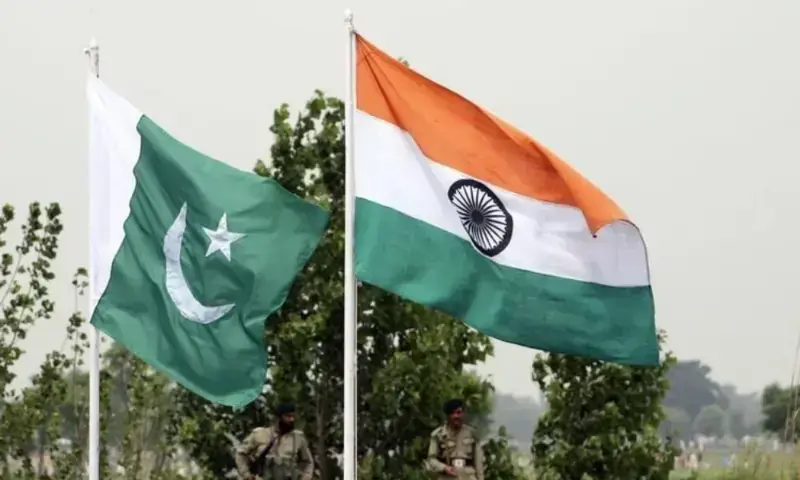
Pakistan-India Conflict 2025: News Updates and Discussion

Keen to know J-10 capabilities or how to actually effectively employ it and take out the top tier of the overhyped 4th Largest airforce?

Lots of learnings and not so easy to walk away. PAF can earn serious $$$ by opening up a dedicated consulting and training branch. Pick and choose a system and bring in their multi domain infrastructure knowledge to help countries like Indonesia, Azerbaijan, Bangladesh etc.

I think PAF is already passing on much knowledge to it's close allies, but stuff like this cannot be made public.

The Qataris will be interested in how the Rafale was defeated as they operate them, the Turks will be very interested as they face Greek Rafales, Indonesians naturally too (they may end up operating both J-10 and Rafale!!!!) and Chinese were probably in the room with us when it all happened making learnings
 
I think PAF is already passing on much knowledge to it's close allies, but stuff like this cannot be made public.

The Qataris will be interested in how the Rafale was defeated as they operate them, the Turks will be very interested as they face Greek Rafales, Indonesians naturally too (they may end up operating both J-10 and Rafale!!!!) and Chinese were probably in the room with us when it all happened making learnings
I doubt Qataris are any really interested........they neither have the will to fight nor they will. Look how easily Israel bombed their capital. Typhoons and Rafales and BLK 60s are just show pieces for GCC nations and sad that even with rapid change of geo politics in middle east, none of these nations have learnt anything.

They only purchase these to keep politicians in west happy.
 
I doubt Qataris are any really interested........they neither have the will to fight nor they will. Look how easily Israel bombed their capital. Typhoons and Rafales and BLK 60s are just show pieces for GCC nations and sad that even with rapid change of geo politics in middle east, none of these nations have learnt anything.

They only purchase these to keep politicians in west happy.

OK, that is just your opinion, lets stick to the subject. Also Qataris do not operate Blk 60. That is UAE.
 
@Yasser76

Yasser Pai,

The Qataris will be interested in how the Rafale was defeated as they operate them,

What will they do with this information/ knowledge?

Regards
 
UN now confirming India acted illegally when attacking Pakistan in May. This is another diplomatic blow.


As per the article: disrupting the flow of the Indus is essentially: "violating the rights to work and livelihood, an adequate standard of living — including the rights to water and food — a clean, healthy and sustainable environment and development."

Yet we are reassured that Delhi is only targeting "terrorists" and that Delhi "encourages us to develop ourselves".
 
I think PAF is already passing on much knowledge to it's close allies, but stuff like this cannot be made public.

The Qataris will be interested in how the Rafale was defeated as they operate them, the Turks will be very interested as they face Greek Rafales, Indonesians naturally too (they may end up operating both J-10 and Rafale!!!!) and Chinese were probably in the room with us when it all happened making learnings


I can't see India engaging it's air force as the tip of the spear again soon

Pakistan taking on 5th gen Chinese is a whole new problem, you cannot stand still

The j10 really was not used for its intrinsic fighter jet prowess, it's about the whole suite of em capabilities and tactics, and Chinese satellites

There is space for Pakistan to professionally strut globally and that should not be missed.

But then you want to be low key, look to the navy and sea capabilities now.
 

India’s ‘unlawful use of force’ in Pakistan after Pahalgam attack violated rights to life, security: UN experts


Baqir Sajjad Syed
December 19, 2025

ISLAMABAD: United Nations (UN) experts have expressed concerns that India’s “unlawful use of force“ on Pakistan’s territory in response to the April 22 Pahalgam attack in occupied Kashmir appears to have “violated the rights to life and security of person”, it emerged on Friday.

This observation by UN special rapporteurs was made in a report dated October 16, which was made public on December 15. The report outlined India‘s military response to the Pahalgam attack, as well as New Delhi’s decision to hold the Indus Waters Treaty (IWT) in “abeyance” following the incident.

The five UN experts who compiled the report also observed that New Delhi’s actions that “may be taken to disrupt the flow of water to Pakistan under the Indus Waters Treaty” appeared to risk violating the rights to work and livelihood, an adequate standard of living — including the rights to water and food — a clean, healthy and sustainable environment and development.
 
The attack on tourists in occupied Kashmir’s Pahalgam on April 22 resulted in the death of 26 people. While New Delhi blamed Islamabad for the attack without evidence, Pakistan denied involvement, with the foreign ministry questioning the credibility of India’s account of the events and saying it was “replete with fabrications”.

A day after the attack, India decided to immediately hold the IWT in “abeyance”. For its part, Pakistan termed any attempt to suspend its water share under the treaty an “act of war”, noting the treaty had no provision for unilateral suspension.

Under the 1960 Indus Waters Treaty, three rivers that flow westwards — Indus, Chenab and Jhelum — were awarded to Pakistan, with India getting three eastern-flowing rivers of the Indus Basin.

Roughly two weeks after the Pahalgam incident, India launched a series of strikes in the early hours of May 7 across Pakistan, an act which led to the worst between the old foes in decades. Both sides used fighter jets, missiles, artillery and drones during the four-day conflict, killing dozens of people, before agreeing to a ceasefire.

UN Special Rapporteur on the Promotion and Protection of Human Rights and Fundamental Freedoms while Countering Terrorism Ben Saul, UN Special Rapporteur on the Human Right to a Clean, Healthy and Sustainable Environment Astrid Puentes Riano, UN Special Rapporteur on Extrajudicial, Summary or Arbitrary Executions Morris Tidball-Binz and UN Special Rapporteur on the Human Rights to Safe Drinking Water and Sanitation Pedro Arrojo-Agudo, as well as an independent expert on the promotion of a democratic and equitable international order George Katrougalos discussed these events in detail in their October report.
 

‘Unlawful use of force’​

The UN experts noted that while India maintained it had exercised its “right to respond and preempt, as well as deter … cross-border attacks” by lauching strikes in Pakistan, New Delhi “did not notify the UN Security Council that its operation was in the exercise to of the right to self-defence under Article 51 of the United Nations Charter, under the procedures required by that article“.

They emphasised that Article 2(4) of the United Nations Charter and customary international law “prohibits India from the threat or use of armed force against the territorial integrity or political independence of Pakistan, whether such force is targeting state or non-state actors”.

“We note further that under Article 51 of the United Nations Charter and customary international law, India may only exercise the right of self-defence in foreign territory where it is necessary and proportionate in response to an armed attack committed by a foreign state, whether directly by state forces or where a state ‘sends’ non-state forces to attack,” they added.

The experts further highlighted that Article 51 required “the victim state“ to report the armed attack to the Security Council.

“There is no separate right to unilaterally use military force in foreign territory in order to counter terrorism.”

The experts also said, “We are concerned that India has not disclosed credible evidence that the militants who committed the Pahalgam attack were sent to attack India by the Government of Pakistan.”

Reiterating that India had not notified the Security Council of any claim of self-defence in carrying out strikes in Pakistan, they experts observed: “It appears that India has violated the prohibition on the use of force under article 2(4) of the UN Charter, and may itself have committed an armed attack on Pakistan, entitling Pakistan to exercise self-defence under Article 51 of the Charter, risking escalation that could pose grave danger to life in both states.”

“The unlawful use of force would consequently constitute a violation of the right to life under Article 6 of the ICCPR (International Covenant on Civil and Political Rights),“ the experts said.

They further noted that “the illegal use of force on foreign territory would also constitute a violation of the foreign state’s sovereignty and the duty of non-intervention in a foreign state”.
 

‘Abeyance’ of IWT​

Discussing the “abeyance” of IWT by India in a unilateral action, the UN experts highlighted its significance for Pakistan.

They noted that rivers irrigate 18 million hectares of farmland in the country (about 80 percent of Pakistan’s arable land), particularly in the food bowl provinces of Punjab and Sindh, contributing 24 per cent of Pakistan’s gross domestic product.

“The rivers are thus vital in providing food security and livelihoods within Pakistan’s population of 240 million people. Limited water storage in Pakistan means that it relies on the unimpeded flow of river water.

“Any disruption of the flow of water under the Indus Waters Treaty (such as by filling large pondage pools and reservoirs, opening dam gates to flood downstream, or the mass release of sediment) could have serious impacts onistan, human rights in Pak including the right to work and livelihood, the right to an adequate standard of living (including the right to water and the right to food), the right to a clean, healthy and sustainable environment and the right to development,” they said.

The experts further stated that Pakistan was “already a water-stressed country and is one of the ten countries most vulnerable to the adverse effects of climate change, including water scarcity”.

They said they were “deeply concerned” that any disruption of the flow of water to Pakistan a a consequence of India holding the IWT in “abeyance” could “severely affect the human rights of millions of people […] who rely on the river for agriculture, industry, drinking water and sanitation and healthy ecosystems”.

They emphasised that the “obligation to respect rights requires states to refrain from directly or indirectly interfering in the enjoyment of the right, including where state conduct has foreseeable transboundary effects”

In this connection, they also cited the UN Committee on Economic, Social and Cultural Rights, which says: “States parties have to respect the enjoyment of the right [to water] in other countries. International cooperation requires states parties to refrain from actions that interfere, directly or indirectly, with the enjoyment of the right to water in other countries.

“Any activities undertaken within the state party’s jurisdiction should not deprive another country of the ability to realise the right to water for persons in its jurisdiction”. States must not prevent the cross-border supply of water and water should never be used as an instrument of political and economic pressure”.

The experts further said that the duty to respect the right to water required refraining from any activity that denied or limited equal access to adequate water, and maintaining access to existing water supplies.

“We note further that there is a strong presumption against retrogressive measures and that if any such measures are taken, the state must prove that they were introduced after the most careful consideration of all alternatives and that they are duly justified by reference to the totality of ICESCR (International Covenant on Economic, Social and Cultural Rights) rights in the context of the full use of the state party’s maximum available resources,” they added.
 

Users who are viewing this thread

Country Watch Latest

Back
Top