Navigation
Install the app
How to install the app on iOS
Follow along with the video below to see how to install our site as a web app on your home screen.
Note: This feature may not be available in some browsers.
More options
Style variation
You are using an out of date browser. It may not display this or other websites correctly.
You should upgrade or use an alternative browser.
You should upgrade or use an alternative browser.
US Economy - News, Updates and Discussion
- Thread starter Get Ya Wig Split
- Start date
More options
Who Replied?


jamal18
Registered Member


What kind of growth?This is massive growth for an economy the size of the US.
Pumping cheap money into a casino stock exchange?
The mother of all resets is coming: collapse of the dollar and most fiat currencies, countries going bankrupt from the US to most of Europe.

SolarWarden
Trusted Member

wachu talking bout Willis? Unhealthy growth is best growth haven't you heard? Stop being a heytah! 

Toxic
Trusted Member
Roughly 8 - 9 % of the US GDP!!!!!!!!!!!!
In less than a year!!!!!!
Somehow managed to massively increase debt while gutting just about every social welfare program



not sure if that makes any sense? Capital is mostly raised through borrowing. In 2025, there is heavy investments in Chips and data centers across the US. These investments contribute to GDP growth but fueled by debt obviously investors scrutinize the viability of the proposal before they lend money so while these investments contribute to GDP growth it's premature to state the growth is "unhealthy" - whatever that means? You could argue, that the investments in data centers and chip production is largely driven by AI and AI will fail to generate the desired returns on investment. You could support that hypothesis with historic trends on AI led growth. But you would be hard pressed to make that argument since there isn't much data to make the case for or against these investments. AI may be a bubble or a smart investment decision the only thing we know for sure is investors can't get enough of AI.It's debt-fuelled unhealthy growth. Why is it so hard to understand?
it's not going to last. Q4 will be bad, largely due to the shut down. Investments are disproportionately being funneled towards AI and related infrastructure this we will mean high unemployment in other sectors. A majority of the industries and industrial leaders I speak with around the world predict a tough 2026. Hold on to your hat it's going to be a wild ride.This is massive growth for an economy the size of the US.

PakFactor
Elite Member
Roughly 8 - 9 % of the US GDP!!!!!!!!!!!!
In less than a year!!!!!!
it's not going to last. Q4 will be bad, largely due to the shut down. Investments are disproportionately being funneled towards AI and related infrastructure this we will mean high unemployment in other sectors. A majority of the industries and industrial leaders I speak with around the world predict a tough 2026. Hold on to your hat it's going to be a wild ride.
After further analysis of the data, consumer spending was driven primarily by upper-middle-class and wealthy individuals, supporting the theory of a K-shaped economy. Taking into account the labor market and job cuts, @dbc 's assessment of 2026 may be correct.
The concentration of funds into AI and data centers will have to be a wait-and-see approach if it yields any returns.


j_hungary
Professional
It depends on how you see the economy; if you are an investor or have enough money and are looking at the direct investment market, that would be good news for you. For a regular Joe who works 9-5 and is deadlocked on a mortgage, that's not very good news.not sure if that makes any sense? Capital is mostly raised through borrowing. In 2025, there is heavy investments in Chips and data centers across the US. These investments contribute to GDP growth but fueled by debt obviously investors scrutinize the viability of the proposal before they lend money so while these investments contribute to GDP growth it's premature to state the growth is "unhealthy" - whatever that means? You could argue, that the investments in data centers and chip production is largely driven by AI and AI will fail to generate the desired returns on investment. You could support that hypothesis with historic trends on AI led growth. But you would be hard pressed to make that argument since there isn't much data to make the case for or against these investments. AI may be a bubble or a smart investment decision the only thing we know for sure is investors can't get enough of AI.
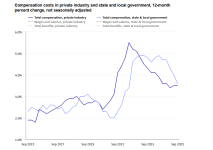
There are two types of GDP growth: tangible or non-tangible growth. Most of the GDP growth we are currently experiencing is from the AI boom, which is non-tangible. When you look at the actual labor data, both job numbers and ECI (Employment Cost Index) were down and unemployment is up...

Compensation costs for private industry workers up 3.5 percent over the year ending September 2025
Compensation costs for private industry workers increased 3.5 percent from September 2024 to September 2025. Wages and salaries increased 3.6 percent over the year and benefits costs increased 3.5 percent. Inflation-adjusted (constant dollar) wages and salaries increased 0.6 percent over the...
 www.bls.gov
JOLTS Home
www.bls.gov
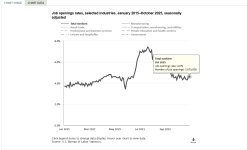
Which means the growth does not translate into a strong labor market, and that's bad news for people who work for a living, because basically we are developing a K-shape economy where people who had money continue to make money at the expense of the lower working/blue collar class.
You can argue AI can make an impact on the economy to a level we can't imagine, but people gotta eat, and you can't eat AI, which means unless this growth translates to the working class, it actually harms the working class more than doing them good. And that is assuming the investment in AI bear dividend

东风夜放花千树
Registered Member
I just hope that ordinary Americans can live better.
I have met some Americans on the Internet who have to rely on selling blood to survive. They work for many years and still can't pay off their college loans. Every day, buying food requires careful planning. Soldiers don't receive their salaries, and the government expects them to take out loans.
And then there are the children, who become toys for American politicians and wealthy people, and are shared with politicians in Western countries.
I have met some Americans on the Internet who have to rely on selling blood to survive. They work for many years and still can't pay off their college loans. Every day, buying food requires careful planning. Soldiers don't receive their salaries, and the government expects them to take out loans.
And then there are the children, who become toys for American politicians and wealthy people, and are shared with politicians in Western countries.
SolarWarden
Trusted Member
The time traveler has spoken.
"Elon Musk’s projection aligns with the transformative impact of the Big Beautiful Bill (H.R. 1), now law, which redirects $1.6 trillion from bureaucratic bloat to strategic sectors like AI, energy, and advanced manufacturing. This legislation accelerates innovation-driven growth by slashing red tape and prioritizing high-output industries—exactly the kind of policy framework that enables the "applied intelligence" surge Musk references.While critics hyperfocus on deficit fears, the bill’s design leverages supply-side velocity: cutting waste while scaling domestic production, tech leadership, and energy dominance. The 4.3% Q3 GDP spike isn’t an anomaly—it’s the baseline for post-bureaucratic economics.Double-digit growth becomes achievable when you stop subsidizing stagnation and start funding industries that actually build wealth. The real question isn’t if it’ll happen—it’s whether D.C. can keep up with the economic momentum it’s unleashed."
"Elon Musk’s projection aligns with the transformative impact of the Big Beautiful Bill (H.R. 1), now law, which redirects $1.6 trillion from bureaucratic bloat to strategic sectors like AI, energy, and advanced manufacturing. This legislation accelerates innovation-driven growth by slashing red tape and prioritizing high-output industries—exactly the kind of policy framework that enables the "applied intelligence" surge Musk references.While critics hyperfocus on deficit fears, the bill’s design leverages supply-side velocity: cutting waste while scaling domestic production, tech leadership, and energy dominance. The 4.3% Q3 GDP spike isn’t an anomaly—it’s the baseline for post-bureaucratic economics.Double-digit growth becomes achievable when you stop subsidizing stagnation and start funding industries that actually build wealth. The real question isn’t if it’ll happen—it’s whether D.C. can keep up with the economic momentum it’s unleashed."
Davey Crockett
Elite Member
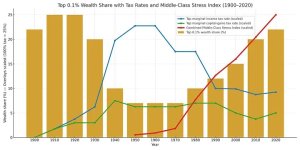
The Most Dangerous Lie We Tell About Capitalism
How a narrowed definition made wealth extraction inevitable — and quietly dismantled the postwar American bargain

Dick Dowdell
Editor’s note: This essay is a follow up to America’s Frightening Stress Index and examines how Americans have been taught to think about capitalism in ways that protect wealth concentration, normalize extraction, and disguise the choices that hollowed out the middle class.
“A system that rewards investment in productivity, people, and long-term stability can coexist with democracy. A system that rewards extraction, consolidation, and short-term gain will eventually undermine it.”

chinasun
Registered Member
Phrase ‘US kill line’ sparks debate on American ordinary people’s economic fragility and social safety nets on Chinese social media
The phrase “the US kill line” has gone viral on Chinese social media in recent days, igniting extensive discussion about economic vulnerability and systemic risk within American society. The term is now used among netizens to describe a precarious financial state in which individuals or households have virtually no margin for error—where a single shock can trigger rapid and potentially irreversible collapse.
The expression “kill line” itself originates from video games, where a “kill line” refers to a health threshold below which a character can be instantly defeated, regardless of remaining defenses or abilities.
The newly aroused attention among Chinese netizens follows a video uploaded on December 8 to the Chinese online video-sharing platform bilibili.com by Chinese content creator “Sikuiqidawang,” titled Cutting Flesh with a Dull Knife and the Kill Line. In the video, he discusses the heavy burden of medical expenses on ordinary Americans and uses the phrase “kill line” as a metaphor for what he describes as a slow, grinding economic pressure. The creator also shared other videos with one depicting the difficult lives of homeless people and people from lower-income groups he encountered in Seattle.
The phrase “the US kill line,” along with the content of the videos, has sparked online discussion for the past several days. A WeChat account affiliated with the Beijing Youth Daily noted that the term “kill line” could be used to describe a precarious financial reality for many Americans: after covering essential expenses, households are left with little margin for error. A sudden shock—such as illness, an accident, or job loss—can push their finances below a critical threshold, triggering a chain reaction within the broader social system that drives people into homelessness.
Online discussions quickly expanded around the concept on Chinese social media, with some netizens sharing videos of Americans describing the burdens of student debt and medical expenses, while others examined what they see as the structural roots of homelessness in the US. Some users also compared the so-called “kill line” with China’s social safety-net mechanisms, referring to China’s policies for poverty alleviation.
One netizen, using the handle “Caizhongxin” commented that, in policy terms, what some online commentators call the “kill line” corresponds to the ALICE threshold in the US—short for Asset Limited, Income Constrained, Employed. Once households slip below the line, they face a persistent risk of financial collapse triggered by even minor shocks.
The discussion has resonated beyond Chinese platforms. On Reddit, under a post asking whether such a “kill line” actually exists, many users who identified themselves as living in the US or Canada responded in the affirmative, sharing personal experiences and observations.
A netizen named “crimbusrimbus” wrote that “I've never heard that phrase but that is 100% accurate. I consider myself financially ‘okay,’ with a good job, but if I was out of work for one month or so I'd have $0.00 liquid assets. The social safety nets that exist are flimsy and once something like this happens it's very hard to recover and very easy to fall through the cracks.”
User “BreadDaddyLenin” wrote that the idea of being “one accident away from homelessness” is “incredibly true.” “I make an okay amount of money, enough to be comfortable, but I have debt, and a single accident would probably completely ruin me,” the user wrote.
Another user wrote, “As an American, yes, it is that bad. We’ve all been brainwashed into thinking that this is just the way things are. I have multiple coworkers who are burdened with such heavy medical debt that they are maxing out credit cards to cover it, forgoing vital medical care, or taking second jobs to afford care for their families.”
Chinese scholar Shen Yi, a professor at Fudan University, has participated in recent discussions on the “US kill line” on Sina Weibo, wrote on Thursday that the concept reflects “the core mechanism of American capitalism.”
“In the US, this is not a concealed phenomenon but a tacitly accepted one, embedded in the fundamental rules of American-style capitalism,” Shen wrote. “The logic of social Darwinism—survival of the strongest—operates openly within the system. Yet for a long time, this underlying mechanism remained largely invisible. Only recently has this underlying logic of American capitalism entered public view.”
The phrase “the US kill line” has gone viral on Chinese social media in recent days, igniting extensive discussion about economic vulnerability and systemic risk within American society. The term is now used among netizens to describe a precarious financial state in which individuals or households have virtually no margin for error—where a single shock can trigger rapid and potentially irreversible collapse.
The expression “kill line” itself originates from video games, where a “kill line” refers to a health threshold below which a character can be instantly defeated, regardless of remaining defenses or abilities.
The newly aroused attention among Chinese netizens follows a video uploaded on December 8 to the Chinese online video-sharing platform bilibili.com by Chinese content creator “Sikuiqidawang,” titled Cutting Flesh with a Dull Knife and the Kill Line. In the video, he discusses the heavy burden of medical expenses on ordinary Americans and uses the phrase “kill line” as a metaphor for what he describes as a slow, grinding economic pressure. The creator also shared other videos with one depicting the difficult lives of homeless people and people from lower-income groups he encountered in Seattle.
The phrase “the US kill line,” along with the content of the videos, has sparked online discussion for the past several days. A WeChat account affiliated with the Beijing Youth Daily noted that the term “kill line” could be used to describe a precarious financial reality for many Americans: after covering essential expenses, households are left with little margin for error. A sudden shock—such as illness, an accident, or job loss—can push their finances below a critical threshold, triggering a chain reaction within the broader social system that drives people into homelessness.
Online discussions quickly expanded around the concept on Chinese social media, with some netizens sharing videos of Americans describing the burdens of student debt and medical expenses, while others examined what they see as the structural roots of homelessness in the US. Some users also compared the so-called “kill line” with China’s social safety-net mechanisms, referring to China’s policies for poverty alleviation.
One netizen, using the handle “Caizhongxin” commented that, in policy terms, what some online commentators call the “kill line” corresponds to the ALICE threshold in the US—short for Asset Limited, Income Constrained, Employed. Once households slip below the line, they face a persistent risk of financial collapse triggered by even minor shocks.
The discussion has resonated beyond Chinese platforms. On Reddit, under a post asking whether such a “kill line” actually exists, many users who identified themselves as living in the US or Canada responded in the affirmative, sharing personal experiences and observations.
A netizen named “crimbusrimbus” wrote that “I've never heard that phrase but that is 100% accurate. I consider myself financially ‘okay,’ with a good job, but if I was out of work for one month or so I'd have $0.00 liquid assets. The social safety nets that exist are flimsy and once something like this happens it's very hard to recover and very easy to fall through the cracks.”
User “BreadDaddyLenin” wrote that the idea of being “one accident away from homelessness” is “incredibly true.” “I make an okay amount of money, enough to be comfortable, but I have debt, and a single accident would probably completely ruin me,” the user wrote.
Another user wrote, “As an American, yes, it is that bad. We’ve all been brainwashed into thinking that this is just the way things are. I have multiple coworkers who are burdened with such heavy medical debt that they are maxing out credit cards to cover it, forgoing vital medical care, or taking second jobs to afford care for their families.”
Chinese scholar Shen Yi, a professor at Fudan University, has participated in recent discussions on the “US kill line” on Sina Weibo, wrote on Thursday that the concept reflects “the core mechanism of American capitalism.”
“In the US, this is not a concealed phenomenon but a tacitly accepted one, embedded in the fundamental rules of American-style capitalism,” Shen wrote. “The logic of social Darwinism—survival of the strongest—operates openly within the system. Yet for a long time, this underlying mechanism remained largely invisible. Only recently has this underlying logic of American capitalism entered public view.”
chinasun
Registered Member
Around 47% of U.S. households have almost no savings; one job loss, illness, or car crash can leave them unable to pay rent or bills and push them onto the street. Soaring inflation, medical costs, and rents are driving these paycheck-to-paycheck families to the brink of bankruptcy.
Users who are viewing this thread
Total: 1 (members: 0, guests: 1)
Pakistan Defence Latest
-
-
Punjab faces greater threat from other provinces than 'neighbouring countries': CM Maryam (17 Viewers)
- Latest: RealNapster
-

-

-

Country Watch Latest
-
-
-
 Pantsir, Kusha, IACCS: How India could strengthen and protect its S-400 squadrons (13 Viewers)
- Latest: Yasser76
-
 Bangladesh Keen To Join Saudi-Pak-Turkey Defence Alliance, Says PM's Top Aide (6 Viewers)
- Latest: LeonBlack08
-

