Trump threatens 100% tariffs on BRICS nations over US dollar replacement plans

Trump's trade war showdown proved that China can now stand up to America


Xi Jinping, Jinping, China President, Donald Trump


President Donald Trump, left, shakes hands with China's President Xi Jinping (Photo:PTI)


There are moments in great-power politics when the tectonic plates seem to shift perceptibly beneath us. The recent summit between President Trump and President Xi Jinping of China was one of those inflection points.
The two leaders agreed during their meeting on Oct. 30 to pause the trade war that Mr. Trump launched this year. But the real story to emerge from the event was not the inconclusive truce they reached in the South Korean city of Busan but the unmistakable demonstration that China could now face America as a true peer.
China absorbed the full weight of American economic pressure and retaliated successfully with greater pressure of its own, weaponising its dominance of global supply chains on which America relies, particularly rare earth minerals and magnets. After decades of deindustrialization, a poorly prepared United States would not — or could not — respond.

If historians someday try to identify exactly when China became America’s geopolitical equal, they might point to the outcome of Mr. Trump’s ill-considered trade war.

This reckoning comes at a critical time.
We are halfway through what strategists in both US political parties believe will be a decisive decade that determines whether America can avoid falling behind China economically, technologically and militarily. Mr. Trump’s team is moving urgently to bring manufacturing back to the United States, rebalance trade and rebuild the defense industrial base.
The outcome of the recent summit could undercut those important efforts.
Mr. Trump framed the meeting as a US-China “G2,” diminishing the importance of allies whose help America needs to reindustrialize at home and balance China abroad. And by showing Beijing that its coercive tools work, Mr. Trump risks inviting more pressure, potentially giving China veto power over his “America First” agenda.


None of this had to happen. The road to Busan began with needless provocation by Mr. Trump. In February, he reignited the trade war that he started in his first term, levying tariffs on Chinese goods that eventually rose past 140 percent. But he failed to first assess America’s own vulnerabilities or shore up its supply chains. By contrast, Beijing had spent the years since 2018, when Mr. Trump first began imposing tariffs, preparing for exactly this moment.

Backed into a corner, Mr. Xi reached for his break-glass tool. In April, he halted exports to the United States of rare earths minerals and magnets — critical materials for everything from cars to missiles — an escalation beyond anything he had threatened under President Joe Biden. It was a calculated risk given the potential for more American retaliation. But Mr. Xi gambled that Mr. Trump would fold. He was right. In May, Mr. Trump radically reduced tariffs and pursued de-escalation.

Emboldened, China wielded rare earths again in October — and raised the stakes dramatically. Using the pretext of new US export controls, Beijing responded with a sweeping licensing regime requiring companies anywhere in the world to obtain China’s approval not only to buy the country’s rare earths but to sell any product made with even trace amounts of them.

It was an unthinkable escalation, well beyond anything Washington had ever attempted, and a gun to the head for US and global manufacturing.
Mr. Trump’s team readied drastic countermeasures — from new chip controls to financial sanctions — that might have forced Beijing to question its coercive approach. Instead, Mr. Trump flinched, shelving those options and retreating to the familiar comfort of tariffs — by now an empty threat since he had lifted them in the spring after Beijing halted rare earths exports. By the time the leaders met in Busan, Mr. Trump’s earlier bravado was nowhere to be seen. He chose to de-escalate, and cut tariffs again,
 
Last edited:
The White House announced that China has effectively suspended further export controls on rare earth elements and will end investigations against American companies in the semiconductor supply chain.

Dude, they say something else.
 
Trump's trade war showdown proved that China can now stand up to America


Xi Jinping, Jinping, China President, Donald Trump


President Donald Trump, left, shakes hands with China's President Xi Jinping (Photo:PTI)


There are moments in great-power politics when the tectonic plates seem to shift perceptibly beneath us. The recent summit between President Trump and President Xi Jinping of China was one of those inflection points.
The two leaders agreed during their meeting on Oct. 30 to pause the trade war that Mr. Trump launched this year. But the real story to emerge from the event was not the inconclusive truce they reached in the South Korean city of Busan but the unmistakable demonstration that China could now face America as a true peer.
China absorbed the full weight of American economic pressure and retaliated successfully with greater pressure of its own, weaponising its dominance of global supply chains on which America relies, particularly rare earth minerals and magnets. After decades of deindustrialization, a poorly prepared United States would not — or could not — respond.

If historians someday try to identify exactly when China became America’s geopolitical equal, they might point to the outcome of Mr. Trump’s ill-considered trade war.

This reckoning comes at a critical time.
We are halfway through what strategists in both US political parties believe will be a decisive decade that determines whether America can avoid falling behind China economically, technologically and militarily. Mr. Trump’s team is moving urgently to bring manufacturing back to the United States, rebalance trade and rebuild the defense industrial base.
The outcome of the recent summit could undercut those important efforts.
Mr. Trump framed the meeting as a US-China “G2,” diminishing the importance of allies whose help America needs to reindustrialize at home and balance China abroad. And by showing Beijing that its coercive tools work, Mr. Trump risks inviting more pressure, potentially giving China veto power over his “America First” agenda.


None of this had to happen. The road to Busan began with needless provocation by Mr. Trump. In February, he reignited the trade war that he started in his first term, levying tariffs on Chinese goods that eventually rose past 140 percent. But he failed to first assess America’s own vulnerabilities or shore up its supply chains. By contrast, Beijing had spent the years since 2018, when Mr. Trump first began imposing tariffs, preparing for exactly this moment.

Backed into a corner, Mr. Xi reached for his break-glass tool. In April, he halted exports to the United States of rare earths minerals and magnets — critical materials for everything from cars to missiles — an escalation beyond anything he had threatened under President Joe Biden. It was a calculated risk given the potential for more American retaliation. But Mr. Xi gambled that Mr. Trump would fold. He was right. In May, Mr. Trump radically reduced tariffs and pursued de-escalation.

Emboldened, China wielded rare earths again in October — and raised the stakes dramatically. Using the pretext of new US export controls, Beijing responded with a sweeping licensing regime requiring companies anywhere in the world to obtain China’s approval not only to buy the country’s rare earths but to sell any product made with even trace amounts of them.

It was an unthinkable escalation, well beyond anything Washington had ever attempted, and a gun to the head for US and global manufacturing.
Mr. Trump’s team readied drastic countermeasures — from new chip controls to financial sanctions — that might have forced Beijing to question its coercive approach. Instead, Mr. Trump flinched, shelving those options and retreating to the familiar comfort of tariffs — by now an empty threat since he had lifted them in the spring after Beijing halted rare earths exports. By the time the leaders met in Busan, Mr. Trump’s earlier bravado was nowhere to be seen. He chose to de-escalate, and cut tariffs again,

Trump is trying to use the "G2" to drag China into a trap.

China cannot agree to "G2" because it means that China has betrayed the third world countries that support China in overthrowing the current world order, and also betrayed China's commitment to a "multipolar world". Once these third world countries believe that China has no intention of establishing a new world order, they will inevitably turn back to the United States.

In October 288 BC, the state of Qin used the same strategy against the state of Qi. The low-level traps of the United States cannot deceive us.
 
Trump’s tariffs have redirected the firehose of cheap Chinese exports to Europe. There are plenty of enthusiastic buyers, but the sex dolls caused a stir.

Read more: https://on.wsj.com/4pGIUqt
 

Op-ed: China won the 2025 battle in Trump’s trade war. Here’s what comes next

Published Wed, Dec 31 202510:12 AM ESTUpdated Wed, Dec 31 202510:23 AM EST

Dewardric L. McNeal
By Dewardric McNeal, managing director and senior policy analyst at Longview Global, and a CNBC contributor
  • A trade surplus that climbed past the $1 trillion mark for the first time in November illustrated how global demand for China’s goods continues to power growth despite President Trump’s tariffs.
  • But the Chinese domestic economy has many problems, and the trade truce that emerged late in the year is a shaky foundation for the U.S. geopolitical rival, the market and investors.
When Mao Zedong declared in 1949 that China had “stood up,” it marked the end of national humiliation. In 2025, China stood up again — economically, without mass movements, banners or bombast — and showed the world that it would not be bullied in a renewed U.S.–China trade war launched by President Trump.

Washington turned to tariffs and tightened access to advanced technology early in the year, assuming China’s slowing growth and overextended property sector would make it an easy target and would force quick concession. It didn’t. Beijing absorbed the shock and retaliated with a master class in economic statecraft and policy discipline. Controls on rare-earth exports were applied with precision where U.S. defense and automobile manufacturers remained deeply reliant and vulnerable. Customs and regulatory friction appeared dialed up just enough to induce pain without provoking panic. And Chinese exporters diverted flows through Southeast Asia and Mexico, dulling the effects of tariffs even as headline restrictions intensified.

The numbers tell the story. As we ended November, China’s goods trade surplus had climbed past the $1 trillion mark for the first time, illustrating how external demand continued to power growth despite American pressure. Exports to the U.S. were down sharply — estimated declines around 40 percent year-on-year in Q3 — but the shortfall was eclipsed by gains elsewhere. Shipments to Asia, Mexico, Europe, and the Middle East continued to expand, supported by competitive industrial output in automobiles, chemicals, solar panels, machinery, and steel. The U.S. squeezed market access for China — China didn’t flinch and sold to the world. It was, unmistakably, a moment of standing up.

But as China stood tall externally and against the actions of Trump, there are still many problems domestically. The other November macroeconomic numbers tell a different story. Industrial activity expanded only modestly; retail sales inched upward at their slowest pace in years; fixed investment fell, especially where property is concerned. Domestic demand is stabilizing — but not yet expanding enough to substitute for old growth drivers or reduce dependence on exports. Credit stress remains visible at local government levels. Consumer caution lingers. Private sector confidence flickers but has not fully ignited. In short, external resilience was real. Internal recovery is still incomplete.

This duality — external strength alongside internal constraint — shaped a debate that has reopened in the global markets: Has China become investable again? The fair answer is more nuanced than the optimism suggests. In 2025, it was not a return to the China of two decades ago, a relatively open market with relatively low risks and low friction. It marked the emergence of a new phase: highly selective openness under deep strategic control. Investors can enter — but not anywhere, not on old assumptions, and never without awareness of the national-security logic shaping both capitals.

The U.S. has softened the rhetoric of “de-risking,” but the policy making environment and institutional architecture of competition and restriction remains intact. Semiconductor controls continue to govern advanced nodes; outbound investment screening has deep institutional support; critical infrastructure and data concerns persist across multiple agencies. Congressional national security hawks — Republican and Democratic — share more DNA on China policy than any other issue and more than either side care to admit publicly, which means legislative hardening in 2026 is a real possibility regardless of the White House tone.

China’s trajectory mirrors this thinking and posture. Under the banner of “new productive forces,” Beijing has elevated frontier technology — AI, robotics, advanced manufacturing, high-end computing — as both an economic priority and a sovereignty imperative. Foreign capital is welcome, but on terms set to advance self-reliance, not dilute it. Foreign investment will expand in the short-term where it strengthens China, and narrow or close where it might create vulnerability. This is what many are calling “managed decoupling” — slower, subtler, more targeted and precise than earlier talk of rapid rupture, yet no less directional and no less determined.

Diplomacy came on late in 2025 and it helped to stabilize the relationship, and it will determine whether this steadiness holds or strains in 2026. After China weathered Washington’s opening blasts in 2025, the Trump administration pivoted — not out of ideological reversal, but because pressure failed to compel surrender. Engagement followed, culminating in the planned April 2026 state visit to Beijing. If handled well, it could impose a further pause on escalation, re-establish a multi-level dialogue process and sustain a leader-to-leader engagement rhythm, as well as set boundaries on competition.

However, Beijing remembers how Trump’s 2017 state visit with all the pomp and pageantry did not sustain bilateral stability and only preceded the 2018 trade confrontation. But a G20 meeting later in the year may offer a second platform for continuing policy stability and sustained leader-to-leader contact — so the 2026 calendar may be a way to stretch restraint beyond the April state visit.

But political gravity will likely tug in the opposite direction as U.S. midterms approach. Congress, sensing leverage or electoral opportunity, could legislate controls that no summit can unwind. A veto-proof coalition tightening investment or semiconductor rules is not hypothetical — it is plausible. The window for calm exists, but it is narrow.

Technology is where that window tightens most. The emergence of DeepSeek in early 2025 was a foot-stomp moment for China, but as important is its progress in industrial AI — applied to logistics, ports, manufacturing lines, and energy systems — and that is accelerating. U.S. investors see the trend-lines, the successes, and want in. U.S. national security strategists see all risks and dual-use capability and enhanced military power projection. Washington is increasingly debating whether American capital should help to fund China’s breakthroughs — not whether it is happening, but whether it should.

Meanwhile, a parallel anxiety grows that the U.S. is wagering heavily on breakthrough AGI while China is building something more grounded — fast, cheap, ubiquitous applied AI with immediate economic effect. A tale of two AIs — one visionary, one industrial — could define competitive perception throughout 2026. Those dynamics carries risk: Chinese success in AI or advanced manufacturing, as well as AI optimism in China, could generate new investment restrictions in the AI space, and legislation that limits the types of business engagement with Chinese AI and tech companies as a way to slow the advancements.

So too with critical minerals. Beijing is loosening the process on granting general export licenses. For now, access is improving. But China retains leverage — and could tighten controls quickly if relations sour or retaliation becomes useful to achieve other state-based goals. Investors should treat flexibility as provisional, not permanent.

Which brings us back to the question U.S. investors are asking themselves again: Is China investable?

Yes — but with extreme caution. Opportunities are most visible in green technology, industrial automation, advanced manufacturing, and applied AI — sectors where China is pace setting and shaping standards rather than copying them.

Undoubtedly, 2025 was a year during which China stood up and got the attention of politicians and investors. China has proven it can withstand U.S. external pressure and that it has the economic chops to stand toe-to-toe with the U.S. It knows that it remains a crucial market. While he never says things are bad, Chinese President Xi Jinping ended the year in an even more boastful mood than we’ve seen from him in recent years. The hard questions now are whether China can convert external resilience into enduring self-sustaining strength at home, and whether 2026 will mark a policy paradigm shift or whether 2025 was just an anomaly.

Amid the current openings, intractable problems exist. Nike’s recently reported weak China results showed that consumer sentiment recovery has a long ways to go. Nvidia’s export controls fight proved how quickly policy on both sides of the Pacific can redraw corporate assumptions. Policy tightening in the U.S. as China advances; enhanced legislative activity in Congress; reputational risk as U.S. political sentiment swings back towards very public displays of competition rhetoric and political volatility around China; and quiet but durable managed decoupling on both shores of the Pacific continuing at pace all remain real risks.

Corporations should prepare for both stability and snapback. Plan for an April Trump-Xi summit to maintain stability — but scenario-plan for a post-visit hardening. That’s what China is doing. China knows it won in 2025 — it stood up to Washington and is using the breathing room to prepare to run in 2026.
 

Op-ed: China won the 2025 battle in Trump’s trade war. Here’s what comes next

Published Wed, Dec 31 202510:12 AM ESTUpdated Wed, Dec 31 202510:23 AM EST

Dewardric L. McNeal
By Dewardric McNeal, managing director and senior policy analyst at Longview Global, and a CNBC contributor
  • A trade surplus that climbed past the $1 trillion mark for the first time in November illustrated how global demand for China’s goods continues to power growth despite President Trump’s tariffs.
  • But the Chinese domestic economy has many problems, and the trade truce that emerged

  • late in the year is a shaky foundation for the U.S. geopolitical rival, the market and investors.
When Mao Zedong declared in 1949 that China had “stood up,” it marked the end of national humiliation. In 2025, China stood up again — economically, without mass movements, banners or bombast — and showed the world that it would not be bullied in a renewed U.S.–China trade war launched by President Trump.

Washington turned to tariffs and tightened access to advanced technology early in the year, assuming China’s slowing growth and overextended property sector would make it an easy target and would force quick concession. It didn’t. Beijing absorbed the shock and retaliated with a master class in economic statecraft and policy discipline. Controls on rare-earth exports were applied with precision where U.S. defense and automobile manufacturers remained deeply reliant and vulnerable. Customs and regulatory friction appeared dialed up just enough to induce pain without provoking panic. And Chinese exporters diverted flows through Southeast Asia and Mexico, dulling the effects of tariffs even as headline restrictions intensified.

The numbers tell the story. As we ended November, China’s goods trade surplus had climbed past the $1 trillion mark for the first time, illustrating how external demand continued to power growth despite American pressure. Exports to the U.S. were down sharply — estimated declines around 40 percent year-on-year in Q3 — but the shortfall was eclipsed by gains elsewhere. Shipments to Asia, Mexico, Europe, and the Middle East continued to expand, supported by competitive industrial output in automobiles, chemicals, solar panels, machinery, and steel. The U.S. squeezed market access for China — China didn’t flinch and sold to the world. It was, unmistakably, a moment of standing up.

But as China stood tall externally and against the actions of Trump, there are still many problems domestically. The other November macroeconomic numbers tell a different story. Industrial activity expanded only modestly; retail sales inched upward at their slowest pace in years; fixed investment fell, especially where property is concerned. Domestic demand is stabilizing — but not yet expanding enough to substitute for old growth drivers or reduce dependence on exports. Credit stress remains visible at local government levels. Consumer caution lingers. Private sector confidence flickers but has not fully ignited. In short, external resilience was real. Internal recovery is still incomplete.

This duality — external strength alongside internal constraint — shaped a debate that has reopened in the global markets: Has China become investable again? The fair answer is more nuanced than the optimism suggests. In 2025, it was not a return to the China of two decades ago, a relatively open market with relatively low risks and low friction. It marked the emergence of a new phase: highly selective openness under deep strategic control. Investors can enter — but not anywhere, not on old assumptions, and never without awareness of the national-security logic shaping both capitals.

The U.S. has softened the rhetoric of “de-risking,” but the policy making environment and institutional architecture of competition and restriction remains intact. Semiconductor controls continue to govern advanced nodes; outbound investment screening has deep institutional support; critical infrastructure and data concerns persist across multiple agencies. Congressional national security hawks — Republican and Democratic — share more DNA on China policy than any other issue and more than either side care to admit publicly, which means legislative hardening in 2026 is a real possibility regardless of the White House tone.

China’s trajectory mirrors this thinking and posture. Under the banner of “new productive forces,” Beijing has elevated frontier technology — AI, robotics, advanced manufacturing, high-end computing — as both an economic priority and a sovereignty imperative. Foreign capital is welcome, but on terms set to advance self-reliance, not dilute it. Foreign investment will expand in the short-term where it strengthens China, and narrow or close where it might create vulnerability. This is what many are calling “managed decoupling” — slower, subtler, more targeted and precise than earlier talk of rapid rupture, yet no less directional and no less determined.

Diplomacy came on late in 2025 and it helped to stabilize the relationship, and it will determine whether this steadiness holds or strains in 2026. After China weathered Washington’s opening blasts in 2025, the Trump administration pivoted — not out of ideological reversal, but because pressure failed to compel surrender. Engagement followed, culminating in the planned April 2026 state visit to Beijing. If handled well, it could impose a further pause on escalation, re-establish a multi-level dialogue process and sustain a leader-to-leader engagement rhythm, as well as set boundaries on competition.

However, Beijing remembers how Trump’s 2017 state visit with all the pomp and pageantry did not sustain bilateral stability and only preceded the 2018 trade confrontation. But a G20 meeting later in the year may offer a second platform for continuing policy stability and sustained leader-to-leader contact — so the 2026 calendar may be a way to stretch restraint beyond the April state visit.

But political gravity will likely tug in the opposite direction as U.S. midterms approach. Congress, sensing leverage or electoral opportunity, could legislate controls that no summit can unwind. A veto-proof coalition tightening investment or semiconductor rules is not hypothetical — it is plausible. The window for calm exists, but it is narrow.

Technology is where that window tightens most. The emergence of DeepSeek in early 2025 was a foot-stomp moment for China, but as important is its progress in industrial AI — applied to logistics, ports, manufacturing lines, and energy systems — and that is accelerating. U.S. investors see the trend-lines, the successes, and want in. U.S. national security strategists see all risks and dual-use capability and enhanced military power projection. Washington is increasingly debating whether American capital should help to fund China’s breakthroughs — not whether it is happening, but whether it should.

Meanwhile, a parallel anxiety grows that the U.S. is wagering heavily on breakthrough AGI while China is building something more grounded — fast, cheap, ubiquitous applied AI with immediate economic effect. A tale of two AIs — one visionary, one industrial — could define competitive perception throughout 2026. Those dynamics carries risk: Chinese success in AI or advanced manufacturing, as well as AI optimism in China, could generate new investment restrictions in the AI space, and legislation that limits the types of business engagement with Chinese AI and tech companies as a way to slow the advancements.

So too with critical minerals. Beijing is loosening the process on granting general export licenses. For now, access is improving. But China retains leverage — and could tighten controls quickly if relations sour or retaliation becomes useful to achieve other state-based goals. Investors should treat flexibility as provisional, not permanent.

Which brings us back to the question U.S. investors are asking themselves again: Is China investable?

Yes — but with extreme caution. Opportunities are most visible in green technology, industrial automation, advanced manufacturing, and applied AI — sectors where China is pace setting and shaping standards rather than copying them.

Undoubtedly, 2025 was a year during which China stood up and got the attention of politicians and investors. China has proven it can withstand U.S. external pressure and that it has the economic chops to stand toe-to-toe with the U.S. It knows that it remains a crucial market. While he never says things are bad, Chinese President Xi Jinping ended the year in an even more boastful mood than we’ve seen from him in recent years. The hard questions now are whether China can convert external resilience into enduring self-sustaining strength at home, and whether 2026 will mark a policy paradigm shift or whether 2025 was just an anomaly.

Amid the current openings, intractable problems exist. Nike’s recently reported weak China results showed that consumer sentiment recovery has a long ways to go. Nvidia’s export controls fight proved how quickly policy on both sides of the Pacific can redraw corporate assumptions. Policy tightening in the U.S. as China advances; enhanced legislative activity in Congress; reputational risk as U.S. political sentiment swings back towards very public displays of competition rhetoric and political volatility around China; and quiet but durable managed decoupling on both shores of the Pacific continuing at pace all remain real risks.

Corporations should prepare for both stability and snapback. Plan for an April Trump-Xi summit to maintain stability — but scenario-plan for a post-visit hardening. That’s what China is doing. China knows it won in 2025 — it stood up to Washington and is using the breathing room to prepare to run in 2026.

:ROFLMAO::ROFLMAO:

tariffs.png
bottoline.png
 
Last edited:

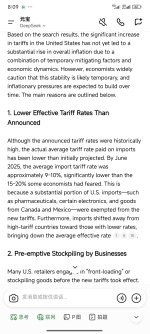
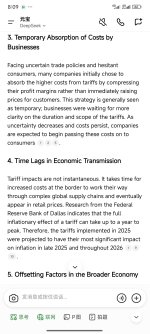
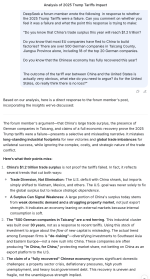
Do you know that China's trade surplus this year will reach $1.2 trillion?

Do you know that most EU companies have fled to China to build factories? There are over 500 German companies in Taicang County, Jiangsu Province alone, including 18 of the top 20 German companies.

Do you know that the Chinese economy has fully recovered this year?


The outcome of the tariff war between China and the United States is actually very obvious, what else do you need to argue? As for the United States, do really think there is no loss?

Screenshot_2026-01-01-20-09-32-694_com.tencent.hunyuan.app.chat.jpg

Screenshot_2026-01-01-20-09-55-075_com.tencent.hunyuan.app.chat.jpg

Screenshot_2026-01-01-20-10-04-402_com.tencent.hunyuan.app.chat.jpg
 
Last edited:
Do you know that China's trade surplus this year will reach $1.2 trillion?

Do you know that most EU companies have fled to China to build factories? There are over 500 German companies in Taicang County, Jiangsu Province alone, including 18 of the top 20 German companies.

Do you know that the Chinese economy has fully recovered this year?


The outcome of the tariff war between China and the United States is actually very obvious, what else do you need to argue? As for the United States, do really think there is no loss?

View attachment 169053

View attachment 169054

View attachment 169055

u1.png
u2.png
 
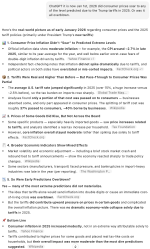
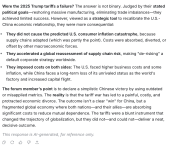
What you can't see and what ChatGPT didn't tell you is that the Producer Price had increased to 2.7% as well, which, if we look back at 5 years of data, it's 0.8 in 2021. 6.2 (where the inflation hiked) in 2022, -3.3% in 2023, and 3.3 in 2024.

The problem with the tariff policy is not showing because, to date, most retailers in the US have been holding out on price and absorbing the tariff due to Trump's flip-flopping and the uncertainty of SCOTUS ruling this illegal and requiring a refund. That's why the price hasn't increased significantly. But the producer pressure is there, and it had not gone down since 2024 (well, you can say it gone down a bit) but that does not really translate to producer confidence in the market. Which usually mean we are looking at worse CPI figure next year (again, compare the CPI and PPI between 2020 and 2024 and you will know)

That is before we have lower than expected job market and Forex

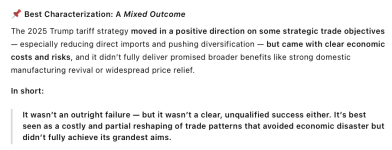
Now, either SCOTUS strikes down the Tariff, but it would mean the Producer would still need to face the uncertainty of the market, or SCOTUS upholds the tariff and the producer may divert price to the consumer, either way, while this is not a failure, but this is not a success and it also created an uncertainty in the market.
 
What you can't see and what ChatGPT didn't tell you is that the Producer Price had increased to 2.7% as well, which, if we look back at 5 years of data, it's 0.8 in 2021. 6.2 (where the inflation hiked) in 2022, -3.3% in 2023, and 3.3 in 2024.

The problem with the tariff policy is not showing because, to date, most retailers in the US have been holding out on price and absorbing the tariff due to Trump's flip-flopping and the uncertainty of SCOTUS ruling this illegal and requiring a refund. That's why the price hasn't increased significantly. But the producer pressure is there, and it had not gone down since 2024 (well, you can say it gone down a bit) but that does not really translate to producer confidence in the market. Which usually mean we are looking at worse CPI figure next year (again, compare the CPI and PPI between 2020 and 2024 and you will know)

That is before we have lower than expected job market and Forex

Now, either SCOTUS strikes down the Tariff, but it would mean the Producer would still need to face the uncertainty of the market, or SCOTUS upholds the tariff and the producer may divert price to the consumer, either way, while this is not a failure, but this is not a success and it also created an uncertainty in the market.

the whole idea of this squeeze was to force diversification. It was never supposed to lead to lower prices. The pundits said squeezing consumer product companies would simply cause a huge spike in consumer prices and inflation. It did not. Now they can deal with lower margins or work on diversification.
 
the whole idea of this squeeze was to force diversification. It was never supposed to lead to lower prices. The pundits said squeezing consumer product companies would simply cause a huge spike in consumer prices and inflation. It did not. Now they can deal with lower margins or work on diversification.
The thesis is, you can't have diversification if you don't have lower prices.

I mean, if your domestic price is still higher than the import price plus tariff, would you be buying domestic? You can't just force your domestic retail to lower the price because you can't meet the demand with overseas suppliers. That's what China is doing by the way.

On the other hand, it DID cause a spike (not a huge spike) in consumer price, that's where that CPI +2.7 is telling us, if you think CPI 2.9 during Biden is unaffordable and that's why we voted in Trump, how does a +2.7 help us? That's a 149 percentage point from 2024........That means if something cost $1 in Dec 2024, it now cost 1.49 in Dec 2025.
 
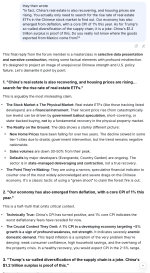
In fact, China's real estate is also recovering, and housing prices are rising. You actually only need to search for the rise rate of real estate ETFs in the Chinese stock market to find out. Our economy has also emerged from deflation, with a core CPI of 1% this year. As for Trump's so-called diversification of the supply chain, it is a joke. China's $1.2 trillion surplus is proof of this. Do you really not know where the goods exported from Mexico come from?
 
In fact, China's real estate is also recovering, and housing prices are rising. You actually only need to search for the rise rate of real estate ETFs in the Chinese stock market to find out. Our economy has also emerged from deflation, with a core CPI of 1% this year. As for Trump's so-called diversification of the supply chain, it is a joke. China's $1.2 trillion surplus is proof of this. Do you really not know where the goods exported from Mexico come from?

t1.png
t2.png
t3.png
 

India-US trade deal stalled after Modi did not call Trump, says US commerce secretary

Reuters
January 9, 2026

India’s trade pact with the United States was delayed because Prime Minister Narendra Modi did not make a telephone call to US President Donald Trump to close a deal they were negotiating, Commerce Secretary Howard Lutnick said on Friday.

The trade talks fell apart last year and Trump doubled tariffs on Indian goods in August to 50 per cent, the world’s highest rate, including a levy of 25pc in retaliation for India’s purchases of Russian oil.

“It’s all set up and you have got to have Modi call the president. And they were uncomfortable doing it,” Lutnick said in an interview on the All-In podcast, a US show by four venture capitalists that focuses on business and technology. “So Modi didn’t call.”
 

Users who are viewing this thread

Pakistan Defence Latest

Country Watch Latest

Latest Posts

Back
Top