Vietnam Defense and News forum

The US gov apparatus becomes dysfunctional. Trump fires Marc Knapper, the US ambassador to Vietnam. Thanks to Musk’s firing spree of US state employees the US trade census can’t publish any actual trade data past Oct 2025.


BUSINESS

Viet Nam exports first batch of power chips to Japanese market​

Tuesday, December 30, 2025 at 14:20
FPT Group said it has delivered its first batch of power management chips to a leading Japanese electronics company via Restar, a leading distributor of electronic devices in Japan.
The FPT engineering team conducts research and refines the design, enabling the “Make in Vietnam, made by FPT” power chip to pass stringent global testing systems.

This marks an initial step in realising the goal of exporting chips designed by FPT to the Asia–Pacific market. It is also the first time a Vietnamese enterprise has brought commercial chips into the Japanese market — one of the most demanding markets in terms of quality, and reliability.

FPT is developing a power management chip ecosystem with multiple product lines such as PMIC, LDO, BUCK, LED Driver, and Power MOSFET, aiming to provide stable power supply and low energy consumption for electronic devices. The power management chip line exported to Japan was specially designed for high-performance multi-function printers (MFPs) serving office and enterprise environments.

The chips designed by FPT help manage and stabilise the power supply inside devices, protect components from voltage, and current fluctuations, and ensure stable operation under high-load conditions.

The exported batch is a concrete step in implementing earlier cooperation between FPT Group and Restar Group (Japan), previously announced in the presence of leaders of the two Governments. The agreement targets Restar distributing 10 million chips designed and manufactured by FPT over the next three years in the Asia–Pacific market.

Over many months, FPT’s engineers continuously refined the design, optimised parameters, and enabled the “Make in Viet Nam, made by FPT” power management chips to pass Japan’s stringent testing system.

The product was comprehensively assessed for electrical characteristics, stability, and load response; met JEDEC-standard reliability tests; and was also tested on actual devices to ensure compatibility and safe operation.

Beyond technical requirements, FPT’s power management chips also meet standards for clean materials and environmentally friendly manufacturing processes, complying with the chemSHERPA chemical declaration system, ensuring material transparency, and aligning with the green supply-chain requirements of Japanese technology groups.

After the first shipment, FPT and Restar will continue working to deploy subsequent batches to fulfil the contract. The two sides are also researching and developing new semiconductor product lines based on Japanese market demand, including next-generation power management chips, control chips, and integrated circuits used in office equipment, imaging devices, and consumer electronics.

In addition to product development, FPT and Restar will also exchange engineers, implement joint research and development (R&D) projects to strengthen design capabilities, and establish a coordinated OSAT service model — including semiconductor packaging and testing. The combination of FPT’s chip-design technology and Restar’s supply-chain capabilities and market experience is expected to create synergy, helping both sides expand semiconductor business activities in a sustainable and effective manner.

Tran Dang Hoa, Chairman of FPT Information System Corporation (FPT IS) and Chairman of FPT Semiconductor under FPT Group, stated: “Exporting the first batch of commercial chips to Japan is not only significant for FPT but also affirms the capabilities of Vietnamese people in core technologies. From this first shipment, FPT hopes Vietnamese chips will increasingly appear in consumer electronics, office devices, Internet of Things (IoT) devices, and other industrial applications.”

“We believe today’s milestone will help reinforce Viet Nam’s position as an emerging destination on the global semiconductor map, while also opening the door for Vietnamese enterprises to participate more deeply in the world’s high-tech value chains,” the Chairman of FPT IS emphasised.

The event is significant as the global power management chip market is projected to reach around 59 billion USD by 2030, while the Japanese market is expected to approach around 3 billion USD over the same period. Demand for power management chips is rising strongly across multiple sectors, including consumer electronics, industrial equipment, automotive, and high-tech applications.
 
FPT power chip
To view this content we will need your consent to set third party cookies.
For more detailed information, see our cookies page.
 
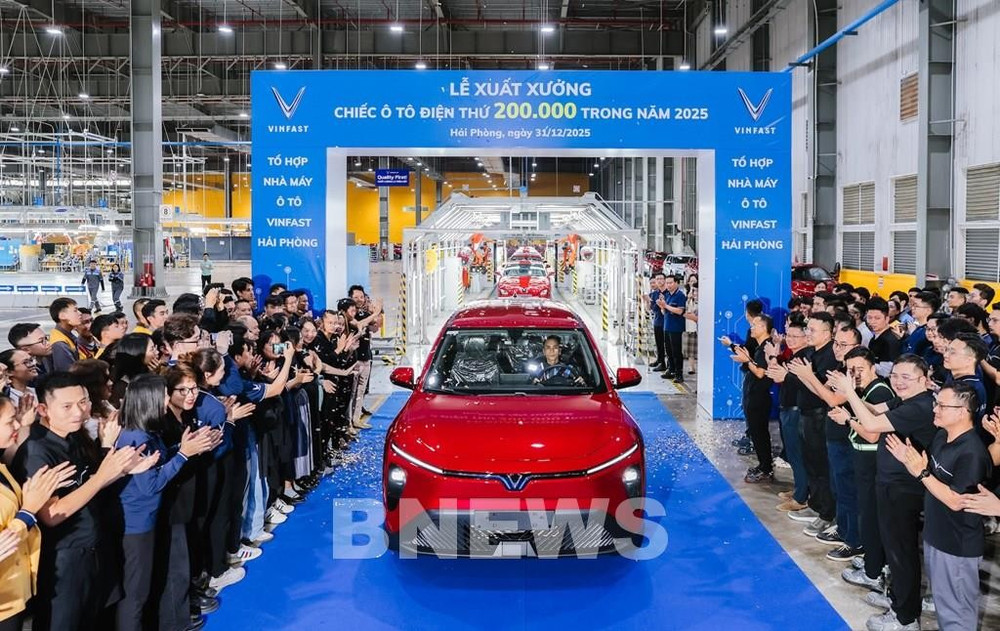
2025 a record year for carmaker Vinfast

The Haiphong manufacturing plant delivered 200,000 electric cars to customers. Combined deliveries with 1 other domestic plant and 2 other plants India and Indonesia the numbers probably surpassed 250,000 cars. The highest number ever in a single year.

To view this content we will need your consent to set third party cookies.
For more detailed information, see our cookies page.
 
Vinfast’s next milestone 500,000 cars in 2026 or 2027
long term manufacturing target 950,000 cars a year at Haiphong factory

The 200,000th vehicle to roll off the production line this year is the all-electric 7-seat MPV model Limo Green. (Photo: VNA)
 
Construction company Hoa Binh seems serious with urban elevation railway.

Using pre-manufactured concrete workers assemble double track lane 10m in length, 9m wide in 1h.

Previously the Chinese company needed 14 years to build Hanoi first elevated railway.

Now the company says it can complete in 1 month.

To view this content we will need your consent to set third party cookies.
For more detailed information, see our cookies page.
 
Prototype of the railway
Workers, engineers apparently still need time to optimize the construction with pre-manufactured concrete parts.
Should Hanoi city gov approve, the company says construction of first railway will start immediately with completion before Tet.
To view this content we will need your consent to set third party cookies.
For more detailed information, see our cookies page.
 
Ccp is super rich.
Since Xi Jinping launched BRI grand scheme in 2013 China loans 920 billion euros to the world in total. Vietnam takes loans from China as well, especially for the Hanoi city train. But unlike many other countries Vietnam can pay back the debt. No further BRI project was approved since then.
Chinese high interest rates, combined with obligations to use Chinese technology, employ Chinese workers push many countries deeper into debt crisis with no way out.

Lol, the Indians and maybe you Vietnamese would like nothing less for China to give out free money to build infra for them. Chinese companies are not in for charity, they are making investments in BRI as well helping other countries develop their infra and industries. The so called debt traps or high interest loans of BRI are first fabricated by the insidious Indians, taken up by the Americans for political motives and now bought by people like you. AS matter of fact, some Indians shamelessly on the forum have proposed that Chinese investments in BRI should be free and Chinese assets should be seized by the hosting countries like India is doing to many foreign companies in the India now. You can expect countries such as India will not receive any significant investments from China, India should be kicked out from AIIB, it is the second largest share holder after China now in AIIB that lends lots loans to BRI projects. The following article specifically explains Chinese investments and loans in Africa as an example.


BRI has led to common growth, not debt trap


By Liang Haiming and Feng Da Hsuan | China Daily | Updated: 2023-09-18 09:44


65098df2a310d2dc6d280dd3.jpeg
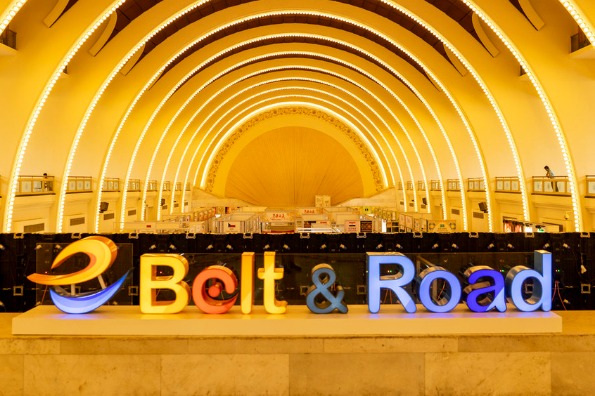
A logo of the Belt and Road is seen in Shanghai. [Photo/VCG]


Ever since its launch 10 years ago, the Belt and Road Initiative has been widely welcomed by the global community as a bridge that supports international cooperation. Yet, there have also been baseless accusations that BRI projects lead to debt traps for its participants. This is merely a misperception, and has damaged the reputation and high-quality development of the program.

Boon for all
In fact, there have been few serious, research-based proofs that verify the Western narratives. Most of these are a result of the politicization of economic issues by scholars, government officials, think tanks and media outlets from countries such as India, the United States and Australia.

For instance, Indian scholar Brahma Chellaney published an article in January 2017 saying that China was pursuing a policy of "debt-trap diplomacy" through the BRI. In the narrative, China was pictured as an insidious lender that ensnares developing countries in unsustainable debt and attempts to take advantage of their military and natural resources when these countries are unable to repay their debts.

Such attempts at politicization have been strongly refuted by various parties.
Apart from the Ministry of Foreign Affairs and Chinese scholars, leaders and officials from a slew of BRI participating countries have publicly rebuffed the fallacious claims regarding China's "debt-trap diplomacy". Some US scholars and think tanks have also published reports based on thorough research data to refute these groundless accusations.

Deborah Brautigam, a professor of political economy at Johns Hopkins University in the United States, has used the example of Montenegro, Kenya and Zambia, among others, to prove that some Western media outlets had vigorously propagated the debt-trap narrative without supporting evidence.

RAND Corp, a renowned US think tank, has also published a research report saying that railway connectivity as a result of the BRI has led to a 2.8 percent increase in exports for countries involved in the initiative.

Besides, various studies have shown that transportation infrastructure projects under the BRI have reduced logistics time by an average 1.2 percent to 2.5 percent in the surveyed countries, lowered global trade costs by 1.1 percent to 2.2 percent, and contributed to a global income increase of 0.7 percent to 2.9 percent. These findings are solid proof of the positive economic effects of Chinese investments in recipient countries as a result of the BRI.

More opportunities
Through extensive research on the so-called "debt-trap diplomacy", we have found that the BRI has led to opportunities and common growth, rather than a trap, for the participating economies, and some unique phenomena have resulted from the initiative.

First, some of the political figures who sensationalized the "debt-trap "myth in countries involved in the BRI have eventually opted to strengthen cooperation with China.
Quite a few opposition parties in countries involved in the BRI had employed the debt-trap diplomacy rhetoric as a political tool in their election campaigns to challenge political rivals in order to garner votes. However, they have swiftly turned to China for loans and investments once they took power.

Second, China has focused on bringing long-term economic benefits to recipients when it invests in countries involved in the BRI. There have been frequent power shifts in many Western countries, where the new governments often fail to honor agreements signed by their predecessors. In contrast, China has been consistently committed to its cooperation agreements with recipient countries, especially those concerning infrastructure investments despite their long payback cycles.

For instance, according to Indonesian official estimates, the Jakarta-Bandung High-Speed Railway built by China at a cost of about $8 billion is projected to generate over $23.1 billion in revenue over the next 40 years. This not only results in returns for both Chinese and Indonesian companies, but deepens economic and trade relations between the two countries.

Third, some countries involved in the BRI have actually aimed to repay their debt to Western governments and multilateral financial institutions by borrowing from China to build infrastructure, since infrastructure projects, which account for about 70 percent of BRI projects, can help them develop their economies and accumulate capital.

The Western governments and institutions have largely refused to lend to such infrastructure projects given their long payback cycles, but China has helped those countries develop their economies and gain access to higher tax revenues so that they have the money to repay their debts to Western entities and improve domestic livelihoods.

Last but not least, the relentless interest rate hikes by the US Federal Reserve, coupled with the impact of the COVID-19 pandemic, have posed unprecedented challenges to debt management and governance in countries involved in the BRI. The recent aggressive interest rate hikes by the Fed have pushed countries with substantial US dollar-denominated debts into drastic debt crises. Additionally, the global economy has experienced a widespread downturn due to the nagging impact of the pandemic, resulting in reduced fiscal revenues and increased debt burdens.

Publicly available data indicate that China is not their sole or primary creditor and countries involved in the BRI have borrowed from a variety of creditors, including the United States, European countries, Japan, the World Bank and the International Monetary Fund, among others.

According to UK charity Debt Justice, African countries, some of which have participated in the BRI, have 12 percent of their debts borrowed from China, and 35 percent from Western entities, especially private institutions. The interest rate of Chinese loans, on average, is about 2.7 percent, while that of Western creditors is 5 percent.

Therefore, rather than accuse China of engaging in "debt trap diplomacy", the Western world should focus more on enhancing the debt management capabilities of these indebted countries, strengthening international negotiations and cooperation in debt governance, and providing comprehensive and systematic solutions for tackling debt crises, so as to help the indebted countries achieve economic recovery and improve their development capabilities.

Liang Haiming is dean of the Hainan University Belt and Road Research Institute. Feng Da Hsuan is honorary dean of the institute.


Last edited:
Lol, the Indians and maybe you Vietnamese would like nothing less for China to give out free money to build infra for them. Chinese companies are not in for charity, they are making investments in BRI as well helping other countries develop their infra and industries. The so called debt traps or high interest loans of BRI are first fabricated by the insidious Indians, taken up by the Americans for political motives and now bought by people like you. AS matter of fact, some Indians shamelessly on the forum have proposed that Chinese investments in BRI should be free and Chinese assets should be seized by the hosting countries like India is doing to many foreign companies in the India now. You can expect countries such as India will not receive any significant investments from China, India should be kicked out from AIIB, it is the second largest share holder after China now in AIIB that lends lots loans to BRI projects. The following article specifically explains Chinese investments and loans in Africa as an example.


BRI has led to common growth, not debt trap


By Liang Haiming and Feng Da Hsuan | China Daily | Updated: 2023-09-18 09:44


65098df2a310d2dc6d280dd3.jpeg
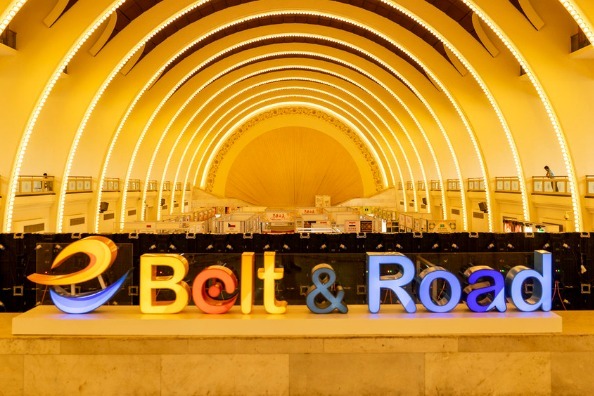
A logo of the Belt and Road is seen in Shanghai. [Photo/VCG]


Ever since its launch 10 years ago, the Belt and Road Initiative has been widely welcomed by the global community as a bridge that supports international cooperation. Yet, there have also been baseless accusations that BRI projects lead to debt traps for its participants. This is merely a misperception, and has damaged the reputation and high-quality development of the program.

Boon for all
In fact, there have been few serious, research-based proofs that verify the Western narratives. Most of these are a result of the politicization of economic issues by scholars, government officials, think tanks and media outlets from countries such as India, the United States and Australia.

For instance, Indian scholar Brahma Chellaney published an article in January 2017 saying that China was pursuing a policy of "debt-trap diplomacy" through the BRI. In the narrative, China was pictured as an insidious lender that ensnares developing countries in unsustainable debt and attempts to take advantage of their military and natural resources when these countries are unable to repay their debts.

Such attempts at politicization have been strongly refuted by various parties.
Apart from the Ministry of Foreign Affairs and Chinese scholars, leaders and officials from a slew of BRI participating countries have publicly rebuffed the fallacious claims regarding China's "debt-trap diplomacy". Some US scholars and think tanks have also published reports based on thorough research data to refute these groundless accusations.

Deborah Brautigam, a professor of political economy at Johns Hopkins University in the United States, has used the example of Montenegro, Kenya and Zambia, among others, to prove that some Western media outlets had vigorously propagated the debt-trap narrative without supporting evidence.

RAND Corp, a renowned US think tank, has also published a research report saying that railway connectivity as a result of the BRI has led to a 2.8 percent increase in exports for countries involved in the initiative.

Besides, various studies have shown that transportation infrastructure projects under the BRI have reduced logistics time by an average 1.2 percent to 2.5 percent in the surveyed countries, lowered global trade costs by 1.1 percent to 2.2 percent, and contributed to a global income increase of 0.7 percent to 2.9 percent. These findings are solid proof of the positive economic effects of Chinese investments in recipient countries as a result of the BRI.

More opportunities
Through extensive research on the so-called "debt-trap diplomacy", we have found that the BRI has led to opportunities and common growth, rather than a trap, for the participating economies, and some unique phenomena have resulted from the initiative.

First, some of the political figures who sensationalized the "debt-trap "myth in countries involved in the BRI have eventually opted to strengthen cooperation with China.
Quite a few opposition parties in countries involved in the BRI had employed the debt-trap diplomacy rhetoric as a political tool in their election campaigns to challenge political rivals in order to garner votes. However, they have swiftly turned to China for loans and investments once they took power.

Second, China has focused on bringing long-term economic benefits to recipients when it invests in countries involved in the BRI. There have been frequent power shifts in many Western countries, where the new governments often fail to honor agreements signed by their predecessors. In contrast, China has been consistently committed to its cooperation agreements with recipient countries, especially those concerning infrastructure investments despite their long payback cycles.

For instance, according to Indonesian official estimates, the Jakarta-Bandung High-Speed Railway built by China at a cost of about $8 billion is projected to generate over $23.1 billion in revenue over the next 40 years. This not only results in returns for both Chinese and Indonesian companies, but deepens economic and trade relations between the two countries.

Third, some countries involved in the BRI have actually aimed to repay their debt to Western governments and multilateral financial institutions by borrowing from China to build infrastructure, since infrastructure projects, which account for about 70 percent of BRI projects, can help them develop their economies and accumulate capital.

The Western governments and institutions have largely refused to lend to such infrastructure projects given their long payback cycles, but China has helped those countries develop their economies and gain access to higher tax revenues so that they have the money to repay their debts to Western entities and improve domestic livelihoods.

Last but not least, the relentless interest rate hikes by the US Federal Reserve, coupled with the impact of the COVID-19 pandemic, have posed unprecedented challenges to debt management and governance in countries involved in the BRI. The recent aggressive interest rate hikes by the Fed have pushed countries with substantial US dollar-denominated debts into drastic debt crises. Additionally, the global economy has experienced a widespread downturn due to the nagging impact of the pandemic, resulting in reduced fiscal revenues and increased debt burdens.

Publicly available data indicate that China is not their sole or primary creditor and countries involved in the BRI have borrowed from a variety of creditors, including the United States, European countries, Japan, the World Bank and the International Monetary Fund, among others.

According to UK charity Debt Justice, African countries, some of which have participated in the BRI, have 12 percent of their debts borrowed from China, and 35 percent from Western entities, especially private institutions. The interest rate of Chinese loans, on average, is about 2.7 percent, while that of Western creditors is 5 percent.

Therefore, rather than accuse China of engaging in "debt trap diplomacy", the Western world should focus more on enhancing the debt management capabilities of these indebted countries, strengthening international negotiations and cooperation in debt governance, and providing comprehensive and systematic solutions for tackling debt crises, so as to help the indebted countries achieve economic recovery and improve their development capabilities.

Liang Haiming is dean of the Hainan University Belt and Road Research Institute. Feng Da Hsuan is honorary dean of the institute.


Any numbers on how much profits Ccp receives on $920 billion loans? How many countries are in debt distress?
Indonesia HSR suffers $260 million loss a year.
That’s huge when multiple 40 years in operation.
How Indonesia can pay back debts if the rail will never make any profit?
 
Test river crossing domestic made PTH-122 self propelled howitzer
122mm main cannon
300HP diesel engine
60kmh maximum speed
The howitzer is part of Vietnamese tank army. Other howitzers are
  • PTH-105 105mm cannon
  • PTH-130 130mm cannon
  • PTH-152 152mm cannon
To view this content we will need your consent to set third party cookies.
For more detailed information, see our cookies page.
 
Any numbers on how much profits Ccp receives on $920 billion loans? How many countries are in debt distress?
Indonesia HSR suffers $260 million loss a year.
That’s huge when multiple 40 years in operation.
How Indonesia can pay back debts if the rail will never make any profit?
Passenger railways are not meant to be profitable, 99% of the world's passenger railways do not make a profit. It should be social welfare.
If your passenger railroad is profitable, the first thing you should do is lower the fares. It's only the freight railroads that are profitable.
 
Passenger railways are not meant to be profitable, 99% of the world's passenger railways do not make a profit. It should be social welfare.
If your passenger railroad is profitable, the first thing you should do is lower the fares. It's only the freight railroads that are profitable.
Nothing wrong with infrastructure investment even not profitable
The problem is most of those countries get infrastructure built by Chinese companies, Chinese workers, Chinese money. Worse, they can’t afford it, and they get infrastructure without bidding.
But no worry, that’s not our problem we learned the lesson with Hanoi urban railway.
And once we learn how to build, we will export Chinese model to other countries but using Vietnamese money, Vietnamese workers, Vietnamese technology.
Win win
 
Nothing wrong with infrastructure investment even not profitable
The problem is most of those countries get infrastructure built by Chinese companies, Chinese workers, Chinese money. Worse, they can’t afford it, and they get infrastructure without bidding.
But no worry, that’s not our problem we learned the lesson with Hanoi urban railway.
And once we learn how to build, we will export Chinese model to other countries but using Vietnamese money, Vietnamese workers, Vietnamese technology.
Win win
The stories that BRI projects are completed by Chinese workers in large numbers are just myths. To control costs, quality and completion schedules of the projects, Chinese companies do bring some skilled workers and management from China, but that's more like necessary. The following two articles list the percent of Chinese workers in Africa and Pakistan as examples, both are about 10% to 17%.


Key takeaways from BRI white paper

Updated: October 11, 2023 20:47 Xinhua

BEIJING, Oct. 11 -- China's State Council Information Office on Tuesday released a white paper titled "The Belt and Road Initiative: A Key Pillar of the Global Community of Shared Future."

The white paper, comprised of preamble, five chapters and a conclusion, presents the achievements of the BRI over the last 10 years, aiming to provide the international community with a better understanding of the value of the initiative, facilitate high-quality cooperation, and deliver benefits to more countries and peoples.

Since its launch in 2013, the Belt and Road Initiative has been welcomed by the international community as both a public good and a cooperation platform. The following are the key takeaways from the white paper, including some of the highlights and major achievements of BRI cooperation over the past decade.

ULTIMATE GOAL

According to the white paper, the ultimate goal of the BRI is to help build a global community with a shared future. The BRI involves countries in different world regions, at different development stages, and with different cultures. It transcends differences in ideologies and social systems.

It enables different countries to share opportunities, realize common development and prosperity, and build a community of shared interests, responsibility and destiny characterized by mutual political trust, economic integration and cultural inclusiveness.

As a practical means of building a global community with a shared future, the BRI has brought new understanding, inspired the world's imagination, and contributed new ideas and new approaches to international exchanges.

PRINCIPLES, CONCEPTS, OBJECTIVES, VISION

The BRI was founded on the principles of extensive consultation, joint contribution and shared benefits. It advocates win-win cooperation in pursuit of shared interests and the greater good. It emphasizes that all countries are equal participants, contributors and beneficiaries, and encourages economic integration, interconnected development and the sharing of achievements.

The BRI is committed to the concept of open, green and clean cooperation on inclusive and sustainable development. It has zero tolerance for corruption, and promotes steady and high-quality growth.

It aims for high standards and sustainability, and to improve lives by raising cooperation standards, investment effectiveness, supply quality and development resilience, delivering real and substantive results for all participants.

The BRI envisions a path to global well-being. As an initiative working for progress, cooperation and inclusiveness, it pursues development, promotes win-win outcomes and inspires hope. It aims to deepen understanding and trust, strengthen comprehensive exchanges, and ultimately achieve common development and shared prosperity.

MAJOR ACHIEVEMENTS OVER LAST DECADE

BRI partners -- By June 2023, China had signed more than 200 BRI cooperation agreements with more than 150 countries and 30 international organizations across five continents, yielding a number of signature projects and small-scale yet impactful projects.

High-level forums -- China has hosted the Belt and Road Forum for International Cooperation twice, providing an important platform for participating countries and international organizations to expand exchanges, increase mutual trust and strengthen ties. China will host the third Belt and Road Forum for International Cooperation from Oct. 17 to 18 in Beijing.

Infrastructure connectivity -- substantial progress is being made in the construction of six economic corridors: the China-Pakistan Economic Corridor, the New Eurasian Land Bridge Economic Corridor, the China-Indochina Peninsula Economic Corridor, the China-Mongolia-Russia Economic Corridor, the China-Central Asia-West Asia Economic Corridor and the Bangladesh-China-India-Myanmar Economic Corridor. And in Africa, railways such as the Mombasa-Nairobi Railway and the Addis Ababa-Djibouti Railway are now operational and have become important drivers of in-depth development in East Africa and across the entire continent.

Maritime connectivity -- The Maritime Silk Road network has continued to expand. By the end of June 2023, it had reached 117 ports in 43 countries, and more than 300 well-known Chinese and international shipping companies, port enterprises and think tanks, among other organizations, have joined the "Silk Road Maritime" association.

Air connectivity -- China has signed bilateral air transport agreements with 104 BRI partner countries and opened direct flight routes with 57 partner countries to facilitate cross-border transport.

International inter-modality transport -- The China-Europe Railway Express now reaches more than 200 cities in 25 European countries. By the end of June 2023, the cumulative volume of the China-Europe Railway Express had exceeded 74,000 trips, transporting nearly 7 million twenty-foot equivalent units (TEUs) and over 50,000 types of goods in 53 categories, including automobiles, mechanical equipment and electronic products, with a total value of more than 300 billion U.S. dollars. Rail-sea freight train routes on the New International Land-Sea Trade Corridor cover 18 provinces and equivalent administrative units in central and western China, transporting goods to more than 300 ports in over 100 countries.

Trade and investment -- From 2013 to 2022, the cumulative value of imports and exports between China and BRI partner countries was 19.1 trillion U.S. dollars, with an average annual growth rate of 6.4 percent. Cumulative two-way investment between China and partner countries came in at 380 billion U.S. dollars during the period, including some 240 billion U.S. dollars from China. By the end of August 2023, more than 80 countries and international organizations had subscribed to the Initiative on Promoting Unimpeded Trade Cooperation Along the Belt and Road, which was proposed by China. And China had signed 21 free trade agreements with 28 countries and regions.

Industrial cooperation -- By the end of June 2023, China had signed agreements on industrial capacity cooperation with more than 40 countries. These countries have promoted cooperation on industrial capacity, expanded cooperation in traditional industries such as steel, non-ferrous metals, building materials, automobiles, engineering machinery, agriculture, and resources and energy, and explored cooperation in emerging industries such as the digital economy, new energy vehicles, 5G, and nuclear energy and technology.

Financial cooperation -- By the end of June 2023, a total of 13 Chinese-funded banks had established 145 first-tier offices and branches in 50 BRI partner countries, some 17.7 million businesses in 131 partner countries had opened UnionPay banking services, and 74 partner countries had opened UnionPay mobile payment services. China has signed bilateral currency-swap agreements with 20 partner countries and established renminbi (RMB) clearing arrangements in 17 partner countries. China has funded the establishment of the Silk Road Fund (SRF) and opened the Asian Infrastructure Investment Bank (AIIB) with other participating countries. By the end of June 2023, the SRF had signed agreements on 75 projects with committed investment of about 22 billion U.S. dollars, there were 106 AIIB members, and the bank had approved 227 projects with a total investment of 43.6 billion U.S. dollars.

Culture and tourism cooperation -- By the end of June 2023, China had signed cultural and tourism cooperation documents with 144 BRI partner countries.

Green development -- China has signed a memorandum of understanding (MoU) with the United Nations Environment Programme on building a green Belt and Road for 2017-2022, reached environmental cooperation agreements with more than 30 countries and international organizations, launched the Initiative for Belt and Road Partnership on Green Development together with 31 countries, and formed the Belt and Road Initiative International Green Development Coalition with more than 150 partners from 40-plus countries.

Scientific and technological innovation -- By the end of June 2023, China had signed intergovernmental agreements on scientific and technological cooperation with more than 80 BRI partner countries. Since 2013, China has hosted more than 10,000 young scientists from partner countries to carry out short-term research and exchanges in China, and trained more than 16,000 technicians and management professionals for partner countries. China has established nine cross-border technology transfer platforms targeting ASEAN, South Asia, the Arab states, Africa, Latin America and other regions since 2013, assisted 22 African countries in building 23 agricultural technology demonstration centers, and established over 50 joint BRI laboratories in areas such as agriculture, new energy and health.

The Digital Silk Road -- By the end of 2022, China had signed MoUs on the construction of the Digital Silk Road with 17 countries, on e-commerce cooperation with 30 countries, and on closer digital economy investment cooperation with 18 countries and regions.

Poverty reduction -- China has signed more than 100 agricultural and fishery cooperation documents with almost 90 BRI countries and international organizations. It has dispatched more than 2,000 agricultural experts and technicians to over 70 countries and regions, and introduced more than 1,500 agricultural technologies and crops such as Juncao grass and hybrid rice to many of these countries. It has aided rural poverty reduction in Asia, Africa, the South Pacific, Latin America and the Caribbean, developing modern agriculture and helping increase farming incomes.

Boosting employment -- In the process of BRI cooperation, China has helped participating countries construct industrial parks and provided guidance for Chinese enterprises to create jobs for locals through high-level industrial cooperation. A McKinsey survey has revealed that Chinese firms in Africa recruit 89 percent of their employees locally, effectively contributing to local employment. The World Bank has estimated that by 2030, BRI-related investment could lift 7.6 million people out of extreme poverty and 32 million out of moderate poverty.


CPEC to generate 2.3 Million jobs by 2030


August 10, 2020


A report said that all projects under the banner of China Pakistan Economic Corridor are moving forward without any delay. Out of total 88, 19 projects have been completed, 28 are under implementation and 41 projects are in the pipeline. CPEC has generated around 75,000 jobs for locals in Pakistan. Chinese labor makes only 17.5 % of the total number of labor currently working on CPEC while 82.5% labor included Pakistani citizens. The power and infrastructure projects under CPEC have contributed to the socio-economic development of Pakistan.


BEIJING: Eighty-eight projects under China-Pakistan Economic Corridor (CPEC) will widely benefit Pakistan with 2.3 million jobs by 2030, says a report published by Gwadar Pro.

All the projects are going as per schedule, within agreed framework. Out of total 88, 19 projects have already been completed, 28 are under implementation and 41 projects are in the pipeline. While 28 projects which are under implementation comprise projects like wind power plant, solar power plant, hydro power project and construction of special economic zones.

Forty one pipeline projects are already approved; their paperwork has been completed but the work on it has not started yet. Either they have been delayed due to the finance collections or are waiting for the right time to start. According to the report, for the past 6 years CPEC has generated around 75,000 jobs for Pakistani citizens alone.

Nearly 47,000 people are working right now on various CPEC projects even during the epidemic crisis. Out of these, 40,000 people are Pakistani citizens including labors, engineers and technicians making around 82.5% .

The other 7,000 are Chinese which include senior engineers and the Chinese labor force makes 17.5 % of the total number
.The report added: CPEC offers enormous opportunities to small and medium enterprises (SMEs) to flourish. CPEC is greatly supporting small and medium businesses in Pakistan, many transporters are working with the CPEC projects.

Also local people and businesses are providing various materials to the ongoing projects. SME segment is the foundation of Pakistan’s economy and these businesses are learning from CPEC projects which can help their businesses grow and flourish in future.CPEC is going to change Pakistan’s economical structure and it will increase Pakistan’s GDP to more than 2 percent. This is a high percentage in terms of GDP increase for any country.

With the establishment of all power projects and energy imports by energy tunnels, the energy supply security will be increased in Pakistan. With this supply of energy, CPEC is expected to add 2.5% into the current GDP and its growth to 7.5%.

This is an ideal GDP growth percentage and can eliminate poverty and unemployment from Pakistan.

CPEC has also made exceptional developments in Gwadar. Some major problems were being faced including major water shortage. This has also been solved and the city is now receiving 1.2 million gallons of water supply daily.

Furthermore 300MW coal power plant inaugurated in Gwadar had lot of issues, all of which have been resolved. And in the coming months this project will also be started and Gwadar will not be dependent on neighboring country Iran anymore for its electricity.

The central park of Gwadar is also ready; work has been completed. Pakistan’s biggest airport in size and capacity is also under construction in Gwadar even during the wake of COVID-19 epidemic.


Any numbers on how much profits Ccp receives on $920 billion loans? How many countries are in debt distress?
Indonesia HSR suffers $260 million loss a year.
That’s huge when multiple 40 years in operation.
How Indonesia can pay back debts if the rail will never make any profit?

Dude, Indonesia HSR operational cost get profit, but it will be a lost if it needs to pay the interest and annual loan payment.

All HSR needs gov subsidy, including in Europe and China. Previously the system is set to not get gov subsidy, but now it will be treated like other mass transportation system like our MRT/LRT/KRL (Commuter Line) and BRT that get gov subsidy

So Just like other Indonesia public transportation system, now Jakarta Bandung HSR get gov subsidy. It is not something uncommont. You dont see many international media outlet barking anymore after my gov under Prabowo decide to give subsidy for the HSR project.

Our gov annual state budget is around half Vietnam overall GDP, so I think you dont need to worry on the payment part, inshaAllah we have the ability to pay it.

To view this content we will need your consent to set third party cookies.
For more detailed information, see our cookies page.


Actually as now PT KAI under Danantara superholding, PT KAI who operate the system can also be helped by the superholding fund, but gov under Prabowo prefer to give direct subsidy from the state like the way the gov treat other public transportation system

For Danantara, if they are given responsibility to give the subsidy, inshaAllah, it is able to do so

Here is the example of Danantara capability, we have 1000 SOE, and it is just one (Antam) of them (not the biggest SOE in Indonesia)


Luhut: Whoosh Is Now Able to Cover Its Own Operational Costs
Zahwa Madjid
2–3 minutes

1767391121716.png
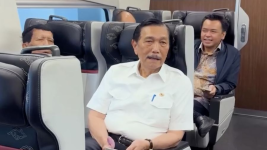
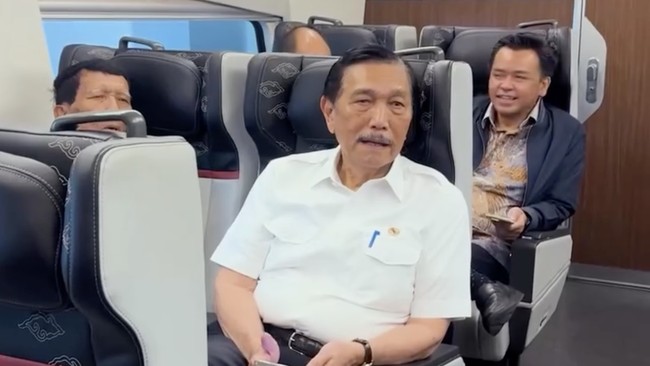
Photo: Chair of the National Economic Council (DEN), Luhut Binsar Pandjaitan, riding the Whoosh High-Speed Train to attend a briefing for prospective officers at SESKOAD. (Instagram/luhut.pandjaitan)


Jakarta, CNBC Indonesia – Chair of the National Economic Council (DEN), Luhut Pandjaitan, revealed the latest condition of the Jakarta–Bandung High-Speed Rail (KCJB) Whoosh amid the ongoing controversy surrounding its debt.

Through his Instagram account, @luhut.pandjaitan, Luhut shared moments of himself using the Whoosh train from Jakarta to Bandung to attend an officer briefing at Seskoad last Thursday (30/10/2025).

According to Luhut, Whoosh has now become financially self-sufficient, as the company is able to cover its own operational costs.

“Regardless of the pros and cons, the fact is that Whoosh is now able to cover its own operational expenses and has served more than 12 million passengers since it began operations in October 2023 until February 2025,” Luhut said via his Instagram account @luhut.pandjaitan, as quoted on Friday (31/10).

He believes that Whoosh’s achievements mark an initial step toward the efficient and responsible management of large-scale projects.

Luhut also said he chooses Whoosh because it is more time-efficient. A trip to Bandung that previously took 3–4 hours by car or conventional train can now be completed in a maximum of 60 minutes using Whoosh.

“Every time I travel to Bandung, I always choose this mode of transportation because of its time efficiency. Trips that used to take 3–4 hours can now be completed in just 30–60 minutes,” Luhut said.

He emphasized that Whoosh has become proof that the courage to make strategic decisions can lead Indonesia toward national self-reliance.

“Whoosh is proof that the courage to make strategic decisions is the beginning of national self-reliance,” Luhut concluded.

 
Small but important difference: Indonesia’s HSR was built by China, Vietnam’s HSR will be built by Vietnamese engineers.
Building HSR is imperative to any country independent development. like building own cars, planes, tanks, ships, missiles, rockets, engines, etc. we can’t rely on foreigners.
You are right. HSR is expensive. But what are other options? Not building it?
There is a joke in Viet Nam, we eat instant noodles to save money to buy a house.

Please dont bee too swallow in thinking just like I see many Indians in their forum (Bharat Defense Forum) mocking Indonesian China trade while they dont actually understand the reality

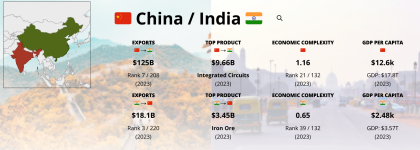
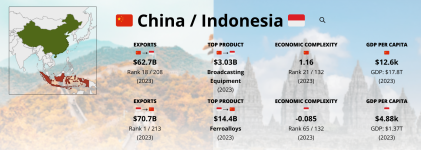
1767393700380.png

1767393753737.png


Jakarta-Bandung HSR stake in majority owned by Indonesian SOE consortium (60 %), one big Indonesian SOE construction firm, Wijaya Karya (WIKA) and SOE electronic companies, PT LEN Industry, are also part of the project SOE consortium on Jakarta-Bandung HSR project.

To view this content we will need your consent to set third party cookies.
For more detailed information, see our cookies page.


And when it comes to railway, other Indonesian construction SOE, Adhi Karya, building 42 kilometers Greater Jakarta LRT system with the electronic part handled by other SOE, PT LEN Industry, and the train made by other SOE (PT INKA) so, alhamdulillah, we do know how to build railway system.

To view this content we will need your consent to set third party cookies.
For more detailed information, see our cookies page.
 

Users who are viewing this thread

Pakistan Defence Latest

Latest Posts

Back
Top